











Payers price dental claims by the CDT codes your team reports. Bill D4342 when the chart supports D4341, and you underbill that quadrant. Report D4341 when the chart supports D4342, and you invite a denial or a records request. Each miss costs little on its own, and your team repeats it on each visit coded that way.
We're the billing team at iDental Billing, and dental claims are our daily work. Exams, cleanings, extractions, and crowns cause more coding trouble than rare procedures, because each one sits one detail away from a neighboring code with a different fee.
Key takeaways
- Definition: CDT is the procedure code set from the American Dental Association (ADA); each code is a D plus four digits, required on HIPAA-standard electronic dental claims.
- Structure: 13 categories of service; the 13th covers sleep apnea and related airway services.
- Limits: CDT reports what the dentist did, ICD-10-CM reports why, and the payer pays under the patient's plan.
- Current edition: the ADA made 60 changes for CDT 2026, effective January 1, 2026, including six deletions such as D1352 and D9248.
- Revenue risk: look-alike pairs such as D0120 and D0180, D7140 and D7210, and D2740 and D6740.
In this guide
- Definition and format
- How a code is built
- HIPAA requirement
- CDT vs. CPT vs. ICD-10
- The 13 categories
- Common codes cheat sheet
- Look-alike codes
- Reporting codes on a claim
- Payer rules
- CDT 2026 changes
- Official codes list
- Costly coding mistakes
- Quick answers
- Before your next claim
What Are CDT Codes?
CDT codes (Current Dental Terminology codes) are the procedure codes, maintained by the American Dental Association (ADA), that dental offices use to report treatment on insurance claims. The set's official name, listed on the ADA's CDT Code page, is the Code on Dental Procedures and Nomenclature.
Billers and payers use several names for the same set: dental codes, ADA codes, ADA CDT codes, and dental procedure codes. Your practice management system and the payer read the same CDT code on a claim. It doesn't matter whether your office runs Dentrix, Eaglesoft, Open Dental, Denticon, or Curve Dental.
- Reports: the dental procedure performed; diagnoses come from ICD-10-CM.
- Format: five characters, a D plus four digits, such as D1110 for an adult prophylaxis.
- Maintained by: the ADA's Code Maintenance Committee, which votes on changes each March; new versions take effect January 1.
- Required on: HIPAA-standard electronic dental claims (the 837D); the paper ADA Dental Claim Form uses the same codes.
The payer prices each code against your fee schedule and checks it against the patient's plan limits. In a review, an examiner compares the code with the clinical note. If the code fails any of those three checks, the payer denies the line, downgrades it, or pays it as a different procedure.
How a CDT Code Is Built
Each CDT code entry has three parts: a five-character procedure code, a nomenclature that names the procedure, and, for many entries, a descriptor that defines what the procedure includes. Read all three before you pick a code, because the deciding detail sits in the title or the descriptor.
Code, Nomenclature, and Descriptor
| Part | What it is | Why it matters for payment |
|---|---|---|
| Procedure code | D plus four digits; the first digit points to the category | The payer adjudicates this code against the plan |
| Nomenclature | The procedure's written title | Claim forms may print a shortened title; the meaning stays the same |
| Descriptor | A narrative defining scope or conditions; some codes have none | Scope limits live here, such as what's included and what's reported on its own line |
The golden rules of coding the American Dental Association (ADA) published in June 2026 start with one rule: code for what you do. Read the full entry and pick the code that matches the chart, whatever the fee. D4341 and D4342 split on the number of teeth treated per quadrant, and the title states that count.
Our dental billing services team checks the chart against the descriptor before a claim goes out. If someone misses a CDT coding error at that step, the payer sends the claim back as a denial or records request. By that point, the visit is weeks old and harder to defend.
What "By Report" and Unspecified Codes Mean
A code with "by report" in its title needs a written narrative on the claim, according to the ADA's glossary. Unspecified codes, such as D2999 for an unspecified restorative procedure, cover treatment no other code describes, and they carry the same narrative requirement.
Expect a manual review on these claims. The narrative needs three facts: what the dentist did, why the patient needed it, and why no other code fits.
Are CDT Codes Required Under HIPAA?
Yes. CDT is the HIPAA standard for dental procedures on electronic claims: 45 CFR 162.1002 names the Code on Dental Procedures and Nomenclature as the code set for dental services. The American Dental Association (ADA) maintains that code set.
In the Transactions and Code Sets final rule, published August 17, 2000, the Department of Health and Human Services (HHS) adopted it as the standard. Your paper claims use the same codes, because the ADA keeps the paper ADA Dental Claim Form in line with the electronic standard.
Which CDT Version Applies to a Claim?
The CDT version in effect on the date of service applies, whatever date you file the claim. Federal rules at 45 CFR 162.1000 require code sets that are valid when the dentist provides the care. The ADA's claim form instructions apply the same rule.
Say the dentist performs a D9248 sedation on December 30, 2025, and your team files the claim on January 6, 2026. CDT 2025 listed D9248 on that date of service, so the claim is valid. On a January 2, 2026, date of service, most payers reject the same code, because CDT 2026 deleted it.
What HIPAA Doesn't Make Payers Do
HIPAA requires payers to accept a valid code, and the plan contract sets whether and how much they pay. ADA News on downcoding drew the same line in June 2026, in a reply about payers downcoding D1110 to D1120 by age.
Frequency limits, age rules, downgrades, and bundling come from the plan, so the payer can pay less than your fee on a claim with the right code.
CDT vs. CPT vs. ICD-10: Which Code Set Goes on Which Claim
CDT codes report dental procedures to dental plans, CPT codes report medical procedures to medical plans, and ICD-10-CM codes report the diagnosis that explains why. The American Dental Association (ADA) maintains CDT, and the American Medical Association (AMA) owns CPT.
| Feature | CDT | CPT | ICD-10-CM | HCPCS Level II |
|---|---|---|---|---|
| What it answers | Which dental procedure | Which medical procedure | Why: the diagnosis | Which device, supply, or service |
| Maintained by | ADA | American Medical Association | CDC's National Center for Health Statistics | CMS |
| Format | D plus four digits (D2740) | Five characters (99213) | Letter, digits, and a decimal (G47.33) | Letter plus four digits (E0486) |
| Claim form | ADA Dental Claim Form or electronic 837D | CMS-1500 or electronic 837P | Either form, when a diagnosis is reported | CMS-1500 or electronic 837P |
| Typical dental use | Routine and specialty dental care | Medically necessary procedures billed to medical plans | Medical necessity; some dental plans ask for it | Oral appliances for sleep apnea |
When a Dental Office Bills Medical Insurance
A dental office bills medical insurance when the patient's medical plan covers the treatment as medically necessary. Depending on the plan, that can include:
- oral appliance therapy for diagnosed obstructive sleep apnea
- trauma care after an accident
- biopsies and other oral pathology services
- some oral surgery
- treatment for temporomandibular disorders (TMD)
Your dental billing codes go to the dental plan. A medical plan requires CPT or HCPCS procedure codes with ICD-10-CM diagnoses, filed on the CMS-1500 or the electronic 837P. If you've searched for dental CPT codes, that combination is what you need.
Sleep apnea appliances are the clearest case. You bill D9947 to a dental plan, and HCPCS code E0486 with ICD-10-CM G47.33, obstructive sleep apnea, to a medical plan.
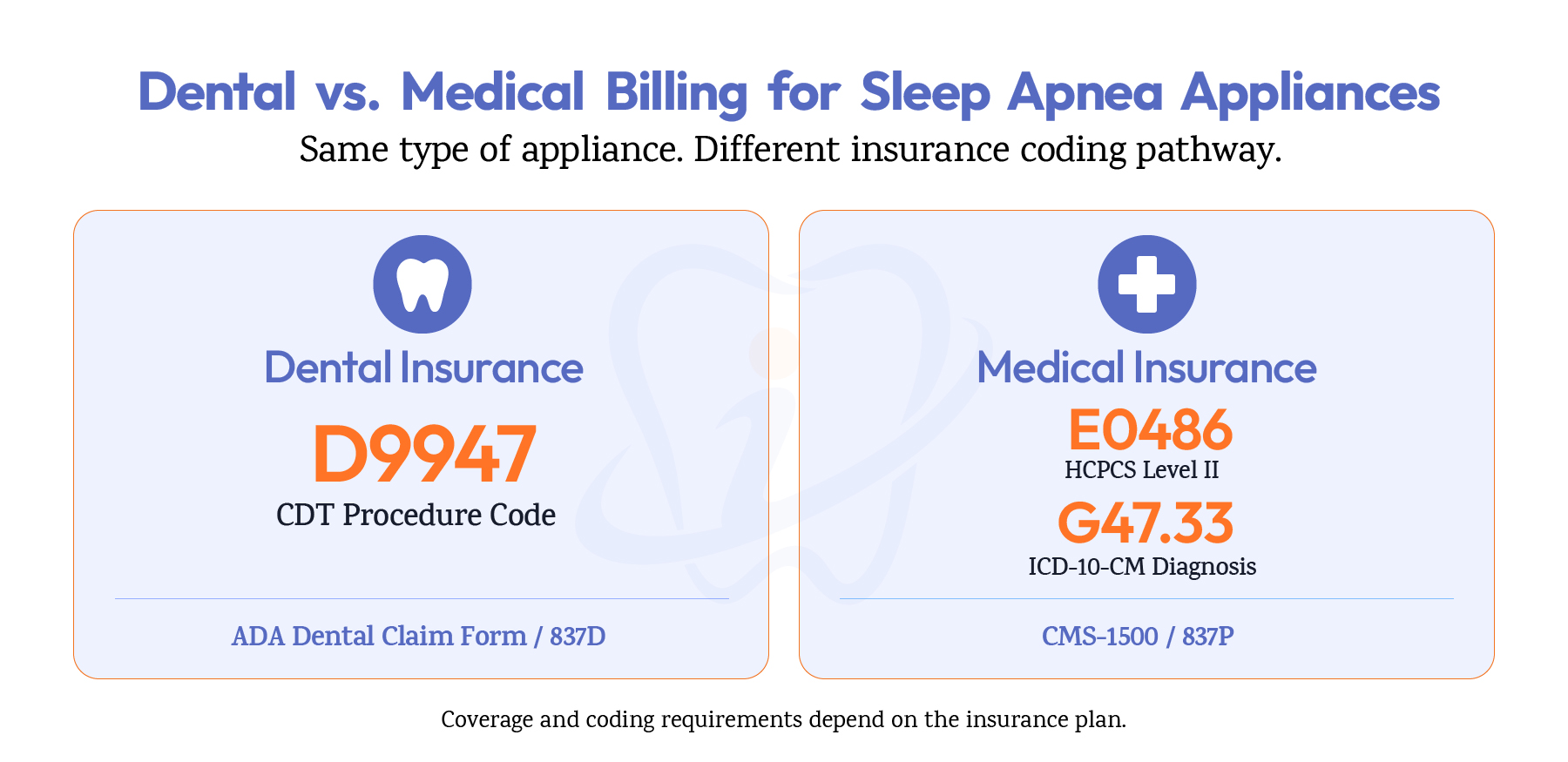
E0486 is a HCPCS Level II code, which the Centers for Medicare and Medicaid Services (CMS) maintains, so you won't find it in a CPT book. Medicare pays for the device when the patient meets the conditions in Medicare LCD L33611.
If a sleep appliance or biopsy case is waiting on a medical claim, send it our way so it doesn't sit unbilled. We handle dental medical billing, including diagnosis codes and prior authorizations, alongside your dental claims.
Do Dental Claims Need ICD-10-CM Codes?
Sometimes. A dental claim needs ICD-10-CM codes when the payer asks for a diagnosis, and many dental plans don't ask on routine claims. The ADA's dental code FAQ names ICD-10-CM as the only diagnosis code set for dental claims, and the 2024 ADA Dental Claim Form holds up to four codes.
On the form, Item 34 carries the qualifier AB for ICD-10-CM, Item 34a lists the codes, and Item 29a points each procedure line to its diagnosis. Medical claims require at least one diagnosis.
Dental diagnosis codes have to match the chart. D3330, a molar root canal, can pair with K04.02 for irreversible pulpitis. D4341 pairs with the chronic periodontitis code that matches extent and severity: the K05.31 series for localized disease and the K05.32 series for generalized disease.
The 13 CDT Code Categories and Their Ranges
The CDT Code has 13 categories of service. Of those, 12 run in number order, from Diagnostic (D0100 to D0999) to Adjunctive General Services (D9000 to D9999). Each of the dental procedure codes belongs to one category.
Category 13 started in CDT 2024 as Sleep Apnea Services. In May 2025, the American Dental Association (ADA) Council on Dental Benefit Programs approved a new name: Sleep Related Breathing Disorders and Airway Management Services. The council's 2025 report of major actions records the vote.
| # | Category | Code range | What it covers | Example codes |
|---|---|---|---|---|
| 1 | Diagnostic | D0100 to D0999 | Evaluations, images, and tests | D0120, D0210 |
| 2 | Preventive | D1000 to D1999 | Prophylaxis, fluoride, sealants, space maintainers | D1110, D1206 |
| 3 | Restorative | D2000 to D2999 | Fillings, crowns, buildups | D2391, D2740 |
| 4 | Endodontics | D3000 to D3999 | Pulp therapy, root canals, retreatment | D3220, D3330 |
| 5 | Periodontics | D4000 to D4999 | Scaling and root planing, perio surgery, maintenance | D4341, D4910 |
| 6 | Prosthodontics, removable | D5000 to D5899 | Complete and partial dentures, relines | D5110, D5213 |
| 7 | Maxillofacial prosthetics | D5900 to D5999 | Facial and intraoral prostheses | D5932 |
| 8 | Implant services | D6000 to D6199 | Implant placement, abutments, implant crowns | D6010, D6058 |
| 9 | Prosthodontics, fixed | D6200 to D6999 | Bridge pontics and retainer crowns | D6245, D6740 |
| 10 | Oral and maxillofacial surgery | D7000 to D7999 | Extractions, biopsies, grafts | D7140, D7210 |
| 11 | Orthodontics | D8000 to D8999 | Limited, interceptive, and comprehensive treatment | D8080, D8670 |
| 12 | Adjunctive general services | D9000 to D9999 | Anesthesia, consultations, occlusal guards | D9230, D9310 |
| 13 | Sleep apnea services (2025 rename approved: sleep related breathing disorders and airway management services) | Selected codes from D9947 to D9959 | Sleep apnea appliances, screening, home sleep test administration, titration | D9947, D9948 |
Plans attach frequency limits to many dental diagnostic codes in the D0100 to D0999 range, so check the patient's history before you bill an evaluation, image, or test.
What the First Digit of a Code Tells You
The digit after the D points to the category. Codes in the 7000 range (D7000 to D7999) relate to oral and maxillofacial surgery, D2 codes cover restorative care, and D4 codes cover periodontics. The pattern has three exceptions:
- D5 splits at D5900: removable prosthodontics below it, maxillofacial prosthetics from D5900 up
- D6 splits at D6200: implant services below it, fixed prosthodontics from D6200 up
- D9 shares its range: sleep and airway codes carry D99 numbers but form their own category
How Many CDT Codes Are There?
Third-party estimates put the CDT code set at more than 700 codes, and the American Dental Association (ADA) doesn't list an official total on its CDT pages. The count shifts each January: CDT 2026 added 31 codes and deleted six.
For billing, focus on whether your fee schedule and practice management software carry this year's version, with deleted codes retired.
Do Categories Limit Which Dentist Can Report a Code?
No, CDT categories don't belong to specialties. A general dentist who performs a molar root canal reports D3330, the same code an endodontist uses, when the procedure falls within that dentist's state scope of practice.
Common CDT Codes by Category: A Dental Codes Cheat Sheet
The most common dental codes on routine claims report evaluations, images, cleanings, fillings, crowns, and periodontal care, such as D0120, D1110, D2391, and D4341. We paraphrased each title and added the billing note that affects payment. For the full list of dental codes, you'll need the current CDT manual from the American Dental Association (ADA).
| Category | Code | What it reports (paraphrased) | Billing note |
|---|---|---|---|
| Diagnostic | D0120 | Periodic evaluation, established patient | Florida Blue Dental (2026): two evaluations per benefit period, any combination |
| Diagnostic | D0140 | Limited, problem-focused evaluation | Emergencies or one specific complaint; document the problem |
| Diagnostic | D0150 | Comprehensive evaluation, new or established patient | New patient, major health change, or three or more years away from active treatment |
| Diagnostic | D0180 | Comprehensive periodontal evaluation | Descriptor revised in CDT 2026 |
| Diagnostic | D0210 / D0330 | Full intraoral series / panoramic image | Florida Blue Dental (2026): one of either per 36 months |
| Diagnostic | D0220 / D0230 | Periapical image, first / each additional | D0230 for each periapical after the first |
| Diagnostic | D0274 | Four bitewing images | Florida Blue Dental (2026): one per benefit period |
| Diagnostic | D0367 | Cone beam CT, both jaws, capture and interpretation | Many plans review CBCT for necessity; check the imaging policy |
| Preventive | D1110 | Prophylaxis, permanent and transitional dentition | CDT goes by dentition; plans add age cutoffs |
| Preventive | D1120 | Prophylaxis, primary and transitional dentition | Florida Blue Dental (2026): 12 and under; Delta Dental of North Carolina (2026): under 14 unless the contract sets another age |
| Preventive | D1206 / D1208 | Fluoride varnish / other topical fluoride | Age and frequency limits vary by plan |
| Preventive | D1351 | Sealant, per tooth | Many plans limit by tooth type and age |
| Restorative | D2391 | Resin composite, one surface, posterior | CDT 2026 removed the lesion-depth limit; some plans pay the amalgam rate |
| Restorative | D2740 | Porcelain or ceramic crown | Natural teeth only; bridge abutments use D6740, implant crowns use implant codes |
| Restorative | D2940 | Interim direct restoration, the "sedative filling" | Renamed in CDT 2025 |
| Restorative | D2950 | Core buildup, including any pins | Delta Dental of California (2025) asks for a preoperative periapical image and a narrative |
| Endodontics | D3220 | Therapeutic pulpotomy | Not the first stage of a root canal |
| Endodontics | D3310 / D3320 / D3330 | Root canal: anterior / premolar / molar | Retreatment uses D3346 to D3348 by the same tooth types |
| Periodontics | D4341 / D4342 | Scaling and root planing: four or more / one to three teeth per quadrant | Count teeth per quadrant |
| Periodontics | D4346 | Full mouth scaling, generalized gingival inflammation | ADA guide: not with D1110, D1120, D4341, D4342, or D4355 |
| Periodontics | D4355 | Full mouth debridement | D0180 goes on the later visit |
| Periodontics | D4910 | Periodontal maintenance | Follows active periodontal therapy |
| Prosthodontics, removable | D5110 / D5120 | Complete denture, upper / lower | One code per arch |
| Implant services | D6010 | Endosteal implant body, surgical placement | Abutment and crown carry their own codes |
| Prosthodontics, fixed | D6245 | Porcelain or ceramic pontic | The replacement tooth in a bridge |
| Prosthodontics, fixed | D6740 | Porcelain or ceramic retainer crown | The abutment crown in a bridge |
| Oral surgery | D7140 | Extraction, erupted tooth or exposed root | Elevator or forceps removal |
| Oral surgery | D7210 | Surgical extraction with bone removal or sectioning | The note must show what the dentist removed or sectioned |
| Oral surgery | D7921 | Autologous blood concentrate, collected and applied | Platelet-rich fibrin or plasma placed at surgery; check plan coverage first |
| Orthodontics | D8080 / D8090 | Comprehensive orthodontics, adolescent / adult dentition | Chosen by dentition stage |
| Orthodontics | D8670 | Periodic orthodontic treatment visit | Many plans pay orthodontics in installments; confirm the schedule |
| Adjunctive | D9230 | Nitrous oxide, single agent | Not added on top of other sedation |
| Adjunctive | D9310 | Consultation, requested by another provider | Another dentist's or physician's opinion, not a routine exam |
| Sleep and airway | D9947 | Custom sleep apnea appliance, fabrication and placement | Medical plans use HCPCS E0486 |
We paraphrased the code titles. CDT is a trademark of the American Dental Association, which holds its copyright; see the current CDT manual for official nomenclature and descriptors.
The dental code for a filling depends on material, surfaces, and tooth position. Amalgams sit in the D2140 series, and resin composites in the D2330 series for anterior teeth and the D2391 series for posterior teeth.
The root canal dental code follows tooth type: D3310 for an anterior tooth, D3320 for a premolar, and D3330 for a molar. On a natural tooth, D2740 is the dental code for a crown in porcelain or ceramic.
Dental implant codes follow the stage of treatment: placement, abutment, and crown. The dental code for dentures changes with the arch and with complete or partial design, and orthodontic codes track the dentition stage.
Payers adjudicate these dental treatment codes against the plan, so give the billing note column the same attention as the code. A payer can deny a covered code on frequency, age, or a missing image.
Is There a CDT Code for Sectioning a Crown?
CDT has no code named for sectioning a single crown; to remove a crown from a natural tooth, report D2956, a code the ADA added in CDT 2025. D9120 covers sectioning a bridge when part of the bridge stays in place.
Some plans don't pay D2956 on its own. Florida Blue Dental's 2026 CDT Guide lists it as integral and rules it out for temporary or provisional restorations.
What Is the CDT Code for a Pulpectomy?
The pulpectomy dental code is D3230 for a primary anterior tooth or D3240 for a primary posterior tooth. Permanent teeth get no separate pulpectomy code, because removing the pulp is part of complete root canal therapy, which you bill as D3310, D3320, or D3330.
Report D3221, pulpal debridement, when the dentist relieves pain ahead of root canal therapy. Under its descriptor, you can't report it if the dentist finishes the root canal the same day.
Look-Alike CDT Codes That Get Claims Denied
Look-alike codes are pairs one detail apart, such as D4341 and D4342, where the chart has to prove which procedure happened. In dental coding, they cluster in exams, cleanings, extractions, buildups, and crowns.
D0120 vs. D0150 vs. D0180: Choosing the Exam Code
Use D0120 for an established patient's periodic exam and D0150 for a new patient's comprehensive exam; D0180 is the comprehensive periodontal evaluation. An established patient qualifies for D0150 after a significant health change or three or more years away from active treatment, as the ADA explains in its exam code guidance.
CDT 2026 rewrote the D0180 descriptor to cover patients with signs or symptoms of periodontal disease, systemic medical conditions, or social risk factors. The revised text includes an oral cancer evaluation, which the old descriptor listed as optional.
Florida Blue Dental's 2026 guide allows two evaluations per benefit period in any combination, so a D0180 can use the patient's second covered exam. Limits like that are plan rules, and your team can catch them during insurance verification before the visit.
D1110, D4346, and D4355: The Cleaning Codes Payers Question
D1110 is the routine adult prophy, D4346 is full mouth scaling for generalized moderate or severe gingival inflammation without periodontitis, and D4355 is full mouth debridement before a periodontal evaluation.
The ADA Guide to Reporting D4346 says to report it after an oral evaluation. Keep it off a visit that includes a prophylaxis, scaling and root planing, or full mouth debridement: D1110, D1120, D4341, D4342, or D4355. You can bill the exam on the same date, and the guide says D4910 doesn't follow D4346.
D4355 is the full mouth debridement code for heavy buildup that blocks a proper periodontal evaluation. Since CDT 2023, its name has said the debridement enables a comprehensive periodontal evaluation on a later visit, which is why D0180 waits.
The ADA allows D0120, D0150, or D0140 on the same date as D4355, with D0180 on the later visit. Florida Blue Dental won't pay D0150 on the same date, by the same provider, as D4355.
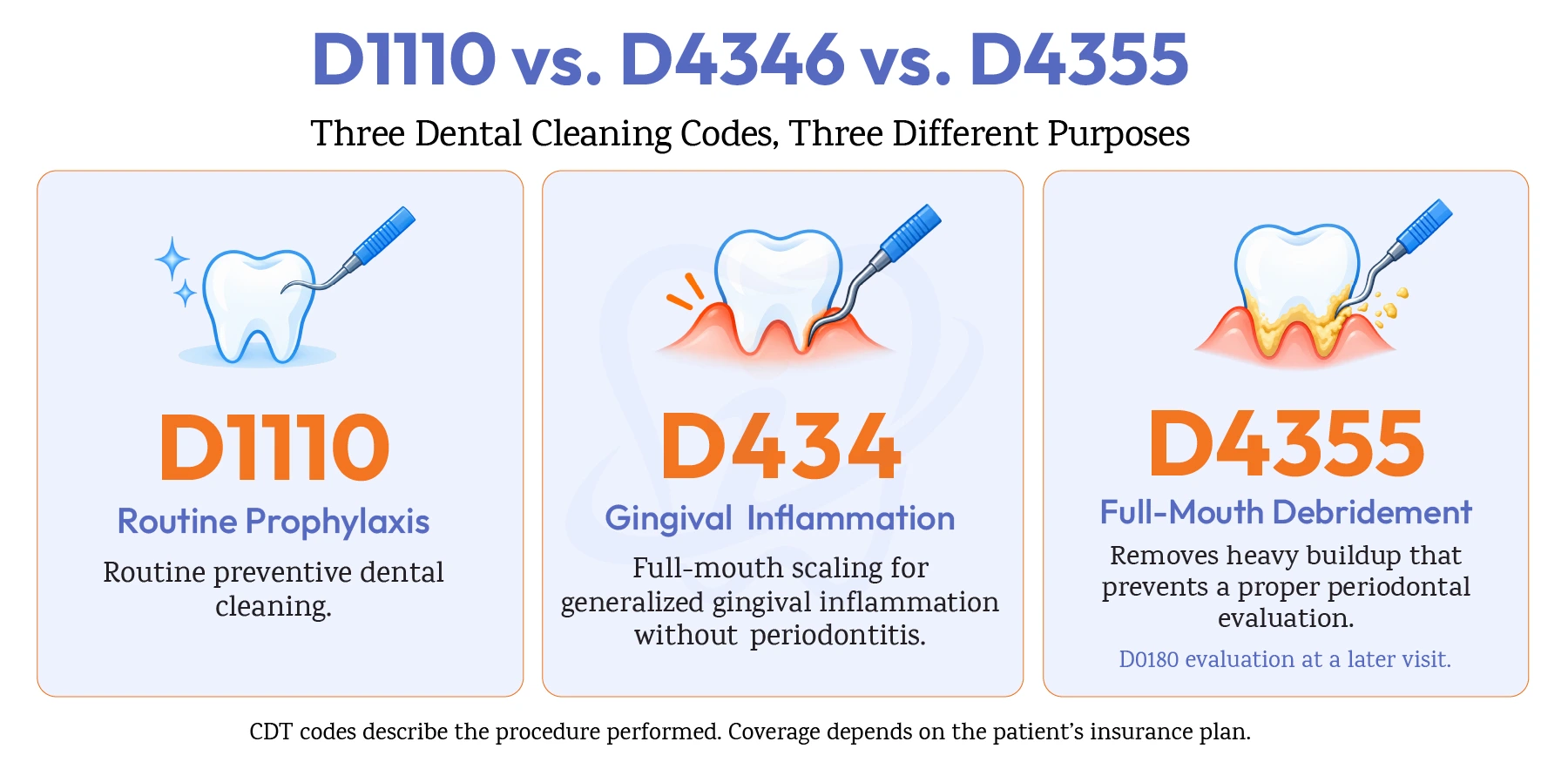
The common dental cleaning codes fall into two sets. Preventive prophylaxis uses D1110 and D1120. Periodontal codes cover the rest: D4346 for gingival inflammation, D4355 for debridement, D4341 and D4342 for scaling and root planing, and D4910 for maintenance.
D4341 vs. D4342: Counting Teeth per Quadrant
Scaling and root planing splits by tooth count: D4341 covers four or more teeth in a quadrant, and D4342 covers one to three teeth. Both treat periodontal disease, and patients call either one a deep cleaning.
Code each quadrant on its own count. Five teeth in the upper right make a D4341; two teeth in the lower left make a D4342. Payers look for full periodontal charting and radiographs that show bone loss.
CDT itself doesn't bar a D1110 on the same day as D4342, but many payers fold a same-day prophy into the scaling. Delta Dental of North Carolina's 2026 handbook lists that prophy as included and not billable to the patient when the same dentist or office does both.
D4910 vs. D1110: Perio Maintenance After Active Therapy
Periodontal maintenance (D4910) follows completed active periodontal therapy, such as scaling and root planing or periodontal surgery, while D1110 is a preventive cleaning.
UnitedHealthcare's Non-Surgical Periodontal Therapy policy, effective March 1, 2026, says D4910 isn't indicated without previous scaling and root planing or periodontal surgery. Florida Blue Dental's 2026 PPO plans cap D1110 and D4910 at two combined visits per benefit period from age 18.
D7140 vs. D7210: Simple or Surgical Extraction
D7140 is a simple extraction of an erupted tooth or exposed root with elevators or forceps; D7210 is a surgical extraction that needs bone removal, tooth sectioning, or both. D7210 includes raising a flap when the dentist needs one, and the dental code for extraction follows the documented technique.
MO HealthNet, Missouri's Medicaid program, said in a July 2026 coding tip that place of service doesn't decide whether an extraction is surgical. Have the dentist chart what they removed or sectioned and why, and check the ADA extractions coding guide for coding tooth remnants.
D2950 vs. D2952 vs. D2954: Buildups and Posts
For a core buildup, report D2950. A post and core billed with a crown is D2952 when a lab makes it and D2954 when it's prefabricated. Delta Dental of California's 2025 processing policies add payer rules on top of CDT:
- D2952 and D2954 are payable only on a tooth with root canal treatment.
- The D2952 fee includes the post and any core buildup.
- D2950 needs a preoperative periapical image and a written narrative.
Delta Dental of Michigan's July 2026 newsletter says it doesn't pay a core on its own when D2952 or D2954 goes with a crown. Aetna's core buildup policy (DCPB043) asks for preoperative and postoperative images, so send both images with the narrative.
D2740 vs. D6740 vs. D6245: Single Crown or Bridge
A single ceramic crown on a natural tooth is D2740. In a bridge, the ceramic retainer crown that anchors it is D6740, and the ceramic pontic that replaces the missing tooth is D6245.
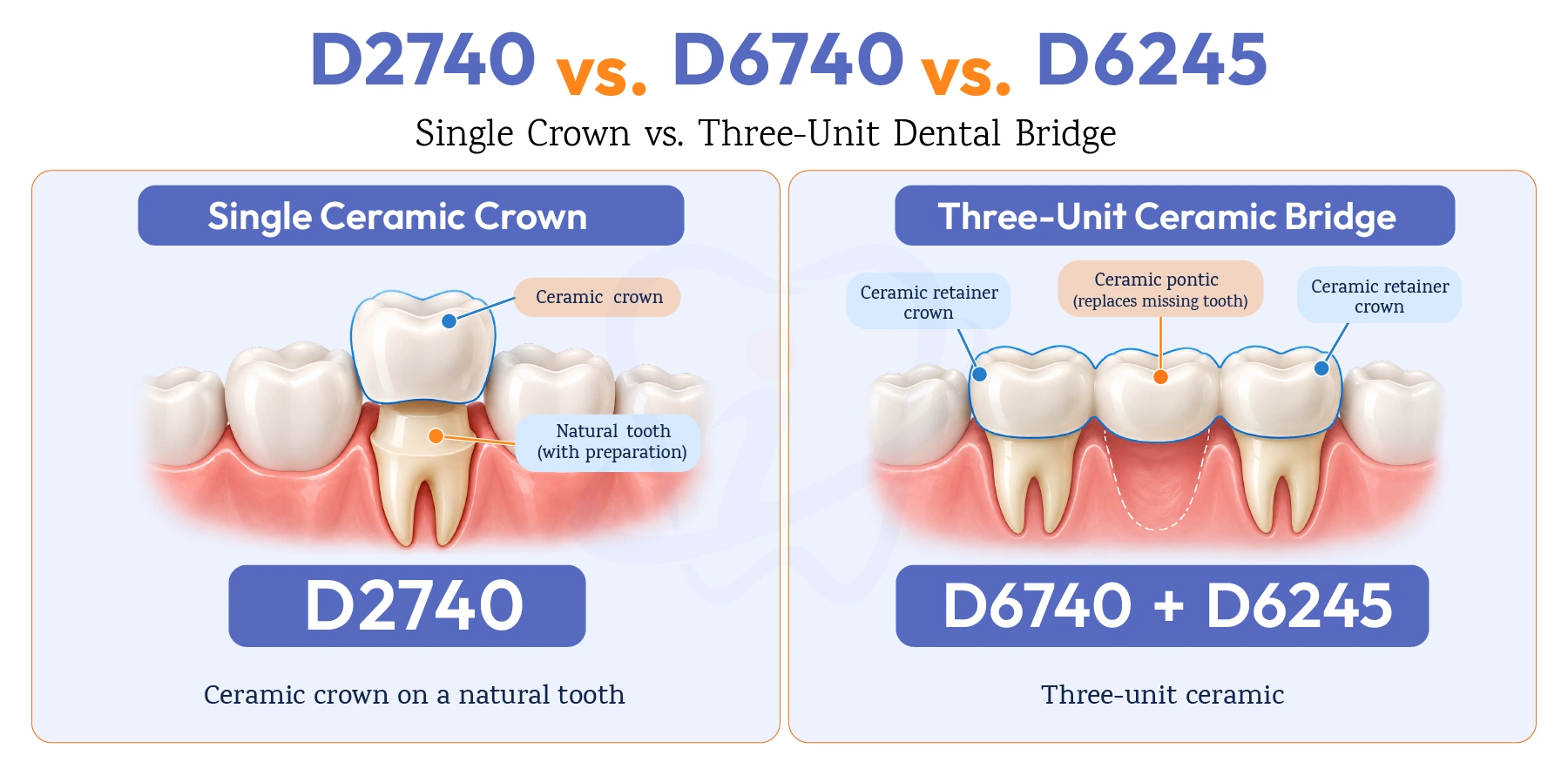
Code a three-unit ceramic bridge as two retainers and one pontic: D6740, D6245, D6740. Pick the dental code for bridge work by what anchors it. Implant crowns take implant codes such as D6058, and a resin-bonded (Maryland) bridge takes retainer codes such as D6549.
Want a second set of eyes on how your team codes exams, hygiene, and crowns? Send us a recent month of claims. In a free billing review, we'll show you which look-alike codes are costing you and what to change.
How to Report CDT Codes on a Dental Claim
Report each CDT code on its own line of the ADA Dental Claim Form or the electronic 837D, with the tooth or area, surfaces, and a diagnosis pointer when required. Restorations need surfaces, quadrant codes need an area, and tooth-specific codes need a tooth number.
The American Dental Association (ADA) publishes the current paper version, the 2024 ADA Dental Claim Form. For each field, the ADA claim form instructions spell out what goes there, including which CDT version to use.
The Claim Form Fields That Cause Rejections
Each CDT code line on the 2024 form needs these fields, and payers and clearinghouses reject lines where one is blank or mismatched.
| Item (2024 ADA Dental Claim Form) | What goes there | Common error |
|---|---|---|
| 25: Area of oral cavity | Two-digit area of oral cavity codes: 00 whole mouth, 01 upper arch, 02 lower arch, and 10, 20, 30, or 40 for the four quadrants | Left blank on quadrant codes such as scaling and root planing |
| 26: Tooth system | Enter JP for the ADA's Universal/National Tooth Designation System | System code missing or wrong for the tooth numbers sent |
| 27: Tooth number or letter | Permanent teeth 1 to 32, primary teeth A to T | Tooth missing on a tooth-specific code |
| 28: Tooth surface | Surface letters, such as M, O, and D for a three-surface filling | Surface count doesn't match the code |
| 29: Procedure code | The CDT code | Deleted or outdated code for the date of service |
| 29a: Diagnosis pointer | A letter linking the line to a diagnosis in Item 34a | Pointer sent with no diagnosis listed |
| 34 and 34a: Diagnosis codes | Qualifier AB for ICD-10-CM, then up to four codes | Non-ICD-10-CM code or a missing qualifier |
For Items 34 and 34a, the ADA CDT-to-ICD-10-CM crosswalk lists diagnosis codes the ADA pairs with each procedure. Your team can start from that short list for each code on the claim.
When a Code Needs a Narrative or Attachment
A CDT code needs a narrative when its title says "by report," and payers ask for narratives or images on high-scrutiny codes such as these:
- Core buildups (D2950): a preoperative image and a note on the tooth structure lost
- Scaling and root planing (D4341, D4342): periodontal charting and radiographs
- Surgical extractions (D7210): a note on bone removal or sectioning
- Unspecified codes such as D2999: a narrative on why no other code fits
Reviewers read dental narratives for three facts: what the dentist did, why the patient needed it, and the finding that proves it. Put each fact on its own line. Pocket depths, a fracture line, or the share of tooth structure lost can serve as that finding.
In the dental billing process, a missing attachment is one of the easiest delays to prevent. Claims that bounce for a missing image or narrative sit in AR until someone resends them, and that's the work our dental AR follow-up team handles.
Payer Rules That Sit on Top of CDT Codes
A valid CDT code identifies the procedure, and the payer decides payment under the patient's plan: frequency limits, age rules, alternate benefits, bundling, and exclusions. The American Dental Association (ADA) says neither HIPAA nor the CDT Code requires a payer to cover each listed procedure.
Payers put most frequency limits on exams such as D0120 and D0150, images such as D0210 and D0274, and cleanings. We pulled the table's payer examples from Florida Blue Dental's 2026 CDT Guide, Delta Dental of North Carolina's 2026 handbook, and Delta Dental of Kansas's 2026 notice.
| Rule | How it shows up on the EOB | Example (named payer, 2026) | What to do |
|---|---|---|---|
| Frequency limit | Denied as frequency exceeded | Florida Blue Dental limits D0150 to one per lifetime per provider | Check service history during verification, and confirm whether the plan runs on a benefit year or calendar year |
| Age rule | D1110 denied or reprocessed as D1120 | Florida Blue Dental pays D1110 at 13 and older; Delta Dental of North Carolina treats 14 as adult unless the contract says otherwise | Code what the dentition shows; the ADA's June 2026 downcoding guidance supports an appeal |
| Alternate benefit (downgrade) | Allowed amount lower than the billed code | Some plans pay a posterior composite (D2391) at the amalgam rate | Check the alternate benefit clause and put it in the estimate |
| Bundling or not billable to the patient | $0 paid, with a note that the fee can't be charged to the patient | Delta Dental of North Carolina includes a same-day D1110 in scaling and root planing by the same office; Delta Dental of Kansas bars a separate patient fee for D0461, D6196, D9128, and D9129 | Know which pairs your top payers bundle and what your contract lets you bill |
Each carrier publishes its own dental billing guidelines in provider manuals and CDT guides. Some offices call the codes dental insurance codes, though they're the same CDT entries with a different rulebook at each payer.
State Medicaid programs use CDT but publish their own covered-code lists, frequency limits, prior authorization rules, and fee schedules. California's Medi-Cal Dental, long known as Denti-Cal, is one example. In dental coding, a state program can deny a code your team got right, so check each program's provider manual.
If your front desk checks eligibility but not frequencies, age rules, and downgrade clauses, your estimates miss the plan's real rules. Our team confirms those details during benefits verification, before the patient sits down.
What Changed in CDT 2026
CDT 2026 took effect January 1, 2026, with 60 changes: 31 new codes, 14 revisions, six deletions, and nine editorial changes, according to the ADA News summary of CDT 2026. In the 2026 CDT code changes, the American Dental Association (ADA) rebuilt the sedation and anesthesia codes and added 14 maxillofacial prosthetics codes.
New CDT Codes for 2026
CDT 2026 added 31 codes: 14 maxillofacial prosthetics codes, six anesthesia codes, and 11 others, including saliva and cracked-tooth tests, photobiomodulation, and an influenza vaccine code. By category, the 31 additions are:
- Diagnostic: D0426, point-of-care saliva analysis, and D0461, testing for a cracked tooth
- Preventive: D1720, influenza vaccine administration
- Removable prosthodontics: D5877 and D5878, duplicate complete dentures, upper and lower
- Maxillofacial prosthetics: 14 codes, D5909, D5930, and D5938 to D5949, for maxillary guidance prostheses and resection prostheses
- Implants: D6049, peri-implantitis scaling of one implant; D6196, removing an indirect restoration from an implant abutment; D6280, full-arch implant denture maintenance
- Adjunctive general services: D9128 and D9129, photobiomodulation, and D9936, occlusal guard cleaning and inspection
- Anesthesia: D9224 and D9225, general anesthesia with an advanced airway; D9244 and D9245, enteral minimal and moderate sedation; D9246 and D9247, non-IV parenteral moderate sedation
The plan has to cover a new code before the payer pays for it, and some payers bar a separate patient fee on new codes.
Revised Codes That Change Your Documentation
The ADA made 14 revisions in CDT 2026, and three affect daily billing:
- D2391, whose lesion-depth limit came out of the descriptor
- D9230, which covers nitrous oxide as the single agent and isn't added on top of other sedation
- D0180, whose rewritten descriptor covers systemic medical conditions and social risk factors and includes an oral cancer evaluation
For anesthesia, the ADA's 2026 anesthesia coding guide counts six new codes, five revised codes, and one deletion, so review your sedation templates first.
Deleted Codes to Remove From Your System
The ADA deleted six codes for 2026, and the ADA's list of deleted codes covers each one:
- D1352, preventive resin restoration: report the work with the revised D2391
- D9248, non-IV conscious sedation: use the new 2026 sedation codes, which the ADA says replace it
- D1705, D1706, D1707, and D1712, COVID-19 vaccine administration for AstraZeneca and Janssen products: drop them, since the ADA says manufacturers stopped making and supplying those vaccines
Pull deleted codes out of fee schedules, templates, and quick-pick lists; you can use them on an older claim if its date of service falls before January 1, 2026.
Some online lists of new 2026 codes include codes from earlier editions. D6089, D7284, and D7939 arrived in CDT 2024, as Delta Dental of California's CDT 2024 summary shows, and D2956 and the D2940 rename came with CDT 2025.
How the ADA Updates CDT Each Year
The ADA updates CDT on a yearly cycle: change requests are due November 1, the ADA Code Maintenance Committee votes in March, and the new version takes effect January 1.
Recent editions shipped in mid-September, ahead of the fourth-quarter date the ADA lists for the new manual. Anyone, including a dental office, can submit a change request using the form at ADA.org/CDT. The next edition takes effect January 1, 2027.
Editor: once the CDT 2027 post is live, add this sentence here with a link to it: "We cover what's changing in our CDT 2027 guide." Until then, leave it out.
Where to Get the Official CDT Codes List
The official ADA CDT codes list comes from the American Dental Association (ADA), which sells the current CDT manual and its CDT app through the ADA Store. Your practice management software loads the same code set each year, so use it for a quick dental procedure codes lookup during daily work.
Searches for a CDT 2026 PDF or an ADA dental codes PDF turn up unofficial copies. The ADA holds the copyright and licenses commercial use, as its page on ADA licensing for commercial users explains. Many free PDFs online are outdated, unlicensed, or both, and old editions list codes the ADA has deleted.
Free references worth bookmarking:
- The ADA coding education page, with free guides on D4346, extractions, anesthesia, and the CDT-to-ICD-10-CM crosswalk
- Payer CDT guides, such as Florida Blue Dental's 2026 CDT Guide, which show each payer's rules by code
- Specialty society guides, such as the Endodontists' Guide to CDT 2026 from the American Association of Endodontists
- Our common codes cheat sheet, with a billing note for each code
The ADA sells the manual and app by edition, so buy the edition that matches the dates of service you're billing.
CDT Coding Mistakes That Cost Practices Money
The costliest mistakes with CDT codes are deleted codes in the fee schedule, unsupported look-alike codes, blank tooth or surface fields, and high-scrutiny codes sent without images. ADA News, from the American Dental Association (ADA), published tips on avoiding coding denials in December 2025. Watch for these six habits in your claims:
- Billing a deleted code, such as D1352 or D9248, on a 2026 date of service
- Picking the look-alike code the chart doesn't support
- Leaving area, tooth, or surface fields blank
- Sending buildups, scaling and root planing, or "by report" codes without dental narratives or images
- Skipping the plan's frequency, age, and bundling rules at verification
- Choosing a code for what it pays instead of what the dentist did
Payers send audits and recoupment requests when they see a pattern of codes that don't match the notes. Staff keep picking old dental billing codes left in a fee schedule until someone removes them. Hold your team to the ADA's first rule: code for what you do.
A Monthly Coding Self-Audit
Run this check once a month, and give it to the person who works your denials, since that person sees which dental coding problems repeat.
- Confirm your practice management software carries the current CDT version, with deleted codes retired.
- Pull a month of claims and compare the top look-alike pairs against the notes.
- Check each "by report" and unspecified code for a narrative.
- Spot-check area, tooth, and surface fields on quadrant and restorative codes.
- Sort denials and downgrades by code and payer to find repeats.
- Retrain staff on this year's revised codes: D0180, D2391, and D9230.
If you'd rather hand these checks to a dental billing and coding team, request a claims review with your last 30 days of claims. We'll run this audit on them and sort what payers denied or downgraded by code, payer, and cause.
Quick Answers to Common CDT Questions
What Does CDT Stand For?
CDT stands for Current Dental Terminology, the American Dental Association's code set for reporting dental procedures. HIPAA names it as the standard for dental services on electronic claims, and the paper ADA Dental Claim Form uses the same codes. Each code is a D followed by four digits, such as D0120.
Are ADA Codes the Same as CDT?
Yes, "ADA codes" is a common name for CDT, because the American Dental Association owns and maintains the code set. Payers, clearinghouses, and practice management systems treat the two names as the same thing, and the ADA's own materials use "CDT Code."
What Is the Difference Between CPT and CDT Codes?
CDT codes report dental procedures to dental plans; CPT codes, owned by the American Medical Association, report medical procedures to medical plans. You file dental claims on the ADA Dental Claim Form or 837D and medical claims on the CMS-1500 or 837P. CPT dental codes belong on medical claims for services such as a biopsy or trauma care.
Where Can I Download a CDT Codes List?
The official list comes in the current CDT manual and CDT app from the American Dental Association (ADA), and your practice management software loads the same set each year. You won't find a free official PDF of the full set, because the ADA holds the copyright. Many free PDFs online are outdated editions.
How Often Does the ADA Update CDT?
The American Dental Association (ADA) updates CDT once a year. Change requests are due November 1, and the ADA's Code Maintenance Committee votes the following March. Recent editions shipped in mid-September, and each version takes effect January 1. Bill each claim with the version in effect on its date of service.
Can I Still Bill a CDT Code That Was Deleted?
You can, if the date of service falls before the deletion took effect. D1352 left the code set on January 1, 2026, so it's valid on a December 2025 date of service. Most payers reject it on a 2026 date. Medi-Cal Dental adopted CDT 2026 on May 1 and pays deleted codes for dates of service through April 30, 2026.
Before Your Next Claim Goes Out
Load this year's CDT codes into your software and retire the six that CDT 2026 deleted. Compare look-alike pairs such as D4341 and D4342 against the clinical notes. Before the patient sits down, verify frequency, age, and downgrade rules while there's time to update the estimate.
We can take these steps off your plate through outsourced dental billing, which covers CDT coding, claim submission, and denial follow-up. Our net collection rate is 98.7%, measured across live client accounts. Rates start at 2.95% of monthly collections, as our billing pricing page shows, and you pay nothing on unpaid or denied claims.
Sources
- American Dental Association: Code on Dental Procedures and Nomenclature (CDT Code); Code Maintenance Committee; coding education; licensing for commercial users
- Electronic Code of Federal Regulations: 45 CFR 162.1002, medical data code sets; 45 CFR 162.1000, general requirements
- Federal Register: HIPAA standards for electronic transactions, final rule, August 17, 2000
- ADA News: 60 changes coming to the CDT Code in 2026, June 2025; codes deleted for 2026, December 2025
- American Dental Association: coding guide for nitrous oxide, sedation, and general anesthesia, 2026
- ADA Council on Dental Benefit Programs: May 2025 report of major actions
- American Dental Association: 2024 ADA Dental Claim Form completion instructions; CDT 2026 to ICD-10-CM crosswalk
- American Dental Association:Guide to Reporting D4346; guide to reporting extractions; frequently asked questions on dental codes
- ADA News: golden rules of coding, June 2026; Dear ADA on downcoding, June 2026; tips to avoid coding denials, December 2025; codes new dentists should know, April 2025
- Centers for Medicare and Medicaid Services: Local Coverage Determination L33611, oral appliances for obstructive sleep apnea
- Payer guides: Florida Blue Dental CDT Guide 2026; Delta Dental of North Carolina Dentist Handbook 2026; Delta Dental of Kansas CDT 2026 code changes; Delta Dental of California 2025 claims processing policies; Delta Dental of California CDT 2024 summary
- Payer and program policies: Delta Dental of Michigan provider newsletter, July 2026; Aetna Dental Clinical Policy Bulletin 043, core buildup; UnitedHealthcare Non-Surgical Periodontal Therapy policy, March 2026; MO HealthNet coding tip on extractions, July 2026; Medi-Cal Dental provider bulletin on CDT 2026, April 2026
- American Association of Endodontists: Endodontists' Guide to CDT 2026
ABOUT THE AUTHOR
Russell Bennett
Russell Bennett is a Dental RCM and Provider Credentialing Specialist at iDental Billing. He reviews billing workflows, resolves claim denials, outstanding insurance balances, and reimbursement discrepancies, and applies CDT coding and payer-specific guidelines. His work includes provider credentialing, payer enrollment, and recredentialing. Russell writes iDental Billing’s educational guides on what claims need, why they matter, and where things go wrong.