

















D6106 at a glance
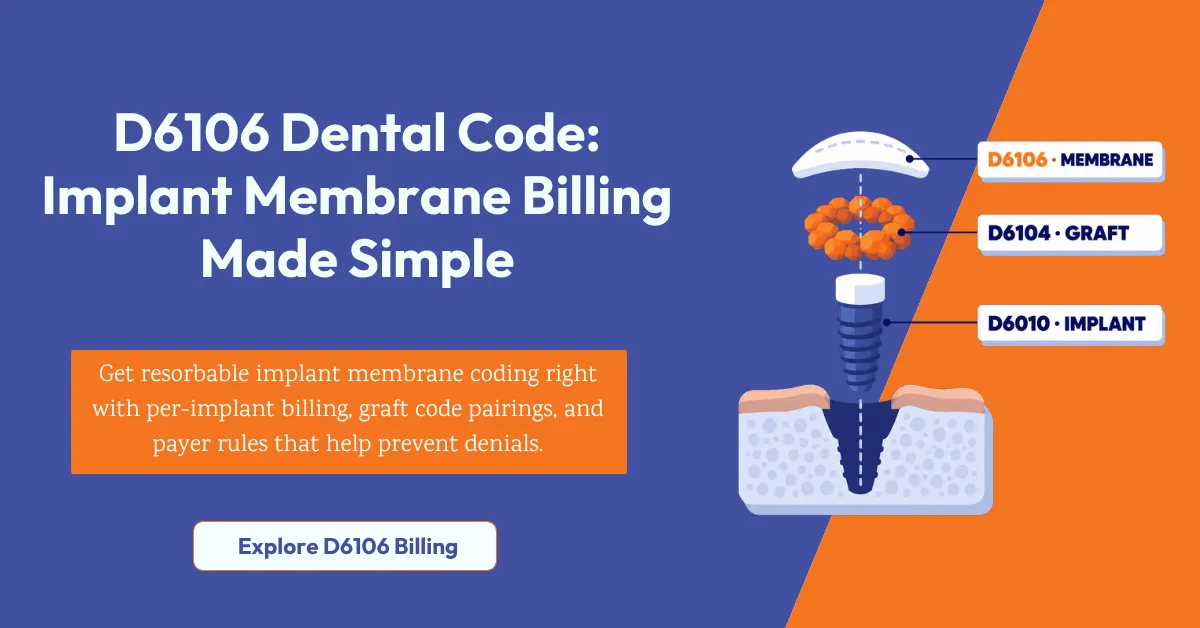
- Definition: D6106 reports guided tissue regeneration with a resorbable barrier placed around a dental implant.
- Unit: D6106 counts implants, so two treated implants mean two claim lines.
- Pairings: the membrane goes on its own line next to D6104 (graft at implant placement) or D6103 (graft repairing a peri-implant defect).
- Wrong families: natural teeth take D4266, empty sites take D7956, and a non-resorbable barrier around an implant takes D6107.
- Coverage: payers often tie D6106 to the implant benefit, and Cigna's 2026 DPPO guidelines disallow it with another bone graft at the same site on the same date.
Picture a periodontist's Friday surgery. The implant went in, the graft line paid, and the membrane line came back denied. Or a biller coded the membrane as D4266 because the office had used that code for years. You can trace both problems to one code that many front desks still treat as an afterthought.
We're the billing team at iDental Billing, and implant claims cross our desks every week. The D6106 dental code trips offices up for two reasons. It has only been in the code set since CDT 2023, and its sibling codes look almost identical on a fee schedule.
This guide walks through D6106 on a real claim: which dental membrane code fits each site, how to count units, which graft codes sit beside it, what to document, and how Cigna, Delta Dental, and Medicaid programs treat it.
What Is the D6106 Dental Code?
The D6106 dental code reports guided tissue regeneration with a resorbable barrier placed around a dental implant, billed once per implant. It covers the membrane itself. The bone graft, any biologic material, and the debridement surgery each go on their own claim lines.
D6106 sits in the implant services category of the CDT code set, which runs from D6000 to D6199 and is maintained by the American Dental Association. It's a valid guided tissue regeneration dental code under CDT 2026, and our CDT codes guide explains how those categories fit together.
Read the D6106 dental code description closely, because the scope sits there. Paraphrased, the title reads: guided tissue regeneration, resorbable barrier, per implant. The ADA's descriptor then lists what the code leaves out, and that list decides how many lines your claim needs.
What D6106 Covers and What It Doesn't
D6106 covers placing a resorbable membrane over a bone defect at an implant. The membrane keeps fast-growing gum tissue out of the space while bone fills in, and then the body absorbs it. Nobody has to go back in to take it out.
UnitedHealthcare's barrier membrane policy lists natural membranes such as collagen and synthetic ones such as aliphatic polyesters as resorbable. Your clinical note should name the product, since the material type is what separates D6106 from D6107.
The descriptor, which Cigna reproduces word for word in its 2026 coverage guidelines, leaves five steps out of D6106:
- Flap entry and closure
- Wound debridement
- Osseous contouring
- Bone replacement grafts
- Biologic materials
Report the graft and any biologic on their own lines. When the implant is already in service, debridement with a flap goes on D6101, or on D6102 if the surgeon also contours the bone.
Guided Tissue Regeneration or Guided Bone Regeneration?
Surgeons often call implant-site membrane work guided bone regeneration, or GBR. If you search for a guided bone regeneration dental code, you won't find one in CDT. The code set sorts membranes by site under its guided tissue regeneration names, so a resorbable membrane around an implant is still D6106.
When to Use D6106
D6106 fits two moments: as the implant goes in, and around an implant already in service that has lost bone. UnitedHealthcare's policy supports guided tissue regeneration with bone grafting for both, and Cigna's copy of the descriptor names the same two uses for the D6106 dental code.
At Implant Placement
Use D6106 when the surgeon places a resorbable membrane during implant surgery. Take a lower first molar implant going into a healed site, where the buccal plate shows a dehiscence and threads sit exposed. The surgeon grafts the gap and covers it, so the claim carries D6010, D6104, and D6106.
During Peri-Implantitis Repair
Use D6106 after peri-implantitis has destroyed bone around an implant and the surgeon regenerates the defect. Most offices start with D6049, new in CDT 2026, which covers nonsurgical scaling and debridement of a single implant with peri-implantitis. Surgery comes in only if that cleaning doesn't control the disease.
Once the surgeon opens a flap, the implant debridement code is D6101, which includes flap entry and closure. D6102 adds osseous contouring. D6103 reports the bone graft that repairs the defect, and D6106 reports the membrane placed over it.
The AAP Coding Coach walks through a case like this. A patient with a hybrid denture had bone loss at two implants, and the periodontist contoured, grafted, and placed resorbable membranes at both. The AAP coded it as D6102 x2, D6103 x2, and D6106 x2.
When D6106 Doesn't Fit
D6106 doesn't apply when the site has no implant, or when the membrane protects a natural tooth. Three cases trip up billing teams most often:
- Implant removed and site grafted: the site is now empty, so the membrane is D7956. The AAOMS implant coding paper codes a failed implant removal as D6100, D7953, and D7956.
- Ridge built up months before any implant: the AAP codes that graft as D7950 and the membrane as D7956.
- Periodontal defect around a natural tooth: the membrane goes on D4266.
D6106 vs D6107, D4266, and D7956: Picking the Dental Membrane Code
The membrane code follows the site first and the material second. If you're looking for the resorbable membrane dental code for an implant, it's D6106. The table sorts each GTR dental code by site, so you can match the dental code for membrane placement to the chart in one look.
| Site | Resorbable | Non-resorbable | Unit |
|---|---|---|---|
| Natural tooth | D4266 | D4267 | Per site |
| Implant | D6106 | D6107 | Per implant |
| Edentulous site (socket, ridge, or sinus) | D7956 | D7957 | Per site |
| Periradicular surgery | D3432 | No separate code | Per site |
Removing a non-resorbable barrier at a later visit has its own code, D4286. Sources: UnitedHealthcare, Aetna, and VA code lists.
D6106 vs D6107
Material decides this one. D6107 reports a non-resorbable barrier around an implant, such as expanded polytetrafluoroethylene (e-PTFE). The body can't absorb it, so the surgeon usually retrieves it at a second visit. Plan for that appointment in the treatment plan and the patient's estimate.
D6106 vs D7956
Ask one question: was an implant in the site when the membrane went in? A socket grafted at extraction, with the implant planned for later, takes D7953 for the graft and D7956 for the membrane. That's the ADA code for membrane after extraction, unless an implant goes in that same day.
Months later, a membrane placed during implant surgery at that same site becomes D6106. One patient can carry both codes for one tooth position, months apart, and both are correct.
D6106 vs D4266
D4266 belongs to natural teeth only. Billing it for an implant or an empty socket is wrong coding even when a payer pays it, and wrongly coded claims can come back as recoupment requests after an audit. The Optum dental coding article flags that exact error.
Matching the membrane code to the site is one of the checks our dental billing services team runs on each implant claim before it goes out, alongside the tooth number and the attachments.
Is D6106 Billed Per Implant or Per Site?
Per implant. The other GTR codes count sites, but the D6106 dental code counts implants, so two treated implants mean two D6106 lines, each with its own tooth number. Aetna's GTR policy bulletin lists the code with that same per-implant wording.
One implant with several defects under the same flap is still one D6106, because there's one implant. Two implants treated in one surgery are two lines when the operative note documents membrane coverage at each fixture. If one sheet of membrane spans both, the note should say it covers both implants.
Check your practice software before the first case. Some systems default surgical codes to a site, quadrant, or arch. Whether you run Dentrix, Eaglesoft, or Open Dental, set D6106 to require a tooth number, then run a two-implant test claim and confirm both lines print.
Can D6106 Be Billed With D6104, D6103, or D6010?
Yes. The graft and the membrane are separate procedures on separate lines, and CDT has no single ADA code for membrane with bone graft. Both the D6104 and D6103 descriptors send barrier membranes to their own line, so the ADA code for bone graft with implant (D6104) and D6106 sit side by side.
Coding both lines correctly doesn't guarantee both get paid. Some plans fold the membrane into the graft by policy, and Cigna's 2026 rules disallow D6106 with another bone graft at the same site on the same date. The insurance section below covers those payer rules.
Six Implant Membrane Scenarios, Line by Line
These six cases cover most implant membrane claims our team sees. Each bone graft dental code in the table follows the same logic as the membrane: the site and the timing of the implant decide it.
| # | Scenario | Lines on the claim | Note |
|---|---|---|---|
| 1 | Extraction and socket graft, implant placed later | Visit 1: extraction code, D7953, D7956. Visit 2: D6010, plus D6104 if regrafted, plus D6106 | Two visits, two membrane families |
| 2 | Immediate implant into a fresh socket | Extraction code, D6010, D6104, D6106 | Coding is correct, but Cigna disallows D6106 at the same site as a tooth removal. If the surgeon keeps part of the root, D7252 replaces the extraction code. |
| 3 | Implant in a healed ridge with a dehiscence | D6010, D6104, D6106 | Standard placement case |
| 4 | Surgical peri-implantitis repair, one implant | D6102 (or D6101), D6103, D6106 | Use D6101 when the surgeon doesn't contour bone |
| 5 | Two implants under a hybrid denture | D6102 x2, D6103 x2, D6106 x2 | AAP worked example |
| 6 | Failed implant removed and the site grafted | D6100, D7953, D7956 | Not D6106, because the site is empty (AAOMS) |
Scenarios 1 and 2 involve the same tooth and the same materials. The only difference is whether the implant goes in that day, and that one fact moves the graft from D7953 to D6104 and the membrane from D7956 to D6106. Our guide to dental extraction codes covers the first line.
If your membrane lines keep coming back reduced or denied, send us a few recent implant claims. In a free billing review, we'll show you which lines your team coded right and which ones the payer's policy blocked.
How to Report D6106 on the ADA Dental Claim Form
Report each D6106 on its own service line, with the implant site's tooth number in item 27, the code in item 29, and the date of service. Because the D6106 dental code describes work at one implant, one line per fixture keeps the claim easy for a payer's reviewer to follow.
The ADA's claim data recommendation says to skip the area of the oral cavity for D6106 and report tooth anatomy, meaning the tooth number. D4266 and D7956 follow the same pattern, so your team can use one habit for each membrane line.
The ADA's form instructions also allow one line that lists several teeth with a quantity. Use separate lines for D6106 anyway. If the payer questions one implant, the other line can still pay. Our walkthrough of the 2024 ADA claim form fields covers the rest of the form.
Send three attachments with the first submission: a pre-op radiograph showing the whole implant, periodontal charting around it, and a short narrative in the remarks field. The documentation section below shows what that narrative should say.
What to Document for a D6106 Claim
D6106 claims hold up when the record shows four things: which implant you treated, why it needed a membrane, what material went in, and images that prove the defect. Leave out any one of the four and the reviewer has a reason to ask for records.
Cigna's 2026 DPPO guidelines allow D6106 when charting and radiographs show probing depths of 5 mm or more around the implant with bone loss, or when the membrane aided regeneration during implant placement. Those two thresholds tell you what your notes have to prove.
The VA community care template works the same way. It treats membrane regeneration as necessary only when the treating or referring provider documents all of the listed criteria, and peri-implant bone loss is one of them.
Build each D6106 record from this list:
- Implant site tooth number, plus the placement date for an implant already in service
- Probing depths and bleeding around the implant
- Pre-op radiograph or CBCT image showing the whole implant and the defect
- Membrane product name, marked as resorbable
- Graft material, with the graft on its own line as D6104 or D6103
- Defect type: dehiscence, fenestration, or a vertical peri-implant defect
A Sample D6106 Narrative
Use this narrative for a peri-implantitis repair as a model, and change each detail to match your own chart. Payer reviewers compare the narrative against the attached images, so a number in the note that doesn't match the radiograph invites a records request.
Example narrative
Implant at #30 placed March 2022. Peri-implantitis with 6 mm probing depths at MB and DB, bleeding on probing, and 4 mm vertical bone loss on the attached PA. Flap reflected, defect debrided and contoured (D6102), grafted with particulate allograft (D6103), and covered with a resorbable collagen membrane (D6106).
Add a diagnosis code only when the payer asks for one. M27.62, post-osseointegration biological failure of a dental implant, is a billable FY2027 ICD-10-CM code. It names implant failure rather than peri-implantitis, so use it only when the chart supports it and the payer accepts it.
D6106 Billing Tips Before You Submit
Run five checks before the claim leaves the office:
- Verify the implant rider along with the periodontal benefit.
- Ask whether the plan bundles the membrane with a same-day graft.
- Get signed financial consent before surgery.
- Attach images to the first submission instead of waiting for a records request.
- Read the posted EOB line by line so nobody writes off a denied membrane line by mistake.
Does Insurance Cover D6106?
It depends on the plan, and the implant benefit usually decides it. A plan that excludes implants will often deny the D6106 dental code too, even when the coding is perfect. The ADA's golden rules of coding say a procedure code's existence doesn't make it a covered or reimbursed benefit.
Cigna's 2026 Rules for D6106
The Cigna 2026 DPPO coverage guidelines set the D6106 rules in policy IMPLNT-13. We've paraphrased them here, and the full policy also covers D6107:
| Allowable when | Not allowable when |
|---|---|
| The plan covers implant placement and the implant meets plan guidelines | Probing depths are under 5 mm, or images show no bone loss |
| Charting and radiographs show probing depths of 5 mm or more around the implant, with bone loss | Another peri-implant regenerative procedure happens at the same site on the same date |
| The membrane aids tissue regeneration during implant placement | Another allowable bone graft happens at the same site on the same date |
| The site is also a tooth removal site | |
| The site is edentulous | |
| The plan doesn't cover implant placement |
Two common cases lose the membrane line on a Cigna DPPO plan even with correct coding: an immediate implant into a fresh socket, and the standard graft-plus-membrane case at one site. Cigna also publishes a separate DHMO version of this policy, IMPLNT-02, so check which plan the patient carries.
Delta Dental: Denied vs Not Billable to the Patient
Northeast Delta Dental's CDT 2023 notice lists D6106 among new codes it doesn't cover as a standard benefit, in the group marked denied and billable to the patient. Denied means you can collect the approved amount from the patient. Not billable to the patient means a participating dentist can't charge for it.
That notice reflects one Delta Dental company's standard processing policy, and group contracts can differ. Check your own Delta company's processing policies before you tell a patient what they'll owe on a membrane line.
Medicaid and Prior Authorization
Medicaid programs set their own D6106 rules, and some require prior authorization. A MassHealth appeal decision describes a request for D6104 and D6106 that the plan, CCA One Care, denied in January 2025 for not meeting medical necessity criteria. Request approval before surgery and send radiographs with it.
Most D6106 surprises start with a verification call that asked about periodontal benefits instead of the implant rider. Our dental insurance verification team checks frequencies, waiting periods, and missing tooth clauses five business days before the appointment, while there's still time to change the estimate.
Why D6106 Claims Get Denied and How to Appeal
Most D6106 dental code denials fall into three groups. Coding errors need a corrected claim, policy bundling rarely changes on appeal, and medical necessity denials need records. Read the reason code on the remittance first, because it tells you which group you're dealing with.
| Reason code | What it means for D6106 | Next step |
|---|---|---|
| 16 | The claim lacks information or has a billing error, such as a missing tooth number | Correct the line and resubmit |
| 252 | The payer needs an attachment to decide the claim | Send the radiograph and charting |
| 50 | The payer doesn't consider the membrane medically necessary | Appeal with probing depths, images, and the narrative |
| 97 | The payer included the membrane in another paid service, often the graft | Check the policy; if it's a stated rule, post per your contract |
| 96 or 204 | The plan doesn't cover the service or excludes it | Bill the patient only if the group code is PR and your contract allows it |
| 197 | A required precertification or authorization was missing | Ask whether the payer allows retro authorization, or appeal |
Reason codes paraphrased from X12's claim adjustment reason code list.
Don't merge the graft and membrane into one line to get around a bundling rule, and don't recode to D4266 or D7956 because those pay more often. Both misstate what the surgeon did. The ADA's first golden rule of coding is to code for what you do, and auditors read claims with that rule in mind.
A Four-Step D6106 Appeal
- Read the reason code, group code, and remark code together before you touch the balance.
- Find the appeal deadline in the EOB or the payer's provider manual.
- Attach charting around the implant, the pre-op image, and the operative note.
- Write a one-page letter that answers the payer's stated reason in the language of its own policy and asks for one specific action.
Membrane lines are easy to write off by mistake when they post at $0. Our dental AR follow-up team works those lines, appeals the ones the record supports, and tells you which ones the policy closed.
Setting Your D6106 Fee and Handling the Patient Balance
Start with the fee schedule. The D6106 dental code entered the code set in CDT 2023, so older fee schedules can still lack a fee for it. Confirm your practice software carries an office fee and, for each in-network PPO, the contracted fee. A blank fee is how membrane lines go out at $0.
Set the office fee from your own costs: membrane material, chair time, and the rest of your fee schedule. Don't copy another office's number. On in-network claims, the PPO's contracted fee replaces your office fee, and that contracted rate applies only to providers the plan has credentialed.
New associates feel this first. Most commercial payers pay in-network rates only from a provider's effective date, so dental credentialing needs to finish before a new surgeon's implant claims go out at contracted fees.
Billing the patient after a denial depends on how the plan adjudicated the line and what your participating agreement allows. A non-covered denial and a bundled line marked not billable to the patient lead to different answers. Some states also limit how plans set fees for services they don't cover, so check your state's rules.
Before surgery, get a signed written estimate that lists the membrane line on its own. A predetermination, requested in box 1 of the ADA claim form, gives you an estimate rather than a guarantee. It's optional unless the plan requires pre-authorization for the procedure.
Is D6106 New? CDT 2023 to CDT 2027
No. The D6106 dental code has been in the code set since CDT 2023, when the ADA split guided tissue regeneration into natural tooth, implant, and edentulous families. D6107, D7956, D7957, and D4286 arrived that same year, according to the Northeast Delta Dental notice cited above.
CDT 2026 brought 60 changes, according to ADA News, and none of them touched D6106. The implant additions that year were D6049, D6196, and D6280. Our rundown of CDT 2026 changes lists the rest.
CDT 2027 takes effect January 1, 2027, with 67 changes and no deletions. New implant codes include D6108 for placing a healing cap and D6109 for removing a screw-retained implant restoration. D6106 doesn't appear among the announced changes, so confirm it in the CDT 2027 manual and see our guide to CDT 2027 implant codes.
D6106 Dental Code FAQs
Is D6106 a Bone Graft?
No. D6106 reports only the resorbable membrane. The graft goes on its own line as D6104 when the surgeon places it with the implant, or as D6103 when it repairs a defect around an implant already in service. Some plans fold the membrane into the graft's payment, but that's a payment rule, not a coding rule.
What Is the ADA Code for a Membrane?
It depends on the site. The resorbable membrane dental code is D4266 at a natural tooth, D6106 at an implant, and D7956 at an empty site such as a socket or healed ridge. Their non-resorbable partners are D4267, D6107, and D7957. To pick the dental code for membrane placement, name the site first and the material second.
What Is the ADA Code for Guided Tissue Regeneration With a Non-Resorbable Membrane?
D4267 at a natural tooth, D6107 at an implant, and D7957 at an empty site. The barrier comes out at a later visit, and that removal has its own code, D4286. Cigna's 2026 guidelines treat the removal as part of the original regeneration service, so build the second visit into the patient's first estimate.
Can D6106 Be Billed the Same Day as Implant Placement?
Yes. D6106 sits on the same claim as D6010, plus D6104 if the surgeon grafted the site. Cigna's 2026 guidelines allow the membrane during implant placement but disallow it at a tooth removal site, so an immediate implant on a Cigna DPPO plan can lose the membrane line even with correct coding.
Does Insurance Cover D6106?
Sometimes. Coverage usually follows the plan's implant benefit, so a plan that excludes implants often excludes D6106 too. Northeast Delta Dental denies it as a standard benefit but lets participating dentists bill the patient. Medicaid programs set their own rules and may require prior authorization. Verify the implant benefit before surgery and list the membrane line on the estimate.
How Many Times Can D6106 Be Billed for One Implant?
Once per implant for each procedure. Two treated implants mean two lines, and several defects around one implant still mean one line. Plans set their own frequency limits for repeat regeneration at the same implant, so check the patient's history and the plan's limits before you schedule a second procedure.
Is D6106 Used When an Implant Is Removed?
No. Once the implant comes out, the site is empty, so a membrane placed there is D7956. AAOMS codes a failed implant removal with a graft and resorbable membrane as D6100, D7953, and D7956. D6106 applies again only if the surgeon places a membrane during the later implant surgery.
Before Your Next Implant Claim Goes Out
Three habits prevent most D6106 dental code problems. Name the site before anyone opens the code list. Put each implant on its own line with charting attached. Read the plan's implant rider before surgery so the EOB doesn't deliver the news for you.
If implant claims are eating your team's week, our outsourced dental billing covers coding, submission, and appeals. Rates run from 3.95% down to 2.95% of collections depending on volume, with nothing charged on unpaid or denied claims. Credentialing starts at $150 per commercial payer, or $95 for billing clients, as our billing pricing page shows.
Sources
- American Dental Association: ADA Dental Claim Data Recommendation, Reporting Area of the Oral Cavity and Tooth Anatomy by CDT Code
- ADA News: 60 changes coming to CDT Code in 2026; 6 golden rules of coding, June 23, 2026
- American Academy of Periodontology: Ask the Coding Coach, March 31, 2025
- American Association of Oral and Maxillofacial Surgeons: Coding for Oral Implants
- Cigna Healthcare: Dental Clinical Coverage Determination Guidelines, DPPO, 2026
- UnitedHealthcare: Dental Barrier Membrane Guided Tissue Regeneration policy
- Aetna: Dental Clinical Policy Bulletin 002, Guided Tissue Regeneration
- Optum and UnitedHealthcare Dental: Reduce denials with the correct CDT code
- Northeast Delta Dental: CDT 2023 Code and Policy Changes
- US Department of Veterans Affairs: Dental Barrier Membrane Guided Tissue Regeneration, community care template
- Commonwealth of Massachusetts: MassHealth appeal decision, D6104 and D6106 prior authorization
- X12: Claim Adjustment Reason Codes
CDT is a trademark of the American Dental Association, which holds the copyright to the CDT Code. We paraphrased code titles in this guide; see the current CDT manual for official nomenclature and descriptors. ICD-10-CM code reflects the FY2027 code set.
ABOUT THE AUTHOR
Russell Bennett
Russell Bennett is a Dental RCM and Provider Credentialing Specialist at iDental Billing. He reviews billing workflows, resolves claim denials, outstanding insurance balances, and reimbursement discrepancies, and applies CDT coding and payer-specific guidelines. His work includes provider credentialing, payer enrollment, and recredentialing. Russell writes iDental Billing’s educational guides on what claims need, why they matter, and where things go wrong.