






Delta Dental credentialing runs through the Delta Dental company that serves your state, and each company sets its own process. Depending on yours, you'll apply through a DataSpring (CAQH) profile, the PACT portal, a DentalXChange portal, or the company's own application. You'll also sign a participation agreement, and most companies recredential every three years.
Your effective date sets the day in-network pay starts. Until you get in-network with Delta Dental, the Delta patients you see aren't covered by a participation agreement, and their claims process out of network. Delta Dental of Iowa goes further on its credentialing form, where it says it can no longer backdate effective dates.
Our credentialing team at iDental Billing files Delta applications for practices across the country. Every rule in this guide comes from the member company's own pages, checked on November 2, 2026. Where a company doesn't publish a rule, we tell you to confirm it instead of guessing.
Key takeaways
- Delta Dental credentialing happens with one of 39 independent companies: the one serving the state where you practice.
- Routes vary: DataSpring (CAQH) for Delta Dental of California and affiliates, PACT in five Midwest and Southeast states, and DentalXChange in Tennessee, Colorado, and Arkansas.
- If your Delta company uses CAQH, you authorize it to view your profile and reattest every 120 days.
- Most Delta companies recredential every three years. Delta Dental of California ends the contract when credentials expire, and you rejoin under its current agreement.
- From January 1, 2027, Delta Dental of California and affiliates make EFT standard and charge contracted offices $15 a week for paper checks, where state law allows.
What Is Delta Dental Credentialing?
Delta Dental credentialing is a member company's check of your license, education, malpractice coverage, and professional history before you join its networks. Contracting runs alongside it, and that's where you sign the participating agreement and file your fees. Delta Dental provider credentialing comes in two types: initial credentialing when you join, and recredentialing on a fixed cycle after that.
Credentialing, Contracting, and Your Effective Date Are Three Different Steps
Credentialing confirms who you are and what you're qualified to do, the same check behind any dental credentialing file. Delta Dental of Michigan, which also serves Ohio and Indiana, says it's accredited by NCQA in credentialing and recredentialing. Expect its staff to check your file against primary sources such as licensing boards.
Contracting covers the participating agreement and the networks you pick. Delta Dental of North Carolina's PACT portal lets you view and sign agreements digitally, customized to your state license and network choice. In Oregon, Delta Dental of Oregon asks participating dentists to pre-file fees, accept direct reimbursement, and accept fees at or below the 90th percentile.
Your effective date is the day your claims start counting as in-network. It works like renting an apartment. The background check, the signed lease, and the keys come at three separate moments, and you can't move in until you hold the keys. Our timeline section covers how long each piece takes.
Like most dental insurance credentialing, the vocabulary gets loose on payer phone lines. A rep who says Delta Dental provider enrollment usually means the network and agreement step, which comes after the background check. Ask which step they mean before your office marks anything as finished.
How to Get Credentialed With Delta Dental, Step by Step
Delta Dental credentialing takes six steps, from finding your member company to confirming your effective date. The longest wait comes after you submit, while the company reviews your file. If the company finds a gap from step three, it sends the file back, so check every item before you submit.
- Find your Delta Dental company: Delta Dental's join page asks for the state where you practice and sends you to your local company's website. If you practice in two states, you'll work with two companies, each with its own file and contacts. Write down the credentialing phone number and email before you start.
- Check eligibility and pull your documents: You need an active license in the state where you'll treat Delta patients. Delta Dental of Colorado, for example, says all licensed Colorado dentists are eligible to join any of its networks. Gather everything on the documents checklist first, so you can finish the application in one sitting.
- Set up your credentialing profile: Your company decides the format. It may want a DataSpring (CAQH) profile you authorize it to view, or an account in its own portal, such as PACT or a DentalXChange portal. Use the state table to find your route, and the CAQH section for profile setup.
- Choose your networks: Delta Dental's join page lists Delta Dental PPO and Delta Dental Premier among its networks. Some companies add DeltaCare USA, Medicare Advantage, or a Medicaid program they administer, like Delta Dental Smiles in Arkansas. Compare the fee schedules before you commit, and see the networks section for the trade-offs.
- Submit the Delta Dental credentialing application and sign the agreement: Companies on PACT, including Delta Dental of North Carolina and Delta Dental of Michigan, let you sign agreements digitally. Read the whole Delta Dental application before you sign, because the agreement sets your fees. If the company asks for more information, answer that day; your file sits until you respond.
- Get your effective date in writing: Hold in-network billing for that dentist until a written effective date arrives from the company. Then load the date into your practice management software and tell the front desk which networks are active. The timeline section explains what happens to claims sent before that date.
Most applications stall because nobody follows up, and steps five and six are where that happens. A request sits in someone's inbox while the clock stops. Our dental credentialing services cover that follow-up, with payer contact twice a week until the file clears.
Delta Dental Credentialing by State: Which Company and Portal You Use
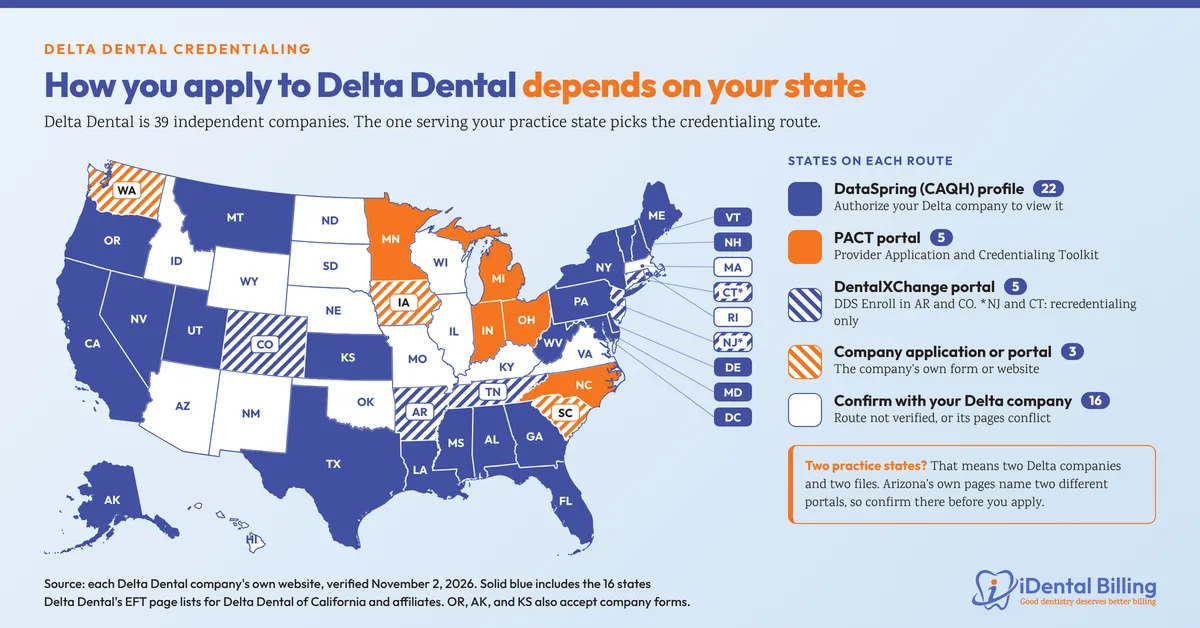
Delta Dental is a national network of 39 independent companies, and the company serving your state decides how you apply. Some pull your DataSpring (CAQH) profile. Others run their own portal, either PACT or DentalXChange, or hand you a paper form. The table below shows what each company publishes about its Delta Dental credentialing portal.
The Four Routes Delta Dental Companies Use
- DataSpring (CAQH) profile: you keep one profile and authorize each company to view it. Delta Dental of California and affiliates, Oregon, Alaska, Kansas, and Northeast Delta Dental use this route.
- PACT, the Provider Application and Credentialing Toolkit: a self-service portal for applications and digital agreements. Delta Dental of Michigan runs it for Michigan, Ohio, and Indiana, and North Carolina and Minnesota use it too.
- DentalXChange portal: online credentialing through DentalXChange, used by Delta Dental of Tennessee and Arkansas, Colorado's DDS Enroll, and New Jersey's online recredentialing.
- Company form or application: Delta Dental of Washington's member dentist application and Delta Dental of Iowa's credentialing form are two examples.
Which Route Each Delta Company Uses
Each row lists what that company publishes on its own site, so you can check your route before you open an account. Arizona isn't listed because its own pages name two different portals; call Delta Dental of Arizona's Professional Relations team at 866-746-1834 to confirm yours.
Delta Dental credentialing routes by member company, verified November 2, 2026
| Member company | States | How you apply or recredential | What the company publishes | Source |
|---|---|---|---|---|
| Delta Dental of California and affiliates | AL, CA, DC, DE, FL, GA, LA, MD, MS, MT, NV, NY, PA, TX, UT, WV | DataSpring (CAQH) profile at no cost; authorize Delta Dental | Recredentialing every three years; notice about 90 to 180 days ahead; process should take 60 days or less | Delta Dental (deltadentalins.com) |
| Delta Dental of Michigan, Ohio, and Indiana | MI, OH, IN | PACT; agreements signed digitally | NCQA-accredited for credentialing and recredentialing; recredentialing every 36 months, started by email | Delta Dental of Michigan |
| Delta Dental of North Carolina | NC | PACT, which replaced AppCentral | Credentialing questions go to the provider records email on its PACT page | Delta Dental of North Carolina |
| Delta Dental of Minnesota | MN | PACT | Provider Services: 800-448-3815 | Delta Dental of Minnesota |
| Delta Dental of Tennessee | TN | DentalXChange portal; invitation by email | Every three years; last credentialed in 2024 means recredentialing in 2027; online tool is free | Delta Dental of Tennessee |
| Delta Dental of New Jersey | NJ, CT | New dentists use the join link or contact the office with the dentist's name and county; recredentialing online through DentalXChange | Every three years; Professional Relations: 888-396-6641 | Delta Dental of New Jersey |
| Delta Dental of Colorado | CO | DDS Enroll | Premier dentists add PPO by emailing the PPO agreement; credentialing team: 720-489-4704 | Delta Dental of Colorado |
| Delta Dental of Arkansas | AR | DDS Enroll | One portal for Premier, Premier/PPO, Delta Dental Smiles (Medicaid), and Medicare Advantage | Delta Dental of Arkansas |
| Delta Dental of South Carolina | SC | credentialing.deltadentalmo.com portal | Delta Dental of Missouri does business in SC under this name | Delta Dental of South Carolina |
| Delta Dental of Washington | WA | Member dentist application on its provider forms page | Response in 18 to 21 business days after a complete application; recredentialing every three years | Delta Dental of Washington |
| Delta Dental of Oregon | OR | CAQH (list Moda Health as an authorized plan) or company forms | Reverification every three years; Premier, PPO, and Medicare Advantage networks | Delta Dental of Oregon |
| Delta Dental of Alaska | AK | CAQH (authorize Moda Health), eApply portal, or emailed forms | Reverification every three years; Premier and PPO networks | Delta Dental of Alaska |
| Delta Dental of Kansas | KS | Authorize the company in CAQH, or complete its paperwork | Every three years; says 92% of its network completes it through CAQH | Delta Dental of Kansas |
| Northeast Delta Dental | ME, NH, VT | DataSpring (CAQH) profile; authorize the company | Up to four full business days after you attest before it can view your profile | Northeast Delta Dental |
| Delta Dental of Massachusetts | MA | Contracting, enrollment, and credentialing line | 800-872-0500 | Delta Dental of Massachusetts |
| Delta Dental of Iowa | IA | Paper credentialing form | Up to 30 days from receipt of a completed application; no backdated effective dates | Delta Dental of Iowa |
| Every other state | All others | State locator on Delta's national join page | Confirm the current portal on your company's site | Delta Dental Plans Association |
Practicing in More Than One State
Each state's Delta company keeps its own file, so a two-state practice sends a Delta Dental credentialing application to each company. Delta Dental of Washington says it can't process out-of-state submissions. The Delta Dental credentialing phone number changes by company too, so call the company where the office sits, whatever the patient's ID card shows.
Rather not learn your state's Delta portal?
Our credentialing team builds or cleans up your DataSpring profile and files with the right Delta Dental company. We follow up with the payer twice a week and confirm your effective date in writing. It's $150 per commercial payer, or $95 when we also run your billing.
Get my credentialing quoteCAQH Credentialing for Delta Dental: DataSpring and the ADA Service
CAQH credentialing for Delta Dental now runs through DataSpring, the name CAQH adopted in June 2026, according to the ADA. DataSpring's Provider Data Portal holds your profile, but DataSpring doesn't approve you. Your Delta company makes that call, and it can only see your profile after you authorize it.
What Is CAQH Credentialing for Dentists?
CAQH credentialing means keeping one profile that participating plans pull from, instead of mailing each plan its own packet. You won't find a CAQH certification to earn. Your profile is a data record, and each plan still makes its own credentialing decision about you.
Dentists can use the ADA's CAQH portal, the ADA Credentialing Service, free whether or not they're members. You sign in with an ADA account. A new CAQH application takes one to two hours on average by the ADA's estimate, and staff handling several dentists get their own office manager guide.
Which Delta Dental Companies Use Your CAQH Profile
- Delta Dental of California and affiliates: contracted dentists credential and recredential online through DataSpring at no cost after authorizing Delta Dental, per Delta Dental's DataSpring page.
- Oregon and Alaska: both accept CAQH once you list Moda Health as an authorized plan.
- Kansas: authorize the company, and it uses your CAQH data in place of its own paperwork.
- Northeast Delta Dental: you authorize it to view your profile, and its FAQ points dentists to the ADA's service.
CAQH dental credentialing only helps when your Delta company pulls the profile. PACT and DentalXChange companies run their own applications, so check your row in the state table before anyone in your office builds a profile that goes unused.
Keep the Profile Usable: Attestation, Authorization, and Matching Details
- Reattest every 120 days: the ADA says it takes 5 to 10 minutes on average, and reminder emails go to the address on file, so keep that inbox monitored.
- Choose global authorization: the ADA and DataSpring recommend the global option, which lets every participating plan view your profile.
- Allow a few days: Northeast Delta Dental says it can take up to four full business days after you attest before it can view the profile.
- Match every detail: Northeast Delta Dental wants the malpractice policy number to match the uploaded document, dashes included.
Delta Dental Credentialing Requirements: The Documents to Gather First
Delta Dental credentialing requirements start from a similar core file at each company we checked. Expect to need an active dental license, your NPI, a malpractice declarations page, a CV, and a W-9. Add DEA and state controlled substance registrations if you hold them, plus your CAQH ID if your company uses CAQH.
Documents Delta Dental companies ask for
| Document | What to check before you submit | Companies that list it (examples) |
|---|---|---|
| State dental license | Active and unrestricted; your name matches your NPI record | Oregon, Alaska |
| DEA registration and state CDS certificate | Current, if you hold one. Iowa's form lets you name who prescribes for your patients if you don't. | Oregon, Alaska, Iowa |
| NPI, Type 1 (individual) and Type 2 (organization) | Type 1 for each dentist; Type 2 tied to the practice TIN | Iowa (for its Medicaid programs) |
| Malpractice declarations page | Dates and limits current; the policy number matches the uploaded document | Oregon, Alaska, Northeast Delta Dental |
| Curriculum vitae and practice history | Iowa wants five years of work history with gaps explained; Oregon wants past and current practice locations | Oregon, Alaska, Iowa |
| IRS Form W-9 | Matches the TIN and practice name you bill under | Oregon, Alaska, Iowa (each office of a new business) |
| CAQH provider ID | The number your DataSpring profile carries | Oregon, Alaska |
| Malpractice case summaries | Any pending or settled cases | Oregon, Alaska |
| Specialty certificate | Needed if you're credentialing as a specialist | Iowa |
| Ownership and control disclosure | Filed for a new business entity | Iowa |
Don't assume one malpractice minimum applies everywhere. Delta Dental of Iowa's own documents list two. Its credentialing form asks for $1,000,000 per claim and $3,000,000 aggregate, while the Dental Wellness Plan regulations set $200,000 and $500,000 for general dentistry.
What is a CAQH ID? It's the provider number DataSpring assigns your profile, and Delta companies that use CAQH ask for it so they can find and pull your record.
Three Small Mismatches That Stall a File
- Names or addresses that differ between documents: your license, NPPES record, and application should read the same, character for character.
- Documents that expire mid-review: renew anything close to its expiration date before you submit.
- An unexplained work gap: Delta Dental of Iowa's form asks you to explain any gap in your five-year history.
Not sure what's missing from your file? Send what you have and ask our credentialing team to check it against your Delta company's list before anything goes out. We'll tell you which documents to renew, match, or track down first.
Choosing Your Delta Dental Networks: PPO, Premier, DeltaCare USA, and More
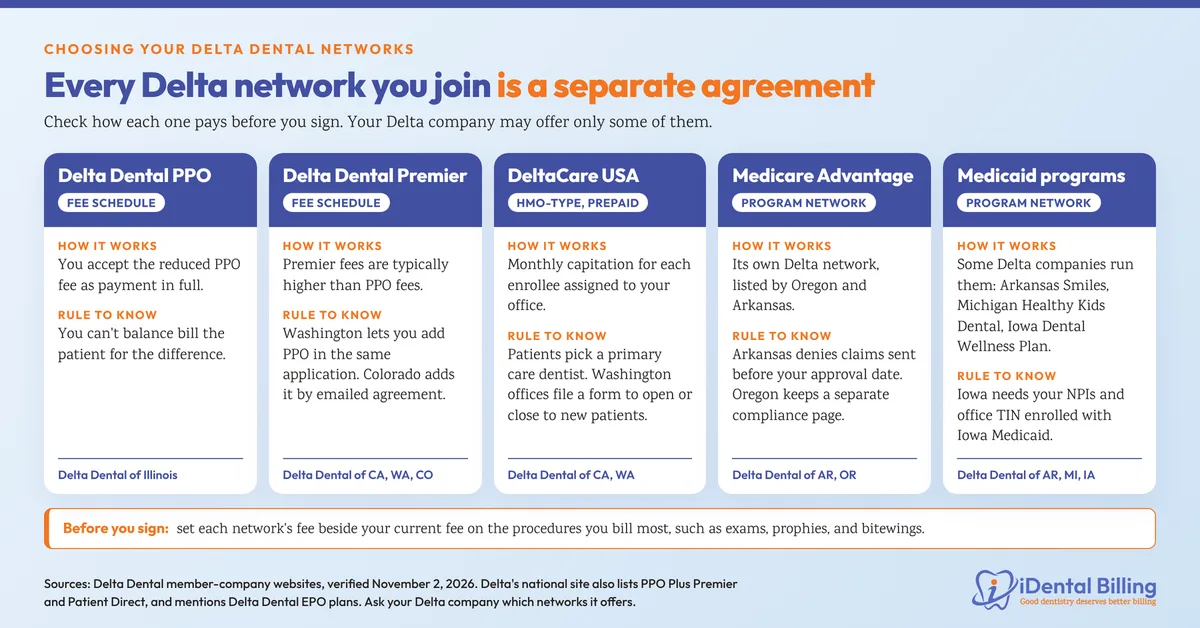
Delta Dental's national join page lists Delta Dental PPO and Delta Dental Premier, along with PPO Plus Premier, Medicare Advantage, DeltaCare USA, and Patient Direct. Your company may offer only some of them. PPO and Premier pay from fee schedules, DeltaCare USA is an HMO-type plan, and each network you join through Delta Dental credentialing carries its own agreement.
Delta Dental PPO vs. the Delta Dental Premier Network
Delta Dental of California tells brokers that Premier fees are typically higher than PPO fees. On the PPO side, Delta Dental of Illinois says its dentists accept the reduced PPO fee as payment in full and agree not to balance bill patients for the difference.
Delta Dental of Colorado treats the two as separate contracts. A dentist already in the Delta Dental Premier network joins PPO by signing and emailing the PPO participating provider agreement. In Oregon and Alaska, participating dentists file their usual fees and can change them only once every six months.
Before you sign, set the offered fee for each network beside your current fee on the procedures you bill most. A small gap on a code you bill twice a year won't matter much. That same gap on exams, prophies, and bitewings decides whether the contract pays for itself.
How to Become a Delta Dental Premier Provider
You apply through your state company's regular credentialing process and select Premier. Delta Dental of Washington says you join Premier through its member dentist application and can add PPO within that same application. In Colorado, you choose PPO or Premier during enrollment, and a Premier dentist can add PPO later.
DeltaCare USA, Medicare Advantage, EPO, and Medicaid Networks
- DeltaCare USA: Delta Dental of California calls it an HMO-type prepaid plan, and DeltaCare USA dentists receive a monthly capitation payment for each enrollee assigned to their office.
- Medicare Advantage: Delta Dental of Oregon and Delta Dental of Arkansas both list a Medicare Advantage network, and Oregon keeps a separate compliance page for it.
- EPO: Delta Dental's national site mentions Delta Dental EPO plans, so ask your company whether its EPO network uses its own agreement.
- Medicaid: Arkansas runs Delta Dental Smiles, Michigan awarded Healthy Kids Dental to Delta Dental of Michigan in April 2026, and Iowa's Delta company administers the Dental Wellness Plan.
In Washington, DeltaCare patients choose a primary care dentist, and your office files a status form whenever it opens or closes to new DeltaCare patients. Medicaid has its own enrollment rules too. Delta Dental of Iowa requires your individual NPI, office TIN, and organizational NPI to be enrolled with Iowa Medicaid for its programs.
To see how each plan type pays once claims start, our dental billing guide lays out PPO, DHMO, Medicaid, and Medicare Advantage billing in one table.
How Long Does Delta Dental Credentialing Take?
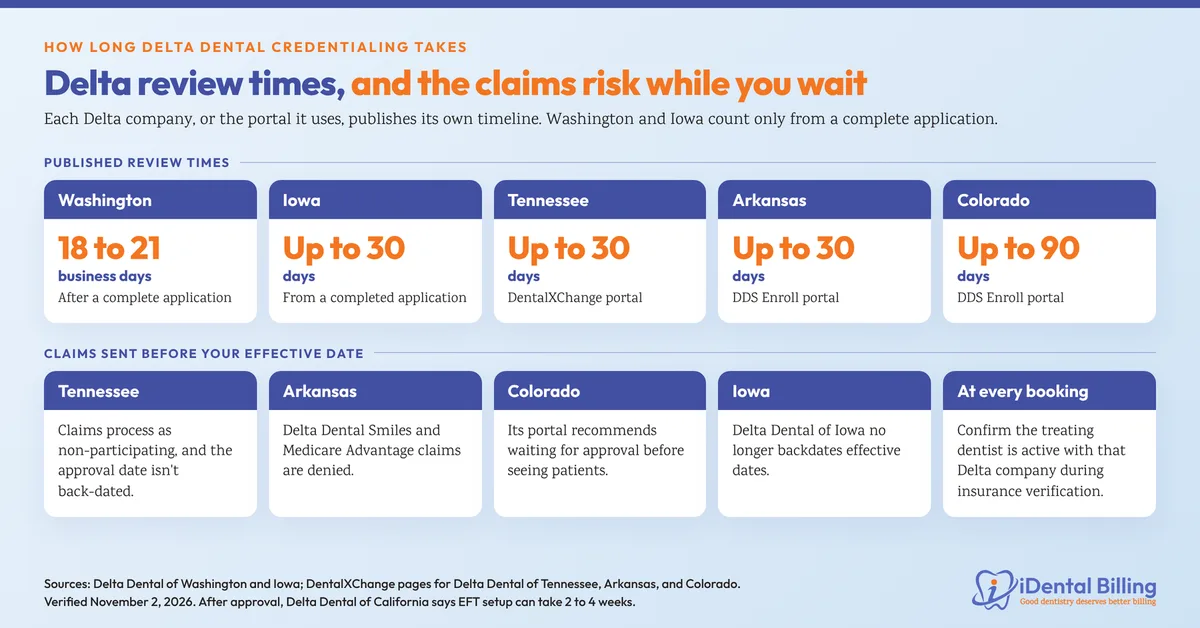
Timing depends on your Delta company and on how complete your file is. Delta Dental of Washington says to expect a response within 18 to 21 business days of a complete application, and Delta Dental of Iowa allows up to 30 days. DentalXChange portals list up to 30 days for Tennessee and Arkansas and up to 90 for Colorado.
What the Clock Includes, and What Adds Time
- Complete files only: Washington and Iowa both count from a completed application, so a file with a gap waits until you fill it.
- Portal invitations: in Tennessee, the process starts with an email from DentalXChange, and a missed email means a late start.
- Requests for information: your file pauses until someone in your office answers.
- Payment setup after approval: EFT and ERA enrollment adds its own wait, covered in the next section.
Our credentialing team averages 55 days across 4,000+ applications, commercial and government payers combined, against the 90 to 120 days most payers take on their own. Treat that as an all-payer midpoint, not a Delta-specific promise. See how our credentialing and payer enrollment work runs.
Can You See Delta Dental Patients Before Your Effective Date?
Yes, you can treat them, but until you're in-network with Delta Dental, those claims don't fall under a participation agreement. Delta Dental of Tennessee's DentalXChange page says such claims process as non-participating, and that the company won't back-date the approval date.
Some programs go further. Delta Dental of Arkansas's credentialing portal says Delta Dental Smiles and Medicare Advantage claims submitted before the approval date will be denied. For Delta Dental of Colorado, the credentialing portal recommends waiting for approval before seeing patients at all. If a retroactive date is possible, get it in writing first.
Make network status part of every booking. Your front desk should confirm the treating dentist is active with that Delta company during dental insurance verification. If claims already went out under a dentist who wasn't active yet, someone has to sort fixable claims from patient balances, and that's dental AR follow-up work.
Why Credentialing Takes Longer Than It Should
Watch for these three causes before you blame the payer:
- The application went to the wrong member company or the wrong route.
- CAQH wasn't authorized, or the attestation lapsed partway through review.
- A request email sat unanswered because the portal sent it to one person who was out of the office.
After Approval: Payer IDs, ERA, and the 2027 EFT Change
Delta Dental credentialing ends with approval, but billing setup comes next. Before the first claim goes out, confirm the effective date and load the dentist into your practice management software with the right NPI and TIN. Then check Delta's claims submission details and enroll in EFT and Delta Dental ERA, so payments post without manual matching.
Set Up EFT, ERA, and the Right Claims Details
Delta Dental of California and affiliates enroll offices through Provider Tools, using the EFT and ERA icon, and enrollment can take two to four weeks. ERA replaces your paper claim statements. Offices in other states enroll with their local Delta company and can opt in to national sharing.
Multiple offices need extra care. Delta told the ADA that a dentist signs up for each office location, and Delta Dental of Washington pays every office under one TIN by the same method. Remittances appear under the Check National ERA tab on Delta's national dentist dashboard.
For claims routing, use the claims submission info lookup tool on deltadental.com. Our billing guide covers posting in its ERA and EFT reconciliation steps, including how to read an ERA line by line.
What Changes on January 1, 2027
From January 1, 2027, Delta Dental of California and its affiliates make EFT standard. Contracted offices that keep paper checks pay a $15 weekly processing fee where consistent with state law, according to Delta Dental's EFT page. The fee applies in AL, CA, DC, DE, FL, GA, LA, MD, MS, MT, NV, NY, PA, TX, UT, and WV.
It covers Delta Dental PPO, Delta Dental Premier, Delta Dental Medicare Advantage PPO, and both New York Select plans. ADA News reported that out-of-network dentists aren't included for now. The California Dental Association says offices pay one fee per week, and only in weeks when they receive one or more checks.
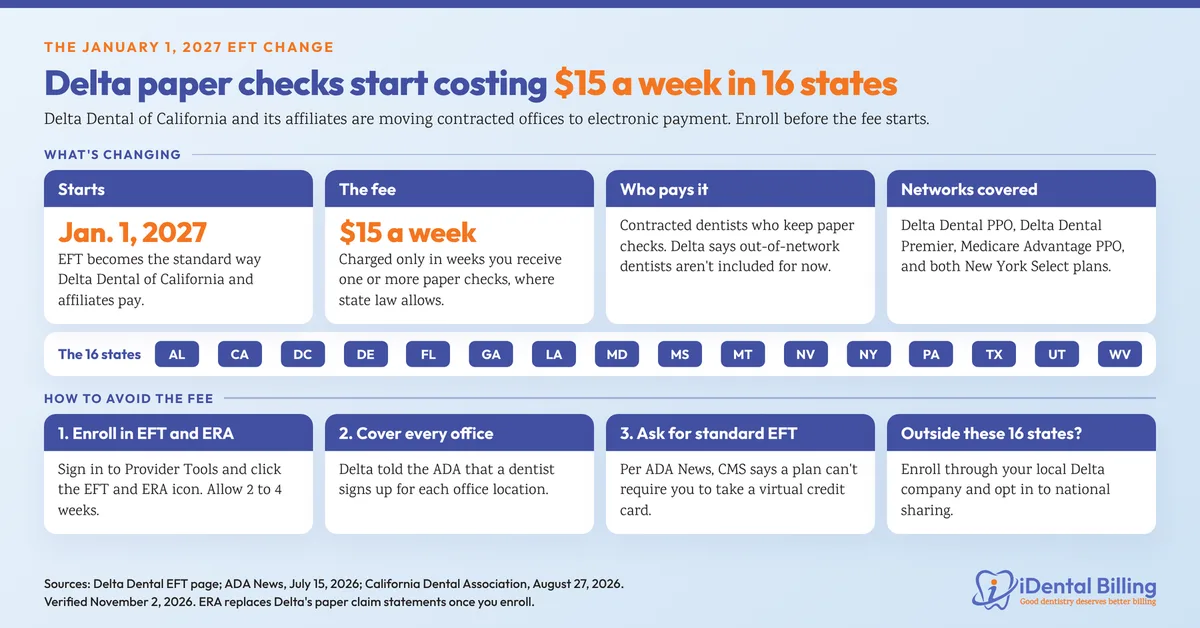
You can also insist on standard EFT. ADA News reports that CMS has clarified a plan must honor a dentist's request for HIPAA standard ACH EFT and can't require a virtual credit card.
When one team runs your dental billing services and credentialing, a new dentist's claims can start going out on the effective date. Nothing gets handed off between vendors in the middle.
Credentialing costs less when we run your billing
Billing clients pay $95 per commercial payer and $175 per government payer for credentialing, instead of $150 and $250. Our billing runs 2.95% to 3.95% of collections by volume, with no setup fee and nothing charged on unpaid claims. Your new dentist's claims can start going out on the effective date.
See billing client pricingDelta Dental Recredentialing: The Three-Year Cycle
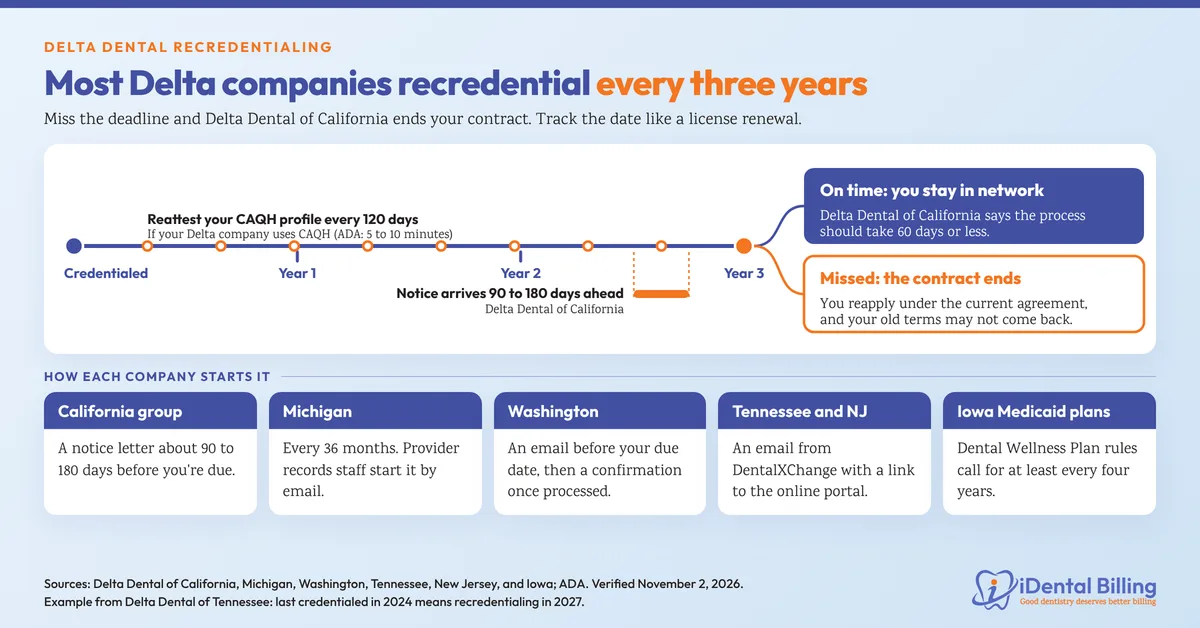
Recredentialing is the repeat half of Delta Dental credentialing. Most companies we checked run it every three years and send a letter, an email, or a portal invitation before the deadline. Miss it, and Delta Dental of California says it has to terminate your contract.
What Recredentialing Means, and How Each Company Starts It
In practice, what recredentialing means is a fresh check of your license, malpractice coverage, and history on a fixed cycle. Each company kicks it off its own way:
- Delta Dental of California and affiliates: a letter about 90 to 180 days ahead, and a process that should take 60 days or less.
- Delta Dental of Michigan: every 36 months, and its August 2026 newsletter says provider records staff start it by email.
- Delta Dental of Washington: every three years, with an email before your due date and a confirmation once it's processed.
- Tennessee and New Jersey: an email from DentalXChange with a link to the online portal.
- Kansas: your CAQH data covers it once you've authorized the company; otherwise, you complete its paperwork every three years.
- Iowa's Dental Wellness Plan: its regulations call for recredentialing at least every four years, which is why "most companies" isn't "all."
Who's Due in 2027
Delta Dental of Tennessee gives its own example: dentists last credentialed in 2024 are recredentialed in 2027.
If your company runs a three-year cycle and your last one closed in 2024, expect a notice during 2027. Each company sets its own date, so go by the letter or portal invitation rather than counting years on the calendar.
What Happens If Delta Dental Recredentialing Lapses
Delta Dental of California says you can reapply after a lapse, but only under its most current dentist agreement. It also warns that your contract might not be the same as before, so terms you signed years ago may not come back.
Keep your CAQH attestation current between cycles, since companies that recredential through DataSpring pull that profile. Put each Delta due date on the same calendar as your license and malpractice renewals, so one person sees all three coming.
Associates, New Locations, and Ownership or TIN Changes
Delta Dental credentialing follows both the dentist and the location. Each treating dentist needs their own credentialing. A new office, a new TIN, or an ownership change also has to be filed with your Delta company before any claims go out under it.
Adding an Associate Dentist
Every associate needs a file of their own, since Delta Dental provider credentialing belongs to the individual dentist and doesn't carry over from the owner. Start before the associate's first day. If the associate is already credentialed with that company, Delta Dental of Michigan's office resource guide describes a provider addition form you return to provider records.
Don't bill an associate's work under the owner's number to bridge the gap. Claims need to show the dentist who treated the patient, and billing under the wrong provider can set the practice up for overpayment recovery later.
New Locations, TIN Changes, and Practice Purchases
- Delta Dental of Washington: an add-a-location application (18 to 21 business days), a TIN change notification (7 to 10 business days), and a termination request when you close an office.
- Oregon and Alaska: tell the company right away about changes to your service location, payment address, TIN, or other W-9 details.
- Iowa: report changes to your credentialing information within 30 calendar days; a new business files a W-9 for each office plus an ownership and control disclosure.
On practice purchases, our view at iDental Billing is that the seller's contracts don't follow the practice. A new owning entity usually means new Delta Dental provider enrollment under your TIN, so ask your Delta company about timing before the sale closes.
What Delta Dental Credentialing Costs, In-House or Outsourced
The Delta routes we checked don't charge dentists to apply. Delta Dental of California's DataSpring route costs nothing, Delta Dental of Tennessee's online tool is free, and the ADA Credentialing Service is free for all dentists. What you pay for is staff time, plus the in-network revenue you can't bill while a file waits.
Doing It In-House vs. Outsourcing
Credentialing costs, in-house vs. outsourced
| Cost | In-house | Outsourced |
|---|---|---|
| Application fee to Delta | None on the routes we checked | None on the routes we checked |
| Staff time | Portal setup, document chasing, follow-up calls, and a recredentialing calendar | Handled by the vendor |
| Pricing model | Salary hours | Usually per application or a flat project fee |
| Main risk | Files stall when the one person tracking them is out | Depends on the vendor's follow-up cadence |
Dental credentialing works out cheaper in-house only when someone on staff has protected time to check portals and answer payer requests the same day.
iDental Billing's Credentialing Prices
Our dental credentialing services are priced per payer, not per month. Every plan includes CAQH setup and attestation, application filing, payer follow-up to approval, and your effective date confirmed in writing.
- $150 per commercial payer, which covers a Delta Dental company
- $250 per government payer, such as Medicaid, Medicare, or PECOS
- $1,099 flat for a full panel of eight payers, up to three of them government
- $95 per commercial payer and $175 per government payer for billing clients
- Recredentialing at $95 per payer, tracked and quoted when it comes due
- A custom quote for 10+ payers or more than one provider
- No setup fee, no charge for resubmissions, and no retainer
See the full credentialing pricing per payer, including billing-client rates and what the full panel covers.
Delta Dental Credentialing FAQs
Does Delta Dental use CAQH?
Some Delta Dental companies do. Delta Dental of California and affiliates, Oregon, Alaska, Kansas, and Northeast Delta Dental pull your DataSpring (CAQH) profile once you authorize them. PACT companies, including Michigan, Ohio, Indiana, North Carolina, and Minnesota, run their own applications, and so do the DentalXChange companies in Tennessee, Colorado, and Arkansas.
If your company does use CAQH, keep the 120-day attestation current so the profile stays readable while your file is in review. Check your company's row in the state table before you build or update anything.
Who do I call about Delta Dental provider credentialing?
Each company runs its own line, so you won't find one Delta Dental provider credentialing phone number. Minnesota lists Provider Services at 800-448-3815, New Jersey lists Professional Relations at 888-396-6641, and Colorado lists its credentialing team at 720-489-4704. Massachusetts uses 800-872-0500 for contracting, enrollment, and credentialing.
For DataSpring profile problems, Delta Dental of California points dentists to 888-599-1771. Call the company where your office sits, and log the rep's name and the date of every call.
How do I check my Delta Dental credentialing application status?
Start with the portal your company uses. Delta Dental of Arkansas says its DDS Enroll portal lets you complete, submit, and track paperwork for all of its networks. PACT gives dentists in Michigan, North Carolina, and Minnesota a self-service portal for their applications.
Companies that work from paper forms, such as Delta Dental of Iowa, need a call or an email to their credentialing team. Ask for the file's status, any open requests, and the expected decision date, then write each answer down.
Is Delta Dental a PPO or an HMO?
Both, depending on the network. Delta Dental PPO and Delta Dental Premier pay dentists from fee schedules, while Delta's national dentist FAQ calls DeltaCare USA its national DHMO.
As Delta Dental of California describes it, DeltaCare USA is an HMO-type prepaid closed network plan that pays offices a monthly capitation for each assigned enrollee. You sign a separate agreement for each network you join, which Delta Dental of Colorado's PPO process shows.
Can my office manager handle Delta Dental credentialing?
Yes, for most of the legwork. For staff who handle credentialing for several dentists, the ADA publishes an office manager guide, so nobody has to share a dentist's login.
Your manager can gather documents, watch the portals, answer requests, and keep the recredentialing calendar. Each dentist still attests to the CAQH profile and signs the participation agreement, since both carry the dentist's own statements. If nobody on staff has protected time for follow-up, that piece is the one worth handing to a vendor.
What happens if I miss Delta Dental recredentialing?
Delta Dental of California says expired credentials end your contract as a network dentist, and getting back in means reapplying under its current dentist agreement.
Watch for the warning first: California sends a notice about 90 to 180 days before the deadline, and Washington emails before the due date.
If your credentials have already lapsed, call the company's credentialing line that day. Ask how claims from the gap will process and which route to use for refiling, then start the application right away.
Why do some dentists drop Delta Dental PPO but keep Premier?
The two networks are separate contracts that pay from different fee schedules, so you can leave one and keep the other. Delta Dental of California tells brokers that Premier fees are typically higher than PPO fees.
For some offices, the PPO fee on high-volume codes like exams and cleanings doesn't cover the cost of the visit. Before deciding, compare both schedules on the procedures you bill most, and count how many of your active patients carry each plan.
Get In-Network Without Losing Months
Delta Dental credentialing comes down to three things you control: the right company, a complete file, and dates you track. The review queue belongs to the payer, so spend your office's effort on the parts that move your date.
- Find your company and route in the state table, and save its credentialing contact.
- If your company uses CAQH, authorize it and put your next 120-day attestation on the calendar.
- Once approved, record your effective date and recredentialing year, then set up EFT and ERA before the first claim.
When a Delta file stalls in our experience, the cause tends to be a missed email or an expired document, and your front office can fix both.
Credentialing a new dentist or a new practice?
Our full panel covers eight payers, up to three of them government, for $1,099 flat. It includes CAQH setup and attestation, application filing, payer follow-up to approval, and your effective date confirmed in writing. There's no setup fee, and resubmissions cost nothing.
Start my full panelSources
Every source below was opened and checked on November 2, 2026.
- Delta Dental Plans Association: Join our network
- Delta Dental Plans Association: Dentist FAQ
- Delta Dental: DataSpring (CAQH) credentialing
- Delta Dental: Recredentialing reminder
- Delta Dental: Electronic funds transfer
- Delta Dental: Join our networks (DeltaCare USA)
- Delta Dental: How our networks work, broker update (2022)
- ADA: ADA Credentialing Service
- ADA News: Delta responds to ADA inquiries about charging dentists to receive reimbursement (July 15, 2026)
- California Dental Association: Dental plans are moving from paper to default electronic payments (August 27, 2026)
- Delta Dental of Michigan: Credentialing
- Delta Dental of Michigan: August 2026 provider newsletter
- Delta Dental of Michigan: Office Resource Guide (PDF)
- Michigan Department of Health and Human Services: Healthy Kids Dental contract award (April 17, 2026)
- Delta Dental of North Carolina: PACT
- Delta Dental of Minnesota: Enroll in our networks
- Delta Dental of Tennessee: Credentialing and recredentialing for dentists
- Delta Dental of New Jersey: Credentialing and recredentialing
- Delta Dental of Colorado: Join our network
- Delta Dental of Arkansas: Become a Delta Dental provider
- Delta Dental of South Carolina: Providers
- Delta Dental of Washington: Provider forms
- Delta Dental of Oregon: Credentialing and contracting
- Delta Dental of Alaska: Credentialing and contracting
- Delta Dental of Kansas: Enhanced credentialing process
- Northeast Delta Dental: DataSpring helpful hints (PDF)
- Northeast Delta Dental: DataSpring FAQ (PDF)
- Northeast Delta Dental: Fact sheet (PDF)
- Delta Dental of Massachusetts: Contact information
- Delta Dental of Iowa: Professional application and credentialing form (PDF)
- Delta Dental of Iowa: Dental Wellness Plan uniform regulations (PDF)
- Delta Dental of Illinois: In-network dentists
- Delta Dental of Arizona: Join our network
- DentalXChange partner pages for Delta Dental of Tennessee, Colorado, and Arkansas (timelines and pre-approval claim rules)
ABOUT THE AUTHOR
Russell Bennett
Russell Bennett is a Dental RCM and Provider Credentialing Specialist at iDental Billing. He reviews billing workflows, resolves claim denials, outstanding insurance balances, and reimbursement discrepancies, and applies CDT coding and payer-specific guidelines. His work includes provider credentialing, payer enrollment, and recredentialing. Russell writes iDental Billing’s educational guides on what claims need, why they matter, and where things go wrong.