















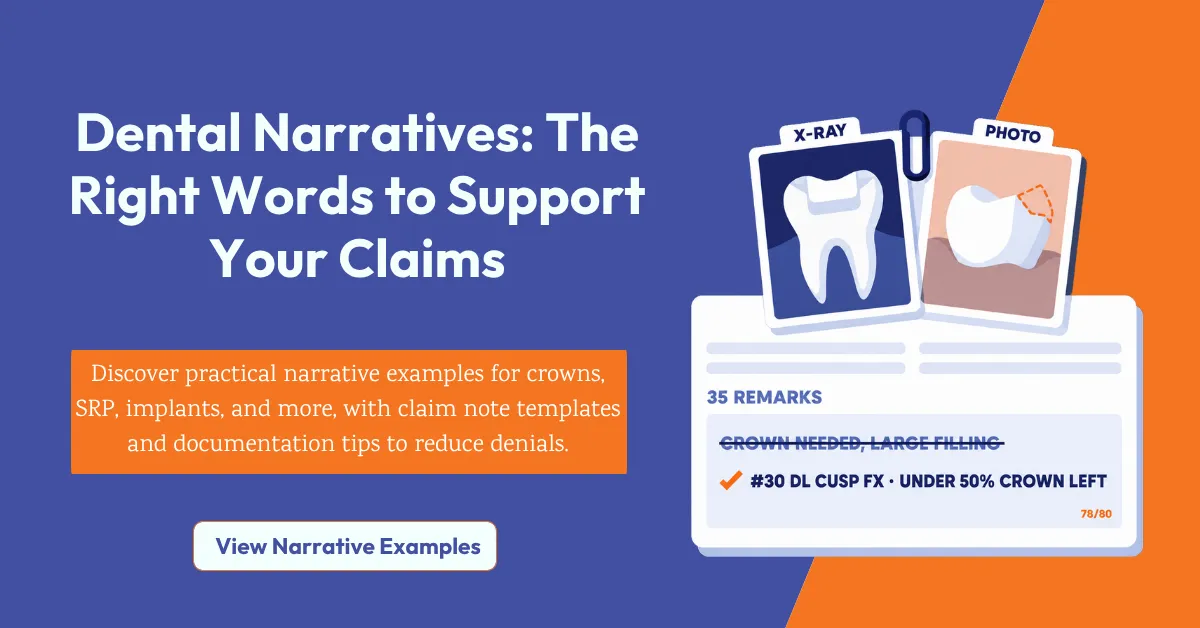
A dental narrative is a short, patient-specific explanation sent with a dental claim, pre-authorization, or appeal that shows the reviewer why the billed CDT (Current Dental Terminology) code was necessary. It goes in Box 35 (Remarks) on the ADA claim form, in the claim note on an electronic claim, or in an attached document.
Picture a typical crown claim for tooth #30 that comes back with a request for more information. The Remarks said "Crown needed, large filling." The x-ray showed the amalgam. Nothing on the claim mentioned the distolingual cusp that had fractured under it, and the reviewer can't approve what nobody told them about.
Below you'll find examples of dental narratives for insurance by procedure, the payer rules behind each one, and where each version goes on the claim. Our team at iDental Billing builds and checks these narratives every day, so each example reflects questions payers send back on real claims.
Quick answer
- Narratives go in Box 35, the electronic claim note, or an attachment.
- Codes marked "by report" need one, and crowns, SRP, oral surgery, grafts, and sedation often need documentation.
- Lead with the tooth and the measured finding.
- Say what the radiograph can't show.
- Write each one from the chart, since reused text draws review.
What Is a Dental Narrative?
A dental narrative, also called a dental insurance narrative, is the written reason a procedure was necessary for one patient on one date. It points the reviewer to the part of the chart that justifies the code. The chart still holds the full record; the narrative tells the reviewer where to look and why it matters.
How a Narrative Works During Claim Review
Someone reads your narrative. The ADA's claim form instructions note that an entry in Remarks may prompt review by a person, which can add processing time. At most dental plans, that person is typically a dental consultant, usually a dentist who reviews claims for the payer.
The consultant never meets your patient. They see the claim lines, the images, the perio charting, and your narrative, and that's all. Think of an insurance adjuster studying photos of a dented car with no note about the impact. The photos prove damage exists, but they can't explain how it happened.
Your narrative pushes the claim toward one of four outcomes:
- Paid as billed
- Paid at a lesser code's allowance under an alternate benefit provision
- A request for more information
- A denial
A clear narrative moves more claims into the first group. It can't rescue a claim the chart doesn't support, and no narrative guarantees payment.
Dental Narratives vs Clinical Notes vs Attachments
Offices mix these three up, and payers treat each one differently. Your dental clinical notes record the visit, the narrative explains the code to the payer, and attachments supply the proof. Problems with dental narratives often start when someone writes them from memory instead of from the note.
| Clinical notes | Narrative | Attachments | |
|---|---|---|---|
| Purpose | Legal record of the visit | Payer-facing reason the code was necessary | Proof: images, perio charts, photos |
| Written | Day of service | When the claim or appeal is built | Captured during care |
| Length | As long as care requires | A few sentences (see the length table below) | Images and charts |
| Where it lives | Patient record | Box 35, claim note, or attached letter | Clearinghouse attachment, payer portal, or mail |
You'll see advice online that a narrative must be written at the time of service to hold up as a legal record. That rule belongs to the clinical note, which is the legal record. A dental narrative gets written when the claim or appeal is built, so it has to match the note on every fact.
Some payer forms call this document a clinical narrative. The purpose and the rules stay the same: it summarizes the record for the reviewer, and the record has to back up every word of it.
When Are Dental Narratives Required on a Claim?
A dental narrative belongs on the claim when one of four things is true:
- The CDT code says "by report" in its name.
- The payer lists the code as needing documentation.
- The claim falls outside normal plan rules, such as a replacement or a frequency exception.
- The submission is a pre-authorization, resubmission, or appeal.
Codes With "By Report" in the Name
Any CDT code with "by report" in its nomenclature needs a narrative, and so do the unspecified codes ending in 999, such as D2999. The ADA's December 2025 coding guidance tells offices to report the unspecified by-report code with a clear narrative when no other code describes the procedure.
Aetna spells out what that narrative has to contain. Its guidelines list four elements: the clinical condition the procedure addressed, the rationale showing need, pertinent history, and the treatment plan. Our CDT codes guide explains how by-report codes fit into the code set.
What Delta Dental and Aetna Ask For, by Procedure
Both payers publish documentation lists, and the lists don't match. Delta Dental's documentation notice, dated October 7, 2025, applies to Delta Dental of California and its affiliates. Aetna's claim documentation guidelines carry a version date of September 22, 2026.
| Procedure | Delta Dental of California and affiliates (October 7, 2025) | Aetna (version dated September 22, 2026) |
|---|---|---|
| Crowns, inlays, onlays | Pre-op periapical radiograph (PA) taken within one year of prep, showing the entire tooth including the root tip; panoramic can't substitute; photos if available | Current dated pre-op radiographs; prior placement date and replacement rationale when replacing |
| Core buildup (D2950) | Not listed in the notice | Pre-op and post-op photos or radiographs showing the buildup in place |
| SRP (D4341, D4342) | Bitewings within 12 months showing bone levels in both arches, or PAs; crestal bone loss beyond 1 to 1.5 mm from the cementoenamel junction (CEJ) visible; perio charting within 12 months; chart notes with periodontal stage and grade | Six-point perio charting; full mouth radiographs showing bone loss; chart notes with local anesthetic and treatment details; appointment length; D4341 needs four or more teeth with periodontitis in the quadrant |
| Surgical extractions, impactions (D7210 to D7241) | PA or panoramic showing current position and surrounding bone; tooth-specific chart notes; photos if available | Full mouth radiographs and/or panoramic; D7241 needs a narrative explaining the unusual surgical complications |
| Bone grafts (D7950 to D7953) | Not listed in the notice | Radiographs; narrative describing the planned prosthetic reconstruction; numbers of all missing teeth |
| Sedation and general anesthesia | Not listed in the notice | Radiographs; narrative documenting the medically compromising condition; anesthesia records |
Delta Dental's notice states that claims lacking the required documentation will be denied. For crowns and SRP, both payers lead with images and charting. Dental narratives for insurance review fill the gap where an image can't prove the need, and Aetna requires one outright for D7241, bone grafts, and sedation.
A claim that's complete for Aetna can still be short an attachment for Delta Dental. That's why our dental billing services team builds each claim to that payer's list instead of one checklist for everyone.
Situations That Need a Narrative Even When the Code Doesn't
Some claims need a written reason even though the code itself doesn't call for one:
- Replacing a crown or prosthesis: give the prior placement date and the clinical reason.
- Billing more SRP quadrants on one date than the plan expects, since Aetna notes SRP usually runs one or two quadrants per appointment.
- A finding the radiograph can't show, such as a cusp fractured under an amalgam or a crack.
- Treatment outside a frequency limit.
- Pre-authorization or predetermination requests.
- Resubmissions and appeals.
Most dental claim narratives we rewrite come from this list. The code looked routine, so nobody flagged the exception until the payer did. Frequency limits and pre-authorization rules sit in each patient's plan, and our dental insurance verification process pulls them before the appointment, so you know ahead of time which claims need a narrative.
Medicare-covered dental claims run on different rules, including a CMS instruction not to send attachments at all. The medical necessity section further down covers them.
Where a Dental Narrative Goes: Box 35, Claim Notes, and Attachments
A dental narrative goes in one of three places: Box 35 Remarks on a paper ADA claim, the claim note on an electronic 837D claim, or a separate attachment linked to the claim. Short reasons fit inside the claim itself. Reasons that need an image to make sense belong in an attachment.
Box 35 Remarks on the 2024 ADA Dental Claim Form
Per the ADA claim form instructions, Remarks can carry information for a procedure code that requires a report, or anything else the payer needs to process the claim, such as what the primary carrier paid on a secondary claim. The ADA asks for remarks that are "concise and pertinent."
Pay attention to the ADA's other warning: an entry in Remarks may prompt review by a person, which can lengthen processing. Don't type anything into Remarks that already has its own field. The 2024 form gives several facts dedicated boxes:
| Item | What it carries | Why it matters |
|---|---|---|
| 29a | Diagnosis pointer linking each procedure line to a code in 34a | Ties the procedure to its diagnosis |
| 33 | Missing teeth | Context for perio, prosthodontic, and implant claims |
| 34 | Diagnosis code qualifier (AB = ICD-10-CM) | Identifies the code set |
| 34a | Up to four diagnosis codes | Carries the diagnosis so Remarks doesn't have to |
| 39 | Enclosures, Y or N | Tells the payer images or other files are coming |
| 39a | Date of the last SRP (new on the 2024 form) | Supports periodontal maintenance claims |
| 43 | Replacement of prosthesis, yes or no | Flags a replacement crown, bridge, or denture |
| 44 | Date of prior placement | Lets the reviewer check the replacement limit |
Fill the structured field first. Then use Remarks for the reason alone, such as "open distal margin, recurrent decay" on a replacement crown, and let the boxes carry the dates and codes.
Claim Notes on Electronic 837D Claims
On an electronic 837D claim, free text rides in a claim note, the X12 NTE segment. Each note holds 80 characters, spaces included. The number of notes a payer reads varies, so check the payer's companion guide or ask your clearinghouse before you count on a second line.
In most offices, the narrative or remarks field in the practice management software (PMS) feeds this note. Write the 80-character version first. Lead with the tooth and the finding, then name the attachment, so a reviewer who reads only that line still knows what you're claiming and where the proof sits.
Writing narratives for dental claims in two lengths, a claim note and a full version, heads off most channel problems. Every claim note in the dental narratives library below was counted to stay at or under 80 characters, spaces included, so you can paste one in and edit the findings.
Attachments, Attachment Numbers, and Payer Portals
Longer narratives, images, and perio charts travel separately, through a clearinghouse attachment service such as DentalXChange or through a payer's own provider portal. MetLife, Aetna, Guardian, and UnitedHealthcare each run provider portals, and upload rules differ by portal, so confirm the method before you send anything.
An attachment control number ties the files to the claim. On the electronic claim, that number sits in the PWK06 element. Minnesota's attachment cover sheet requires the number to be unique and to match the claim. A mismatch leaves the payer holding images it can't connect to anything.
Label images the way Aetna asks: duplicates, dated, marked right and left, unannotated, and less than 36 months old. Medicare breaks the pattern. CMS tells offices not to send x-rays or periodontal charting with Medicare dental claims, so you keep the records ready and send them only if the Medicare administrative contractor (MAC) asks.
The 2026 HIPAA Attachments Rule and What Changes by 2028
The 2026 HIPAA claims attachments rule, CMS-0053-F, adopts federal standards for sending and requesting health care claim attachments electronically. CMS published it in the Federal Register on March 24, 2026. It took effect May 26, 2026, and covered entities have until May 26, 2028 to comply.
According to the CMS fact sheet on the final rule, the rule adopts the X12N 275 (006020X314) for sending attachments, the X12N 277 (006020X313) for requesting them, HL7 standards for the attachment content, and electronic signature standards. CMS projects $781.98 million in savings a year.
The fact sheet doesn't single out dental, and it doesn't carve dental out either. Nothing about your claims changes today. Two steps make sense now:
- Ask your clearinghouse when it plans to support the X12 275.
- Keep images labeled and charting dated, so your files are ready when payers switch over.
Our 2026 dental billing guide puts the rule next to the other changes affecting dental claims this year, along with how to read the denial codes on your remittances.
If attachments are where your claims stall, our claim submission team sends the narrative, images, and charting with the first submission, matched to each payer's list, so the reviewer has the full picture on the first pass.
How Do You Write a Dental Claim Narrative?
Learning how to write a narrative for dental insurance comes down to five parts, built from the chart in this order: the tooth and diagnosis, the measured finding, the evidence and what it can't show, why this code fits instead of a cheaper one, and what's attached. Leave out anything the chart doesn't support.
The Five Parts of a Narrative That Gets Paid
- Tooth and diagnosis. Give the tooth number and surfaces or the quadrant, plus the ICD-10 code when the payer wants one.
- The measured finding. Use numbers: probing depths in millimeters, percent of structure lost, mobility class.
- The evidence and its blind spot. Name the image and its date, then state what the image can't show.
- Code rationale. Explain why the less costly alternative won't work, since that's the alternate benefit question reviewers ask.
- Attachments. List each file so the reviewer knows what to open.
If your office writes notes in SOAP format, the mapping is simple. Subjective complaints add context but seldom carry a claim on their own. Objective findings, the assessment, and the plan do the real work, and they map to parts two through four.
The AAE's narrative guide, published by the American Association of Endodontists on August 27, 2026, makes the same points. Check coverage first, customize each narrative, keep it succinct, and cover who, what, where, and why.
Compare two versions for a crown on #30:
- Weak: "Crown needed due to large filling."
- Strong: "#30 MOD amalgam, DL cusp fractured at gumline, under half of coronal structure left; pre-op PA [date] attached."
The weak version describes the x-ray. In the strong version, the reviewer learns what the x-ray can't show: the distolingual (DL) cusp is gone, and less than half the crown remains. If the image already shows something, spend your words elsewhere.
How Long Should a Dental Narrative Be?
Online advice on length runs from one sentence to 500 words, because writers mix up the channels. Length depends on where the narrative goes:
| Where it goes | Practical length | What sets the limit |
|---|---|---|
| Electronic claim note | 80 characters per note | X12 claim note field; payer companion guide |
| Box 35 Remarks | One to three sentences | ADA: "concise and pertinent" |
| Attached narrative | Three to six sentences, plus image references | Practice standard; AAE: succinct |
| Appeal letter | One page | Practice standard |
The last two rows reflect practice standards, not payer rules. If dental narratives for insurance run long, they're usually describing what the x-ray already shows. A long narrative slows the reviewer down without adding proof, so cut anything the attachments already cover.
Words That Get Narratives Denied
Certain phrases tell a reviewer the procedure was elective, routine, or excluded. Aetna's September 22, 2026 guidelines name several of these exclusions outright. Each row below pairs a risky phrase with what to write instead:
| Phrase | Why it hurts | Write this instead |
|---|---|---|
| "Patient requested" or "patient wants" | Shows preference, not necessity | The clinical finding behind the treatment |
| "Cosmetic" or "esthetic improvement" | Aetna doesn't cover crowns placed strictly for cosmetic reasons | The function and structure lost |
| Attrition, abrasion, erosion, or abfraction as the reason | Aetna generally doesn't cover crowns for wear under most plans | Decay or fracture, when the chart documents it |
| "Sensitivity" as the only reason for a crown | Aetna's crown criteria are structural: 50% loss, a failing restoration of half the tooth, or root canal treatment | The structural finding |
| "Old restoration" or age alone | Age isn't one of Aetna's criteria; it asks for the replacement rationale | Recurrent decay or fracture, plus the prior placement date |
| "Difficult" or "took longer" | Codes follow the procedure performed, not the effort | The technique performed |
The age row trips up plenty of offices. A sealed 12-year-old crown won't meet Aetna's criteria on age alone. Put an open margin and recurrent decay on that same crown, document both, and you have a replacement rationale the reviewer can check against the image.
Dental Narrative Templates vs Stock Narratives
A dental narrative template is a checklist of what to pull from the chart: tooth, finding, evidence, code rationale, and attachments. Stock narratives are finished text pasted onto claim after claim. Templates save time. Stock text puts the claim at risk, since identical wording across patients can draw review or an audit.
Plenty of sites offer free dental narratives, and a search for "dental narrative templates free" turns up dozens of downloads. Use them for structure only. A dental insurance narrative template that hands you "favorable prognosis, patient has no further symptoms" gives you a sentence that won't fit most of your patients.
The AAE advises against templated narratives for the same reason. Accuracy is the bigger issue. A narrative that states something the chart doesn't support is a false statement on a claim, and the payer can request the records to check it. Fill each line from the record or leave it out.
Who Writes the Narrative and Who Signs Off
The treating dentist or hygienist records findings in the clinical note on the day of service. Billing staff can draft the narrative from that note, and the treating dentist reviews it before the claim goes out. ADA Item 53 is the treating dentist's signature certifying the procedures, so the dentist owns every word.
A typical mismatch looks like this. The hygienist charts 6 mm pockets on #3. Working from memory, the biller writes "5 to 7 mm generalized." The reviewer requests the chart, finds one 6 mm site, and denies the quadrant. Copy the numbers straight from the chart.
If claims keep coming back with requests for documentation you already sent, our AR follow-up team works those requests and appeals each week, so they don't sit in aging while the payer waits on you.
Dental Narrative Examples by Procedure
The 13 examples of dental narratives for insurance below cover the procedures that draw the most documentation requests in our work. Each one follows the same five parts: when payers ask, a claim note of 80 characters or fewer, a full narrative for Box 35 or an attachment, what to attach, and the trap that gets it denied.
Tooth numbers, dates, and measurements in these dental narrative samples are illustrative. Fill every bracket from the chart, and delete anything the chart doesn't show. Claim notes use standard abbreviations (fx for fracture, BOP for bleeding on probing, FMX for full mouth x-rays) to fit 80 characters, and the AAE warns against unfamiliar ones.
A free worksheet turns these dental narrative examples into a fill-in dental narrative template, with an 80-character claim-note box and an attachment checklist for each procedure. It's a two-page PDF with no form to fill out first.
Crown Narrative for a Broken or Decayed Tooth (D2740, D2750)
When payers ask: Delta Dental's October 7, 2025 notice wants a pre-op PA taken within one year of the prep that shows the entire tooth, root tip included; a panoramic can't substitute. Aetna's September 22, 2026 guidelines cover full crowns when at least one of these applies:
- At least 50% of tooth structure lost to decay or fracture
- An existing restoration of at least half the tooth needing replacement for recurrent decay or fracture
- Root canal treatment
A narrative for crown claims has one job: prove the structural criterion the radiograph can't show. In our experience, crown dental narratives fall short when they describe the old filling instead of the missing tooth structure.
Claim note (80 characters):
#30 MOD amalgam, recurrent decay, DL cusp fx; under 50% crown left. PA attached.
Full narrative:
"Tooth #30: existing MOD amalgam with recurrent decay at the distal margin and a distolingual cusp fractured to the gumline. After removal of the restoration and decay, less than half of the coronal tooth structure remains. The pre-op periapical radiograph dated [date] shows the full root and no periapical pathology; the fractured cusp shows in the attached photo, not on the radiograph. A direct restoration can't replace the missing cusp, so a full-coverage crown is indicated."
Attach: Pre-op PA showing the root tip, plus an intraoral photo of the fractured cusp. For a cracked tooth, say how you confirmed the crack (bite test, visible fracture line, or photo), and add ICD-10 K03.81 (cracked tooth) when the payer wants a diagnosis code.
Trap: "Sensitivity" alone isn't one of Aetna's crown criteria, and craze lines with no structural crack seldom qualify. Use this dental crown narrative example as the pattern for any posterior tooth with a lost cusp.
Replacement Crown Narrative (Items 43 and 44)
When payers ask: Aetna wants the prior placement date and a replacement rationale. On the 2024 ADA form, mark Item 43 "yes" and enter the prior placement date in Item 44. Many plans also set a replacement limit, often five years, so check the plan's limit before the prep.
A dental narrative for crown replacement answers one question for the reviewer: what failed? Look up "replacement crown narrative dental" samples online and many of them justify the new crown by the old one's age, which doesn't meet Aetna's criteria.
Claim note (80 characters):
#14 crown placed 03/2014; open D margin, recurrent decay. PA and photo attached.
Full narrative:
"Tooth #14: replacement of a porcelain-fused-to-metal crown placed in March 2014 (Item 44). The distal margin is open, with recurrent decay extending under the crown, confirmed on the periapical radiograph dated [date]. The crown can't be repaired because the decay undermines its margin. Periodontal and periapical status are sound on the radiograph. A replacement crown is needed to remove the decay and restore a sealed margin."
Attach: A current PA, plus a photo of the open margin.
Trap: "Crown is 12 years old" won't carry the claim. Name the open margin, the recurrent decay, or the fracture, and let the prior placement date sit in Item 44.
Anterior Crown Narrative
When payers ask: Aetna's 50% criterion covers structure lost to decay or fracture "affecting incisal angles." Aetna also excludes crowns placed for cosmetic reasons and points crowns for traumatic injury, such as a car accident or a sports injury, to medical or other coverage.
A dental narrative for anterior crowns has to show function, because a front tooth invites the cosmetic question before the reviewer reads a word. Lead with the fracture and the lost structure.
Claim note (80 characters):
#8 M incisal angle fx, over 50% of crown lost, failing comp. PA, photo attached.
Full narrative:
"Tooth #8: fractured mesial incisal angle with a failing four-surface (MIFL) composite. Over half of the clinical crown is lost or restored, and the remaining facial enamel is unsupported. The photo dated [date] shows the fracture line; the periapical radiograph shows no periapical pathology. Another direct restoration can't support the incisal angle, so a full-coverage crown is indicated to restore function."
Attach: A photo, which you need to show the fracture, plus a PA.
Trap: Keep "esthetics" and "shade match" out of the narrative. If a recent accident caused the fracture, check medical or accident coverage first.
Core Buildup Narrative (D2950)
When payers ask: Aetna wants pre-op and post-op photos or radiographs showing the buildup in place. The ADA crowns and buildups guide (2021) states that a core buildup and a crown are distinct and separate procedures, and that not every crown needs a buildup.
A dental narrative for core build up has to name the missing walls. If you send a dental narrative for crown and build up on the same tooth, give each code its own reason, since the reviewer judges each code on its own.
Claim note (76 characters):
#19 buildup needed to retain crown: 3 of 4 walls lost. Pre/post PA attached.
Full narrative:
"Tooth #19: after removal of the failing MO amalgam and recurrent decay, the mesial, distal, and lingual walls were missing, and the remaining structure couldn't retain a crown. A composite core buildup was placed to create retention and resistance form for the crown, not as a base or to fill an undercut. Pre-op and post-op radiographs dated [date] show the defect and the completed core."
Attach: Pre-op and post-op radiographs or photos.
Trap: "Buildup under crown" with no missing structure stated reads as a base or filler, and payers bundle it into the crown. That bundling shows up as CARC 97, covered in the denial table further down.
Crown and buildup claims move faster when coverage, frequency, and replacement history are confirmed before the prep. Those checks are part of our pre-treatment benefit checks, so the narrative you write lines up with what the plan will consider.
SRP Narrative for Scaling and Root Planing (D4341, D4342)
When payers ask: The ADA Council on Dental Benefit Programs lists SRP among the procedures payers deny most often, according to ADA SRP claims guidance from February 2023. Delta Dental and Aetna both want charting and radiographs that show bone loss; the payer table near the top has the full lists.
A narrative for SRP depends on numbers that match the chart. Of the dental narratives we check before submission, perio claims are the ones where a single mismatched pocket depth costs the quadrant. An SRP narrative for insurance review should also state stage and grade, since Delta Dental asks for both in the chart notes.
Claim note (79 characters):
UR D4341: PD 5 to 7 mm #2 to #5, BOP, bone loss on BWX. Chart and FMX attached.
Full narrative:
"UR quadrant (D4341): probing depths of 5 to 7 mm with bleeding on probing at #2, #3, #4, and #5, and clinical attachment loss of [3 to 4] mm. Radiographs dated [date] show horizontal crestal bone loss and subgingival calculus on #3 and #4. Diagnosis: generalized moderate periodontitis, Stage [II], Grade [B] (ICD-10 K05.322 when required). SRP performed under local anesthesia in a [60]-minute appointment. Full-mouth six-point charting and radiographs attached."
Attach: Six-point charting (Aetna; Delta Dental wants it within 12 months), plus radiographs showing crestal bone loss. Repeat this scaling and root planing narrative for each quadrant, with that quadrant's teeth and depths.
Trap: Aetna requires four or more teeth with periodontitis in the quadrant for D4341. One to three teeth is D4342, and the narrative's numbers have to match the chart to the millimeter.
Perio Maintenance Narrative With SRP History (D4910)
When payers ask: ADA 2024 Item 39a now carries the date of the last SRP. Aetna notes that D4910 visits include site-specific scaling and root planing. Many plans also want proof of prior active therapy before they pay D4910.
Offices used to type the SRP history into Remarks. With Item 39a on the form, a periodontal maintenance narrative can skip the history and focus on today's findings. If a payer still asks for a dental narrative for a history on SRP, give the date and the quadrants treated.
Claim note (66 characters):
D4910: SRP all 4 quads completed 04/12/2026. Perio chart attached.
Full narrative:
"Periodontal maintenance (D4910) after active therapy: SRP completed in all four quadrants on 04/12/2026 (Item 39a). Current charting shows residual 4 to 5 mm pockets with bleeding at #14, #15, and #30; site-specific root planing performed at those sites. Patient is on a [three]-month interval. Charting dated [date] attached."
Attach: Current periodontal charting.
Trap: A blank SRP date, or switching between D4910 and D1110 (adult prophylaxis) with no explanation.
D4346 Narrative for Gingival Inflammation
When payers ask: Per the ADA D4346 guidance, D4346 is scaling in the presence of generalized moderate or severe gingival inflammation, with or without pseudo-pockets, and no bone loss. The CDT descriptor says it isn't reported with prophylaxis, SRP, or debridement.
A D4346 dental narrative has to prove a negative: inflammation across the mouth, no bone loss anywhere. Write the dental narrative for D4346 so it states the absence of bone loss outright, because that line separates this code from SRP.
Claim note (80 characters):
Generalized severe gingival inflammation, heavy BOP, no bone loss. FMX attached.
Full narrative:
"Full mouth (D4346), after comprehensive oral evaluation: generalized severe gingival inflammation with bleeding on probing at [70]% of sites and 4 to 5 mm pseudo-pockets from gingival enlargement. Radiographs dated [date] show no crestal bone loss, and charting shows no clinical attachment loss. Supragingival and subgingival calculus removed full mouth."
Attach: Radiographs, plus periodontal charting.
Trap: Describing bone loss. Once the chart shows bone loss, the claim belongs under SRP.
Occlusal Guard and Night Guard Narrative (D9944, D9945, D9946)
When payers ask: Coverage varies by plan, so check benefits before you take impressions. The codes are D9944 (hard appliance, full arch), D9945 (soft appliance, full arch), and D9946 (hard appliance, partial arch).
An occlusal guard narrative should read like a diagnosis of grinding, with the damage to back it up. The narrative for occlusal guard claims below pairs wear with muscle findings and symptoms, so the reviewer sees cause and effect.
Claim note (77 characters):
Bruxism: wear facets #6 to #11, masseter pain, AM headaches. Photos attached.
Full narrative:
"Hard full-arch maxillary occlusal guard (D9944) for sleep-related bruxism (ICD-10 G47.63 when required). Exam shows wear facets with exposed dentin on #6 to #11, fractured enamel on #3, and masseter tenderness on palpation. Patient reports morning jaw pain and headaches. The guard protects existing restorations and remaining tooth structure from continued grinding. Intraoral photos dated [date] attached."
Attach: Photos of the wear.
Trap: In a night guard narrative, wear is evidence of bruxism, so don't turn it into a crown argument. Leave out "for comfort," and remember that an athletic mouthguard is a different code (D9941).
Root Canal Narrative (D3310 to D3330; Retreatment D3346 to D3348)
When payers ask: Aetna wants current dated radiographs, including one showing the completed root canal. Aetna may not cover teeth with a poor or questionable prognosis, and it lists factors such as a poor crown-to-root ratio, advanced periodontal disease, and decay at or below the bone crest.
Endo reviewers look for two things: proof the pulp is irreversibly involved, and proof the tooth is worth saving. Weak root canal narratives tend to cover the first and skip the second.
Claim note (73 characters):
#19 irreversible pulpitis: cold lingers 45 sec, PDL widened. PA attached.
Full narrative:
"Tooth #19 (D3330): symptomatic irreversible pulpitis (ICD-10 K04.02). Patient reports spontaneous pain for three days; cold test produced lingering pain of 45 seconds, and percussion was positive. The pre-op periapical radiograph dated [date] shows deep distal caries approaching the pulp and a widened PDL space. The tooth is restorable with adequate periodontal support. Pre-op and post-op radiographs attached."
Attach: Pre-op and post-op radiographs. For retreatment, add the original treatment date, the restorative history, current pulp and periapical findings, and the reason the first treatment failed, the same structure the AAE uses in its retreatment example.
Trap: Leaving out restorability and prognosis.
Tooth Extraction Narratives (D7210, D7241)
When payers ask: Delta Dental wants a PA or panoramic image showing the tooth's current position and the surrounding bone, plus tooth-specific chart notes. Aetna requires a narrative explaining the unusual surgical complications on D7241.
A tooth extraction narrative for D7210 has to show surgery happened: a flap, bone removal, or sectioning. Our D7210 narrative guide covers that code in depth. For D7241, the narrative for wisdom teeth extraction has to name the complication, since "completely bony" alone describes D7240.
D7210 claim note (72 characters):
#30 sectioned, buccal bone removed to deliver roots. Pre-op PA attached.
D7241 claim note (76 characters):
#17 full bony, roots on IAN canal per CBCT, nerve dissection. Pano attached.
Full D7241 narrative:
"Tooth #17: completely bony impaction, with 50% or more of the anatomical crown covered by bone, and roots in contact with the inferior alveolar canal on the CBCT dated [date]. Removal required a flap, bone removal, sectioning, and dissection to free the roots from the canal, beyond a typical completely bony impaction. Panoramic radiograph and CBCT slices attached."
Attach: A panoramic radiograph and cone beam CT (CBCT) slices for D7241; a pre-op PA for D7210.
Trap: "Difficult" isn't a complication. Name the factor, such as nerve proximity, ankylosis, or a dilacerated root. For the rest of the code family, see our breakdown of dental extraction codes.
Implant Narrative With Ridge Preservation (D6010, D7953)
When payers ask: Aetna wants:
- Full mouth or panoramic radiographs
- Extraction dates of the teeth being replaced
- The prior prosthesis date
- All missing teeth
- The proposed implant site
For D7950 to D7953 grafts, Aetna also wants a narrative describing the planned prosthetic reconstruction, and some Aetna plans include a missing but unreplaced provision.
A dental implant narrative for insurance answers three questions: when the tooth was lost, why an implant over a bridge, and which teeth are already missing. The dental bone graft narrative belongs in the same text, tied to the planned implant.
Claim note (78 characters):
#19 ext 02/15/2026, VRF. D7953 graft for planned D6010 implant. Pano attached.
Full narrative:
"Site #19: tooth extracted 02/15/2026 for vertical root fracture; socket grafted (D7953) the same day to preserve ridge width for a planned single implant. Implant (D6010) placed [date] after [four] months of healing. Adjacent #18 and #20 are sound and unrestored, so a bridge would mean preparing two healthy teeth. No prior prosthesis at this site. Missing teeth: #1, #16, #17, #32. Panoramic and periapical radiographs attached."
Attach: Panoramic or full mouth radiographs, plus a PA.
Trap: If the tooth was missing before coverage began, the plan's missing tooth clause may apply. Keep the implant narrative's extraction date exact.
Bridge Narrative (D6750, D6240)
When payers ask: Aetna wants full mouth or panoramic radiographs, extraction dates, the prior prosthesis date and rationale, and all missing teeth. Aetna plans can also apply an alternate benefit or a missing and unreplaced provision.
Use this dental bridge narrative example when the abutments already carry large restorations. A bridge narrative for dental insurance reads differently when the abutments are healthy, as the trap below explains.
Claim note (74 characters):
#19 ext 01/2026; #18, #20 abutments sound; no prior bridge. Pano attached.
Full narrative:
"Three-unit bridge #18 to #20 (D6750, D6240, D6750) replacing #19, extracted 01/2026 for non-restorable decay. Abutments #18 and #20 both have large existing restorations and adequate bone support on radiographs dated [date]. No prior prosthesis at #19. Missing teeth: #1, #16, #32. The bridge restores occlusion and prevents drifting of #18 and #20 and supraeruption of #14."
Attach: Panoramic or full mouth radiographs, plus PAs of both abutments.
Trap: If the abutments are unrestored, the reviewer will ask why you prepared two sound teeth. Explain the choice over an implant or partial, using the clinical factors in the chart.
Crown Lengthening Narrative (D4249)
When payers ask: Aetna wants current pre-op radiographs, and its D4249 criteria are:
- A full-thickness flap with bone removal that alters the crown-to-root ratio
- No soft-tissue-only lengthening
- A healthy periodontal environment
- Four to six weeks before final preparation or impressions
A dental narrative for crown lengthening has to show that bone came off. Without that detail, the reviewer reads the procedure as gum tissue only.
Claim note (77 characters):
#30 decay 2 mm subgingival; flap, bone removed for crown margin. PA attached.
Full narrative:
"Tooth #30 (D4249): distal caries extends 2 mm below the gingival margin, close to the alveolar crest on the radiograph dated [date]. A full-thickness flap was reflected and crestal bone removed to expose sound tooth structure for a crown margin without violating biologic width. Periodontium is otherwise healthy. Final crown preparation is scheduled [six] weeks after surgery."
Attach: The current pre-op radiograph.
Trap: A gingivectomy-only crown lengthening isn't D4249.
Medical Necessity Narratives for Medical and Medicare Claims
Medical plans and Medicare judge necessity against a medical diagnosis instead of dental plan rules. If you send dental narratives for insurance review by a medical payer, the narrative has to tie the dental procedure to that medical condition, with the ICD-10 codes on the claim carrying the diagnosis.
Medicare-Covered Dental Services
Medicare dental claims have needed an ICD-10 diagnosis code since July 1, 2025, and the KX modifier, allowed since January 1, 2025, became required on July 1, 2025. The CMS Medicare dental coverage page, modified March 10, 2026, lays out both rules.
Medicare still doesn't cover routine dental care. It covers dental services inextricably linked to covered medical treatment, and the KX modifier tells the contractor that link exists. Claims go on the 837D or the 2024 ADA claim form, the same formats you already use for commercial dental plans.
Attachments are where Medicare parts ways with dental payers. CMS's instruction reads: "Don't send attachments, like x-rays or periodontal charting, with your claim." Keep the records and the narrative in the chart, ready to send if the contractor asks for them.
A typical case: extracting an abscessed tooth (ICD-10 K04.7) before a cardiac valve replacement. The chart, and any dental narrative you keep on file, has to document coordination with the cardiac team, including who referred the patient, when surgery is scheduled, and why the infection has to clear first.
Commercial Medical Claims for Sleep Apnea, TMD, and Trauma
On a commercial medical plan, the narrative becomes a letter of medical necessity, billed on the CMS-1500 instead of a dental form. Offices call this dental-to-medical cross-coding. For a custom oral appliance for sleep apnea, often reported with HCPCS E0486, the letter covers:
- The diagnosis, such as G47.33 obstructive sleep apnea
- The sleep study or physician referral behind it
- The functional impact on the patient
- The reason an oral appliance fits this patient's treatment
Temporomandibular disorder (TMD) and trauma claims follow the same pattern with different codes. Coverage varies by medical plan, and no plan pays every appliance claim, so verify medical benefits before delivery. Our post on orofacial pain billing changes covers when a service belongs on a dental claim or a medical one.
Fixing a Claim Denied for a Missing or Weak Narrative
Start with the claim adjustment reason code (CARC) and the remark code on the explanation of benefits (EOB) or electronic remittance advice (ERA). Together they tell you whether to send missing documentation, correct the claim, or appeal. Resending the same narrative without reading those codes tends to earn the same denial.
What the Denial Code Is Telling You
Five codes from the X12 reason code list show up on narrative problems again and again. Each row gives the X12 meaning and the next step:
| CARC | X12 description | What to do |
|---|---|---|
| 16 | Claim or service lacks information or has submission or billing errors | Read the remark code; correct and resubmit |
| 252 | An attachment or other documentation is required to adjudicate the claim | Send the narrative and images the remark code names |
| 150 | Information submitted doesn't support this level of service | Appeal with stronger findings and images |
| 97 | Benefit included in the payment for another service | For a bundled buildup, appeal citing the ADA's position that buildups and crowns are separate procedures |
| 169 | Alternate benefit has been provided | Check the plan clause; appeal only if documentation supports the billed code |
X12's usage notes say CARC 16 isn't meant for attachment requests and requires at least one remark code. A CARC 150 on dental narratives usually means the narrative described the procedure instead of the finding that justified it. Track which dental claim narratives draw each code, and patterns by procedure and payer show up fast.
Writing the Narrative for a Resubmission or Appeal
A dental narrative letter to insurance for resubmission should include:
- The claim number and patient identifiers
- A copy of the EOB
- The denial reason, answered directly
- The detail the reviewer couldn't see the first time, with the image or chart that shows it
Send the full packet again, original narrative and images included, plus the new piece. The New Jersey Dental Association warns that a resubmission can go to a completely different reviewer, who starts from scratch. Keep a copy of each narrative you send with the claim record, because a second-level appeal will ask what you said the first time.
Keep the letter to one page, factual, and free of frustration. Take the appeal deadline from the payer's provider manual or the EOB, since windows vary by payer and plan. ADA members can also route payer problems to the ADA Third Party Payer Concierge.
If denials pile up faster than your team can answer them, we can help. Our team will appeal denied dental claims with the documentation each payer asked for and follow every one through to a decision.
Can You Use AI to Draft Dental Narratives?
Yes, AI tools can draft dental narratives from charted facts, with two conditions. The treating dentist reviews every draft, and no patient information goes into a tool unless the vendor has signed a business associate agreement. AI tools predict likely wording, so they can add findings the chart doesn't contain.
A safe workflow runs in five steps:
- Chart the findings during the visit.
- Pull the structured facts: tooth, measurements, and image dates.
- Have the tool draft from those facts only.
- Let the dentist edit and approve the draft.
- Submit with the attachments.
Watch two failure points. A tool that fills a gap with a plausible pocket depth or date has put a false statement on your claim. Identical AI phrasing across hundreds of claims also reads like a stock narrative to a reviewer, with the same review risk covered in the templates section.
Never let a tool add a measurement, date, or diagnosis to a dental narrative that the clinical note doesn't contain. On the privacy side, HHS business associate guidance explains that a vendor handling protected health information for you is a business associate, and you need a signed agreement before sharing that data.
Dental Narrative FAQs
Where can I find free dental narratives?
The best free sources are the payers themselves. Aetna's claim documentation guidelines and Delta Dental's documentation notice list what each procedure needs, and the ADA's claim guides cover crowns, buildups, and SRP. The AAE's narrative guide does the same for endodontic claims. All 13 examples on this page are built from those sources. Use any of them as structure, and favor dental insurance narratives that name a payer criterion over generic lines like "favorable prognosis."
Can I reuse the same narrative for different patients?
Not as finished text. The structure can repeat from claim to claim, but the findings, measurements, and image dates have to come from each patient's chart. Reviewers compare dental narratives against the records they request, and identical wording across patients can draw review or an audit. Give your team a checklist to fill in for each claim, plus a short list of payer criteria to cite. The hygienist supplies the depths, the biller adds codes and dates, and the dentist signs off.
Is there a PDF of dental narrative examples?
Yes. We built a free two-page worksheet for teams that want examples of dental narratives for insurance as a PDF they can print. Page one is the five-part fill-in with an 80-character claim-note box. The second page is an attachment checklist by procedure, built from the payer table and examples above. It's ungated, so there's no form or email step.
What should an IV sedation narrative include?
A dental insurance narrative for IV sedation should document why sedation is necessary: the medically compromising condition, or the qualifying procedure. Aetna asks for current dated radiographs, that narrative, and anesthesia records. Its qualifying criteria include removal of one or more impacted teeth on the same day, extraction of five or more teeth, placement of two or more endosteal implants on the same date, and patients for whom treatment under local anesthesia can't be expected to succeed.
What goes in a narrative for a replacement denture?
A dental narrative for dentures being replaced starts on the claim form. Mark ADA Item 43 "yes," enter the prior placement date in Item 44, and mark missing teeth in Item 33. The narrative then explains why the existing denture can't be relined or repaired, such as a fractured base or ridge changes a reline won't correct. Check the plan's replacement limit first, since many plans set one, and pull the actual delivery date for Item 44 from the chart.
Does a narrative help on a predetermination?
Yes. Mark ADA Item 1 as a request for predetermination or preauthorization, and the payer reviews the narrative and images before treatment, the cheapest point to learn the plan's position. Treat the answer as an estimate, though. Aetna's guidelines state that coverage of a service doesn't guarantee payment, so eligibility, frequency limits, and plan maximums on the date of service still apply. You also get a written answer to share with the patient before they commit.
Before Your Next Dental Narrative Goes Out
Three habits prevent the problems we see most often:
- Chart the measured finding on the day of service.
- Fill the claim form's structured fields before you write Remarks.
- Attach the image that proves what the narrative says.
Build those habits into the workflow, and the dental narrative examples above give your team a starting structure for each procedure. Strong dental narratives come from the chart, so the work starts in the operatory long before anyone opens the claim.
If your team rewrites narratives after denials instead of before submission, we can take that work on. Our billing team handles narratives, attachments, and appeals as part of full-service dental billing, from 2.95% of monthly collections on the Scale tier, with no setup fees or long-term contracts. Compare the billing pricing tiers to see which fits your practice.
Sources
- ADA 2024 Dental Claim Form Completion Instructions
- ADA Claim Submissions: Crowns and Core Buildups
- ADA News: Scaling and Root Planing Claim Submissions (February 2023)
- ADA News: Tips to Avoid Claim Denials (December 2025)
- ADA: D4346 Scaling Procedure
- ADA Dental Insurance FAQ (Third Party Payer Concierge)
- Aetna Dental Claim Documentation Guidelines (September 22, 2026)
- Delta Dental: Documentation for Faster Claim Processing (October 7, 2025)
- AAE: Writing a Strong Dental Narrative (August 27, 2026)
- CMS: Medicare Dental Coverage
- CMS: Claims Attachments Final Rule Fact Sheet (CMS-0053-F)
- X12: Claim Adjustment Reason Codes
- HHS: Business Associates
- New Jersey Dental Association
- Minnesota Department of Health: Attachment Cover Sheet
CDT codes and nomenclature are © American Dental Association.
ABOUT THE AUTHOR
Russell Bennett
Russell Bennett is a Dental RCM and Provider Credentialing Specialist at iDental Billing. He reviews billing workflows, resolves claim denials, outstanding insurance balances, and reimbursement discrepancies, and applies CDT coding and payer-specific guidelines. His work includes provider credentialing, payer enrollment, and recredentialing. Russell writes iDental Billing’s educational guides on what claims need, why they matter, and where things go wrong.