











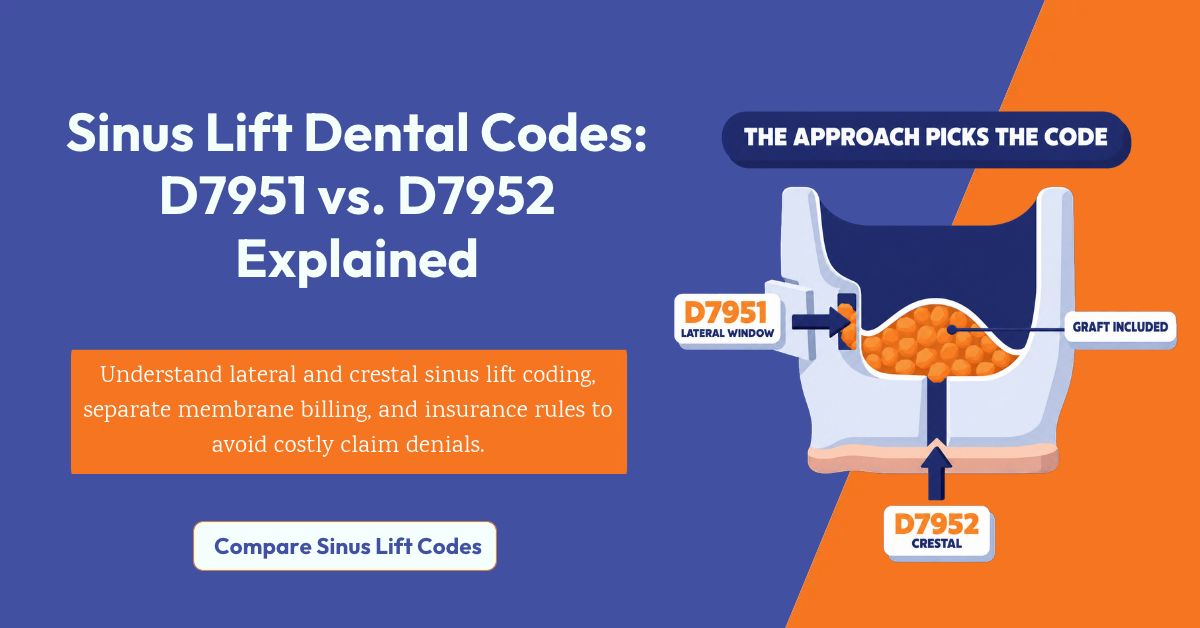
The dental code for a sinus lift is D7951 when the surgeon opens a window in the side of the upper jaw to reach the sinus. It's D7952 when the surgeon raises the sinus floor through the ridge crest. Both codes include the graft material, so bone doesn't get its own line.
You choose the dental code for sinus lift claims from the operative note. Code from the access route the surgeon documented, because graft volume and implant timing don't change the CDT code for sinus lift work. Membranes and implants go on separate lines. Some cases qualify for a medical claim too, though plenty don't.
We're the billing team at iDental Billing, and oral surgery and implant claims are part of our daily work. The errors that hold these claims up tend to repeat. We keep seeing the wrong approach code, a graft billed twice, a membrane on the wrong code, or a medical claim with no diagnosis behind it.
Key Takeaways
- D7951 reports the lateral open approach; D7952 reports the vertical approach through the ridge crest.
- Both codes include obtaining the bone or bone substitute; don't add D7953 or D4263 for the sinus graft.
- Barrier membranes go on their own line; D7956 and D7957 describe membranes in edentulous areas.
- AAOMS says D7951 may crosswalk to CPT 21210 in extensive cases; D7952 isn't an appropriate crosswalk.
- Medical claims need a diagnosis; K08.24 to K08.26 cover minimal, moderate, and severe maxillary atrophy.
The Dental Code for a Sinus Lift Depends on the Surgical Approach
CDT has two sinus augmentation codes, D7951 and D7952, both in the oral and maxillofacial surgery range (D7000 to D7999) of the CDT code categories. The ADA splits them by how the surgeon reaches the sinus floor. Any search for the ADA code for sinus lift work points to the same pair.
D7951: Sinus Augmentation With Bone or Bone Substitutes via a Lateral Open Approach
D7951 is the CDT code for a sinus lift done through a lateral open approach. The D7951 dental code description covers augmenting the sinus cavity to add alveolar height, so the surgeon can rebuild an edentulous part of the maxilla. Obtaining the bone or bone substitute is part of the code.
In plain terms, the surgeon cuts a window in the lateral wall of the maxilla, lifts the Schneiderian membrane, and packs graft beneath it. Some charts call it a direct sinus lift. The descriptor tells you to report any barrier membrane on a separate line.
The AAOMS bone graft coding paper, revised January 2026, confirms that D7951 includes obtaining the bone. A coder who asks for the lateral sinus lift ADA code, or the sinus augmentation dental code for a window approach, wants the D7951 dental code.
D7952: Sinus Augmentation via a Vertical Approach
D7952 is the CDT code for a sinus lift done through vertical access at the ridge crest. The D7952 dental code description covers raising the sinus floor from the crest and grafting "as necessary." Like D7951, it includes obtaining the bone or bone substitute.
Access comes up through or near the implant osteotomy, so surgeons often pair a crestal lift with implant placement at the same visit. Anyone asking for the vertical sinus lift ADA code or the D7952 dental code is asking about this entry.
What Surgeons Call Each Technique in the Chart
Surgeons describe the same procedure in different words, and an unfamiliar term can send a new biller hunting for a sinus lift dental code that doesn't exist. The word in the chart varies, but the dental code for a sinus lift comes down to the access route.
| Chart term | Code |
|---|---|
| Lateral window, direct, open, external | D7951 |
| Crestal, transcrestal, internal, indirect, osteotome (Summers technique), closed | D7952 |
A request for the internal sinus lift dental code, the indirect sinus lift code, or the crestal sinus lift dental code gets the same answer: D7952. Neither code changed for CDT 2027, which takes effect January 1, 2027, and our breakdown of CDT 2027 changes covers the codes that did.
How to Choose Between D7951 and D7952
Pick the dental code for a sinus lift from the access route in the operative note. A window cut in the lateral maxillary wall is D7951, and sinus floor elevation through the ridge crest is D7952. Graft volume, implant timing, and residual bone height don't change the sinus lift ADA code.
D7951 vs D7952 at a Glance
| Code | Approach | Typical clinical use | Graft material | Barrier membrane | CPT 21210 crosswalk (AAOMS) |
|---|---|---|---|---|---|
| D7951 | Lateral open approach through a window in the lateral maxillary wall | Larger vertical gain; implant often staged | Included | Own claim line, as the descriptor states | May apply when the procedure is extensive |
| D7952 | Vertical access through the ridge crest | Smaller lift; implant often placed at the same visit | Included | Own claim line when placed | Not an appropriate crosswalk |
Three Questions That Settle the Code
- Did the surgeon cut a window in the lateral wall of the maxilla? Code D7951.
- Did the surgeon raise the sinus floor through the crest or the implant osteotomy? That's the vertical sinus lift code, D7952.
- Did the graft go on the ridge, into a socket, or around an implant instead of under the sinus membrane? You need a different code, such as D7950 for ridge augmentation; the next section covers those codes.
Residual bone height on the CBCT explains why the surgeon picked one approach. Carriers often ask for that number in the narrative for a lateral sinus lift dental code, and it helps a crestal sinus lift ADA code claim too. Treat it as evidence for the sinus lift code you chose from the access route.
What D7951 and D7952 Include, and What You Bill Separately
D7951 and D7952 both include obtaining and placing the bone or bone substitute, so you don't bill the graft material on another line. Barrier membranes, biologics, blood concentrates, the implant body, and imaging are separate procedures, and each one goes on the claim with its own CDT code.
Built Into the Sinus Code
- Graft material, whether autograft, allograft, xenograft, or alloplast. D7953 describes extraction and implant removal sites, and D4263 describes natural teeth, so neither one describes the sinus graft.
- Autogenous bone harvest. AAOMS reserves D7295 for harvest that the graft code doesn't already include, and both sinus codes include obtaining the bone.
- Surgical access. Expect payers to treat flap access as part of the sinus surgery, so don't add a separate flap code.
Reported on Their Own Lines
Once you've chosen the dental code for sinus lift work, everything else the surgeon placed goes on its own line. AAOMS's bone graft paper lets you report biologics on their own line, even when the surgeon mixes them into the graft. The same paper says D7921 goes on top of the graft code.
| Item | CDT code | Note |
|---|---|---|
| Barrier membrane, resorbable, edentulous area | D7956 | Per site |
| Barrier membrane, non-resorbable, edentulous area | D7957 | Per site |
| Biologic materials mixed into the graft | D4265 | Per site; AAOMS allows it alongside graft codes |
| Collection and application of autologous blood concentrate (PRF or PRP) | D7921 | AAOMS says to report it in addition to the graft code |
| Implant body placed at the same visit | D6010 | Its own procedure, on the date of placement |
| Separate graft around the implant at placement | D6104 | Only on the day an implant goes in |
| Cone beam CT | D0364 to D0367 | Code by field of view; plan imaging rules vary |
D7956 and D7957, or D4266 and D4267?
AAOMS's 2026 list describes D4266 and D4267 as guided tissue regeneration for natural teeth, and D7956 and D7957 as the edentulous area version. A sinus lift site is edentulous maxilla, so D7956 or D7957 is the dental membrane code that matches the descriptor.
Some payers and older guides still ask for D4266 or D4267, so check the payer's published code list before you submit. New York Medicaid's 2026 dental manual went further and removed D4266 and D4267 from its program, replacing them with D7956 and D7957. The ADA hasn't deleted either code.
A membrane line that comes back bundled or paid at $0 tends to trace to a coding choice someone made before the claim went out. Our dental billing services team codes each oral surgery line against the clinical notes before submission, while a fix still costs nothing.
How to Code a Sinus Lift With an Implant, a Membrane, or Both Sides
Code each procedure on its own line. That means the sinus code for the lift, D6010 for the implant body, and a membrane code when the surgeon places a barrier. D6104 applies only to a separate graft around the implant. Timing changes the dates of service, but the codes stay the same.
Use these examples to see where the dental code for a sinus lift sits next to the other lines. Payer rules on units, dates, and membranes vary, so check the plan before you copy a pattern.
| Scenario | Claim lines | Watch for |
|---|---|---|
| Lateral window lift with graft and resorbable membrane; implants staged | Surgery date: D7951, D7956. Implant date: D6010 | No D6104 at the sinus visit, because no implant went in |
| Crestal lift with an implant placed at the same visit | D7952 and D6010 on the same date | Don't swap D7952 for D6104 |
| Crestal lift plus a separate graft around the implant | D7952, D6010, and D6104 | The narrative separates the sinus graft from the graft around the implant |
| Crestal lift, implant postponed for lack of primary stability | D7952 now; D6010 at the later visit | The narrative states why the surgeon deferred the implant |
| Lateral lift with PRF mixed into the graft | D7951 and D7921, plus a membrane code if placed | Check plan coverage for D7921 |
| Both sinuses grafted on the same day | One sinus code line per side | Confirm the payer's unit and area rules |
Implant Placed the Same Day: D7952 Stays on the Claim
The AAOMS implant coding paper describes D6104 as a bone graft at the time of implant placement. It says not to use D6104 on a day when no implant goes in. A biller who reaches for the bone graft at time of implant placement code on a crestal lift can drop D7952 by mistake.
Keep D7952 for the sinus floor graft, whichever day the implant goes in. Swapping it for D6104 undercodes the case and leaves the sinus surgery off the record.
Coding a Bilateral Sinus Lift
Each maxillary sinus is its own surgical site, so offices report a bilateral sinus lift as one line per side. The 2024 ADA Dental Claim Form uses area of the oral cavity code 10 for the upper right and 20 for the upper left. Unit and frequency rules differ by payer, so verify before you submit.
Bone Graft Codes That Get Confused With Sinus Lift Codes
Sinus lift codes cover grafting under the raised sinus membrane and nothing else. A graft on the ridge, in an extraction socket, around a new implant, or around a natural tooth takes a different code. Payer reviewers who read your narrative can catch the mismatch.
Billers mix these codes up with the dental code for sinus lift work because the descriptors share words like graft, ridge, and augmentation. Our guide to dental extraction codes covers D7953 and alveoloplasty in more depth.
| Code | What it reports | Why it isn't a sinus lift code |
|---|---|---|
| D7950 | Osseous, osteoperiosteal, or cartilage graft of the mandible or maxilla, by report; AAOMS says you report it per arch | Ridge augmentation; AAOMS says not to use it at the time of implant placement or on the day of an extraction or implant removal at the site |
| D7953 | Bone replacement graft for ridge preservation, per site | Extraction or implant removal site |
| D6104 | Bone graft at time of implant placement | Graft around the implant, billed on top of any sinus code |
| D4263 and D4264 | Bone replacement graft, retained natural tooth | Periodontal defect on a natural tooth |
| D7310 and D7311 | Alveoloplasty in conjunction with extractions | Ridge recontouring with no sinus graft |
| D7955 | Repair of a maxillofacial soft or hard tissue defect | AAOMS reserves it for reconstruction after trauma or for congenital defects |
D6104 is the bone graft with implant placement code. It can share a claim with D7952 when the surgeon grafts both the sinus floor and the bone around the implant. D7950 is a ridge augmentation code. It belongs on the claim only when the surgeon also builds up the ridge, and it never replaces D7951 or D7952.
Why Some AI Answers Still Call D7950 a Sinus Lift Code
Older CDT code lists described D7950 as a graft for a sinus lift or ridge augmentation, and some public PDFs still carry that wording. AI tools that cite those files can repeat it. The current entry describes ridge augmentation or reconstruction, and AAOMS's 2026 paper treats D7950 as a ridge code reported per arch.
Bill from the CDT version in effect on the date of service. For new or unfamiliar descriptors, go to the ADA's CDT Code page, since the ADA maintains the code set and publishes each annual update.
Documentation and Narratives That Get Sinus Lift Claims Paid
A sinus lift claim needs three things: a preoperative image showing the sinus floor and residual bone height, a narrative naming the surgical approach, and a record of the graft material and any membrane. The narrative is how the payer checks that your code matches what the surgeon did.
What the Chart and Claim Should Show
You can pick the right sinus lift dental code and still lose the claim without the image behind it. Reviewers often ask for the CBCT and the narrative together on D7951 and D7952 claims, so build both into the chart before the claim goes out.
- Preoperative CBCT or radiograph showing the sinus floor and residual bone height
- Surgical approach in plain words: lateral window or crestal access
- Graft material type: autograft, allograft, xenograft, or alloplast, since it affects modifier 52 on medical claims
- Membrane type, resorbable or non-resorbable, if the surgeon placed one
- Tooth sites for the planned implants
- Implant timing, same visit or staged, so the dates of service line up
- Pre-authorization number, when the plan issued one
A Narrative Template You Can Adapt
Fill in the brackets from the operative note and the CBCT report, then paste the result into the claim narrative.
Sinus augmentation via [lateral open / vertical crestal] approach, [right / left] maxilla, sites #[ ]. Preoperative CBCT shows [ ] mm residual bone height below the sinus floor, insufficient for implant placement. Grafted with [material type]. [Resorbable / non-resorbable] membrane placed. Implant placement [same visit / planned for (date range)].
Put the surgeon's measured value in the brackets. If you copy a typical number from an old claim, you'll have no answer when an auditor compares it with the image.
Send the narrative and image with the first submission instead of waiting for a records request, which can add weeks to payment. Medicare dental claims are the exception: CMS says to leave attachments off, and the contractor asks in writing if it needs records. Our walkthrough of the dental billing process shows where attachments fit.
Dental Insurance Coverage, Predeterminations, and Payer Policy
Coverage for a sinus lift comes from the patient's plan language. Some dental plans exclude implants and the surgery that prepares for them, while others pay under the annual maximum. Verify benefits, request a predetermination, and check the payer's clinical policy before the office books the surgery.
What UnitedHealthcare's Sinus Augmentation Policy Says
UnitedHealthcare's oral surgery policy, DCP027.15, took effect August 1, 2026. It says sinus augmentation may be indicated when poor bone quality or quantity would rule out implant placement. The same policy says augmentation isn't indicated when conditions block ventilation and clearance of the maxillary sinus.
UnitedHealthcare also states that listing a code in the policy doesn't mean the service is covered. The member's benefit plan document controls, and it wins when the two conflict. Read the policy as the clinical bar a case has to clear, then read the plan to see whether it pays.
Predeterminations Before Surgery
A predetermination works like a contractor's estimate: it shows what the plan expects to pay, and the final number can still move. Eligibility, frequency limits, and the remaining annual maximum can change before the surgery date. The right dental code for a sinus lift won't get around an implant exclusion written into the contract.
Before you request one, check for implant exclusions, missing tooth clauses, and whether the plan routes the case to medical benefits. Our dental insurance verification team pulls those details before you schedule surgery. Every billing plan includes prior authorizations and predeterminations at no added cost, as our billing pricing page shows.
Billing a Sinus Lift to Medical Insurance: CPT 21210 and ICD-10 Codes
AAOMS says a sinus lift may go to a medical carrier as CPT 21210, a bone graft to the nasal, maxillary, or malar areas. That crosswalk fits an extensive D7951 case, and it doesn't fit D7952. The claim also needs a diagnosis that supports medical necessity, such as maxillary atrophy.
When the Sinus Lift CPT Code Fits, and When It Doesn't
AAOMS's bone graft paper says you may crosswalk D7951 to 21210 in certain circumstances, when the procedure is extensive. Treat 21210 as the CPT code for sinus lift procedure claims with a large lateral reconstruction behind them. A modest lateral lift may not meet that bar.
D7952 isn't an appropriate crosswalk to 21210, according to AAOMS, because the level of reconstruction doesn't match the code. For minor reconstructions, AAOMS says the CDT code itself is the better code to report to both dental and medical carriers. Forcing a bone graft CPT code onto a small case risks an upcoding finding.
Modifier 52, CPT 99070, and the Harvest Rule
AAOMS sets three rules for building a 21210 claim:
- Modifier 52: append it to 21210 when the surgeon uses non-autogenous graft material and harvests no bone, and set the fee to reflect the reduced service.
- CPT 99070: report graft material the surgeon supplied, with an invoice for the added supply cost. Some payers fold it into the global fee.
- No harvest codes: leave 20900 and 20902 off a 21210 claim, because 21210 already includes obtaining the graft.
Diagnosis Codes for a Sinus Lift Medical Claim
K08.24, K08.25, and K08.26 describe minimal, moderate, and severe atrophy of the maxilla. Pick the one that matches the documented severity as your ICD 10 code for sinus lift claims. All three are valid in the FY2027 set in the CMS ICD-10 code files, effective October 1, 2026.
AAOMS's implant paper also points to categories J34, K08, and M27 when you look for a diagnosis code for sinus lift and implant cases. J34.830, odontogenic sinusitis of the maxillary sinus, is new for FY2027 and can't go on claims with dates of service before October 1, 2026.
Treat J34.830 as a red flag on a sinus lift claim. UnitedHealthcare lists blocked sinus ventilation and clearance as a reason augmentation isn't indicated, so a sinusitis diagnosis on the same claim undercuts medical necessity for the lift. Medical claims go on the CMS-1500 or the electronic 837P.
Medicare and the Audit Warning
CMS Medicare dental coverage rules exclude dental services from Original Medicare unless the service is inextricably linked to a covered medical service. CMS's example is ridge reconstruction done at the same time as surgery to remove a tumor. A sinus lift for an elective implant won't meet that test on its own.
For a linked case that qualifies, CMS requires the KX modifier and an ICD-10 code on the dental claim, and the dentist must enroll in Medicare before billing. Medicare Advantage plans may cover dental care as an added benefit, so check the plan before you assume the exclusion applies.
AAOMS also reports a Medicare contractor audit of medical claims that dental providers filed for bone grafts with implants and extractions. The records showed synthetic bone instead of harvested bone, and AAOMS notes that many providers crosswalk D7950 or D7953 to 21210 or 21215. AAOMS calls that crosswalk inappropriate.
Crossing a sinus lift to medical takes the right diagnosis, the right modifier, and a CMS-1500 that matches the chart. Our dental medical billing team handles those claims next to your dental ones. If the medical payer hasn't enrolled your surgeon yet, our dental credentialing services start at $150 per commercial payer, or $95 for billing clients.
Why Sinus Lift Claims Get Denied and How to Fix Them
Five causes account for the sinus lift denials we work: a mismatched approach code, a missing pre-authorization, an implant exclusion, a graft billed on its own line, and missing documentation. Read the claim adjustment reason code (CARC) on your EOB to see which one you're facing.
| Denial cause | CARC often seen | Fix |
|---|---|---|
| Missing narrative, image, or tooth sites | 16 or 252 | Send the narrative and CBCT, then correct and resubmit |
| Approach code doesn't match the note | 16 or 50 | Correct the code to the documented approach, or appeal with the note |
| Graft billed on its own line (D7953 or D4263) | 97 | Remove the line, since the sinus code includes the graft |
| Required pre-authorization absent | 197 | Ask for a retroactive authorization if the plan allows it, or appeal |
| Plan excludes implant procedures | 96 or 204 | Bill the patient per the signed estimate, and check whether the medical route applies |
| Membrane code not on the payer's list | 16 | Resubmit with the payer's accepted membrane code |
X12 maintains the CARC list, and payers pair each CARC with remark codes, so read both before you pick a fix. An exclusion is contract language, and an appeal seldom changes it.
Fix the root cause along with the claim. If one surgeon's notes keep leading to the wrong sinus lift code, update the narrative template with that surgeon instead of correcting claims one at a time. Our denial and AR follow-up team works the same way: appeals go out with documentation, and aging gets a review every week.
Sinus Lift Coding FAQs
What is the CDT code for a sinus lift?
The CDT code for sinus lift surgery is D7951 for a lateral window approach and D7952 for a vertical approach through the ridge crest.
Both codes include obtaining and placing the bone or bone substitute. The operative note's access route sets the dental code for a sinus lift, so read the note before you look at graft volume or the implant date.
Is the ADA code for a sinus lift the same as the CDT code?
Yes. The ADA maintains the CDT Code, so the ADA code for sinus lift surgery and the CDT code are the same two entries, D7951 and D7952.
Both official names start with the words "sinus augmentation," which is why a search for the sinus augmentation ADA code returns them too. Payers, claim forms, and EOBs use the same D codes.
Is a sinus lift covered by dental insurance?
Sometimes. Coverage depends on how the plan treats implant surgery, how much of the annual maximum remains, and whether the case meets the payer's clinical criteria.
Verify benefits and request a predetermination before surgery, and check whether the patient's medical plan applies. A correct sinus lift dental code won't change a plan exclusion, so give the patient a written estimate first.
What is the CPT code for a sinus lift?
AAOMS points to CPT 21210 as the sinus lift CPT code when the case goes to a medical carrier and the lateral (D7951) procedure is extensive. D7952 isn't an appropriate crosswalk to 21210, according to the same paper.
Add modifier 52 when the surgeon uses only non-autogenous graft material, and don't bill harvest codes 20900 or 20902 with 21210. For minor cases, AAOMS favors reporting the CDT code to the medical carrier.
Do you need both a bone graft code and a sinus lift code?
No, not for the sinus graft itself. D7951 and D7952 include obtaining and placing the bone or bone substitute, so payers tend to deny a separate line for that graft, such as D7953 or D4263, as included.
Code a graft at a different site, or around an implant placed the same day, on its own line; D6104 covers the implant case. Membranes and biologics take their own lines too.
Is there a separate code for a sinus membrane perforation?
D7261, primary closure of a sinus perforation, is the closest CDT code. UnitedHealthcare's policy describes primary closure for defects of 2 mm or larger, such as those left by a routine extraction.
Payers differ on whether they accept D7261 for a Schneiderian membrane tear during sinus augmentation, so document the repair and confirm with the payer before you add the line.
Did CDT 2027 change the sinus lift codes?
No. The ADA's CDT 2027 announcement lists 67 changes effective January 1, 2027, and D7951 and D7952 aren't among the revisions.
The announcement's highlights focus on implant healing caps, screw-retained restorations, splints, D2390, neuromodulators, and orofacial pain. A check of the ADA's March 2026 Code Maintenance Committee report shows no action on either sinus code, so keep billing them under the descriptors you use now.
Before Your Next Sinus Lift Claim Goes Out
Getting the dental code for sinus lift claims right starts before the surgery. Run these three checks on the next case:
- Match the code to the access route in the operative note.
- Put membranes, implants, and any graft around the implant on their own lines.
- Decide on dental, medical, or both before the surgery date, with benefits verified.
Practices with repeated oral surgery denials tend to have one gap in the workflow, and you can find it in a month of EOBs. Our outsourced dental billing team codes, submits, and follows up on sinus lift claims alongside your routine dental work.
Rates run from 3.95% of monthly collections down to 2.95% as volume grows, with no setup fee and nothing charged on unpaid or denied claims. Send your last 30 days of claims for a free billing review.
Sources
- AAOMS, Coding Bone Grafts (revised January 2026)
- AAOMS, Coding for Oral Implants (revised January 2026)
- New York State Medicaid, Dental Policy and Procedure Manual (2026)
- American Dental Association, CDT Code
- ADA News, 67 Changes Coming to CDT 2027
- UnitedHealthcare, Oral Surgery: Miscellaneous Surgical Procedures, Dental Clinical Policy DCP027.15
- CMS, ICD-10 Codes
- CMS, Medicare Dental Coverage
CDT is a trademark of the American Dental Association; see the current CDT manual for official nomenclature and descriptors. CPT is a registered trademark of the American Medical Association.
ABOUT THE AUTHOR
Russell Bennett
Russell Bennett is a Dental RCM and Provider Credentialing Specialist at iDental Billing. He reviews billing workflows, resolves claim denials, outstanding insurance balances, and reimbursement discrepancies, and applies CDT coding and payer-specific guidelines. His work includes provider credentialing, payer enrollment, and recredentialing. Russell writes iDental Billing’s educational guides on what claims need, why they matter, and where things go wrong.