






Quick answer
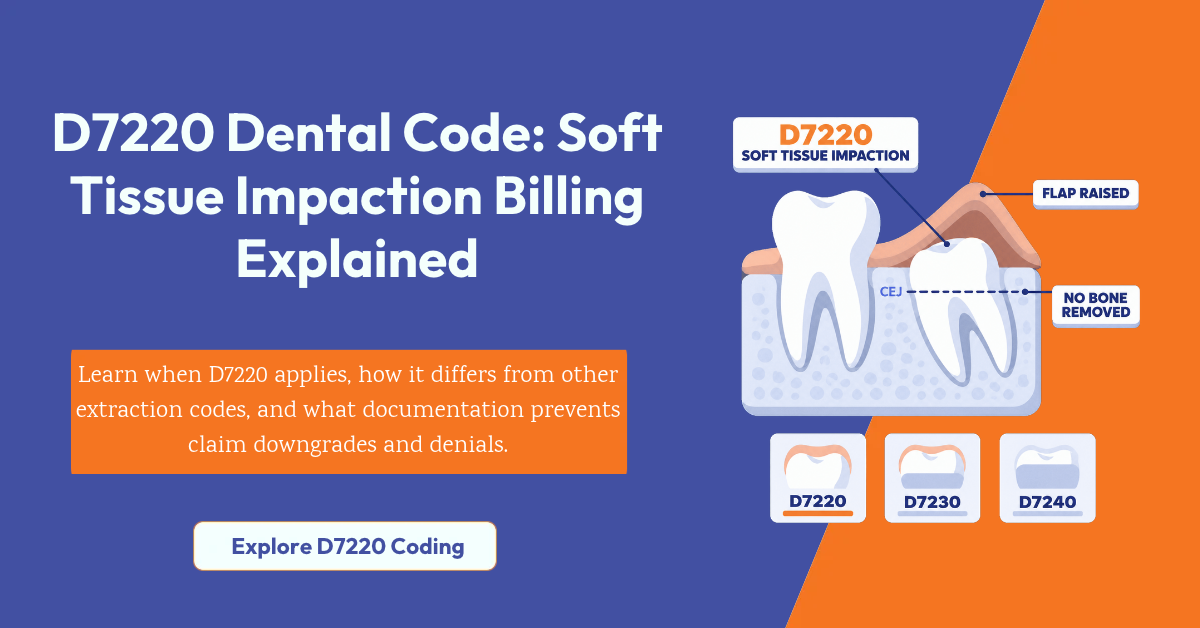
The D7220 dental code is CDT's soft tissue impaction code. It covers removal of an impacted tooth whose occlusal (chewing) surface sits under gum tissue. The dentist raises a mucoperiosteal flap (gum and its lining lifted off the bone) and removes no bone. If bone over the crown has to come off, a bony impaction code applies instead.
Plenty of online explanations describe D7220 as a partially bony impaction, and offices copy that wording into their chart notes. A claim built that way contradicts its own radiograph. Payers catch the mismatch and pay the D7220 dental code claim at a lower level, or deny it.
Our team at iDental Billing works impaction claims for general dentists and oral surgery practices. The sections ahead cover the soft tissue test, where D7220 ends and D7210 begins, the documentation payers ask for, same visit codes, denial fixes, coverage rules, and 2026 Medicaid fees.
Key takeaways
- D7220 means soft tissue over the occlusal surface, a raised flap, and no bone removal.
- The ADA says none of the four impaction codes are based on difficulty.
- Payers such as Delta Dental ask for a current periapical or panoramic image plus chart notes.
- Local anesthesia comes with D7220, and sedation goes on its own claim lines.
- D7220's wording is unchanged for CDT 2027.
What Is the D7220 Dental Code?
D7220 is the ADA's CDT code for removal of an impacted tooth, soft tissue. It applies when gum tissue covers the tooth's occlusal surface and the dentist elevates a flap to deliver it. CDT files it in the oral and maxillofacial surgery category, beside the other extraction codes.
You'll also see it written as dental code D7220 or ADA code D7220. Across all the dental extraction codes, the right pick follows how the tooth presents on the image and in the chart. Two impacted wisdom teeth in one mouth can carry two different codes.
The Official D7220 Dental Code Description
The ADA's nomenclature reads "removal of impacted tooth, soft tissue." Its descriptor adds one line: "Occlusal surface of tooth covered by soft tissue; requires mucoperiosteal flap elevation." You can read both in Kansas DCF's ADA code reference, a state agency copy of the ADA listing.
In plain terms, the tooth hasn't broken through the gum, the gum covers its biting surface, and no bone sits over the crown. Even so, the removal of impacted tooth soft tissue procedure still needs surgical access. The dentist cuts and lifts the gum before the tooth can come out.
What the D7220 Fee Already Includes
The D7220 fee includes local anesthesia, suturing if needed, and routine postoperative care, because the heading of the CDT extractions section applies those to every code in it. D7220's own descriptor adds only two elements: soft tissue over the occlusal surface and flap elevation. Socket smoothing language belongs to the D7140 and D7210 descriptors.
Did D7220 Change in CDT 2026 or CDT 2027?
D7220 didn't change in either edition. It kept the same nomenclature and descriptor in CDT 2026, and it isn't among the 67 changes approved for CDT 2027. Claims use the CDT version in effect on the date of service. Our roundup of CDT 2027 changes lists what did move.
When to Use D7220: The Soft Tissue Test
Bill D7220 only when four things are true: the tooth is impacted, soft tissue covers its occlusal surface, a flap was elevated, and no bone came off the crown. Miss any one of the four, and another code fits better.
The D7220 dental code describes how the tooth presents, and effort plays no part in it. Per the ADA's 2025 coding guidance, none of the four impaction codes are based on difficulty. A long, stubborn soft tissue case is still D7220.
Four Conditions for D7220
- The tooth is impacted and hasn't erupted into the mouth.
- Gum tissue covers the occlusal surface.
- A mucoperiosteal flap was raised for access.
- No bone removal was needed to expose the crown.
Payers apply the same logic. Delta Dental of Michigan's criteria consider a D7220 claim only when documentation shows a soft tissue impaction that required incision and mucoperiosteal flap elevation. Without a documented flap, the soft tissue impaction code has nothing to stand on.
When D7220 Is the Wrong Code
- Bone covered part of the crown and had to come off: a bony impaction code (D7230 or D7240)
- The tooth was fully erupted and came out with forceps or an elevator: D7140
- The tooth was erupted but needed bone removal or sectioning: D7210
- A gum flap over the tooth was trimmed and the tooth stayed: D7971
Bony cases split on the anatomical crown (the part of the tooth covered by enamel, above the cementoenamel junction). Under the ADA impaction guidance, bone over less than 50% of that crown is D7230, and 50% or more is D7240. Our hub explains how bony impactions are coded in full.
Is a Partially Erupted Wisdom Tooth D7220?
A partially erupted wisdom tooth is D7220 only when gum tissue still covers its occlusal surface and the dentist raises a flap to remove it. If the biting surface is exposed and the tooth comes out with forceps, D7140 fits instead.
Many partially erupted third molars sit under an operculum (the hood of gum over a partially erupted tooth). Pulling that inflamed cuff aside to seat forceps doesn't count as flap elevation. Your preoperative image and the dentist's note decide the code, and the treating dentist makes the final call.
What If the Dentist Finds Bone After Opening the Flap?
If the dentist finds bone after opening the flap, code what was actually done. Bone over the crown that had to be removed moves the procedure into a bony impaction descriptor, and D7220 no longer applies.
Ask the dentist to record the finding in their own words: what bone covered the crown, how much came off, and why the preoperative image didn't show it. Paired with that note, a soft tissue image supports the higher code on review. Skip vague phrases like "difficult removal," since the ADA ties code choice to the literal CDT entry.
D7220 vs D7210 and D7140: Where the Flap Line Sits
D7220 is for an impacted tooth under soft tissue, while D7210 and D7140 are for erupted teeth. D7210 requires bone removal or sectioning, and D7140 covers forceps or elevator removal. A flap alone never turns an erupted tooth into D7210.
Flaps cause most of the confusion. D7210's descriptor allows a flap "if indicated," so offices assume any flap means a surgical code. On an erupted tooth, a flap without bone removal or sectioning stays D7140. For an impacted tooth, the flap is what defines D7220.
Payers back that reading in their own extraction criteria, and a D7210 claim for an erupted tooth that only needed a flap can come back paid at D7140. Our D7210 surgical extraction guide walks through the payer language behind the flap rule.
| Code | Tooth status | What the dentist does | Key test | Use another code if |
|---|---|---|---|---|
| D7140 | Erupted tooth or exposed root | Elevator or forceps removal | No bone removal or sectioning | Bone removal or sectioning was needed: D7210 |
| D7210 | Erupted tooth | Bone removal, sectioning, or both, with a flap if indicated | A flap alone doesn't qualify | The tooth was impacted: D7220 or a bony code |
| D7220 | Impacted; occlusal surface under soft tissue | Flap raised; tooth delivered with no bone removed | Only soft tissue over the crown | Bone came off the crown: D7230 or D7240 |
| D7230 / D7240 | Impacted; bone over under 50% or 50% or more of the anatomical crown | Flap plus bone removal | Share of the anatomical crown under bone | See our impaction code breakdown |
CDT codes and nomenclature are © American Dental Association; descriptors paraphrased.
D7220 vs D7140 on a Partially Erupted Tooth
On a partially erupted tooth, an exposed occlusal surface and forceps delivery point to D7140. Gum over the occlusal surface plus a raised flap point to D7220. Our D7140 simple extraction rules cover the erupted side. Check the image before the D7220 dental code goes on the claim.
Can D7220 Be Billed With D7210 on the Same Tooth?
D7220 and D7210 can't both be billed for the same tooth. A tooth gets one extraction code per date of service, because it only comes out once. If one tooth is impacted and another is erupted, each goes on its own claim line with its own tooth number.
Codes That Aren't Extractions: D7971 and D7280
D7971 and D7280 treat tissue around an impacted or partially erupted tooth that stays in the mouth, while D7220 removes the tooth. If the tooth leaves, you're in the impaction codes. A tooth that stays points to one of these two.
D7971 and the Dental Code Operculectomy Question
D7971 is excision of pericoronal gingiva (the gum around a tooth's crown), and it's the dental code for an operculectomy. The dental code for tissue removal around an impacted tooth depends on what leaves the mouth. Cutting away the gum flap is D7971, and taking out the tooth is D7220.
Payers expect the tooth to stay. Envolve's soft tissue excision policy supports D7971 when recurrent inflamed or overgrown tissue surrounds a partially erupted or impacted tooth that's planned for retention. It also limits D7971 to one per tooth every 12 months. Billing D7971 and D7220 on the same tooth contradicts that plan.
D7280 Exposure vs D7220 Removal
D7280 exposes an unerupted tooth so it can erupt or be moved with orthodontics, and the tooth stays. MassHealth's D7280 transmittal treats that exposure as included when an adjacent impacted tooth is extracted. MassHealth won't pay D7280 with D7220 through D7241 billed for the adjacent tooth. Other plans set their own pairing rules.
Documentation That Supports a D7220 Claim
A D7220 claim needs two proofs: a current preoperative image showing only soft tissue over the crown, and an operative note confirming that coverage, a raised flap, and no bone removal. Each payer can ask for more.
Delta Dental spelled out its list in a documentation notice dated October 7, 2025. For D7210 through D7241, it asks for periapical or panoramic radiographs showing the tooth's current position and surrounding bone, detailed chart notes, and any available photos. Claims lacking that documentation, the notice says, will be denied.
What the Preoperative Image Must Show
- The whole tooth, crown and roots
- Soft tissue over the occlusal surface, with no bone over the crown
- A capture date the plan accepts
- The same tooth number used on the claim
Plans set their own rules on image age, so check the plan before reusing an older panoramic image. A postoperative image of an empty socket proves nothing about what covered the crown, and reviewers won't accept it in place of the preoperative one.
Operative Note Wording That Holds Up
A reviewer sees only the note and the image. Your note has to name three things in plain words: the coverage, the access, and the absence of bone removal. One clear line does more work than a paragraph of general surgical detail.
Example note line
Tooth #17 impacted; occlusal surface covered by soft tissue only. Mucoperiosteal flap elevated. Tooth delivered without bone removal. Site irrigated and closed with two sutures.
Compare that with "impacted tooth removed" or "difficult extraction." Neither phrase says what covered the crown or how the dentist reached it, so a reviewer can't confirm the code. Specific wording gives the D7220 dental code its best chance of surviving review on the first pass.
When to Add a Narrative
Add a narrative when the image alone doesn't make the soft tissue coverage obvious, or when the reason for removal needs stating. Common reasons include pericoronitis (infection of the gum around a partially erupted tooth), recurrent infection, and caries on the impacted tooth. Keep it to the tooth, the reason, the coverage, and the steps taken.
If D7220 claims keep bouncing back for missing images or thin notes, our dental claim submission team sends both with the first submission. The payer then has what it needs before anyone reviews the claim.
Billing D7220 With Other Codes on the Same Day
Local anesthesia is part of D7220, so it isn't billed separately. Sedation, general anesthesia, bone grafts, and socket dressings go on their own lines, and each one needs its own documentation and plan coverage.
Does D7220 Include Anesthesia?
D7220 includes local anesthesia but not sedation. Moderate sedation, deep sedation, and general anesthesia each have their own CDT 2026 codes, and the timed IV, parenteral, and general anesthesia codes bill in increments of 15 minutes.
Nitrous oxide has one rule worth memorizing. The ADA's 2026 sedation coding guide says D9230 is used only when nitrous oxide is the single agent. Other sedation and anesthesia codes already include nitrous when it's given alongside them. Document the nitrous anyway, even when it can't be billed.
| Service at the same visit | Code(s) | Separate line? | Note |
|---|---|---|---|
| Local anesthesia | D9215 | No | Included with the extraction; payers commonly bundle it |
| Nitrous oxide alone | D9230 | Yes | Only when nitrous is the single agent |
| Minimal sedation, single drug, enteral | D9244 | Yes | New in CDT 2026 |
| Moderate sedation, enteral | D9245 | Yes | New in CDT 2026 |
| Moderate sedation, parenteral without an IV | D9246, D9247 | Yes | New in CDT 2026; first 15 minutes, then each added 15 minutes |
| Moderate IV sedation | D9239, D9243 | Yes | First 15 minutes, then each added 15 minutes |
| Deep sedation or general anesthesia | D9222, D9223 | Yes | First 15 minutes, then each added 15 minutes |
| General anesthesia with an advanced airway | D9224, D9225 | Yes | New in CDT 2026; timed the same way |
| Evaluation for sedation or general anesthesia | D9219 | Yes | The ADA allows it on the same day as the sedation codes |
| Bone graft for ridge preservation | D7953 | Yes | Reported per site |
| Biological dressing in the socket | D7922 | Yes | Reported per site; coverage varies by plan |
Sedation details from the ADA's 2026 coding guide. Plan coverage for each line varies.
D9248 was deleted in CDT 2026, so don't report it for dates of service on or after January 1, 2026. Our summary of CDT 2026 code changes lists the other deletions and the codes that replaced them.
Can D7220 and D7971 Be Billed on the Same Tooth?
D7220 and D7971 usually can't be billed on the same tooth. Envolve's policy ties D7971 to teeth planned for retention, and D7220 removes the tooth, so the two codes describe opposite plans. If tissue was excised around a different tooth, that tooth gets its own D7971 line.
Why D7220 Claims Get Downgraded or Denied
Most D7220 problems come from a mismatch. The image or note doesn't show soft tissue coverage and a flap, so the payer pays the claim as D7140 or D7210. In other cases, the plan excludes the reason the tooth came out.
A downgraded D7220 dental code claim isn't always a lost claim. Start with the remittance. The claim adjustment reason code (CARC) tells you which problem you have, and the group code, such as CO or PR, shows whether the practice or the patient owns the balance. Definitions come from X12's reason code list.
| What happened | Reason code you'll usually see | Common trigger | First fix |
|---|---|---|---|
| Paid as D7140 | CARC 150 or 169 | Image shows an erupted crown, or the note reads like a forceps extraction | Appeal with the preoperative image and a note naming soft tissue coverage and the flap |
| Paid as D7210 | CARC 150 or 169 | Flap documented, but nothing shows the tooth was impacted | Same appeal, stressing the impaction and the occlusal coverage |
| D7230 paid as D7220 | CARC 150 | Note never mentions bone removal, or the image shows no bone over the crown | Appeal only if the note documents bone removal; otherwise accept it and fix the note template |
| Denied for a missing image | CARC 252 | No current periapical or panoramic image attached | Send the image through the payer's attachment process |
| Denied as not covered | CARC 96 or 50 | Prophylactic removal without a reason the plan accepts | Read the plan policy; appeal with the documented indication if one exists |
| Denied for a limit | CARC 119 | The lifetime limit for that tooth's impaction code was already used | Check claim history by tooth number |
| Denied for missing authorization | CARC 197 | The plan required pre-authorization | Ask about retroactive approval, or appeal if verification showed none was needed |
Reason code meanings come from X12. Payers choose which code to send, so read the remark code too.
One detail catches billing teams off guard. X12 says CARC 16 shouldn't be used for missing claim attachments, and CARC 252 covers that case. If a payer sends 16 for a missing image, the remark code on the same line usually names what it wants.
What to Send With a D7220 Appeal
- The EOB or ERA line and the original claim
- The dated preoperative image showing the crown under soft tissue
- The operative note for that tooth and date
- A short letter quoting the D7220 descriptor beside the matching sentence from the note
- The payer's appeal form, if it requires one
Appeal deadlines and escalation steps vary by payer. Our walkthrough of D7210 downgrade appeals lays them out, and the same evidence logic works for an impaction claim: show the payer the image and the sentence that proves the code.
If downgraded D7220 claims are sitting on your aging report, our team can take them on. We follow up on aging insurance claims and appeal each one with the documentation that payer asked for, before the appeal window closes.
Is D7220 Covered by Insurance?
D7220 is often covered, but coverage depends on why the tooth is coming out. Many dental plans pay for documented problems such as pericoronitis, recurrent infection, or caries, and limit or exclude removal done purely as prevention.
UnitedHealthcare's impacted teeth policy, DCP006.14, effective March 1, 2026, lists infection (including pericoronitis), caries that can't be restored, periodontal disease, and orthodontic treatment among its indications. It says impaction surgery isn't indicated for prophylactic reasons other than an underlying medical condition, or for pain from normal eruption.
Envolve's rules run along similar lines. Its CP.DP.11 policy on impacted teeth lists absence of pathology as a contraindication and allows one D7220, D7230, D7240, or D7241 per tooth per lifetime, subject to state rules. Other plans write their own criteria, so read the patient's plan policy before you promise anything.
What to Check Before Scheduling a D7220 Extraction
- The benefit class the plan assigns to oral surgery
- The remaining annual maximum and the deductible already met
- Any waiting period on oral surgery
- Pre-authorization or predetermination rules for impactions
- Claim history for that tooth number
- Any medical plan that should pay first for this diagnosis
Plans classify oral surgery differently, so the patient's share comes from their own plan document. Pull the oral surgery coinsurance, frequency limits, and any alternate benefit clause from that document before quoting a number.
Our team runs benefits checks before surgery five business days ahead, so a lifetime limit or a prophylactic exclusion shows up before the patient is in the chair. Verification is included for practices on our billing service.
D7220 Reimbursement: What Payers Pay in 2026
There's no national D7220 rate. Each dental plan and each state Medicaid program sets its own fee, so the same soft tissue impaction can pay very differently from one payer to the next.
Two 2026 Medicaid schedules show how wide the D7220 dental code range runs. Florida Medicaid's 2026 dental fees pay different amounts for children and adults, and New Hampshire's 2026 dental fee schedule lists a single rate. Both schedules took effect January 1, 2026.
| Code | Florida Medicaid, ages 0 to 20 | Florida Medicaid, ages 21+ | New Hampshire Medicaid |
|---|---|---|---|
| D7140 | $40.31 | $27.12 | $126.28 |
| D7210 | $59.71 | $40.18 | $157.86 |
| D7220 | $92.56 | $62.27 | $164.77 |
| D7230 | $114.95 | $77.34 | $221.00 |
Fees effective January 1, 2026. Check the current schedule before quoting a fee.
What a D7220 Downgrade Costs per Tooth
In Florida's schedule for patients 20 and under, a D7220 paid as D7140 loses $52.25 per tooth, and paid as D7210 it loses $32.85. New Hampshire shows $38.49 and $6.91 for the same downgrades. Coding a true partially bony case as D7220 leaves $22.39 (Florida) or $56.23 (New Hampshire) unclaimed.
PPO contracted fees aren't published, so your own remittances are the best source. Pull the D7220 allowed amount from recent EOBs by payer and compare it with each contract. An allowed amount below the contracted fee is an underpayment worth disputing.
What Medicare Pays for D7220
Original Medicare pays for D7220 only in narrow cases tied to covered medical care, although many Medicare Advantage plans add dental benefits of their own. CMS publishes ambulatory surgical center (ASC) facility rates in its ASC payment rates addenda, updated each year.
D7220 on Medical Claims and ICD-10 Codes
Original Medicare covers D7220 only when the extraction is inextricably linked to covered medical treatment, such as dental care before an organ transplant or cardiac valve replacement. Commercial medical plans write their own rules for impaction surgery, so check the medical policy before sending the claim there.
Since July 1, 2025, CMS's Medicare dental coverage rules have required the KX modifier on these linked dental claims, plus an ICD-10 code on the dental claim form (837D or 2024 ADA). CMS also tells providers not to send attachments such as radiographs with the claim.
On the diagnosis side, Envolve's impacted teeth policy pairs these codes with K01.1 (impacted teeth) and K01.0 (embedded teeth). The diagnosis you report has to match the chart. For CPT and medical claim detail, see our guide to extraction codes on medical claims.
Our outsourced dental billing team handles the medical side of oral surgery claims too, including the KX modifier and ICD-10 coding on linked Medicare claims. Across live client accounts, our net collection rate is 98.7%.
D7220 Dental Code FAQs
What is procedure code D7220?
Procedure code D7220 is the ADA's CDT code for removing an impacted tooth whose occlusal surface is covered by soft tissue, with a mucoperiosteal flap raised and no bone removed. Offices also write it as dental code D7220 or ADA code D7220. It sits in the oral and maxillofacial surgery category of CDT 2026. Because the code describes how the tooth presents, the image and the operative note have to show soft tissue coverage, a flap, and no bone removal.
Is D7220 considered oral surgery?
Yes, D7220 is an oral surgery code. CDT places it in the oral and maxillofacial surgery category with the other extraction codes, and that section includes local anesthesia, suturing if needed, and routine postoperative care in each code. Dental plans often put oral surgery in the basic or major benefit class, which changes the patient's coinsurance. Check the plan's own classification during verification, since two plans can treat the same D7220 claim differently. The category stays the same whoever performs the procedure.
Is D7220 a simple extraction?
No, D7220 isn't a simple extraction. A simple extraction of an erupted tooth or exposed root is D7140, done with forceps or an elevator. D7220 is an impaction code, and it always involves a flap, because the gum covering the occlusal surface has to be lifted before the tooth can come out. If an erupted tooth needed only a flap, the claim stays at D7140 unless bone removal or sectioning made it D7210. Images and notes have to show the difference.
Can a general dentist bill D7220?
Yes, a general dentist can bill D7220. Nothing in the CDT entry limits the code to oral surgeons, because it describes the tooth's presentation and the procedure and says nothing about specialty. Payment still depends on the patient's plan and the dentist's contract with that plan. Some plans pay specialists and general dentists from different fee schedules, and an associate who isn't credentialed with the plan may be paid out of network. Check the contract before quoting a fee.
How many times can D7220 be billed for one tooth?
D7220 can be billed once per tooth, because a tooth only comes out once. Many plans write that limit into policy. Envolve, for example, allows one D7220, D7230, D7240, or D7241 per tooth per lifetime, subject to state rules. A second claim for the same tooth number usually points to a tooth number error or a duplicate submission. Check the claim history by tooth number and correct the chart before you send it. Payers deny repeats as duplicates or as over the limit.
Does D7220 require pre-authorization?
D7220 requires pre-authorization only when the patient's plan says so, and the rules differ widely. Some commercial plans and Medicaid programs ask for approval before impaction surgery, often with the preoperative image attached to the request. Confirm the rule during benefits verification, before the surgery date. If the plan issues an approval or predetermination number, put it on the claim so the payer can match the two. A missing approval often shows up as CARC 197.
Is D7220 covered by Medicare?
Original Medicare usually doesn't cover D7220. CMS lists extraction of an impacted tooth as not covered. The exception applies when the extraction is inextricably linked to covered medical treatment, such as care before an organ transplant or cardiac valve replacement. Those claims need the KX modifier and an ICD-10 code, and CMS asks providers not to send radiographs with them. Many Medicare Advantage plans include their own dental benefits, so check the patient's specific plan before assuming there's no coverage.
Before a D7220 Claim Goes Out
Run five checks on every D7220 claim before it leaves the office. Each one heads off a specific downgrade or denial.
- Confirm the note names soft tissue coverage, the flap, and no bone removal.
- Attach a current preoperative image showing the whole tooth.
- Match the tooth number on the claim, the chart, and the image.
- Put sedation and grafts on their own lines, and leave local anesthesia off.
- Check the plan's indication rules and the lifetime limit for that tooth.
If you'd like a second set of eyes on your impaction claims, send us a few recent D7220 dental code claims for a free billing review. We'll show you where they're getting downgraded and what the fix is worth.
Our billing plans start at 2.95% of monthly collections, with no setup fee and nothing charged on unpaid claims. Provider credentialing for a new associate runs $150 per commercial payer, or $95 per commercial payer for billing clients.
CDT codes and nomenclature are © American Dental Association. Descriptors are paraphrased except where quoted. Reviewed for CDT 2026; CDT 2027 makes no change to D7220.
Sources
ADA and code sets
- ADA, D7230 and D7240: Guidance on Coding for Impacted Teeth Removal Procedure
- ADA News, Tips to Avoid Claim Denials Due to Common Coding Mistakes, December 2, 2025
- ADA, CDT Coding Guide: Nitrous Oxide, Sedation and General Anesthesia (2026)
- Kansas DCF, ADA Procedure Codes reference
- X12, Claim Adjustment Reason Codes
Government and Medicaid
- CMS, Medicare Dental Coverage (modified March 10, 2026)
- CMS, ASC Payment Rates Addenda
- Florida AHCA, 2026 Dental Fee Schedule, effective January 1, 2026
- New Hampshire Medicaid, Covered Dental Procedures Fee Schedule, as of January 1, 2026
- MassHealth, Transmittal Letter DEN-113
Payer policies
- UnitedHealthcare, Surgical Extraction of Impacted Teeth, DCP006.14, effective March 1, 2026
- Envolve, Extraction of Impacted Teeth, CP.DP.11
- Envolve, Excision of Soft Tissue, CP.DP.30
- Delta Dental of Michigan, Clinical Criteria for Extraction of Teeth, 282.24 v3 (revised February 18, 2026)
- Delta Dental, Stop Claim Denials Before They Even Start, October 7, 2025
ABOUT THE AUTHOR
Russell Bennett
Russell Bennett is a Dental RCM and Provider Credentialing Specialist at iDental Billing. He reviews billing workflows, resolves claim denials, outstanding insurance balances, and reimbursement discrepancies, and applies CDT coding and payer-specific guidelines. His work includes provider credentialing, payer enrollment, and recredentialing. Russell writes iDental Billing’s educational guides on what claims need, why they matter, and where things go wrong.