













We reviewed this guide for CDT 2026 and checked CDT 2027 status in October 2026.
The D7140 dental code is the extraction code offices bill on autopilot, and small leaks start there. A rooted baby tooth goes out as D7111. Someone bills a forceps-only case as D7210 with nothing in the note to back it. Another claim pends because the team didn't attach the pre-op film.
Billers mix up the ADA code for simple extraction with D7111, D7210, and D7250, and you settle each case from the operative note. A D7140 extraction also needs a tooth number on each claim line and the right add-on codes beside it.
Our billing team at iDental Billing wrote this from the extraction claims we work, then checked each rule against ADA, payer, and Medicaid documents in October 2026.
What Is the D7140 Dental Code?
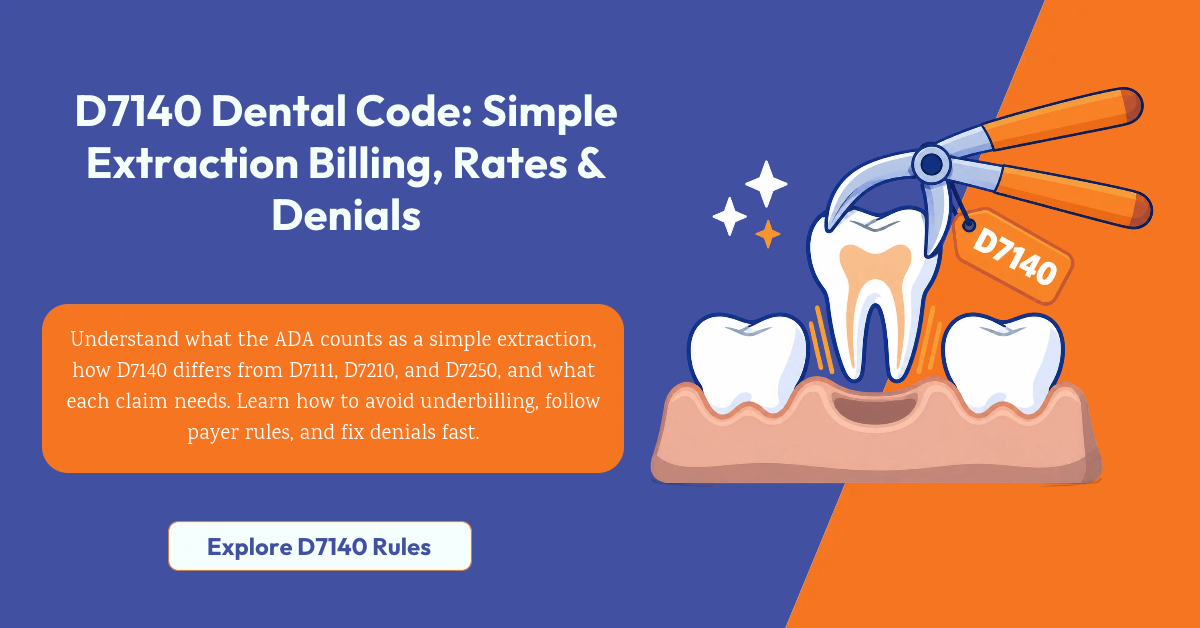
D7140 is the CDT code for extracting an erupted tooth or an exposed root with an elevator, forceps, or both. It's the simple extraction dental code: the dentist removes no bone and doesn't section the tooth. Dental code D7140 sits in the CDT Code's Oral and Maxillofacial Surgery category, under Extractions.
| D7140 at a glance | Detail |
|---|---|
| CDT category | Oral and Maxillofacial Surgery (D7000 to D7999), Extractions |
| Technique | Elevator, forceps, or both |
| Common name | Simple or non-surgical extraction. The CDT entry itself doesn't use the words "simple" or "difficult" (ADA Q&A #2) |
| How you report it | One claim line per tooth, with the tooth number |
| Teeth it covers | Permanent teeth, primary teeth with roots remaining, and supernumerary teeth |
| Also listed as | 7140 on some fee schedules, so you may also see dental code 7140 or ADA code D7140 |
The full D7140 dental code description in the CDT Code reads:
D7140 extraction, erupted tooth or exposed root (elevation and/or forceps removal). Includes removal of tooth structure, minor smoothing of socket bone, and closure, as necessary.
Source: American Dental Association, ADA Guide to Extractions
What D7140 Includes
The CDT entry for D7140 covers three steps:
- Removing tooth structure: the whole tooth, the root, or both (ADA Q&A #1 and #8)
- Minor smoothing of the socket bone
- Closure, when the site needs it
An exposed root is one the dentist can see and lift out with forceps or an elevator, including a root left behind after the crown fractured.
What D7140 Does Not Include
Five situations fall outside D7140, and each one takes a different code:
- Bone removal or sectioning to deliver the tooth: D7210
- A residual root that needs soft tissue and bone cut away: D7250
- Soft-tissue-retained coronal remnants of a primary tooth: D7111
- An impacted tooth: D7220 to D7241
- An extraction the dentist couldn't finish: D7999, by report
D7140 vs D7210, D7250, and D7999: Choosing the Right Code
You pick the dental code for extraction by technique: the D7140 dental code for elevator or forceps work alone, D7210 for bone removal or sectioning, D7250 for cutting to residual roots, and D7999 for an unfinished extraction. ADA coding subcommittee chair Paula Crum, DDS, states the rule in ADA News: code for what you do.
Dental extraction codes compared by technique
| Code | Use it when | ADA basis |
|---|---|---|
| D7140 | An erupted tooth or exposed root comes out with an elevator, forceps, or both, including an exposed root left by a fracture or by another dentist's attempt | Descriptor; Q&A #4 and #8 |
| D7210 | The dentist removes bone or sections the tooth to deliver it, including a separated root tip that needs bone removal | Descriptor; Q&A #1 |
| D7250 | A residual root needs soft tissue and bone cut away to reach it | Descriptor; Q&A #4 and #6 |
| D7999 | The dentist started the extraction and couldn't complete it; it's a by-report code, so send a narrative | Q&A #3 |
| D7111 | Only soft-tissue-retained coronal remnants of a primary tooth remain | Descriptor; see primary teeth below |
| D7220 to D7241 | The tooth is impacted; the code follows the tooth's clinical presentation | ADA News, December 2, 2025 |
AAPD's coding column warns that abbreviated code names in practice software drop-down menus can lead to coding errors. A biller who picks the simple extraction code from a menu label doesn't see the descriptor. Keep the CDT descriptors open beside the drop-down menu whenever your team codes extractions.
D7140 vs D7210: Bone Removal or Sectioning Decides
D7140 vs D7210 turns on two steps in the operative note: bone removal and sectioning. No bone removal and no sectioning means D7140. Either one, even on a quick case, means D7210.
D7210's CDT entry includes a mucoperiosteal flap if indicated. A flap raised for access, with no bone removed and no tooth sectioned, still leaves you with a D7140.
Chair time doesn't change the code in either direction, so a long, stubborn forceps extraction stays D7140. In a D7210 vs D7140 dispute, the payer's reviewer looks for bone removal or sectioning in the operative note.
D7140 vs D7250: Exposed Roots vs Residual Roots
D7140 covers roots too, and the root tip extraction code depends on access. The ADA code for root tip extraction is D7140 when an exposed root comes out with forceps or an elevator. Another dentist's failed attempt doesn't change the code (ADA Q&A #4 and #8).
The D7250 dental code describes a cutting procedure: the dentist cuts soft tissue and bone to reach a residual root. ADA Q&A #2 rules out adding it to a difficult extraction of the same tooth.
Some payers deny the cutting code because the root wasn't "encased" in bone. The ADA says that reasoning doesn't match the CDT entry, and you can quote its Q&A #5 in the appeal.
When an Extraction Can't Be Finished: D7999
A D7140 the dentist can't finish has no CDT code of its own. The ADA points to D7999, unspecified oral surgery procedure, by report, with a narrative describing what the dentist completed (Q&A #3). If a second dentist later lifts out the exposed roots, that dentist bills the visit as D7140.
Can D7140 Be Used for Primary Teeth? D7111 vs D7140
Yes, D7140 applies to a primary tooth whenever root structure remains and the dentist removes the tooth with forceps or an elevator. D7140's nomenclature doesn't separate primary from permanent teeth. The D7111 dental code covers only coronal remnants that soft tissue holds, with no roots remaining, as the AAPD Coding Corner explains.
AAPD calls billing D7111 in place of D7140 a common error that cuts legitimate reimbursement. Its September 2019 column adds that most dental plans pay D7140 at a higher allowance than the remnant code. An office that uses D7111 as its default baby tooth extraction code underbills each rooted primary tooth it removes.
A Four-Step Test for Primary Teeth
For a baby tooth, the primary tooth extraction code comes from four checks:
- Only coronal remnants remain, held by soft tissue with no root anchoring them: D7111.
- Root structure still holds the tooth, and it comes out with forceps or an elevator: D7140.
- The dentist has to remove bone or section the tooth: D7210, subject to the Medicaid rule below.
- Only residual roots remain and need soft tissue and bone cut away: D7250 (ADA Q&A #7 uses a primary second molar as its example).
Medicaid Rules That Narrow the Choice
In a MO HealthNet coding tip dated July 2, 2026, the program says it doesn't cover D7210 for primary teeth. MO HealthNet also ties surgical status to the procedure performed, whatever the place of service.
CDT puts no primary-tooth limit on the surgical code, so MO HealthNet is setting a coverage rule. Your claim still has to match what the dentist did. Check your state's Medicaid dental manual before treatment. A state can deny a pediatric claim under its own age limits and coverage rules, even when the CDT Code allows the procedure.
How to Report D7140 on the Dental Claim
Report D7140 once per tooth, with each extraction on its own claim line and its own tooth number. The ADA's Dental Claim Data Recommendation, effective January 1, 2026, lists the tooth number as the recommended detail for D7140. That holds for the paper ADA claim form and for the 837D electronic claim.
One Claim Line per Tooth
Three teeth out means three D7140 lines, each with a tooth number that matches the chart and the image. A transposed number can make a valid claim look like a duplicate or like a tooth the patient lost years ago. Check each tooth number against the chart before the claim goes out.
Supernumerary Teeth: Numbers 51 to 82 and AS to TS
The dental code for supernumerary tooth extraction is still D7140 when the extra tooth comes out with forceps or an elevator. Your claim carries a supernumerary tooth number in place of a standard one.
| Supernumerary tooth | Number on the ADA claim form |
|---|---|
| Permanent | 51 to 82. #51 sits next to #1, and #82 sits next to #32 |
| Primary | Add "S" to the adjacent tooth letter, from AS to TS |
Source: ADA claim form completion instructions, 2024 version. UnitedHealthcare's Non-Surgical Extractions policy (DCP022.13, effective January 1, 2026) lists supernumerary teeth among its indications, though each plan sets its own coverage.
D7140 Documentation That Gets Claims Paid
Payers can pay a D7140 dental code claim on the first pass when the note, tooth number, and any requested attachment agree. Together they have to show which tooth came out, why, and that the dentist used only an elevator or forceps. If any of them disagree, payers pend the claim or ask for records.
What to Send With a D7140 Claim
Good D7140 documentation is short. Five pieces cover it:
- The tooth number, matching the chart and the image
- A pre-op periapical image when the plan asks for one
- The reason the tooth came out
- A date of service that matches the date in the note
- A short narrative when something unusual happened
Payers spell out the reasons they accept in their clinical policies. UnitedHealthcare's Non-Surgical Extractions policy (DCP022.13) lists non-restorable teeth, failed root canal treatment, and poor prognosis, along with crowding, orthodontic needs, and teeth blocking planned prosthetic work. Attachment rules differ by payer, so check each plan's list of required documents before you submit the claim.
A D7140 Note That Holds Up
Write the note at chairside, while the details are fresh. A note in this shape supports D7140 without a narrative:
Example D7140 note
Tooth #30 extracted. Reason: non-restorable caries.
Local anesthetic given.
Tooth elevated and delivered with forceps. No flap, no bone removal, no sectioning.
Socket irrigated; minor smoothing of socket bone. Hemostasis achieved.
Post-op instructions given.
Your coder confirms D7140 from the line that starts "Tooth elevated." On a disputed extraction, check that line first, then the image.
When the Note and the Code Don't Match
Sometimes the dentist documents bone removal or sectioning, and the claim still goes out as D7140. The office underbills the visit and leaves a chart that contradicts the claim, a mismatch auditors look for.
Vague notes cause a different problem. A note that says only "difficult" or "sutures placed" doesn't show the technique, so it supports neither code. Fix the template so each note names the technique the dentist used: elevator, forceps, bone removal, or sectioning.
If your extraction notes and codes keep drifting apart, look at the workflow before you look at the team. In a CDT coding review, our coders check each extraction claim against the dentist's note before it goes out.
Is D7140 Oral Surgery? Basic vs Major Coverage
Yes, in the CDT Code: D7140 sits in the Oral and Maxillofacial Surgery category, D7000 to D7999. Coverage is a separate call each plan makes. FEDVIP, the federal employee dental and vision program, groups tooth extractions with intermediate services, and two public employee plans pay in-network simple extractions at 80%.
Plans don't classify the D7140 dental code the same way, so you answer "is D7140 basic or major?" from the patient's plan document. The class the plan assigns sets the coinsurance percentage, which determines the patient's share at checkout.
How Dental Plans Classify Simple Extractions
Three published plan documents show how far apart plans sit on the simple extraction dental code:
| Plan document | Where simple extractions fall | Coinsurance shown |
|---|---|---|
| OPM FEDVIP service classes (federal employees) | Class B, intermediate, which lists tooth extractions; oral surgery sits in Class C, major | Varies by FEDVIP plan |
| New Jersey SHBP and SEHBP Aetna Dental Expense Plan, plan year 2026 | "Simple extraction," grouped with basic restorative services | 80% in network, 70% out of network |
| Delta Dental of Virginia, The Local Choice brochure, January 2026 | "Oral surgery (simple extractions and other minor surgical procedures)" under primary dental care | 80%, deductible applies |
The Virginia plan labels simple extractions oral surgery and still pays them at 80% under primary dental care. Quote the patient from the plan's coinsurance line, whatever label the plan puts on the procedure.
Seven Checks Before the Extraction
Run these seven checks during dental insurance verification, before the patient sits down:
- The class and coinsurance the plan applies to D7140
- Deductible met so far this benefit year
- Annual maximum remaining
- Any waiting period on extractions or oral surgery
- Whether the history already shows that tooth extracted
- Pre-authorization or predetermination rules
- Secondary coverage and coordination of benefits order
With those seven answers in hand, the front desk quotes a patient portion the office can collect at checkout.
How Much Does the D7140 Dental Code Pay in 2026?
D7140 has no national rate: 2026 Medicaid rates in five states range from $27.12 (Florida adults) to $228.42 (Delaware), and each PPO contract sets its own allowed amount. Each claim carries three numbers: the practice's fee, the payer's allowed amount, and the patient's share, which is the D7140 dental code cost patients ask about.
2026 Medicaid Rates for D7140
Medicaid programs post their fee schedules, so you can compare published D7140 rates:
| Program | D7140 rate | Effective | Note |
|---|---|---|---|
| Delaware Medicaid | $228.42 | April 1, 2026 | One rate for all ages |
| New Hampshire Medicaid | $126.28 | Schedule as of January 1, 2026 | Covered dental procedures schedule |
| Colorado Medicaid | $106.89 | July 1, 2026 | Fee-for-service schedule published by DentaQuest |
| New York Medicaid | $50.50 | January 1, 2026 | Listed as once per lifetime per tooth |
| Florida Medicaid (AHCA) | $40.31 ages 0 to 20; $27.12 ages 21 and older | January 1, 2026 | Separate child and adult rates |
Delaware pays more than eight times as much for the same extraction as Florida's adult schedule. Arkansas Medicaid's fee schedule has a run date of September 16, 2026, and applies its rates as of that date. It lists $72.20 for adults and $129.02 for children and its Adult-IDD group.
Finding Your PPO Allowed Amount
PPO rates sit in contracts that payers don't publish. Your fastest source for D7140 reimbursement is your own remittance data. Pull the allowed amount for D7140 from recent EOBs and ERAs, payer by payer, and compare it with the fee schedule in each contract.
An allowed amount below the contracted fee is an underpayment you can dispute, and line-by-line EOB and ERA posting is how your team finds it.
The plan prices out-of-network claims from its out-of-network schedule, and the patient may owe the difference. A dentist the plan hasn't credentialed yet sees a different D7140 reimbursement on the same extraction.
What the Patient Owes: A Worked Example
These figures are an example and don't reflect any payer's rates.
| Line | Amount |
|---|---|
| Practice fee for D7140 | $200 |
| PPO allowed amount | $110 |
| Plan pays at 80%, deductible already met | $88 |
| Patient owes | $22 |
| Contractual write-off | $90 |
On a plan that pays extractions at 50%, the same $110 allowed amount splits into $55 from the plan and $55 from the patient.
If a payer allows less than your contract says, someone has to catch the gap and chase it. Our dental AR follow-up team works those underpayments before the payer's appeal window closes.
What the D7140 Fee Includes and What You Bill Separately
The D7140 fee covers local anesthesia, suturing if needed, and routine postoperative care, which the CDT extractions category includes. Payers repeat that list in documents such as the Delta Dental clinical criteria. Anything else the dentist does that day needs a separate code and claim line, and coverage depends on the plan.
| Code | What it covers | With D7140 |
|---|---|---|
| D9215 | Local anesthesia with an operative or surgical procedure | Part of the extraction; expect the plan to treat a separate line as included |
| D9210 | Local anesthesia not tied to an operative or surgical procedure | Doesn't fit an extraction visit, since its descriptor excludes surgical procedures |
| No separate code | Routine post-op check and suture removal | Included as routine postoperative care, so you won't find a dental code for suture removal to add |
| D0171 | Post-operative re-evaluation visit | The dental post op code for a re-evaluation; check whether the plan counts the visit as routine post-op care |
| D9930 | Treatment of post-surgical complications, unusual circumstances, by report | Separate and by report, for care beyond routine follow-up. Its CDT descriptor names dry socket treatment as an example, so it's the dental code for dry socket care; the payer decides coverage |
| D0140 | Limited, problem-focused oral evaluation | Separate line, for example a same-day emergency exam |
| D0220, D0230 | Periapical image, first and each additional | Separate lines |
| D7310, D7311 | Alveoloplasty with extractions, per quadrant (four or more teeth or spaces; one to three) | Separate only as a distinct procedure, since minor smoothing sits inside D7140 (ADA News, December 2, 2025) |
| D7953 | Bone replacement graft for ridge preservation, per site | Separate line; this is the ADA code for bone graft with extraction sites |
| D7922 | Intra-socket biological dressing for hemostasis or clot stabilization, per site | Separate line; coverage varies by plan |
| D9239, D9243 | IV moderate sedation, first and each added 15 minutes | Separate, time-based lines |
| D9222, D9223 | Deep sedation or general anesthesia, first and each added 15 minutes | Separate, time-based lines |
| D9224, D9225 | General anesthesia with an advanced airway, first and each added 15 minutes, new in CDT 2026 | Separate, time-based lines |
| D9244 to D9247 | Minimal or moderate enteral sedation and moderate non-IV parenteral sedation, new in CDT 2026 | Separate lines where used; D9248 no longer exists |
| D7910 | Suture of recent small wounds up to 5 cm | Doesn't apply to extraction closure, which D7140 already includes |
Billing anesthesia, sutures, and closure as separate lines next to D7140 charges the plan twice for one service. Plans deny those extra lines as included, with CARC 97 on the remittance, and a payer that sees the pattern repeat can open an audit.
CDT 2026 renamed the IV moderate and deep sedation codes, added D9224, D9225, and D9244 to D9247, and deleted D9248. Update the code tables and fee schedules in your practice software to match. Sedation lines also need start and stop times in the note, and graft lines need per-site counts.
Why D7140 Claims Get Denied and How to Fix Them
Denied D7140 dental code claims fall into five buckets: missing information, bad tooth numbers, plan limits, bundled add-ons, and codes the note doesn't support. Read the CARC on the ERA to find the bucket, then the remark code to find the fix.
D7140 Denial Reasons by CARC Code
The meanings below come from X12's claim adjustment reason codes list. Triggers in the third column are common D7140 cases.
| CARC | X12 meaning | Common D7140 trigger | Fix |
|---|---|---|---|
| 16 | Claim or service lacks information or has submission or billing errors | Missing or invalid claim data, such as the tooth number; X12 pairs this code with a remark code | Read the remark code, correct the data, and send a corrected claim |
| 252 | An attachment or other documentation is required to adjudicate the claim or service | The pre-op image, chart note, or narrative the plan asked for didn't arrive | Send the requested attachment through the payer's attachment process, tied to the claim |
| 18 | Exact duplicate claim or service | Two lines with the same tooth and date, or a corrected claim sent as a new one | Fix the tooth number, or resend as a corrected claim |
| 96 | Non-covered charges | Waiting period, plan exclusion, or history showing that tooth already extracted | Check the verification notes; appeal if verification confirmed coverage, or bill the patient under the plan terms |
| 97 | Benefit included in the payment for another service | D9215, a routine post-op visit, or alveoloplasty billed beside D7140 | Remove the line, or appeal with notes that show a distinct procedure |
| 150 | Information submitted doesn't support this level of service | A surgical extraction paid down toward D7140 | Appeal with documentation if bone removal or sectioning happened; accept the change if it didn't |
| 169 | Alternate benefit provided | The plan paid a lesser procedure than the code billed | Same as 150, and read the plan's alternate benefit clause |
Appealing a D7210 Downgraded to D7140
Compare the operative note with the D7210 entry before you appeal a downgraded surgical claim. If the note documents bone removal or sectioning, appeal with the note, the pre-op image, and a short narrative naming the step and the reason for it.
A note without either step means the downgrade stands. Accept D7140, and ask the dentist to record each step on the next surgical case.
Each payer sets its own appeal deadline. Pull it from the provider manual or the EOB and log it with the claim, since a payer can refuse an appeal filed after that window closes.
If the same reason code keeps showing up on extraction claims, check verification and documentation first. Our dental denial management team works the backlog and traces each code to its source.
Can D7140 Be Billed to Medical Insurance?
Sometimes: a medical plan may pay for the extraction when trauma or covered medical treatment drives it, while routine D7140 extractions stay on the dental claim. Commercial medical plans take a CMS-1500 or 837P coded in CPT and ICD-10-CM, and AAPD notes that most dental plans want trauma care billed to medical first.
Medicare's Dental Exceptions
Medicare Parts A and B pay for dental services that CMS calls "inextricably linked" to covered treatment, as the CMS Medicare dental coverage page explains. CMS added these five scenarios through its annual physician fee schedule rules, on top of older exceptions such as ridge reconstruction done during tumor surgery:
- Dental work tied to an organ transplant, including stem cell and bone marrow transplants (CY2023 rule)
- Dental work tied to cardiac valve replacement or valvuloplasty (CY2023 rule)
- Dental services tied to head and neck cancer treatment (CY2023 rule, payment from 2024)
- Dental services tied to chemotherapy, CAR-T therapy, or high-dose bone-modifying agents for cancer (CY2024 rule)
- Dental services tied to dialysis for end-stage renal disease (CY2025 rule)
Since July 1, 2025, CMS has required the KX modifier on these claims and an ICD-10 diagnosis code on the dental claim form (837D or 2024 ADA). Add both to claims for these linked services, and leave the KX modifier off routine extractions for Medicare patients.
Coding the Medical Claim: CPT 41899 and ICD-10-CM
CPT has no tooth extraction code, so the extraction CPT code on a commercial medical claim is 41899, unlisted procedure, dentoalveolar structures, unless the plan names another code. Payers price unlisted codes by report, so the dentist's note has to describe the full procedure.
Hospitals billing Medicare for outpatient dental cases follow a different rule. CMS tells hospitals to report the specific CDT code when CMS has assigned it to an APC (MLN Matters MM13031). Hospitals keep 41899 for dental procedures without an APC-assigned code. Before you pick a CPT code for tooth extraction in hospital or surgery-center cases, check that facility's claim rules.
For ICD-10 codes for tooth extraction, the ADA's 2026 CDT Code to ICD Diagnosis Code Crosswalk lists possible codes for D7140, including:
- K02.53: dental caries on a pit and fissure surface, into the pulp
- K04.7: periapical abscess without sinus
- K05.311: chronic periodontitis, localized, slight
- K08.439: partial loss of teeth due to caries, unspecified class
- S02.5XXA: traumatic tooth fracture, initial encounter for closed fracture
The ADA calls its crosswalk a reference tool, so the diagnosis still has to match the chart. All five codes are valid in the FY2027 ICD-10-CM set, in effect from October 1, 2026.
Some patients need a dental claim and a medical claim in the same month. Billers who handle medical claims for oral surgery keep the tooth number, dates, and diagnosis consistent across both.
Did D7140 Change in CDT 2026 or CDT 2027?
No, the D7140 dental code is unchanged in CDT 2026 and absent from the CDT 2027 decisions as of October 2026. In March 2025, the ADA Code Maintenance Committee set CDT 2026, and in March 2026 it set CDT 2027. The submitter of the 2027 cycle's only D7000-series code request, a D7953 revision, withdrew it.
At the same meeting, the committee postponed a proposed change to the oral surgery category descriptor, which addresses local anesthesia, to its March 2027 meeting. Check D7140 against the CDT 2027 manual once it ships.
CDT 2026 took effect January 1, 2026, with 60 changes: 31 additions, 14 revisions, six deletions, and nine editorial changes. The 2027 edition takes effect January 1, 2027, with 67 changes: 28 additions, 33 revisions, and six editorial updates, per the ADA's CDT 2027 announcement.
HIPAA requires the CDT version in effect on the date of service (ADA dental code FAQ; 45 CFR 162.1002). A claim filed in January 2027 for a December 2026 extraction still uses CDT 2026. An outsourced dental billing team keeps both code versions loaded through that changeover.
D7140 Dental Code FAQs
D7140 has no CPT twin and no CDT frequency limit, and the treating dentist chooses the extraction code. Plans set their own pre-authorization rules, and D7140 and D7210 can share a date of service on different teeth. An erupted wisdom tooth that comes out with forceps or an elevator qualifies as D7140.
Is There a CPT Code for D7140?
No CPT code mirrors D7140. Dental code D7140 is a CDT code, and CDT is the HIPAA standard code set for dental services under 45 CFR 162.1002.
CPT has no tooth extraction code, so a commercial medical plan that requires CPT gets 41899, unlisted procedure, dentoalveolar structures. Keep the tooth number and date of service the same on the dental and medical claims.
Does D7140 Need Pre-Authorization?
The CDT Code sets no pre-authorization rule for D7140, so each plan decides for itself. Some commercial plans and Medicaid programs keep their own prior authorization lists.
Confirm the plan's rules during a benefits check before treatment, note the reference number from the call or portal, and attach any approval number to the claim. Skipping a required authorization can cost you the whole line.
Can D7140 and D7210 Be Billed on the Same Day?
Yes, you can bill D7140 and D7210 on the same day for different teeth, each on a separate line with its tooth number. For example, you might bill tooth #19 as D7210 and tooth #30 as D7140 on one date.
Don't report both codes for one tooth. If the dentist starts with forceps and ends up removing bone on that tooth, report D7210 alone, as ADA Q&A #1 and #2 describe.
Is a Wisdom Tooth Extraction Ever D7140?
Yes, a wisdom tooth extraction is D7140 when the third molar has erupted and comes out with an elevator or forceps. The simple extraction code works for a third molar as it does for a premolar. An erupted third molar that needs bone removal or sectioning takes D7210.
Impacted third molars use D7220 to D7241, with D7230 as the partial bony extraction code. ADA News notes that the impaction codes don't depend on difficulty. For an impacted tooth, the wisdom teeth removal procedure code follows how the tooth presents.
Is There a Frequency Limit on D7140?
D7140 has no frequency limit in the CDT Code. A tooth comes out once, so payers check claim history by tooth number. New York Medicaid's 2026 fee schedule lists D7140 as once per lifetime per tooth.
Plan limits on extractions per year, waiting periods, and annual maximums show up during verification. If a frequency denial lands on an extraction, check the tooth number before anything else.
Who Chooses the Extraction Code, the Dentist or the Biller?
The treating dentist chooses the extraction code, whether it's D7140 or a surgical code. According to the ADA's Guide to Extractions, code selection depends on the dentist's clinical training and experience.
Your biller's job is to check that the code matches the note and to query the dentist when it doesn't. A biller who changes an extraction code without the dentist's sign-off and supporting documentation puts the practice at audit risk.
Before You Submit: A D7140 Claim Checklist
Run these seven checks in order on each D7140 dental code claim. Your team handles the first during insurance verification and the next five at claim entry, before the claim reaches the payer. The seventh comes after the EOB or ERA arrives:
- Verify the coverage class, deductible, maximum, waiting period, and tooth history.
- Match the code to the note: elevator or forceps, no bone removal, no sectioning.
- Bill D7140 rather than D7111 for a primary tooth that still has roots and comes out with forceps or an elevator.
- Put each tooth on its own line, with a tooth number that matches the chart and image.
- Attach the image and the extraction reason when the plan asks for them.
- Put billable add-ons on their own lines, and leave included items off.
- Check the EOB's allowed amount against the payer's contracted fee schedule.
Our percentage of collections pricing runs from 2.95% to 3.95% of collections, depending on monthly volume. You pay no setup fee and no monthly minimum, and we charge nothing on unpaid or denied claims.
A new dentist may need to get in-network before payers pay D7140 claims at contracted rates. Our dental credentialing costs billing clients $95 per commercial payer and $175 per government payer, or $150 and $250 per payer as a standalone service.
For a second set of eyes on your extraction claims, ask for a free billing review. We'll look at where your D7140 revenue is slipping and what it would take to recover it.
ABOUT THE AUTHOR
Russell Bennett
Russell Bennett is a Dental RCM and Provider Credentialing Specialist at iDental Billing. He reviews billing workflows, resolves claim denials, outstanding insurance balances, and reimbursement discrepancies, and applies CDT coding and payer-specific guidelines. His work includes provider credentialing, payer enrollment, and recredentialing. Russell writes iDental Billing’s educational guides on what claims need, why they matter, and where things go wrong.