














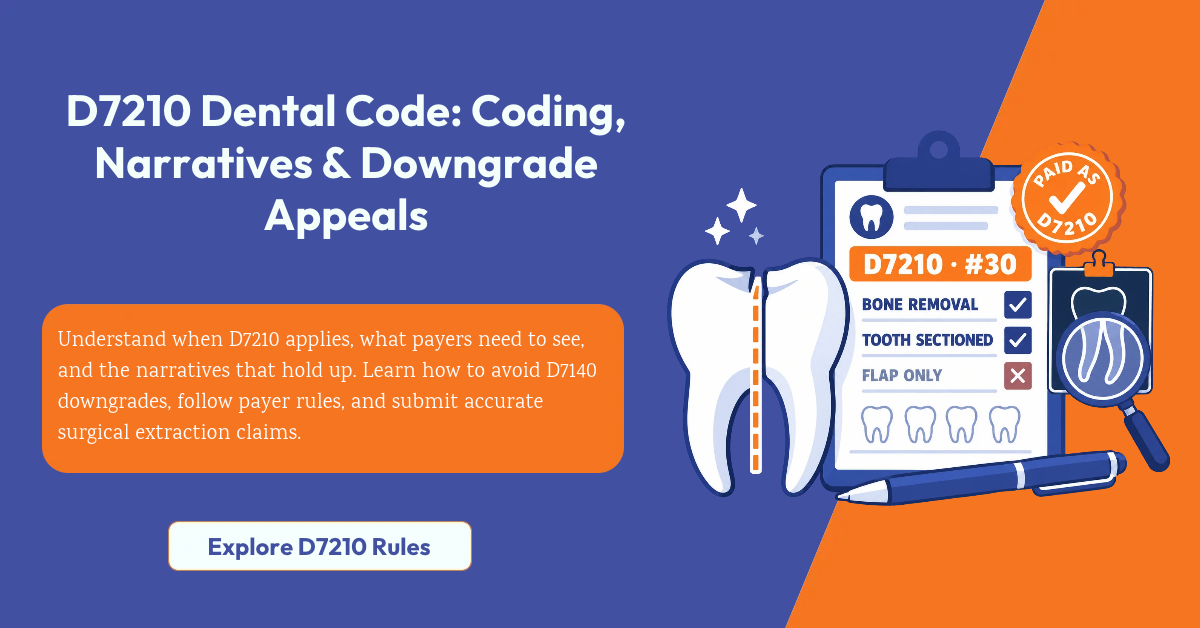
The D7210 dental code is the CDT code for extracting an erupted tooth when the dentist has to remove bone, section the tooth, or both. That includes a flap when the case needs one, but a flap alone doesn't qualify. Impacted teeth and leftover roots have their own codes.
Payers can downgrade D7210 to D7140 when the chart note and images don't show bone removal or sectioning. Aetna's downcoding policy uses that change as an example. Our team at iDental Billing works these claims for dental practices and DSOs, and the first place we look is the chart note.
Key takeaways
- D7210 requires bone removal, tooth sectioning, or both. A flap alone isn't enough.
- D7210 is for erupted teeth only. Impacted teeth use D7220 to D7241; residual roots needing cutting use D7250.
- The procedure performed sets the code, whatever the difficulty or chair time.
- Delta Dental of California and Aetna want current radiographs; Delta Dental of California also wants tooth-specific chart notes.
- D7210 wasn't revised in CDT 2026 and isn't among the approved CDT 2027 changes.
- Medicare accepts CDT codes, so D7210 itself can go on a Medicare claim when coverage applies.
What Is the D7210 Dental Code?
D7210 is the CDT code for "extraction, erupted tooth requiring removal of bone and/or sectioning of tooth, and including elevation of mucoperiosteal flap if indicated." In the ADA's Guide to Extractions, that nomenclature and a descriptor listing the included steps make up the full D7210 dental code description.
Some payer documents still print older wording. Aetna's downcoding page uses "surgical removal of erupted tooth requiring elevation of mucoperiosteal flap and removal of bone and/or section of tooth." UnitedHealthcare's Medicare review guideline, DRG050.05, prints a different older version that also starts with "surgical removal." Code from the current ADA wording.
Your staff may see it written as CDT code D7210 or dental code 7210, and it's the same code either way. CMS lists CDT, the ADA's Code on Dental Procedures and Nomenclature, as the HIPAA standard code set for dental procedures, so commercial plans and Medicaid programs read the same nomenclature.
What the D7210 descriptor includes
The ADA descriptor bundles four steps into D7210:
- Cutting of the gum tissue and bone around the tooth
- Removal of tooth structure
- Minor smoothing of the socket
- Closure of the site
In plain terms, the tooth has come through the gum, but elevators and forceps couldn't deliver it on their own. The dentist removed bone, sectioned the tooth, or did both, and then closed the site.
Is D7210 considered oral surgery?
Yes. Dental code D7210 sits in the oral and maxillofacial surgery category of CDT, codes D7000 to D7999, under surgical extractions. Any dentist can report it when the procedure matches, since the CDT Code makes no distinction between general dentists and specialists.
ADA News wrote on December 2, 2025, that "in the past, this code was often referred to as the 'surgical extraction code' since all extractions are essentially surgeries." Because of that old nickname, staff searching for an ADA code for surgical extraction can land on D7210 for cases that don't fit it.
D7210 status in CDT 2026 and CDT 2027
As of October 2026, D7210 hasn't changed. CDT 2026 took effect January 1, 2026, with 60 changes: 31 additions, 14 revisions, six deletions, and nine editorial changes, according to ADA News on June 5, 2025. None of them touched D7210.
CDT 2027 runs from January 1, 2027, through December 31, 2027, and brings 67 changes: 28 additions, 33 revisions, no deletions, and six editorial changes. D7210 isn't among the approved changes in the ADA Code Maintenance Committee's March 2026 decisions. Confirm against the printed CDT 2027 manual when it arrives.
When D7210 Applies: Bone Removal, Sectioning, or Both
The D7210 dental code applies when getting an erupted tooth out required bone removal, sectioning, or both, and the operative note says which. ADA News put the rule in five words on December 2, 2025: "Code for what you do."
Bone removal means cutting away alveolar bone to reach or free the tooth. Sectioning means cutting the tooth into pieces so each piece comes out on its own. The note has to name at least one of those two steps to support the surgical extraction code, whatever the route slip says.
Does flap elevation alone qualify for D7210?
No. Raising a flap without removing bone or sectioning the tooth doesn't qualify for D7210. Delta Dental of Arkansas's clinical criteria, dated September 25, 2025, put it in one line: "Elevation of a flap without bone removal or tooth sectioning is not a D7210 procedure."
You'll find the same sentence in Delta Dental of Washington's clinical criteria for individual and family plans. The phrase "if indicated" means the code includes a flap when the case needs one, and you don't bill the flap on its own.
Medi-Cal Dental's October 2025 bulletin sets a higher bar: D7210 is a benefit when removal "requires the elevation of a mucoperiosteal flap and the removal of substantial alveolar bone or sectioning of the tooth."
Does a long or difficult extraction qualify?
Chair time and effort don't change the code. The ADA Guide to Extractions points out that the extraction codes don't use words like "simple" or "difficult," so a 45-minute case with no bone removal or sectioning is still D7140.
Place of service doesn't change the code either. MO HealthNet's coding tip of July 2, 2026, says the procedure used determines whether an extraction is surgical. A D7210 surgical extraction done in an oral surgeon's office still needs bone removal or sectioning in the note.
Clinical indications that often lead to D7210
UnitedHealthcare's policy DCP005.13, effective November 1, 2025, lists these indications for surgical extraction of an erupted tooth:
- Tooth or roots fractured during a nonsurgical attempt
- Unusual root shape, such as dilaceration or cementosis
- Developmental abnormalities that make nonsurgical removal unsafe
- Fusion to an adjacent tooth
- Periapical lesions
- Maxillary posterior roots extending into the sinus
- Crowns or prior root canal treatment
An indication explains why the dentist chose a surgical approach, but your claim still has to show the bone removal or sectioning itself. Some conditions work against you: Aetna treats periodontally involved teeth with excessive bone loss or exposed roots as routine removal and won't pay them as surgical extractions.
D7210 vs D7140: How to Choose the Right Extraction Code
The difference between D7210 and D7140 is technique: D7140 covers an erupted tooth or exposed root removed by elevation and/or forceps, and D7210 adds bone removal, sectioning, or both. Per ADA News, both codes include removal of tooth structure, minor smoothing of the socket bone, and closure.
That shared smoothing step means filing down a sharp edge won't turn a D7140 into a D7210. Any D7210 vs D7140 call starts with tooth status, then technique. Use this table to compare the surgical extraction dental code with the other dental extraction codes your team reports.
Dental extraction codes at a glance
| Code | Use it when | Common mix-up |
|---|---|---|
| D7111 | Coronal remnants of a primary tooth | Using it for a rooted primary tooth (that's D7140) |
| D7140 | Erupted tooth or exposed root removed with elevators or forceps | Switching to D7210 because the case took longer |
| D7210 | Erupted tooth that needed bone removal, sectioning, or both | Billing it for a flap only, or for an impacted tooth |
| D7250 | Residual roots that need cutting of soft tissue or bone | Adding it to D7140 or D7210 on the same tooth |
| D7220 to D7241 | Impacted tooth, coded by clinical presentation | Coding an impacted third molar as D7210 |
| D7999 | Incomplete extraction (by report) | Billing D7140 for an incomplete extraction |
What if the tooth breaks during a D7140 extraction?
If the crown and root separate during a D7140 extraction and removing the root tip requires bone removal, report D7210, per the ADA Guide to Extractions Q&A. The separation can happen for any reason. A tooth that comes out in one piece with elevators and forceps stays D7140.
Say the crown of #19 snaps at the gumline during luxation, and the mesial root won't move until the dentist removes buccal bone. That case belongs under the D7210 dental code. If a separated root comes out with an elevator or forceps and no bone removal, the tooth stays D7140.
An unfinished extraction goes to D7999, "unspecified oral surgery procedure, by report," with a narrative. A second dentist who later removes the remaining roots reports D7140 or D7250, depending on whether those roots needed cutting. Note the moment the case changed: what broke, where, and what the dentist did next.
Can D7140 and D7210 be billed on the same visit?
Yes, on different teeth. Each code goes on its own claim line, with the tooth number in field 27. A D7210 on #30 and a D7140 on #19 on the same date make a normal claim. For one tooth, the codes are alternatives, never add-ons, so the D7140 vs D7210 choice happens tooth by tooth.
If your team argues D7140 versus D7210 case by case, pull last quarter's extraction claims and you'll see where the notes fall short. Request a free billing review, and a specialist will go through your claims, aging, and collections and show you what's recoverable.
Free billing reviewD7210 vs D7250, Impaction Codes, and Primary Teeth
D7210 covers erupted teeth only. Residual roots, impacted teeth, and primary tooth remnants each have their own code, so confirm tooth status before you look at technique.
Residual roots: when D7250 applies instead of D7210
Roots already sitting in the socket are D7140 if they come out with an elevator or forceps, and D7250 if removing them takes cutting. The D7250 dental code is "removal of residual tooth roots (cutting procedure)," and its descriptor includes cutting of soft tissue and bone, removal of tooth structure, and closure.
D7250 isn't an add-on for a hard extraction, and you don't report it with D7140 or D7210 on the same tooth. Some plans set a narrower test than CDT does. UnitedHealthcare's DCP005.13 ties D7250 to roots left in the bone after a previous incomplete extraction.
If a denial says a root wasn't "encased" in bone, the ADA Guide to Extractions treats that as a plan criterion, not a CDT requirement. CDT has no separate root tip extraction code. A root that breaks during your extraction stays on that tooth's line: D7140 if it came out with elevators or forceps, D7210 if it took bone removal.
Erupted wisdom teeth vs impacted third molars
Staff asking for "the wisdom teeth removal procedure code" need to hear that third molars are coded by eruption status, so no single surgical tooth extraction code covers them. An erupted third molar that needs bone removal or sectioning is D7210, and one delivered with elevators or forceps is D7140. Impacted third molars use four codes:
- D7220: removal of impacted tooth, soft tissue
- D7230: removal of impacted tooth, partially bony
- D7240: removal of impacted tooth, completely bony
- D7241: removal of impacted tooth, completely bony, with unusual surgical complications
ADA News says none of the four is based on difficulty; each one reflects how the tooth presents. Putting the D7210 dental code on an impacted third molar is miscoding. Aetna also asks for a written rationale on third molar extractions for patients age 15 or under.
Primary teeth: D7111, D7140, and Medicaid limits
Primary teeth add one code to the set. The D7111 dental code covers extraction of a primary tooth's coronal remnants retained by soft tissue. D7140's nomenclature names no dentition, so a rooted primary tooth removed with elevators or forceps fits it, and residual roots of a primary molar that need cutting are D7250.
Medicaid adds its own limits. MO HealthNet doesn't cover D7210 for primary teeth, according to its coding tip of July 2, 2026. State rules differ, so check the program manual and run dental insurance verification for Medicaid patients before the visit.
What D7210 Includes and What You Can Bill Separately
The fee for the D7210 dental code covers the extraction plus local anesthesia, suturing if needed, and routine postoperative care. Sedation, bone grafts, membranes, and some socket dressings are separate codes, and payers attach conditions to each one.
Does D7210 include anesthesia?
Local anesthesia, yes. Sedation and general anesthesia, no. The surgical extractions heading in CDT includes local anesthesia, suturing if needed, and routine postoperative care, and Rhode Island's Medicaid dental manual (version 3.0, May 2026) prints the same heading.
Leave D9210, "local anesthesia not in conjunction with operative or surgical procedures," off the claim for that visit. You bill sedation on its own lines, by time: D9222 and D9223 for deep sedation or general anesthesia; D9239 and D9243 for intravenous moderate sedation.
Sedation criteria come from the payer. Aetna, for example, considers sedation eligible for benefits when surgical extractions (D7210, D7220, D7250) span more than one quadrant on the same day, or when five or more teeth come out. It also wants a narrative and anesthesia records.
Alveoloplasty, sutures, and post-op complications
Minor smoothing of the socket bone, or bone removal that makes the extraction possible, is part of the extraction code. ADA News treats alveoloplasty as a distinct procedure. If the dentist does separate, documented recontouring, the D7310 dental code covers alveoloplasty in conjunction with extractions, four or more teeth or tooth spaces, per quadrant.
D7311 is the alveoloplasty dental code for one to three teeth or tooth spaces with extractions. D7320 and D7321 apply when the dentist performs alveoloplasty without extractions, in the same quadrant groupings.
Staff looking for a suture removal dental code after a D7210 should check the plan first. The CDT heading puts routine postoperative care inside the extraction, and Rhode Island Medicaid, for one, lists suture removal among services that don't warrant an additional fee.
Complications beyond routine care go to D9930, "treatment of complications (post-surgical), unusual circumstances, by report," with a narrative. CDT has no separate dental code for dry socket, though the D9930 descriptor in CDT 2017 used treatment of a dry socket as its example.
Some plans won't pay for dry socket care separately. Rhode Island Medicaid counts post-extraction treatment for alveolitis as part of total treatment, with no additional fee, so ask the plan how it handles a dry socket visit before you bill D9930.
Bone grafts, membranes, and socket dressings
You report D7953, D7921, and D7922 apart from D7210. For a bone graft with an extraction, the D7953 dental code covers a bone replacement graft for ridge preservation, per site. The ADA's 2026 graft reporting guide says D7953 doesn't include obtaining the graft material.
That same guide says to report a membrane on its own line. Before you put D7956 or D7957 (guided tissue regeneration, edentulous area, resorbable or nonresorbable barrier, per site) on the claim for an extraction-site membrane, check with the plan.
The D7921 dental code is "collection and application of autologous blood concentrate product," and dental code D7922 is "placement of intra-socket biological dressing to aid in hemostasis or clot stabilization, per site." Coverage for both varies by plan, so verify benefits first and document the reason.
D7210 Documentation Requirements by Payer
D7210 documentation requirements come down to two proofs: a current image that shows why a surgical approach was needed, and a chart note naming the step performed. Build each claim so a reviewer can confirm the D7210 dental code from your attachments alone, without calling the office or requesting the full chart.
Delta Dental of California and affiliates spelled this out in a notice dated October 7, 2025. For codes D7210 to D7241 and D7250 to D7252, it asks for a periapical or panoramic radiograph showing the tooth's current position and surrounding bone, plus chart notes. "Claims lacking the required documentation will be denied," the notice warns.
What the chart note must show
A note that supports the D7210 dental code in review covers five points, in the order the dentist worked:
- Tooth number and diagnosis
- The reason elevators and forceps weren't enough, such as root form, a crown, or a fracture during the attempt
- Flap elevation, if any
- Bone removal site or sectioning pattern
- Closure and sutures, if placed
In its FYI of July 16, 2026, the same Delta Dental group lists "tooth number or surgical complexity not documented" as a common reason for denial on extractions with general anesthesia. A note that only says "difficult" or "complicated" doesn't document surgical complexity.
Radiographs and attachments payers ask for
Every payer below wants a radiograph with a D7210 claim, but the image type, age limit, and extras differ. Aetna's documentation guidelines, last updated July 21, 2025, ask for unannotated films less than 36 months old.
D7210 documentation by payer
| Payer | Document and date | What it asks for with D7210 |
|---|---|---|
| Delta Dental of California and affiliates | FYI notice, October 7, 2025 | Periapical or panoramic radiographs showing current position and surrounding bone; tooth-specific chart notes; photographs if available |
| Delta Dental of New Jersey and Connecticut | Required documentation chart for CDT-2025 | PA and/or pano; a narrative in some cases (see the next section) |
| Aetna | Dental and Oral Surgery Claim Documentation Guidelines, last updated July 21, 2025 | Current dated full-mouth radiographs and/or a panoramic radiograph, unannotated and less than 36 months old |
| Medi-Cal Dental | Provider Bulletin Vol. 41, No. 35, October 2025 | Current diagnostic preoperative periapical or panoramic radiograph showing the entire tooth; a tooth code |
Send the preoperative image the payer names; a postoperative image of an empty socket meets none of these requirements. Attach everything to the first submission. The July 2026 FYI from Delta Dental of California and affiliates says missing details can lead to extra review, requests for information, denials, and resubmissions.
When a narrative is required
Send a narrative whenever the image alone doesn't show why bone removal or sectioning was needed. Delta Dental of New Jersey and Connecticut requires one for D7210 when the radiographs don't show gross decay, fracture, endodontic treatment, a large existing restoration, or anatomic variation.
Aetna's downcoding policy says teeth with advanced caries, large restorations, crowns, or a history of root canal therapy "may be considered" surgical extractions. Name those findings in your narrative when they're present, because Aetna's own policy names them as possible grounds for a surgical extraction.
If your team chases attachments claim by claim, iDental Billing's dental claim submission team sends the preoperative image and the chart note with the first submission, so the reviewer sees both before deciding.
Dental claim submissionD7210 Narrative Examples That Hold Up in Review
A D7210 narrative holds up when it answers three questions in order: why the tooth came out, why forceps alone wouldn't work, and which surgical step followed. The third answer is the one a reviewer needs to approve the D7210 dental code, so make it the most specific line in the narrative.
Write for a reviewer who never saw the patient and has only your note and images to go on. Weak notes give that reader a label or an effort level where they need a surgical step, as these three examples show:
Weak vs stronger D7210 chart notes
| Weak note | Why it fails | Stronger version |
|---|---|---|
| "Surgical extraction #30, sutures placed." | Names a label, not a step. Closure is part of D7140 too. | "Buccal bone removed around the roots of #30 to deliver the tooth; closed with two sutures." |
| "Difficult extraction, 45 minutes." | The ADA's extraction codes don't use "difficult," and time isn't a criterion. | "#3 sectioned into three root segments; each segment delivered on its own." |
| "Flap raised for access." | A flap alone isn't D7210 under Delta Dental of Arkansas's criteria. | "Flap raised; distal bone removed to free #18; tooth delivered." |
Bone removal narrative
Tooth #[number] extracted for [diagnosis]. [Short clinical crown, root form, or other finding] prevented delivery with elevators and forceps. Full-thickness mucoperiosteal flap raised on the [buccal]. [Buccal] bone removed around the [roots] to gain access and a path of delivery. Tooth delivered. Socket irrigated; closed with [number] sutures. Preoperative [PA or pano] dated [date] attached.
Sectioning narrative
Tooth #[number] extracted for [diagnosis]. Preoperative [PA] dated [date] shows [divergent or curved roots]. Forceps delivery risked [root fracture]. Tooth sectioned through the [furcation] into [mesial and distal] segments; each segment elevated and delivered. No bone removal beyond minor smoothing of the socket. Closed with [number] sutures. Image attached.
Keep the "no bone removal" line in the sectioning template. Sectioning alone qualifies, and putting that in writing heads off a reviewer who goes looking for bone the dentist never removed.
Crown and root separated during extraction
Extraction of #[number] began with elevators and forceps for [diagnosis]. Crown separated from the root at [level]. Root couldn't be elevated, so [buccal] bone was removed to deliver it. Socket irrigated; closed with [number] sutures. Reported as D7210 because removing the root required bone removal (ADA Guide to Extractions). Preoperative image dated [date] attached.
Fill every bracket from the chart, and never describe a step the note doesn't record. If these templates live in your charting software, recheck the wording before each January 1, when the new CDT version takes effect.
Why D7210 Gets Downgraded to D7140, and How to Appeal
D7210 gets downgraded to D7140 when a reviewer finds no bone removal or sectioning in the images and notes, or when plan policy calls the tooth a routine removal; you appeal with records that show the step. Aetna's downcoding policy says Aetna "does not automatically change" a submitted code but may change one after professional review.
The policy names what its reviewers read: x-rays, photographs, periodontal charting, narratives, and treatment notes. If a D7210 dental code comes back as D7140, start by asking which of those documents failed to show the bone removal or sectioning.
Read the EOB before you react
Read the EOB line for D7210 first, and quote its remark code and printed text in your request. A code change, a documentation denial, and a plan limitation each need a different response:
- Processed as D7140: request a reconsideration or appeal with stronger evidence.
- Denied for missing documentation: send the missing records as a re-evaluation, if the plan allows one.
- Limited by the plan, such as benefit class, frequency, or a waiting period: check eligibility, since new evidence won't change the contract.
What a D7210 appeal packet should include
Build the D7210 appeal packet around the step performed, and leave out how hard the extraction was. Send these five items:
- The payer's form, such as Aetna's Provider Complaint and Appeal Form or Delta Dental of New Jersey's Form 1A
- A copy of the EOB and the original claim
- The dated preoperative radiograph
- The chart note for the date of service, plus any photos
- A short letter quoting the D7210 nomenclature and the step from the note
Delta Dental of California and affiliates allow one re-evaluation per claim in most cases, and Delta Dental of Colorado wants "new and previously unreviewed documentation" in an appeal. Make the first request complete, with every document the reviewer could ask for.
Appeal deadlines differ by payer
Take each window from the payer's own appeals page or your provider contract, and calendar it the day the EOB posts.
D7210 appeal deadlines by payer
| Payer | First step for a D7210 downgrade | Deadline | Page date |
|---|---|---|---|
| Aetna Dental | Reconsideration (formal review of a coding decision) | 180 calendar days from the claim decision; then 60 days to appeal the reconsideration result; contract or state law can allow more time | Undated; checked October 3, 2026 |
| Delta Dental of New Jersey | Re-review, then internal appeal on Form 1A | 30 days from receiving the determination; the internal appeal is due 30 days after the determination or the re-review decision, whichever is later | Updated January 25, 2016 |
| Delta Dental of Colorado | Written appeal (commercial plans) | 180 days from the date the initial determination was sent | 2025 participating provider handbook |
Those two Delta Dental windows differ by 150 days, so note which Delta Dental company processed the claim. Call Delta Dental of New Jersey to confirm its window, since its appeals page dates to January 25, 2016.
A downgrade nobody appeals inside the payer's window stays a D7140 payment. If your ledger holds unappealed D7210 downgrades, iDental Billing's AR and denial follow-up team can take them on. That team works the aging report every week and appeals with the narrative, radiographs, or documentation the payer asked for.
AR and denial follow-upPosting a D7210 downgrade on the ledger
Post a D7210 downgrade as the EOB processed it, and check your participation contract before billing the patient more than the EOB's patient responsibility. The Delta Dental Dentist Handbook dated January 1, 2026, posted by Delta Dental of North Carolina, says participating dentists accept the approved amount when a procedure is "processed as" a different one.
Its alternative benefit rule works the other way: when the EOB applies an alternative benefit instead of a "processed as" change, you can collect the difference from the patient. Aetna's downcoding page is silent on patient liability, so follow the EOB and your contract.
Keep the original D7210 line in the ledger with an adjustment note beside it. If the appeal succeeds, your payment poster can repost the difference without rebuilding the claim.
Is D7210 Basic or Major? Coverage, Fees, and Medicaid Rules
D7210 is basic in some dental plans and major in others, and the plan document decides. Delta Dental of Arkansas noted in an October 2024 blog post that insurers may not agree on what counts as "basic." Because the class sets the patient's coinsurance, it belongs in the estimate your front desk gives before the extraction.
How dental plans classify D7210
Three published plan documents show the split:
- Delta Dental of Oklahoma's 2023 group packet lists "extractions and other covered oral surgery procedures" under basic services.
- Delta Dental of Arkansas's individual plans list "oral surgery (tooth removal)" under major services.
- Humana's New Mexico Complete Dental plan lists simple extractions as basic, covered at 80% after the deductible, and surgical extractions as major, at 50%.
Under that Humana plan, the patient owes 20% coinsurance after the deductible for a simple extraction and 50% for a surgical one. A downgrade from D7210 to D7140 on a plan like that changes the patient's share as well as the payer's.
What D7210 pays depends on the fee schedule
You won't find a national D7210 dental code cost; each payer's fee schedule and your contract set the number. Colorado Medicaid (Health First Colorado) pays $171.05 for D7210 and $106.89 for D7140 under the fee schedule DentaQuest posted, effective July 1, 2026.
That's a $64.16 gap per tooth in one program. Commercial fees come from each PPO contract, which your office gets through dental credentialing. Keep a grid of D7210 and D7140 allowances by payer, since that gap is what a downgrade costs you on each plan.
Medicaid rules that limit D7210
Three state programs show how far apart Medicaid rules on D7210 can run, so check the manual for each program you bill before treatment:
Medicaid rules for D7210 by program
| Program | D7210 rule | Source and date |
|---|---|---|
| MO HealthNet (Missouri) | Not covered for primary teeth; place of service doesn't make an extraction surgical | Coding tip, July 2, 2026 |
| Rhode Island Medicaid | No age limit and no prior authorization; extractions limited to once per tooth per lifetime | Dental Coverage Manual v3.0, May 2026 |
| Medi-Cal Dental (California) | Flap elevation and removal of substantial alveolar bone or sectioning (bulletin wording); current preoperative PA or pano showing the entire tooth; a tooth code | Provider Bulletin Vol. 41, No. 35, October 2025 |
Erupted wisdom teeth, annual maximums, and estimates
Coverage for an erupted wisdom tooth billed under the D7210 dental code follows the plan's class for D7210, then the deductible, the annual maximum, and any waiting period. An impacted third molar goes on the claim as D7220 to D7241, so check the class for the exact code you'll bill.
Before the visit, confirm class, coinsurance, remaining maximum, deductible, waiting period, and frequency through pre-treatment benefit checks. A pre-treatment estimate helps the patient plan, but Delta Dental of California and affiliates say an estimate "is not a guarantee of payment," and Aetna's PPO office guide says the same.
Billing D7210 to Medical Insurance
Medical insurance can pay for an extraction that's part of covered medical treatment; a routine extraction stays with the dental plan. If it is covered and the payer accepts CDT codes, the D7210 dental code itself can go on the medical claim. CMS's HCPCS Level II Coding Procedures say CDT codes "are considered HCPCS Level II codes."
When medical insurance may pay for an extraction
Medicare excludes routine dental care, including removal of teeth, but can pay for dental services inextricably linked to certain covered medical treatments. CMS's Medicare dental coverage page, modified March 10, 2026, lists examples that include treating an oral or dental infection before or alongside:
- An organ transplant, including stem cell and bone marrow transplants
- Cardiac valve replacement or valvuloplasty
- Chemotherapy, CAR T-cell therapy, or high-dose antiresorptive therapy for cancer
- Head and neck cancer treatment
- Dialysis for end-stage renal disease
Since July 1, 2025, Medicare requires the KX modifier to identify these services as inextricably linked to covered medical care. It also requires an ICD-10 code on dental claims filed on the 837D or 2024 ADA form.
Commercial medical plans set coverage plan by plan. On the dental side, Delta Dental of New Jersey and Connecticut asks for a medical EOB on D7210, but only for one listed group. If both plans cover the extraction, coordination of benefits applies, so record which plan paid first and attach its EOB where the dental plan asks for one.
Filling out the CMS-1500 for D7210
On a CMS-1500, the D7210 dental code goes in item 24D like any HCPCS code, with the tooth number in the shaded area above that line. Before hunting for a D7210 CPT code, check whether the medical payer takes D7210 itself.
Noridian, a Medicare contractor, says on its dental page that it accepts CDT or CPT codes. Blue Cross and Blue Shield of Louisiana's January 2026 provider manual requires CDT codes for extractions. The NUCC 1500 instructions, version 13.0 from July 2025, set the field rules:
CMS-1500 fields for a D7210 claim
| CMS-1500 item | What goes in it for D7210 |
|---|---|
| 19 | Only what the payer's own instructions ask for |
| 21 | ICD indicator 0, then up to 12 ICD-10-CM codes lettered A to L |
| 24, shaded area | Qualifier JP plus the tooth number, such as JP30 |
| 24D | D7210, or the code the payer requires, plus modifiers such as KX for Medicare |
| 24E | Diagnosis pointer letters from item 21 |
| 24G | The number of teeth on the line (1 for a single tooth) |
Search for an extraction CPT code or a CPT code D7210 crosswalk, and some sites point to 41899, "unlisted procedure, dentoalveolar structures." That's an unlisted code with no extraction in its title.
In Transmittal 11801 (January 20, 2023), CMS clarified 41899 for hospital outpatient and ambulatory surgery center claims. It told providers to use a specific CDT code assigned to an APC instead, when one is available. Blue Cross and Blue Shield of Louisiana returns extraction claims filed with 41899.
Use 41899 only when a payer's written policy asks for it, and keep a copy of that policy on file with the claim.
Extraction of teeth: ICD-10 codes that support the claim
The ICD-10-CM code on a D7210 claim should state why the tooth came out, such as a periapical abscess, a cracked tooth, or a traumatic fracture.
ICD-10-CM codes that support a D7210 claim
| ICD-10-CM code | Official description | When it fits a D7210 claim |
|---|---|---|
| K04.7 | Periapical abscess without sinus | Infected tooth removed, including before a covered medical treatment |
| K02.53 | Dental caries on pit and fissure surface penetrating into pulp | Decay into the pulp; tooth not restorable |
| K03.81 | Cracked tooth | Crack leaves the tooth not restorable |
| S02.5XXA | Fracture of tooth (traumatic), initial encounter for closed fracture | Traumatic fracture at the first encounter |
| K05.311 to K05.329 | Chronic periodontitis, localized, slight (K05.311) through chronic periodontitis, generalized, unspecified severity (K05.329) | Use with care: Aetna treats periodontally involved teeth with excessive bone loss as routine removal |
K08.3, retained dental root, describes leftover roots, which you'd report as D7140 or D7250 under CDT, not D7210. On the ADA claim form, ICD-10-CM codes go in field 34a with qualifier AB in field 34, and you use field 29a to point each line to its diagnosis.
FY2027 ICD-10-CM codes apply to encounters from October 1, 2026, through September 30, 2027. Check that the code was valid on the date of service before the claim goes out.
D7210 Pre-Submission Checklist
Run these seven checks before a D7210 claim leaves the office, and fix anything that fails before you submit.
- Confirm the note names bone removal, sectioning, or both, on a numbered tooth.
- Verify the tooth was erupted; impactions use D7220 to D7241, and residual roots needing cutting use D7250.
- Attach a dated preoperative radiograph that shows the whole tooth and the bone around it.
- Add a narrative when the image alone doesn't show why surgery was needed.
- Remove D9210 from the claim, and bill sedation, grafts, and dressings only as separate, supported lines.
- Check benefit class, remaining maximum, and any prior authorization before treatment.
- Put the ICD-10 code and JP tooth number on a medical claim, plus KX when Medicare covers the service.
If you want these checks run on every surgical claim before it goes out, iDental Billing's dental billing services team runs them, with pricing from 2.95% of monthly collections. You won't pay a setup fee or sign a long-term contract, and claims that don't pay cost you nothing.
Practices still joining PPO networks can add credentialing at $150 per commercial payer, or $95 for billing clients. The full rate card, including government payers, is on the iDental Billing pricing page.
iDental Billing pricing pageD7210 Dental Code FAQs
Is D7210 a surgical extraction?
Yes. D7210 sits in the CDT surgical extractions subcategory, and ADA News notes it was often called the surgical extraction code in the past. That label doesn't decide the claim, though. D7210 applies only when the dentist removed bone, sectioned the tooth, or both, and the chart note shows it.
What does surgical removal of an erupted tooth mean?
Surgical removal of an erupted tooth means extracting a tooth that has come through the gum by removing bone, sectioning the tooth, or both, because elevators and forceps weren't enough. The phrase is older wording for D7210 that some payer documents still print. Today's ADA nomenclature begins "extraction, erupted tooth requiring removal of bone and/or sectioning of tooth."
Does sectioning without bone removal qualify for dental code D7210?
Yes. The nomenclature says "removal of bone and/or sectioning of tooth," so sectioning alone qualifies under CDT when the note records it. A flap alone is different: D7210 includes one "if indicated," but Delta Dental of Arkansas's criteria, dated September 25, 2025, state that a flap without bone removal or sectioning is not a D7210 procedure.
Is there a D7210 CPT code?
You don't need one when the payer accepts CDT codes, since CMS says CDT codes "are considered HCPCS Level II codes." Blue Cross and Blue Shield of Louisiana requires them for extractions. For hospital outpatient and surgery center claims, CMS prefers an APC-assigned CDT code over unlisted 41899, so use 41899 only when a payer's policy asks.
Does D7210 need prior authorization or a predetermination?
Prior authorization for D7210 depends on the plan. Rhode Island Medicaid requires none for D7210, per its May 2026 manual. For commercial plans, check during verification. A pre-treatment estimate shows the expected patient share, but Delta Dental of California and affiliates say an estimate isn't a guarantee of payment.
How many times can D7210 be billed for one tooth?
Once, because a tooth can come out only once. If the extraction can't be finished, the ADA Guide to Extractions points to D7999 by report, and a dentist who later removes the remaining roots reports D7140 or D7250. Rhode Island Medicaid also writes a once-per-tooth lifetime limit for extractions into its manual.
Where does the tooth number go on a D7210 claim?
On the ADA claim form, the tooth number goes in field 27, either one tooth per line or several on one line with the count in field 29b. A CMS-1500 takes it in the shaded area of item 24 as JP plus the number, such as JP19. Medi-Cal Dental requires a tooth code for the D7210 dental code.
Sources
ADA and code sets
- American Dental Association, Guide to Extractions: Tooth and Remnants (© 2024)
- ADA News, Tips to avoid claim denials due to common coding mistakes, December 2, 2025
- ADA News, 60 changes coming to CDT Code in 2026, June 5, 2025
- American Dental Association, Code Maintenance Committee (CDT 2027 changes)
- American Dental Association, Final Report of March 2026 Code Maintenance Committee Meeting Decisions
- American Dental Association, Guide to Graft Material Collection Procedure Reporting (© 2026)
- American Dental Association, Guide to Reporting Placement of Wound Dressing Materials (© 2024)
- American Dental Association, Dental Claim Form Completion Instructions, version 2024
- CMS, HIPAA Administrative Simplification Code Sets
- CMS, HCPCS Level II Coding Procedures, revised December 2022
- NUCC, 1500 Claim Form Reference Instruction Manual, version 13.0, July 2025
- CMS, ICD-10 (2027 ICD-10-CM files)
- American Academy of Pediatric Dentistry, Code on Dental Procedures (CDT 2017 reproduction)
Government and Medicaid
- CMS, Medicare Dental Coverage, modified March 10, 2026
- CMS, Transmittal 11801 (Change Request 13031), January 20, 2023
- Noridian Healthcare Solutions, JF Part B Dental, last updated June 11, 2025
- MO HealthNet, Coding dental extractions D7210 and D7140, July 2, 2026
- Rhode Island EOHHS, Medicaid Dental Services Coverage Manual, version 3.0, May 2026
- Medi-Cal Dental, Provider Bulletin Volume 41, Number 35, October 2025
- Colorado Medicaid (Health First Colorado) Dental FFS Fee Schedule, effective July 1, 2026, posted by DentaQuest
Payer policies
- Delta Dental of Arkansas, Clinical Criteria Guidelines, September 25, 2025
- Delta Dental of Washington, Clinical Criteria Guidelines (individual and family plans)
- Delta Dental of California and affiliates, Stop claim denials before they even start, October 7, 2025
- Delta Dental of California and affiliates, How to avoid common claim documentation gaps, July 16, 2026
- Delta Dental of New Jersey and Connecticut, Required Documentation Chart (CDT-2025)
- Delta Dental of California and affiliates, Dental insurance claims and payments
- Delta Dental of California and affiliates, Pre-Treatment Estimates
- Delta Dental of New Jersey, Review and Appeals Procedures (updated January 25, 2016)
- Delta Dental of Colorado, Participating Provider Handbook, 2025 update
- Delta Dental Dentist Handbook, January 1, 2026, posted by Delta Dental of North Carolina
- Delta Dental of Arkansas, Dental insurance terms explained, October 2024
- Delta Dental of Arkansas, Individual and family dental plans
- Delta Dental of Oklahoma, Select 2023 plan packet
- Aetna Dental, Downcoding and Bundling
- Aetna, Dental and Oral Surgery Claim Documentation Guidelines, last updated July 21, 2025
- Aetna Dental, Dispute and Appeal Process Overview
- Aetna Dental, Dental Office Guide (PPO, PDN, EPP)
- Humana, New Mexico Complete Dental plan summary
- UnitedHealthcare, Surgical and Partial Extractions of Erupted Teeth and Removal of Retained Roots, DCP005.13, effective November 1, 2025
- UnitedHealthcare, Medicare Dental Utilization Review Guideline, DRG050.05
- Blue Cross and Blue Shield of Louisiana, Professional Provider Office Manual, section 5.45 Dental, January 2026
ABOUT THE AUTHOR
Russell Bennett
Russell Bennett is a Dental RCM and Provider Credentialing Specialist at iDental Billing. He reviews billing workflows, resolves claim denials, outstanding insurance balances, and reimbursement discrepancies, and applies CDT coding and payer-specific guidelines. His work includes provider credentialing, payer enrollment, and recredentialing. Russell writes iDental Billing’s educational guides on what claims need, why they matter, and where things go wrong.