




















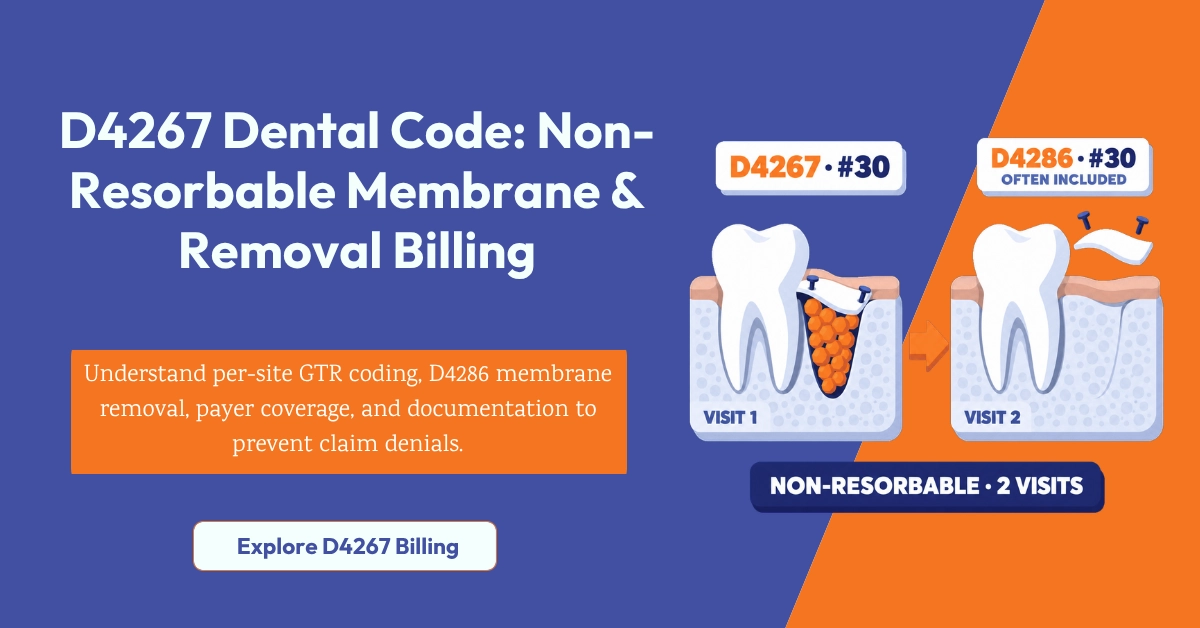
The D4267 dental code reports guided tissue regeneration (GTR) at a natural tooth with a non-resorbable barrier membrane, billed per site with a tooth number. Since CDT 2023, taking that membrane out has its own code, D4286. Cigna's guideline and Delta Dental Insurance Company's processing policy both fold it into the D4267 fee.
Money slips through on both visits. Some offices bill D4267 at an extraction socket or an implant, where D7957 or D6107 applies. Others send the removal visit to the patient when the contract says it isn't billable, or miss that the plan paid the placement at the D4266 rate.
This guide comes from the billing team at iDental Billing. It covers the code's current wording, the site codes, D4286, 2026 rules from Cigna, UnitedHealthcare, and Aetna, Medicaid examples, documentation, and appeals.
D4267 at a Glance
| Code | D4267 |
|---|---|
| Official wording (paraphrased) | Guided tissue regeneration, natural teeth, non-resorbable barrier, per site |
| CDT category | Periodontics, surgical services |
| Unit | Per site, with a tooth number on every line |
| Barrier type | Non-resorbable. UnitedHealthcare lists e-PTFE and alginate. |
| Removal visit | D4286 since CDT 2023. Cigna and Delta Dental Insurance Company include it in the placement fee. |
| Not included | Flap entry and closure, wound debridement, osseous contouring, bone grafts, and biologic materials |
| Wrong site, right code | Implant: D6107. Edentulous area or extraction socket: D7957. With periradicular surgery: no non-resorbable code exists (D3432 is resorbable only). |
| Resorbable twin | D4266 |
| CDT 2027 | No GTR code appears in the ADA's March 2026 decisions. |
What Is the D4267 Dental Code?
The D4267 dental code is the CDT code for guided tissue regeneration on a natural tooth with a non-resorbable barrier, reported per site. That membrane stays in place until a second procedure removes it. Every other part of the surgery, from the flap to the graft, goes on its own line.
You'll see it written as 4267, ADA code D4267, or CDT D4267 on fee schedules and EOBs. Pull the D4267 dental code description from any current source and you'll find the same core terms: natural teeth, non-resorbable, per site. Older payer tables add a removal phrase that CDT dropped in 2023.
A barrier keeps gum tissue from growing down into the bony defect while bone and periodontal ligament fill in. UnitedHealthcare's GTR policy (DCP045.10) names e-PTFE and alginate as non-resorbable options. It also cites a 2025 review in Periodontology 2000: GTR gained 3.27 mm of clinical attachment and cut probing depth 4.04 mm at five or more years.
D4267 sits in the Periodontics category of CDT, under surgical services, next to its resorbable twin. Our guide to CDT code sections shows how those categories fit together on a claim.
What Changed in CDT 2023, and Why Some Sources Still Say Removal Is Included
CDT 2023 rewrote D4267. The ADA added "natural teeth," removed the "includes membrane removal" phrase and peri-implant use, and created D4286 for the removal visit. That release also added D6107 and D7957 for implants and edentulous areas. The VA's DNT-0005 template (July 1, 2026) reprints the current wording with no removal language.
Old wording hasn't gone away. Aetna's DCPB002 bulletin still lists D4267 with "(includes membrane removal)" and lists D4286 in the same code table, and several coding sites copy the pre-2023 text. That's why search answers still say removal is included. Removal is its own CDT procedure now; whether anyone pays for it is a plan decision.
D4267 vs D4266: Same Procedure, Different Barrier
Barrier material is the only difference between D4267 and D4266. Both report GTR at a natural tooth, per site, with the same exclusions. D4266's membrane resorbs on its own. D4267's doesn't, so a second visit, reported as D4286, takes it out. Cigna covers all three codes in one policy, PERIO-09.
| D4266 | D4267 | |
|---|---|---|
| Barrier | Resorbable | Non-resorbable |
| Second visit | None | Removal, reported as D4286 |
| Materials UnitedHealthcare lists | Collagen, aliphatic polyesters | e-PTFE, alginate |
| Implant version | D6106 | D6107 |
| Edentulous area version | D7956 | D7957 |
| Unit | Per site | Per site |
The resorbable side, with the full GTR code family and a six-line surgical claim, is covered in our D4266 billing guide.
Why a Plan May Pay D4267 at the D4266 Rate
Some dental plan contracts carry an alternate benefit clause: the plan pays for the least costly treatment it considers professionally acceptable, and the patient may owe the rest. Membranes give payers room to use it. UHC's GTR policy cites Merli et al. (2016), which found no difference between e-PTFE and resorbable collagen membranes.
A plan with that clause may allow D4267 at the D4266 amount. The patient owes the difference only where the plan and your network contract allow it. Ask about alternate benefit clauses during benefits checks so the estimate holds up.
Merli's review did see complete defect fill more often with e-PTFE than with one resorbable type (PLGA). If the surgeon chose a non-resorbable barrier for a clinical reason, that reason belongs in the note.
Which Non-Resorbable Code Fits the Site? D4267, D6107, and D7957
Two questions decide the code: where's the defect, and does the membrane resorb? The D4267 dental code fills one cell in that grid. Rows below follow the code lists in the VA's DNT-0005 template and UHC's DCP045.10 policy.
| Site | Resorbable | Non-resorbable | Unit |
|---|---|---|---|
| Natural tooth | D4266 | D4267 | Per site |
| Implant | D6106 | D6107 | Per implant |
| Edentulous area, including an extraction socket | D7956 | D7957 | Per site |
| With periradicular surgery | D3432 | No code | Per site |
Source: VA DNT-0005 (July 1, 2026) and UnitedHealthcare DCP045.10 code lists. Removal of a non-resorbable barrier is D4286.
D4267 vs D6107: Membranes at Implants
Implant membranes bill per implant: D6107 when the barrier is non-resorbable and D6106 when it resorbs. Grafts there go on D6104 at implant placement or D6103 for a peri-implant defect, with the membrane on its own line. Cigna's natural-teeth policy also rules out GTR at an existing implant or at the same site and date as implant placement.
Descriptors before 2023 listed peri-implant defects under D4267, and a few coding pages still do. Any D4267 line on an implant is a corrected claim waiting to happen.
D4267 vs D7957: Sockets and Edentulous Ridges
Once the tooth is out, D4267 no longer fits. A non-resorbable membrane over a fresh socket or an edentulous ridge is D7957, per site. Cigna's PERIO-09 says GTR isn't allowable "when performed at the same site as a tooth removal or where there is no natural tooth present."
A public case shows why the 2023 change matters. In New York DFS external appeal 202108-140260, decided in 2021, a reviewer overturned Cigna's denial of D4267. The membrane covered a graft in the #14 area before an implant. Under today's codes, that membrane bills as D7957. Our extraction code guide covers the extraction line itself.
D4267 With Periradicular Surgery
No non-resorbable GTR code exists for periradicular surgery. D3432 covers a resorbable barrier placed with periradicular surgery, and nothing pairs with it on the non-resorbable side. Cigna's PERIO-09 also doesn't allow GTR at the same site as an apicoectomy, hemisection, root amputation, or periradicular surgery.
Endo-perio cases need care here. A D3428 graft with periradicular surgery and a D4267 membrane can both be valid on one tooth when they treat separate sites. A Cigna plan still won't allow GTR at the periradicular site. Document each site separately and check the plan before you quote the patient.
D4286: How to Bill the Membrane Removal Visit
D4286 is removal of a non-resorbable barrier, a code the ADA added in CDT 2023. Report it on the removal date with the same tooth number as the placement. Most of the payer policies below treat it as part of the D4267 dental code fee, at least when the same office handles both visits.
| Payer | Policy | What it says about D4286 |
|---|---|---|
| Cigna PPO | PERIO-09, guide 999493 (May 2026) | Removal "is considered part of the primary guided tissue regeneration service." |
| Delta Dental Insurance Company | Delta Dental Insurance Company, CDT 2023 summary | The removal fee is included in the D4267, D6107, or D7957 fee from the same tooth site. |
| Northeast Delta Dental | CDT 2023 code and policy changes | "Denied if done by a different dentist/dental office who placed the barrier (D4267)." Also: "Not billable to the patient if done by the same dentist/dental office who placed the barrier (D4267)." |
| Aetna | DCPB002 | Lists D4286, but still prints D4267 with "(includes membrane removal)." |
| UnitedHealthcare | DCP045.10 (May 1, 2026) | Lists D4286 as an applicable code, with no separate payment rule. |
Read Northeast Delta Dental's two lines word for word. The wording on the different-office case is ambiguous, so call the plan before you count on payment or bill anyone for the visit.
Same Office or a Different Office?
Cross-office removal is where policies split. A general dentist places the membrane and a periodontist takes it out, or the reverse. Put the placement date, the placing office, and the same tooth number in the removal note so the payer can match both visits.
How to Post the Removal Visit in Your Practice Software
Add D4286 to the perio surgical template right next to D4267. Post it on the removal date with the tooth number, even when the plan won't pay it, so the chart shows both visits. If the policy says the visit isn't billable to the patient, write the balance off. Don't let it drop to a patient statement by default.
If removal visits keep showing up on patient statements, our full-service dental billing team can set the posting rules with you.
What D4267 Doesn't Include, and What Bills on Its Own Line
Read the D4267 descriptor and you'll find it leaves out flap entry and closure, wound debridement, osseous contouring, bone replacement grafts, and biologic materials. If the surgeon does any of them, each one gets its own line. The membrane line pays for the barrier and nothing more.
| What the surgeon did | Code to report |
|---|---|
| Osseous surgery with a full-thickness flap | D4260 (four or more contiguous teeth or tooth-bounded spaces per quadrant) or D4261 (one to three) |
| Gingival flap with root planing, no bone reshaping | D4240 (four or more) or D4241 (one to three) |
| Bone replacement graft at a natural tooth | D4263 (first site in quadrant) or D4264 (each additional site in quadrant) |
| Biologic material, such as enamel matrix derivative | D4265, per site |
| Autologous blood concentrate (PRF or PRP) | D7921 |
| Non-resorbable barrier membrane | D4267, per site |
| Membrane removal at a later visit | D4286 |
Count sites the way you would for D4266. Separate defects on adjacent teeth are separate sites, and a defect that runs across the interproximal space between two teeth counts as one. D4267 has no "each additional site" code, so every site repeats D4267 on a new line.
Is D4267 a Bone Graft?
No. D4267 is the barrier, and the graft under it is a separate procedure. At a natural tooth, the graft is D4263 for the first site in a quadrant and D4264 for each additional site. For a socket, the graft is D7953 and the membrane is D7957. Implant sites take D6104 or D6103, with D6107 for the membrane.
When Do Payers Cover D4267? Medical Necessity Rules for 2026
Published GTR policies cover two defect types at a natural tooth: intrabony (vertical) defects and Class II furcations, on a tooth with a fair or better outlook. Cigna's PPO guideline adds a measurable test for the D4267 dental code: pocket depths of 5 mm or more plus bone loss on X-rays.
| Payer and policy | What it says |
|---|---|
| Cigna PPO: PERIO-09 (guide 999493, May 2026) | Allowable at a natural tooth with pocket depths of 5 mm or more plus bone loss. Not allowable under 5 mm or with no bone loss on X-rays, at a tooth removal site or where no natural tooth exists, at the same site as an apicoectomy, hemisection, root amputation, or periradicular surgery, at an existing implant, or at the same site and date as implant placement. |
| UnitedHealthcare: DCP045.10 (May 1, 2026) | Indicated for intrabony defects and Class II furcations. Not indicated for teeth with a poor or hopeless prognosis, uncontrolled medical conditions, healing-impairing medications including nicotine, non-compliance or poor oral hygiene, defects with fewer than two walls, crater defects, or periapical lesions of endodontic origin. |
| VA: DNT-0005 (July 1, 2026) | Lists current smoking or tobacco use and Grade III furcations as not clinically necessary. Requires favorable defect morphology, such as two-wall or greater defects, documented maintenance compliance, and controlled systemic conditions. |
Frequency and Site Limits
Cigna's PERIO-09 doesn't allow retreatment of the same tooth or site by the same office within 36 months, and it says the patient isn't responsible for that line. Northeast Delta Dental denies fees for more than two GTR sites in one quadrant, for D4266 and D4267 alike. Check frequency history during verification, not after surgery.
Medicaid Rules for D4267
Medicaid coverage for D4267 depends on the state program and the managed care plan. Three published examples show the range:
- DentaQuest's Texas authorization catalog lists D4267 for ages 13 to 20, with review required and a narrative of medical necessity plus pre-op X-rays.
- AZ Blue's Medicaid dental prior authorization list, dated January 1, 2026, includes D4267.
- UHC's Ohio Medicaid GTR policy (CSDEN308OH.A, effective December 1, 2023) lists both D4267 and D4286.
Check the state's current provider manual and the plan's own authorization list before treatment. The two don't always match, and the plan's list is the one that decides the claim.
Documentation That Gets D4267 Paid
UnitedHealthcare's claim review guideline DRG042.21 (January 1, 2026) asks for three items on a D4267 dental code claim: current dated pre-op radiographs, complete 6-point periodontal charting, and a narrative of necessity. Delta Dental of Colorado lists periodontal charting and X-rays as required attachments for D4266 and D4267.
Before surgery:
- Verify D4267 and D4286 benefits and any predetermination rule
- Check frequency history and the plan's site limit per quadrant
- Take a current, dated periapical of the tooth
- Record 6-point probing depths
- Chart the defect walls or the furcation class
- Write the prognosis grade with a one-line reason
- Confirm the site is a natural tooth
On the placement claim:
- One line per site, each with a tooth number
- Barrier described as non-resorbable, with the material named
- Each graft, biologic, or blood concentrate on its own line
- Radiograph, charting, and narrative attached on first submission
- Date of service matching the surgical note
At the removal visit:
- D4286 posted on the removal date
- Same tooth number as the placement line
- Placement date and placing office in the note
- Plan's D4286 rule checked before any patient balance
Claim Fields: The Tooth Code Your Carrier Requires
The ADA's Dental Claim Data Recommendation marks D4267 for a tooth number and recommends against reporting an area of the oral cavity. On the 2024 ADA claim form, item 27 carries the tooth and item 25 stays blank. Our walkthrough of ADA claim form fields covers the rest of the form.
Diagnosis codes go in item 34a with the "AB" qualifier in item 34, and each line points to its diagnosis in item 29a. Chronic periodontitis falls under K05.31 (localized) and K05.32 (generalized), with a sixth character for severity, such as K05.323 for generalized severe disease.
D4267 Narrative Templates for Placement and Removal
A guided tissue regeneration narrative should hold only facts a reviewer can check against the X-ray and the chart. Use one template for each visit.
Placement visit (D4267)
Tooth #[ ] [mesial/distal/buccal/lingual]: [2-wall/3-wall] intrabony defect [or Class II furcation] with [ ] mm probing depth and vertical bone loss on the periapical dated [Month Day, Year]. Prognosis: [good/fair]; tooth is maintainable. [Scaling and root planing completed on (date), re-evaluated on (date), if applicable.] Guided tissue regeneration performed with a non-resorbable [material] barrier at this site; removal planned. [Clinical reason for a non-resorbable barrier, in the surgeon's words, optional.] Bone replacement graft reported separately as D4263 [and biologic material (product) as D4265, if used]. No extraction, implant, or periradicular surgery at this site.
Removal visit (D4286)
Removal of non-resorbable barrier, tooth #[ ] [surface], placed on [Month Day, Year] by [this office / name of placing office]. Reported as D4286.
The optional line about the barrier choice helps when a plan applies an alternate benefit, though it won't guarantee the higher allowance.
Want a second set of eyes on how your recent perio claims went out? Ask for a free billing review and we'll go through the D4267 and D4286 lines with you.
Why D4267 Gets Denied and How to Appeal
The published payer rules point to five common triggers for a D4267 dental code denial: the wrong site code, defect criteria not met, a frequency or quadrant limit, a removal visit billed as extra, or an alternate benefit. Read the reason code first, because an appeal and a corrected claim fix different problems.
| Denial reason | What to do |
|---|---|
| No natural tooth at the site | Send a corrected claim with D7957 (socket or ridge) or D6107 (implant). |
| Pocket depth under 5 mm or no bone loss on X-rays (Cigna) | Appeal only if the charting and a periapical show both. |
| Same site as an apicoectomy or periradicular surgery (Cigna) | Not allowable at that site. If the sites differ, show it with tooth surfaces and the X-ray. |
| Same site retreated by the same office within 36 months (Cigna) | Write it off. Cigna says the patient isn't responsible. |
| More than two sites in one quadrant (Northeast Delta Dental) | Expect denial beyond the second site. |
| D4286 denied as included | Write it off where the policy says it isn't billable to the patient. |
| Paid at the D4266 allowance | Check the alternate benefit language. Bill the difference only if the plan and contract allow it. |
| Not a covered benefit | Bill the patient only if the contract allows it and they agreed in writing. |
For denials worth appealing, work in this order:
- Match the EOB reason code to the payer's published GTR policy.
- Pull the dated periapical, the 6-point charting, and the surgical note, and confirm the dates match.
- Write a one-page letter that answers the denial in the payer's own policy language.
- File before the appeal deadline printed on the EOB or in the provider manual.
- If the first level fails, ask about a second-level appeal and a dentist-to-dentist review, then any state external appeal. Medicaid managed care members can request a fair hearing.
Escalation can work. In the New York external appeal above, the reviewer cited the AAOMS Parameters of Care and a 2017 randomized study on socket preservation, and concluded that "the medical necessity is substantiated."
If denied perio claims are aging in your AR, our denied claim follow-up team can work them for you.
What Does D4267 Cost, and Can It Go to Medical Insurance?
There's no national fee for D4267. The D4267 dental code cost a patient sees depends on the office fee, the plan's allowed amount for each site, and the patient's coinsurance, deductible, and remaining annual maximum. A removal visit often adds nothing to the paid amount when the same office did the placement.
Per-site estimate (example letters only)
| Allowed amount per site | A |
|---|---|
| Plan pays per site | (A minus any unmet deductible) times the plan's coinsurance percentage, capped by the remaining annual maximum |
| Patient owes per site | A minus the plan payment, in network |
| Visit total | Each D4267 site, plus each graft or surgery line, plus D4286 only if the plan pays it |
Guided bone regeneration at an edentulous ridge isn't D4267. It bills as D7957 or D7956 for the membrane plus a graft code, such as D7950 for ridge augmentation or D7953 for ridge preservation, so the estimate needs both lines.
Aetna's DCPB002 calls GTR dental-in-nature oral surgery and says such procedures "may be covered under either medical or dental plans." Check the medical policy before you count on it, and send the K05 diagnosis with a narrative.
D4267 in CDT 2026 and CDT 2027
CDT 2026 took effect January 1, 2026, with 60 changes: 31 additions, 14 revisions, six deletions, and nine editorial changes. The VA's July 2026 template prints D4267 with the post-2023 wording, so the 2023 version still stands.
For CDT 2027, the ADA approved 67 changes, made up of 28 additions, 33 revisions, and six editorial updates, effective January 1, 2027. The Code Maintenance Committee's March 2026 decisions report shows no action on D4267, D4286, or any other GTR code. Its submitter withdrew a requested D7953 revision.
Code by date of service. A removal visit on December 30, 2026, uses CDT 2026, and one on January 4, 2027, uses CDT 2027. Our CDT 2027 update covers the rest of the changes.
D4267 FAQs
Short answers to common D4267 dental code questions from billers and front desks.
Is Membrane Removal Included in D4267, or Do I Bill D4286?
Removal has been its own CDT procedure, D4286, since CDT 2023, so the D4267 line covers placement only. Whether anyone pays for D4286 is a plan decision. Cigna treats removal as part of the primary GTR service, and Delta Dental Insurance Company includes it in the D4267 fee from the same tooth site.
Northeast Delta Dental bars billing the patient when the placing office removes the barrier. Some payer documents, including Aetna's DCPB002, still print the old "(includes membrane removal)" wording. Post D4286 on the removal date either way, and check the plan before anything moves to the patient.
Can D4267 Be Billed With Other Periodontal Procedures?
Yes, when the surgeon performed them. Osseous surgery, a bone replacement graft, a biologic, and the membrane each go on their own line, because the D4267 descriptor excludes everything except the barrier. A graft under the membrane at a natural tooth is D4263 or D4264.
Payment rules still apply. Cigna's PPO guideline doesn't allow D4265 when other regrowth treatments happen at the same site on the same date. It also bars GTR at the same site as periradicular surgery. Bill what was done, then set the estimate by each plan's rules.
How Often Can D4267 Be Billed?
It depends on the plan, and the published limits are specific. Cigna's PERIO-09 doesn't allow retreatment of the same tooth or site by the same office within 36 months, and the patient isn't responsible for that line. Northeast Delta Dental denies fees for more than two GTR sites in one quadrant.
Other plans write their own frequency rules into the benefit summary. Check frequency history during verification, before the surgery date, because better records can't fix a denial that comes from a frequency limit.
Does D4267 Need Prior Authorization?
It depends on the plan and the program. Commercial dental plans set their own rules, so check whether the plan requires prior authorization for D4267 or only offers an optional predetermination. Some Medicaid programs require review before surgery and publish lists of the codes that need it.
DentaQuest's Texas catalog lists D4267 for ages 13 to 20 with review required, and AZ Blue's Medicaid list dated January 1, 2026, includes it. Even when it's optional, a predetermination earns its keep on a two-visit procedure, because the response shows how the payer will treat both visits.
Why Was D4267 Paid at the D4266 Rate?
The plan probably applied an alternate benefit clause, paying the allowance for a less costly treatment it considers acceptable. For a non-resorbable membrane, that alternative is D4266. UHC's GTR policy cites research finding no difference between e-PTFE and resorbable collagen membranes, which gives payers room to treat them as interchangeable.
Check the plan's alternate benefit language and your network contract before billing the patient the difference. If the surgeon had a clinical reason for a non-resorbable barrier, put it in the narrative and appeal with the chart and X-ray attached.
Is D4267 Covered by Insurance?
Usually, when the plan covers periodontal surgery and the chart meets the payer's defect criteria. Payers that publish GTR policies, including UnitedHealthcare and Cigna, accept dental code D4267 for intrabony defects or Class II furcations at a natural tooth with a fair or better prognosis.
Payment still runs through coinsurance, the deductible, and the annual maximum, and some employer plans exclude periodontal surgery. The removal visit may add nothing to what the plan pays. Verify both codes before scheduling so the patient's estimate covers the whole treatment.
Before You Send Your Next D4267 Claim
Run three checks on each D4267 dental code line before the claim leaves the office:
- Is the site a natural tooth, with each separate defect on its own line?
- Is the removal visit set up under the plan's D4286 rule?
- Are the dated periapical, the 6-point charting, and the narrative attached?
If you'd rather hand these claims to a team that works dental claims full time, iDental Billing offers outsourced dental billing, including periodontal billing services for practices and DSOs. Billing pricing runs from 3.95% down to 2.95% of monthly collections based on volume, with nothing charged on unpaid or denied claims.
Sources
- American Dental Association, Dental Claim Data Recommendation: Area of the Oral Cavity and Tooth Anatomy (January 1, 2025)
- American Dental Association, Final Report of March 2026 Code Maintenance Committee Decisions
- ADA News, 67 Changes Coming to CDT 2027 (April 14, 2026)
- ADA News, 60 Changes Coming to CDT Code in 2026 (June 5, 2025)
- U.S. Department of Veterans Affairs, CDI DNT-0005: Dental Barrier Membrane Guided Tissue Regeneration (July 1, 2026)
- UnitedHealthcare, Dental Barrier Membrane Guided Tissue Regeneration, DCP045.10 (May 1, 2026)
- UnitedHealthcare, National Standardized Dental Claim Review Guidelines, DRG042.21 (January 1, 2026)
- UnitedHealthcare Community Plan of Ohio, Dental Barrier Membrane Guided Tissue Regeneration, CSDEN308OH.A (December 1, 2023)
- Cigna Healthcare, Dental Clinical Coverage Determination Guidelines, DPPO and Indemnity, 999493 (May 2026)
- Aetna, Dental Clinical Policy Bulletin DCPB002: Guided Tissue Regeneration
- Northeast Delta Dental, CDT 2023 Code and Policy Changes
- Delta Dental Insurance Company, CDT 2023 Summary of Changes and Claims Processing Policies
- Delta Dental of Colorado, Codes Requiring Attachments
- New York State Department of Financial Services, External Appeal 202108-140260
- DentaQuest, Texas Authorization Catalog
- AZ Blue, Medicaid Dental Prior Authorization Codes List (January 1, 2026)
CDT is a trademark of the American Dental Association, which holds the copyright to the CDT Code. Code titles in this guide are paraphrased except where quoted.
ABOUT THE AUTHOR
Russell Bennett
Russell Bennett is a Dental RCM and Provider Credentialing Specialist at iDental Billing. He reviews billing workflows, resolves claim denials, outstanding insurance balances, and reimbursement discrepancies, and applies CDT coding and payer-specific guidelines. His work includes provider credentialing, payer enrollment, and recredentialing. Russell writes iDental Billing’s educational guides on what claims need, why they matter, and where things go wrong.