








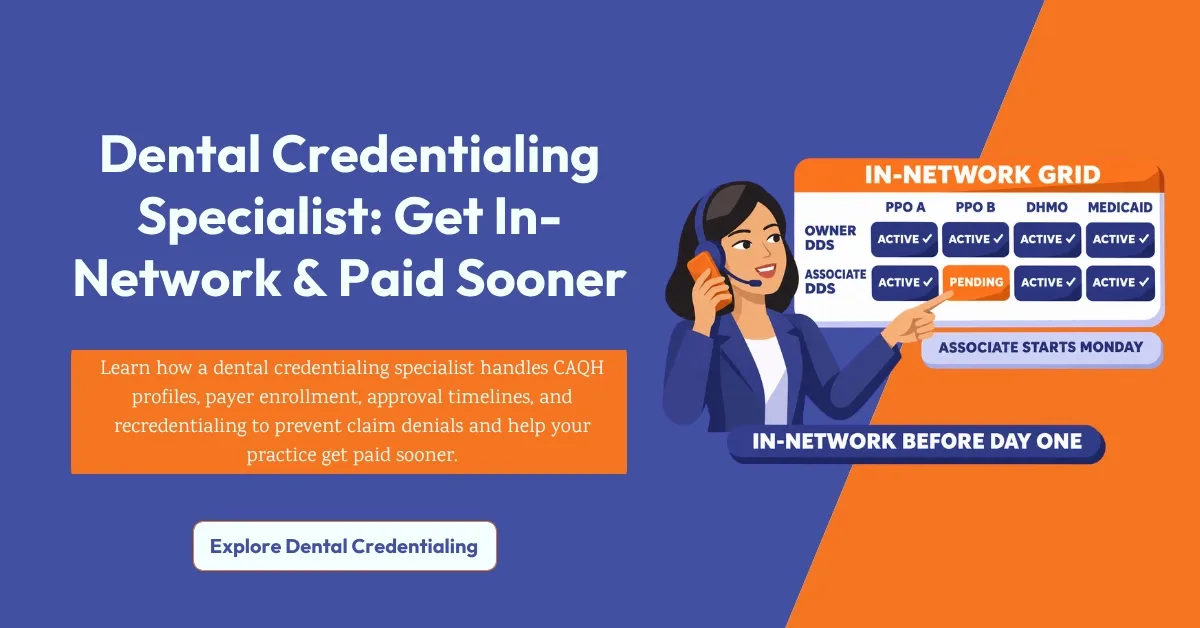
Your new associate starts Monday. The schedule's full, and half those patients carry PPO (preferred provider organization) plans. Your front desk can't confirm whether any of those payers has issued an effective date yet. Until someone does, each claim filed under that dentist is a guess about in-network payment.
A dental credentialing specialist gets each dentist approved, active, and billable with every payer you accept, then keeps them that way. Dental credentialing takes months, and each payer runs its own process. It's also the first job your team drops when the phones are ringing and the waiting room is full.
The answers below cover four things: the specialist's core jobs, payer timelines, what happens to claims during the wait, and who should own the work. We file these applications every week at iDental Billing, and the scenarios here come from those files.
Key takeaways
- A credentialing specialist gets each dentist approved and active with insurance payers, so claims pay at in-network rates.
- The core work is a clean DataSpring (formerly CAQH) profile re-attested every 120 days, complete payer applications, steady follow-up, and recredentialing filed before it's due.
- In our experience, many payers take 90 to 120 days on their own. A July 2026 American Dental Association (ADA) toolkit asks payers to decide clean, complete applications within one week.
- Claims for a dentist who isn't active with a payer yet can deny or pay at out-of-network rates.
- Practices can keep credentialing in-house or outsource it. Volume, staff time, and cost decide which option fits.
What Is a Dental Credentialing Specialist?
A dental credentialing specialist verifies a dentist's qualifications and enrolls that dentist with dental insurance payers so the practice can bill in-network. Those payers include PPO, dental HMO (DHMO), Medicaid, and Medicare plans. The specialist then keeps each file current through license renewals, profile updates, and recredentialing.
Credentialing vs. Payer Enrollment vs. Contracting
Owners often swap these three terms, but payers treat them as separate steps. Credentialing dentists comes first, and a dentist still can't bill a payer in-network until the payer completes all three.
| Step | What happens | What you get |
|---|---|---|
| Credentialing | The payer verifies the dentist's license, education, malpractice coverage, work history, and National Practitioner Data Bank (NPDB) record | Approval to join the network |
| Payer enrollment | The payer loads the dentist and the practice into its network and claims system | An effective date and in-network status |
| Contracting | The practice signs the participation agreement and accepts the payer's fee schedule | Contracted rates |
Many dental payers bundle all three steps into one application packet. That's why dental insurance credentialing feels like one long wait, even though the payer runs three reviews inside it. A common snag: the approval email lands while the participation agreement sits unsigned in the owner's inbox.
Where Credentialing Specialists Work
Dental credentialing work happens in four places:
- Inside the practice, often an office manager handling it on top of a full day
- On a dental service organization's (DSO) central credentialing team
- At an outsourced credentialing company or revenue cycle management (RCM) partner
- On the payer side, reviewing applications instead of filing them
Insurance companies and credentials verification organizations (CVOs) hire their own specialists to check incoming files. Those reviewers work for the payer. The specialist this guide describes works for your practice and prepares the files they review.
No state or federal agency licenses the title. You'll see voluntary certifications on resumes, and the CPCS versus CPES comparison further down shows which one fits dental work.
What a Dental Credentialing Specialist Does for Your Practice
A dental credentialing specialist keeps revenue moving through six jobs. Those jobs are maintaining each dentist's CAQH profile, submitting complete payer applications, following up until the payer confirms an effective date, connecting approvals to billing, tracking renewals, and helping the practice pick its PPO networks.
Keeps Your CAQH Profile Ready for Every Payer
The ADA Credentialing Service, powered by CAQH, is free to all dentists licensed in the U.S., member or not. Each dentist enters credentials once, then authorizes dental plans to pull them. The portal requires a re-attestation every 120 days, so CAQH for dentists is a standing task with a deadline.
CAQH rebranded as DataSpring, powered by CAQH, in June 2026, and the ADA says the service continues without interruption. Most offices still say CAQH or ADA credentialing, and we will too. Solid CAQH dental credentialing work keeps documents and plan authorizations current, because one expired malpractice certificate can stall each application that pulls from that profile.
Builds a Complete Application for Each Payer
Each payer has its own forms, portal, and quirks. A specialist tailors the packet to that payer and sends it complete the first time, since a returned file often goes back to the end of the line. Some payers also bypass CAQH and require their own portal, which the payer notes below cover.
Mismatched details cause more returned files than anything else we see. The application, the National Provider Identifier (NPI) record, the state license, and the Drug Enforcement Administration (DEA) registration need to agree. An old practice address on one of them can send the whole packet back.
Follows Up Until You Have an Effective Date
Applications move through a set of statuses: submitted, in review, more information requested, approved, and active. A specialist checks status on a fixed schedule, answers payer requests the same week, and keeps the file open until the effective date arrives in writing.
That date is the first day the dentist can bill the payer in-network. If the approval email doesn't name an effective date, your specialist still has a call to make before anyone books that dentist's plan patients.
Connects Credentialing to Your Billing
Once a payer confirms the dentist, someone has to load that approval into your practice management software, whether you run Dentrix, Eaglesoft, or Open Dental. That means the dentist's NPI, the practice's tax identification number (TIN), and the payer's fee schedule. Electronic funds transfer (EFT) and electronic remittance advice (ERA) enrollment happen payer by payer.
Dentist credentialing isn't finished until the front desk has a simple grid showing which dentist is in-network with which plan. Skip the grid, and someone books a Delta Dental patient with the one associate who isn't active with Delta Dental yet.
Tracks Renewals and Recredentialing
Licenses, DEA registrations, and malpractice policies expire on their own schedules. A specialist tracks each date and renews before a payer spots the gap. Payers run their own cycle too: federal Medicare Advantage rules require plans to recredential providers at least every three years. Commercial dental plans often run a similar cycle of two to three years.
Miss a recredentialing request, and the payer can end your network participation. Claims for that dentist then process out-of-network until someone gets the file reinstated.
Helps You Choose Which PPO Networks to Join
Getting paneled with every PPO in town fills chairs, but it doesn't always raise collections. Before applying, a specialist compares each payer's fee schedule with your own fees and patient mix. Some payers will discuss fees with a practice. Many won't move much for a small office, and you're better off knowing that before you sign.
Smart PPO credentialing starts with a short list. A network with low fees can fill Tuesday afternoons while cutting what you collect per visit, and leaving a network later means following the termination terms in your agreement.
If nobody on your team has the hours to chase applications and re-attestations, our dental credentialing services cover the full file, from CAQH setup to a written effective date.
How Long Does Dental Credentialing Take?
Dental credentialing usually takes a few months per payer. In our experience, many payers take 90 to 120 days on their own, and Medicaid and Medicare often take longer. A complete, consistent application is the biggest factor you control, since a returned file often restarts the clock.
Dentist Credentialing Requirements: The Documents Payers Ask For
A missing or outdated document can hold up a file for weeks, so gather these before you open a single application:
- An active, unrestricted state dental license
- The dentist's individual NPI (Type 1), plus the group NPI (Type 2) if you bill under a group
- A DEA registration and any state controlled substance registration, if the dentist prescribes
- A malpractice certificate of insurance at the limits each plan requires
- The dental degree, any specialty training, and a CV with month and year dates and each gap explained
- A W-9, the practice TIN, and each location where the dentist will see patients
- A complete, attested CAQH profile
The name and address should match on the license, the NPI record, the DEA registration, and the application. A dentist who moved practices last year and never updated the NPI address is the classic example of a file that bounces.
How to Credential a Dental Provider, Step by Step
The dental credentialing process runs through seven steps with most payers. Forms and portals differ, but dental provider credentialing keeps this order:
- Gather documents. Start with the checklist above and fix any mismatches first.
- Complete and attest the CAQH profile. Then authorize each plan, or pick the global option the ADA recommends, so payers can view it.
- Choose payers and submit applications. Use each payer's own form or portal where it requires one.
- Clear primary source verification. The payer confirms the license with the state dental board and queries the NPDB. A dentist can run an NPDB self-query first to see any reports on file.
- Pass committee review. The payer's credentialing committee approves or denies the file.
- Sign the contract and confirm the effective date. The practice signs the participation agreement, and the payer assigns the date.
- Set up billing and tracking. Load the payer in your practice management software, enroll in EFT and ERA, and calendar the recredentialing date.
Why Timelines Vary from Payer to Payer
Two practices can file with the same payer in the same week and get approvals months apart. Four factors drive the gap:
- Payer backlog and staffing, which you can't control
- Returned files from incomplete forms, mismatched addresses, or expired documents
- Government programs, since Medicaid and Medicare enrollment tends to run longer than commercial PPOs
- Tighter plan monitoring under the National Committee for Quality Assurance's (NCQA) 2025 credentialing updates
Those NCQA updates have accredited plans review sanctions, exclusions, and expirations at least every 30 days, and files processed from July 1, 2025 face shorter verification time limits. For dental insurance credentialing, that means a plan flags an expiring document sooner than it used to.
Can a Dentist Get Provisional Credentialing?
In July 2026, the ADA published a toolkit, approved by its Council on Dental Benefit Programs, that encourages payers to offer provisional credentialing. The ADA's provisional credentialing toolkit recommends capping that window at 60 days while the payer finishes its full review. It also asks payers to decide clean, complete applications within one week.
Payers can adopt the toolkit or ignore it, because it's voluntary guidance. Ask each payer whether it offers provisional participation before you put a new dentist on the schedule.
What Happens to Your Claims While Credentialing Is Pending?
Claims for a dentist who isn't active with a payer usually won't pay at in-network rates. Depending on the plan, they deny, process at the out-of-network level, or sit until the payer confirms the effective date. Some payers backdate the effective date. Many don't, so confirm before scheduling.
Three Ways Pending Credentialing Shows Up on Your EOBs
Pending credentialing tends to surface on explanation of benefits (EOB) forms in one of three ways:
- Denials with a non-participating provider reason, common with DHMO plans and Medicaid managed care, which typically pay only assigned or participating dentists
- Out-of-network processing on PPO plans, with a lower allowed amount, a bigger patient balance, and sometimes a check mailed to the patient instead of your office
- Held claims that sit in pending status until the payer finishes the file
A typical case of credentialing associate dentists too late goes like this. The associate starts in March, the applications go out in April, and six weeks of PPO claims process out-of-network before anyone checks the EOBs.
Why Billing Under Another Dentist's NPI Isn't a Workaround
Dental claims identify the dentist who performed the treatment, along with the billing provider. Putting an associate's work under the owner's NPI misidentifies who treated the patient. Payers can treat that as misrepresentation and recoup the payments later, sometimes across months of claims.
The safer options take patience. Wait for the effective date, ask about provisional participation, or book plan patients with a dentist who's already active, when that works for the patient's care.
How to Protect Revenue During the Wait
A dental credentialing specialist earns their keep in the gap between a signed offer and a confirmed effective date. Six habits protect your cash flow during that stretch:
- Start applications the day the dentist signs the offer, not the first day of work.
- Get each payer's effective date in writing before booking that dentist's plan patients.
- Ask each payer whether it offers provisional participation.
- Book plan patients with an active dentist while the new one is pending.
- Tell patients up front when a visit may process out-of-network.
- Run dental insurance verification before each visit, so surprises show up before treatment instead of on the EOB.
Already sitting on claims that denied because a dentist wasn't active yet? Once the payer confirms the effective date, you can often correct and resubmit some of them. Our team works aging accounts receivable (AR) like that every week through dental AR follow-up.
In-House vs. Outsourced Dental Credentialing: Which Fits Your Practice?
Outsourced dental credentialing usually fits practices that add dentists or payers often, or that don't have someone with time to follow up each week. In-house works when one trained person owns the work and volume stays steady. Software helps either way, but it doesn't file or chase applications for you.
Four Ways to Cover Credentialing
Each option below still needs a dental credentialing specialist's skills, and your decision comes down to who supplies them.
| Option | Best for | Main risk |
|---|---|---|
| Office manager, part time | One location with few payer changes | Follow-up slips when the front desk gets busy |
| Dedicated in-house specialist | Groups adding dentists each year | Files stall when that one person is out or leaves |
| Outsourced company or RCM partner | Practices short on staff time, or working across many payers or states | Picking a partner without dental payer experience |
| Dental credentialing software run by your staff | Teams that already have a trained person | Tracks tasks but doesn't do the payer work |
A virtual dental credentialing service works online through CAQH and payer portals, so its location has no effect on your files.
What a Credentialing Specialist Costs In-House
Hiring a dental credentialing specialist adds a payroll line with benefits attached. Indeed's salary data for credentialing specialists across healthcare, updated June 2026, shows average pay near $25 an hour and a typical range of about $18 to $36. At full time, $25 an hour comes to about $52,000 a year.
A dental group posting we reviewed in November 2026 offered $22 to $25 an hour for a remote role. Owners also forget the extras: benefits, training time, software, and coverage when that person is out. Picture your only credentialing person on vacation during the week three re-attestations come due.
What Outsourced Credentialing Costs
Dental credentialing cost depends on how a vendor prices the work: per application, per provider, or bundled into a billing contract. As one transparent example, iDental Billing publishes its dental credentialing pricing:
- $150 per commercial payer
- $250 per government payer (Medicaid, Medicare, or the Provider Enrollment, Chain, and Ownership System, known as PECOS)
- $1,099 flat for a full panel of eight payers, up to three of them government
- $95 per payer for recredentialing when it comes due
- $95 per commercial payer and $175 per government payer for iDental billing clients
Our average is 55 days to approval across more than 4,000 applications, mixing commercial and government payers. That compares with the three to four months many payers take without steady follow-up. Resubmissions after a payer returns a file don't cost extra.
When Outsourcing Makes Sense
A dental credentialing company tends to pay off when one or more of these sounds like your office:
- You add associates, locations, or payers more than once a year.
- Your payer mix includes Medicaid or Medicare, which take longer and need more follow-up.
- Nobody on staff can block out weekly time for status checks.
- You've had claims deny because someone missed a recredentialing request.
- You practice in more than one state.
Dental credentialing services also work as a short project, such as a startup opening, even if you bring the work in-house later. Some offices use dental insurance credentialing services only for government payers and keep commercial PPOs in-house.
If you'd like a timeline and a quote for your specific payers before deciding, our outsourced dental credentialing team can map it out.
What to Look for in a Dental Credentialing Specialist
A good credentialing hire or partner brings experience enrolling dentists with dental payers, a fixed status report routine, and active tracking of CAQH and recredentialing dates. Certifications help but aren't required. For dental offices, the enrollment certification from the National Association Medical Staff Services (NAMSS) often beats the more familiar CPCS.
CPCS vs. CPES: Which Certification Fits a Dental Office?
Job ads often name only the CPCS, which leaves out the certification closest to dental office work. Both come from NAMSS:
| Certification | What it covers | Eligibility |
|---|---|---|
| Certified Provider Credentialing Specialist (CPCS) | Credentialing, privileging, and primary source verification; the exam excludes provider enrollment | At least 12 consecutive months in the field within the last 24 months, plus three years of experience in the past five |
| Certified Provider Enrollment Specialist (CPES) | Provider enrollment with payers and Medicare, plus ongoing monitoring and compliance; first exam offered in the Fall 2025 testing window | At least 12 consecutive months in provider enrollment within the last 24 months, plus three years of experience in the past five |
Most of a dental office's credentialing work is payer enrollment, so the NAMSS CPES certification lines up better with it. Experience with your own payers still counts for more than either certificate.
Questions to Ask Before You Hire or Outsource
Lists of the best dental credentialing services tend to sound alike, so test any candidate or dental credentialing company with these seven questions:
- Which dental payers have you enrolled dentists with in my state?
- How often will I get status updates, and in what format?
- Who tracks CAQH re-attestation, license and malpractice expirations, and recredentialing dates?
- What's your average time from submission to effective date, and how do you measure it?
- What happens when a payer returns an application?
- Will you sign a business associate agreement (BAA) under the Health Insurance Portability and Accountability Act (HIPAA) before handling provider data?
- Do you charge per file, per dentist, or monthly, and what's excluded?
A solid dentist credentialing partner answers all seven without hedging. If an answer sounds vague, ask to see a sample status report with the names blacked out.
Payer Notes: CAQH, ADA, Delta Dental, UnitedHealthcare, and Medicaid
Many dental payers can pull credentialing data from CAQH, but each one still runs its own process. Delta Dental works through separate member companies, UnitedHealthcare requires its own portal, and Medicaid follows each state's rules. A specialist keeps one clean CAQH profile, then works each payer's path.
That split means dental insurance credentialing still involves more than one form, even for a dentist with a spotless CAQH profile and every authorization in place.
CAQH and the ADA Credentialing Service
Three habits keep a CAQH dentist profile useful to payers:
- Pick global authorization, which the ADA and DataSpring recommend, or authorize each plan you join by name.
- Re-attest every 120 days, which the ADA says takes most dentists five to 10 minutes.
- Treat emails branded DataSpring, powered by CAQH, as normal, and open the portal from a saved bookmark instead of an emailed login link.
ADA credentialing data also downloads as a PDF summary or a full state application. Keep a current copy on file for payers that insist on their own forms.
Delta Dental Credentialing
Delta Dental operates through independent member companies. Each one serves its own state or region and runs its own network application. For a new dentist, Delta Dental credentialing starts with the member company for the state where that dentist practices.
Most member companies offer more than one network, such as Delta Dental PPO and Delta Dental Premier, with different fee schedules. Decide which networks fit before you apply, because PPO credentialing and Premier participation pay at different levels. Delta Dental recredentialing follows that member company's cycle, so calendar the date the day approval arrives.
UnitedHealthcare's Separate Portal
UnitedHealthcare requires in-network dentists to complete initial credentialing and recredentialing through its own portal. According to the ADA's report on UnitedHealthcare, published August 12, 2026, the portal can import CAQH data. The ADA wants UnitedHealthcare to accept a dentist's CAQH provider ID as a complete submission.
Until that changes, the ADA suggests asking provider relations whether the CAQH ID can replace the manual application. If some typing is unavoidable, offer the current CAQH PDF instead of rekeying each field, and keep the profile current.
Medicaid Dental Credentialing
Medicaid dental credentialing follows state rules, since each state runs its own Medicaid dental program. Many states contract with dental managed care plans or benefits administrators, so a dentist may need state Medicaid enrollment plus that plan's own credentialing. States also require periodic revalidation, on top of each plan's recredentialing.
A pediatric office can be active with the state program and still see denials from the managed care plan that pays the claims. Check both enrollments before the first Medicaid patient sits down.
Credentialing for New Associates, Startups, and Multi-Location Groups
Credentialing timing depends on your practice's situation. A new associate needs applications filed well before the start date. Startups need the business entity, TIN, and group NPI in place before any individual applications. Multi-location groups need each dentist linked to the right locations and to the TIN each payer pays.
Credentialing Associate Dentists Before Their First Day
A dental credentialing specialist works backward from the start date. File the day the associate signs, then link the associate's individual NPI to the practice's group NPI and TIN with each payer. Add the associate to each group agreement too.
Hold PPO patients for the new dentist until each payer confirms an effective date, and use the revenue steps above to cover the gap.
PPO Credentialing for a Startup Practice
PPO credentialing for a startup follows a strict order, because payers need the practice to exist on paper before they'll enroll a dentist there:
- Form the business entity and get an employer identification number (EIN), which becomes the practice TIN.
- Get the group NPI (Type 2) for the practice.
- Confirm the practice address, since payers need a service location on the application.
- Open the business bank account that EFT payments will land in.
- Update the dentist's CAQH profile with the new practice, then apply to the PPOs that fit your expected patient base.
Multi-Location Groups and DSOs
Multi-location groups need each dentist linked to each location where that dentist treats patients, under the TIN each payer pays. Acquisitions often change the TIN, which can mean new agreements or re-enrollment, so start that work before closing. Some payers let large groups handle credentialing under a delegated arrangement. Ask whether yours do once you reach that size.
Oral Surgeons and Medicare Enrollment
Medicare covers dental care only in limited cases tied to covered medical treatment, according to the Centers for Medicare & Medicaid Services (CMS). An oral surgeon clearing infection before a patient's heart valve replacement is a common example.
Other examples on the CMS Medicare dental coverage page include exams before an organ transplant and care linked to certain cancer treatments. Stabilizing teeth after a jaw fracture qualifies too, as do exams and infection treatment around dialysis for end-stage renal disease.
To bill Medicare and receive payment for those services, the dentist must enroll in Medicare through Medicare PECOS. Original Medicare doesn't cover routine cleanings or fillings, though some Medicare Advantage plans add dental benefits.
If you're adding a dentist or opening a location this year, our dental insurance credentialing services start by mapping which payers to file first, and when.
What's Changing in Dental Credentialing in 2026 and 2027
Last reviewed: November 3, 2026
Dental credentialing in 2026 and 2027 is shifting toward faster payer decisions and stricter data upkeep. CAQH became DataSpring in June 2026, and the ADA asked payers for provisional participation and faster reviews in July 2026. Current Dental Terminology (CDT) 2027 takes effect January 1, 2027. Clean, current files remain the part you control.
| When | What changed | What it means for your practice |
|---|---|---|
| June 2026 | CAQH rebranded as DataSpring, powered by CAQH, and the ADA Credentialing Service stays free | Same service, with emails under the new name |
| July 2026 | ADA toolkit encourages payers to offer provisional credentialing for up to 60 days and to decide clean applications within one week | Ask each payer whether it offers provisional participation |
| August 12, 2026 | ADA objected to UnitedHealthcare requiring its own credentialing portal | Keep the CAQH PDF ready to offer instead of retyping |
| January 1, 2027 | CDT 2027 takes effect, and the ADA lists 67 changes coming to CDT 2027, including 28 new codes | Update fee schedules and claim templates before your first 2027 date of service |
| July 1, 2027 (proposed) | NCQA's proposed 2027 standards would apply to plan surveys, with small administrative credentialing changes proposed | The 2025 monitoring rules stay in force, so expired documents still stall files |
| January 1, 2028 | California AB 1041 requires full-service health plans and insurers to use the CAQH credentialing form and sets a 90-day decision deadline for completed applications | Matters most for dentists credentialed with medical plans, such as oral surgeons, since the law doesn't name dental plans |
| Start date not set | The Dentist and Dental Hygienist Compact has 13 member states, but the commission hadn't issued any privileges as of September 2026 | Each state license still stands on its own for credentialing |
We review this table each January and July, and sooner when a payer or rule changes. If a row doesn't match what your payer told you, follow the payer's written policy for your contract.
Dental Credentialing Specialist FAQs
What is dental credentialing?
Dental credentialing is how a dental insurance payer checks a dentist's qualifications and approves that dentist to join its network. The payer verifies the license, education, malpractice coverage, and work history, then enrolls the dentist with an effective date. Until that date arrives, the dentist can't bill that payer at in-network rates.
A new associate with a clean record can still wait months for one PPO, because each payer's committee meets on its own schedule.
Can a dentist see patients before being credentialed?
Yes, a dentist can see patients before credentialing, but the claims may not pay as expected. Depending on the plan, claims for that dentist can deny or process out-of-network. Only some payers backdate the effective date, so you can't count on recovering the difference.
Since July 2026, the ADA has encouraged payers to offer provisional participation for up to 60 days, but it's voluntary. Confirm with each payer and get its answer in writing first.
How do you get credentialed with dental insurance?
You get credentialed with dental insurance by building a complete, attested CAQH profile, then applying to each payer you want to join. Answer payer requests within the week, follow up on a fixed schedule, and get the effective date in writing.
Finish by setting up EFT and ERA so payments post without manual work. A license address that doesn't match the NPI record is a common reason a file comes back unprocessed several weeks later.
How much does dental credentialing cost?
Dental credentialing costs depend on who does the work. An in-house specialist is a payroll expense, and Indeed's June 2026 data shows credentialing specialists averaging about $25 an hour. Outsourced services usually charge per application, per provider, or as part of a billing contract.
For reference, iDental Billing charges $150 per commercial payer and $250 per government payer, with lower rates for billing clients. Three commercial PPOs would come to $450 total at those rates.
How often do dentists need to recredential?
Dentists typically recredential with commercial dental payers every two to three years, and Medicare Advantage plans must recredential at least every three years. On a much shorter cycle, the CAQH profile needs re-attestation every 120 days.
Licenses, DEA registrations, and malpractice policies renew on their own dates, so each expiration needs tracking. A practice with four dentists can end up watching more than 20 renewal dates in a single year, which is why a shared calendar helps.
What does it mean to get paneled with dental insurance?
Getting paneled means a payer accepts you into its network as an in-network dentist, lists you in its directory, and pays its contracted fees. It takes credentialing plus a signed participation agreement, and the payer sets the fee schedule you'll accept.
Before joining, compare that fee schedule with your own fees, because a full schedule at low fees can still shrink collections. Run the numbers on your 10 most common procedures before you sign anything.
Getting Credentialed Is the First Step to Getting Paid
Each week a credentialing file sits untouched, you wait another week for that dentist's first in-network payment. A dental credentialing specialist can sit in your office or ours. Either way, three checks are worth doing this week:
- Look up each dentist's CAQH re-attestation date and fix anything due within 30 days.
- Build a simple grid of each dentist by payer, with the effective date for each.
- Start applications now for anyone joining the practice in the next three months.
If you'd rather hand credentialing and the billing that follows to one team, our outsourced dental billing services cover both, and billing clients pay less for dental credentialing services.
ABOUT THE AUTHOR
Russell Bennett
Russell Bennett is a Dental RCM and Provider Credentialing Specialist at iDental Billing. He reviews billing workflows, resolves claim denials, outstanding insurance balances, and reimbursement discrepancies, and applies CDT coding and payer-specific guidelines. His work includes provider credentialing, payer enrollment, and recredentialing. Russell writes iDental Billing’s educational guides on what claims need, why they matter, and where things go wrong.