












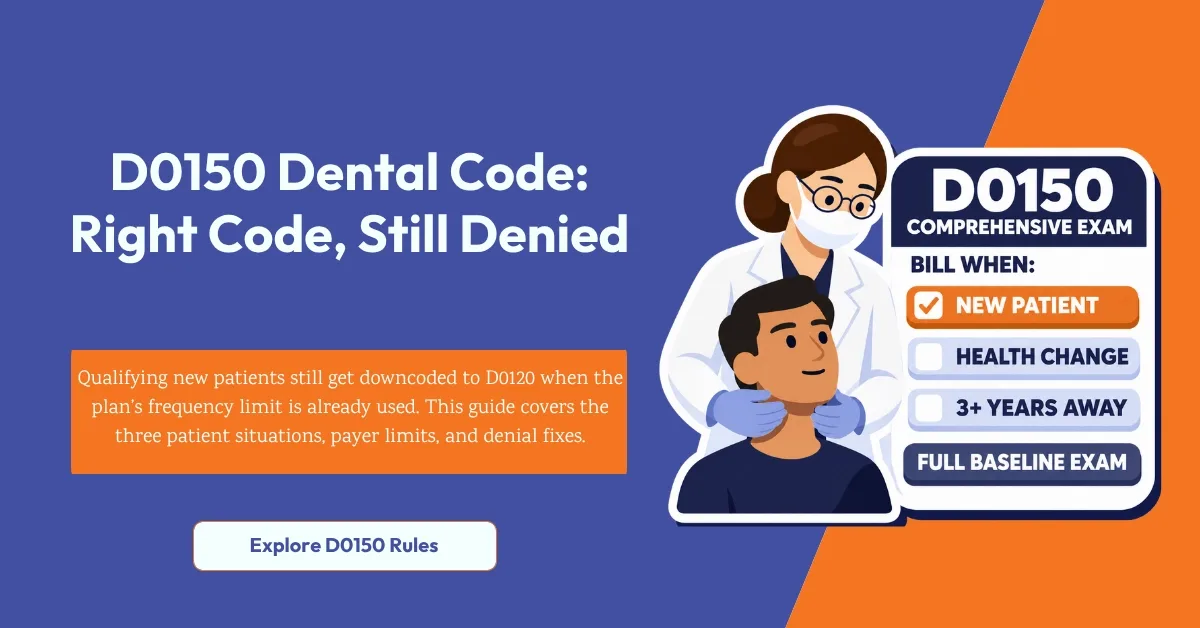
Covers CDT 2026 and CDT 2027 (effective January 1, 2027). Code wording and payer rules checked November 6, 2026.
The D0150 dental code is the ADA's CDT code for a comprehensive oral evaluation of a new or established patient. You can pick the right code, chart a thorough exam, and still watch the claim deny. Often, the plan already paid a comprehensive exam, sometimes at another office.
Three things decide whether D0150 pays: the patient situation, a chart note that shows comprehensive scope, and the plan's frequency rule. Picture a patient back after two years. Your front desk books a comprehensive exam, the claim goes out as D0150, and the EOB pays it as a D0120.
We're the billing team at iDental Billing, and exam codes cross our desks every day. You'll find the three qualifying situations below, plus what the exam must and may include, exam code comparisons, same-day and frequency rules, denial fixes, and where D0150 stands for CDT 2027.
Key Takeaways
- Definition: D0150 is a comprehensive oral evaluation for new or established patients, in the CDT Diagnostic category.
- Who qualifies: new patients, a significant health change by report, or three or more years away from active treatment.
- Required scope: extraoral and intraoral hard and soft tissues, an oral cancer evaluation, history, and a general health assessment.
- Payment: plans set D0150 frequency limits, and some pay it once per lifetime per provider.
- CDT 2027: the March 2026 Code Maintenance Committee report contains no change to D0150.
What Is the D0150 Dental Code?
D0150 is the American Dental Association's CDT code for a comprehensive oral evaluation, new or established patient. It sits in the Diagnostic category. General dentists and specialists report it for a new patient, a significant change in health, or a patient absent from active treatment three or more years.
For billing, comprehensive means baseline. A D0150 records the full picture that every later D0120 recall exam measures change against. Front desks call it the comp exam, so you'll also see people search for a comp exam dental code or a comprehensive dental exam code. Both point back to D0150.
The Official D0150 Dental Code Description, Paraphrased
Each CDT entry for D0150 has two parts. The nomenclature names the procedure: comprehensive oral evaluation, new or established patient. Its descriptor sets the scope and the conditions of use, and billers who stop reading at the name miss those conditions.
In paraphrase, the descriptor allows D0150 for a patient new to the dentist, for an established patient with a significant change in health or other unusual circumstances, and for an established patient away from active treatment three or more years. The ADA exam code guidance lists the same three situations.
That middle situation carries the words "by report," so your chart has to describe the change. The descriptor applies to general dentists and specialists alike. Since the ADA holds the CDT copyright, pull exact wording from the current CDT manual before you build a template around it.
Where ADA Code D0150 Sits in the CDT Code Set
D0150 belongs to the Diagnostic category, D0100 to D0999. Within it, the code sits under Clinical Oral Evaluations, next to D0120, D0140, D0145, D0160, D0170, D0171, and D0180. You'll find all 13 ranges in our breakdown of CDT code categories.
CDT is the HIPAA standard code set for dental procedures on electronic claims. Staff often say or type 0150 without the letter. Your claim still has to carry the full dental code D0150, with the D in front, or the payer's system won't read it as a valid procedure.
What Must a D0150 Comprehensive Oral Evaluation Include?
A D0150 must include an evaluation and recording of the extraoral and intraoral hard and soft tissues, an oral cancer evaluation, the dental and medical history, and a general health assessment. Everything else on the list is optional. Radiographs and other diagnostic tests go on their own claim lines.
D0150 scope at a glance
| Element | Status | What the chart note should show |
|---|---|---|
| Extraoral and intraoral hard and soft tissues | Must include | Head, neck, and intraoral findings, normal or not |
| Oral cancer evaluation | Must include | Screening done and its result |
| Dental and medical history | Must include | History reviewed and dated, medications listed |
| General health assessment | Must include | Overall health status and any risks the dentist noted |
| Caries, missing or unerupted teeth, restorations, prostheses, occlusion, tissue anomalies | May include | Findings charted for each item evaluated |
| Periodontal screening or charting | May include | Screening scores or probing depths, if done |
| Radiographs and other diagnostic tests | Report separately | Images taken and the dentist's interpretation |
| Prophylaxis | Not part of D0150 | Cleaning billed under its own code |
The must and may split above follows the CDT descriptor. You'll see the same breakdown, element by element, in the IHS exam code guidance, which also rules out D0150 for a routine six-month checkup.
Does D0150 Need Perio Charting?
No. The D0150 descriptor lists periodontal screening and charting among the things the exam may include, so the code requires neither a six-point chart nor a screening. D0180 is the exam code that requires full mouth probing and periodontal charting.
Many offices probe every new patient anyway, and the chart is stronger for it. If that probing shows periodontal disease, D0180 may describe the visit better than D0150 does. Section 4 walks through how to choose between the two.
Does D0150 Include X-Rays?
No. The dentist may interpret images during a D0150, but the descriptor sends additional diagnostic procedures to their own lines. Common pairings with a comprehensive exam are D0210 for a full mouth series, D0274 for four bitewings, D0330 for a panoramic image, and D0220 or D0230 for periapicals.
Our D0210 full mouth series guide covers when a full series pays. For two or four films, read through the bitewing codes guide. Each image code carries its own frequency limit, separate from the exam's, so a paid D0150 tells you nothing about whether the plan will pay the films.
Who Can Perform a D0150 Evaluation?
A dentist performs the evaluation. Under the CDT Clinical Oral Evaluations section, staff may collect and record some exam data, but diagnosis and treatment planning stay the dentist's responsibility. Bill D0150 under the dentist who completed the evaluation.
In March 2026, the ADA Code Maintenance Committee voted 23 to 1 against rewording that section, including language about qualified healthcare providers under state practice acts. The March 2026 committee report records the vote, so the dentist's role stays as written.
When to Bill D0150: Three Patient Situations That Qualify
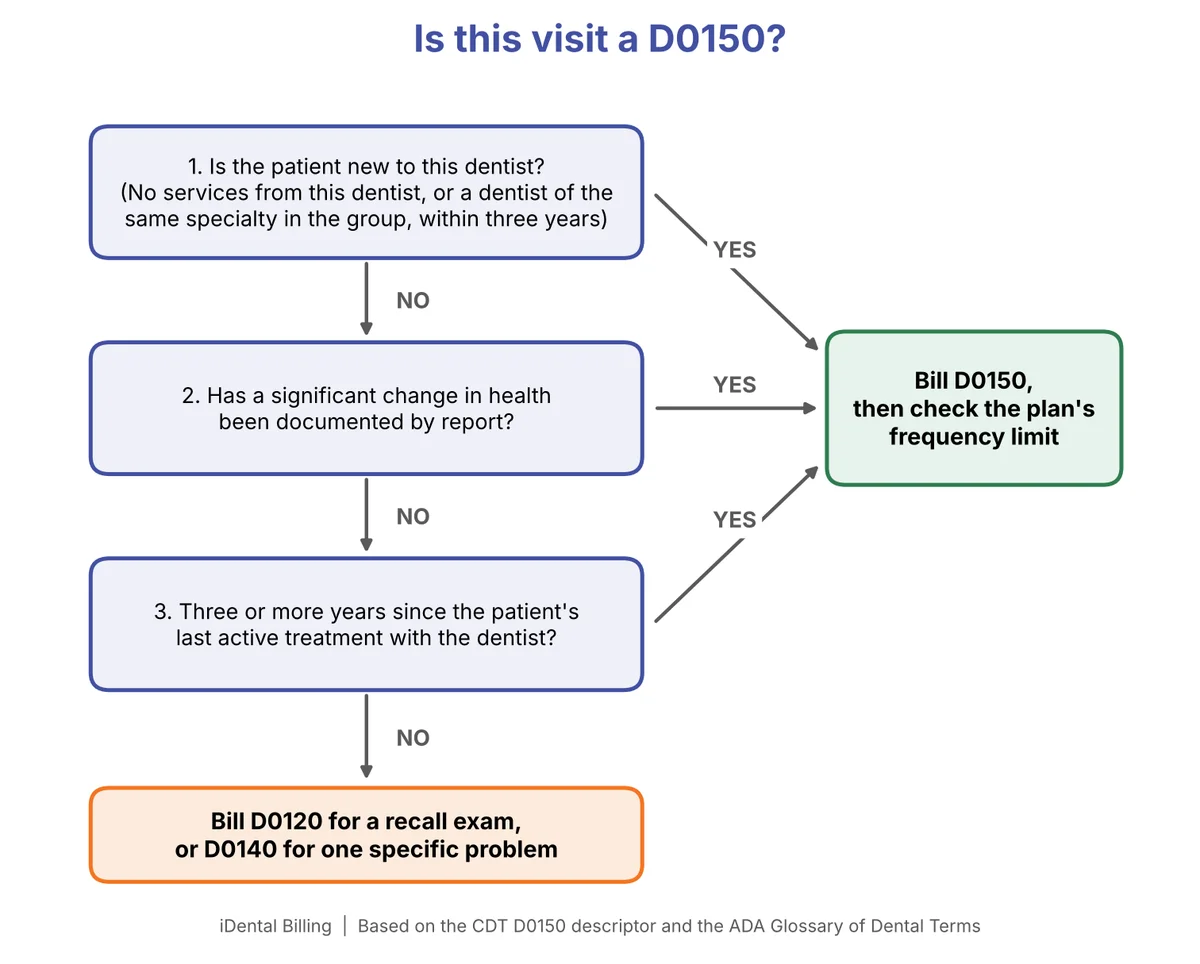
Bill D0150 when the patient is new to the dentist, when an established patient has a significant change in health or other unusual circumstances documented by report, or when an established patient has been absent from active treatment for three or more years. Payer frequency rules are a separate check.
New Patients, and Who Counts as New
A patient counts as established if they received professional services from the dentist, or from another dentist of the same specialty in the same group practice, within the past three years, subject to state law. That's the ADA glossary definition. Anyone outside it is new to the dentist.
A transfer from another practice is new to your dentist, so the D0150 dental code fits the coding rule. Payment is a separate question. The patient's last office may have billed a comprehensive exam months ago, and Section 6 shows how plans count that earlier claim.
Recall patients who switch to a new associate in the same group stay established if both dentists share a specialty. By that definition, the visit is a D0120 unless another qualifying situation applies. Check your state's rules too, since the glossary definition defers to state law.
Multispecialty groups add a wrinkle. Going by the glossary wording, a periodontist in the group may be seeing a new patient even if the group's general dentist examined them last month. The plan can still count that earlier exam against its limit, so verify benefits before booking the D0150.
Established Patients With a Significant Change in Health
Your chart carries this situation. The descriptor requires the change to be documented by report, so the record has to name the change and explain why it calls for a new baseline. One example: a medical diagnosis since the last visit that changes how the dentist plans care.
The ADA glossary defines "by report" as a written description that belongs in the patient record and goes out with the claim. Put a short narrative in Box 35 (Remarks) that names the change and when it started. Our dental narrative examples show how to keep it short and specific.
Time between visits doesn't count as a change in health. An established patient with no new diagnosis, medication, or condition won't qualify under this situation, however long the gap feels to the front desk.
Established Patients Away Three or More Years
Count the three years from the patient's last active treatment with the dentist. The date of the last D0150 has nothing to do with it. A patient back after 18 months gets a D0120 unless they've had a significant change in health.
Many offices flag a patient as inactive after two years and book the return as a new patient visit. That flag is an office label. It doesn't meet the three-year threshold in the descriptor, so a two-year return under dental code D0150 sets the claim up for a downcode.
Even after three full years, the plan may still show a D0150 on file from another office inside its own window. Section 6 lays out how far apart those windows run, from 60 months to a lifetime.
If your front desk can't call every plan for exam history, our dental insurance verification team does it five business days before the visit. You'll see the plan's last exam date before the patient sits down. Verification is free for billing clients, or $5 per check on its own.
D0150 vs Other Dental Exam Codes
Pick the exam code by scope and patient situation. D0150 is the comprehensive baseline, and D0120 is the recall exam for a patient of record. For one problem, use D0140. D0180 adds a full periodontal workup, D0145 covers children under three, and D9310 is a referred consultation.
Which exam code fits the visit
| Code | Paraphrased name | Use when | Billing note |
|---|---|---|---|
| D0150 | Comprehensive oral evaluation, new or established patient | New patient, documented health change, or three or more years away | Plan sets the frequency (Section 6) |
| D0120 | Periodic oral evaluation, established patient | Recall exam for a patient of record | Counts toward the plan's exam limit |
| D0140 | Limited oral evaluation, problem focused | One specific problem or complaint | Frequency rules vary by plan |
| D0145 | Oral evaluation, patient under three, with caregiver counseling | Child under age three | Document the counseling |
| D0160 | Detailed and extensive oral evaluation, problem focused, by report | Complex problem after a comprehensive evaluation | By report, not routine |
| D0180 | Comprehensive periodontal evaluation, new or established patient | Signs of periodontal disease, systemic conditions, or social risk factors | Not on the same date as D0150 |
| D9310 | Consultation by a provider other than the one who asked | Patient referred for an opinion | Needs a referral and a written report |
D0150 vs D0180: Comprehensive Oral or Comprehensive Periodontal
D0150 and D0180 are both comprehensive exams, and periodontal scope decides between them. CDT 2026 revised D0180. The current descriptor covers patients with signs or symptoms of periodontal disease, systemic medical conditions, or social risk factors, and it calls for full mouth probing and periodontal charting.
You can read the revised comprehensive periodontal evaluation wording in the Florida Blue Dental 2026 CDT guide. Older guides that tie the comprehensive perio evaluation to smoking or diabetes reflect the pre-2026 descriptor, so retire those cheat sheets.
IHS guidance keeps D0180 off the same visit as D0150, because a D0180 can contain everything the comprehensive oral exam does. Suppose the visit turns into a full periodontal workup with complete charting. Drop the D0150 dental code you scheduled and bill the comprehensive periodontal evaluation instead.
D0150 vs D0120
D0120 is the periodic exam for a patient of record, and it checks for changes since the last comprehensive or periodic evaluation. A thorough recall exam still bills as D0120 when none of the three qualifying situations applies. Our D0120 periodic exam guide covers its frequency and denial rules.
D0150 vs D0140: Comprehensive or Problem Focused
D0140 is the limited exam dental code for one problem or complaint, such as pain, swelling, or trauma. A new patient who walks in with a broken tooth often gets a problem focused exam that day and a D0150 at a later visit, once the dentist completes the full evaluation.
Plans set their own rules on a limited and a comprehensive exam on the same date. Section 5 covers the same-day combinations and the payer wording behind them, including one plan that allows a single evaluation code per dentist per day.
D0150 vs D0160
D0160 is a detailed and extensive problem focused evaluation, billed by report. It builds on a comprehensive evaluation and suits complex conditions such as dentofacial anomalies, complicated TMD, or facial pain of unknown origin. The AAPD warns against treating D0160 as a routine follow-up to every D0150.
D0150 vs D9310: Consultations and Second Opinions
D9310 requires a referral from a dentist, physician, or other appropriate source, plus a written report back to whoever asked. A patient who books a second opinion on their own doesn't meet that test. Code D0150 or D0180 for a general second opinion and D0140 for a specific complaint.
The AAPD adds that a self-referred patient counts as new. An established patient who returns on a later day to go over a detailed treatment plan gets D9450, case presentation, rather than a consultation dental code like D9310. The AAPD evaluation code primer notes that payers seldom reimburse D9450.
Patients Under Three: D0145 Instead of D0150
D0145 covers the oral evaluation of a child under age three, plus counseling for the parent or caregiver. The AAPD notes you can report it for the first visit and any later evaluation until the third birthday. Plans limit D0145 in different ways, so verify the benefit before the appointment.
Exam codes that keep coming back downcoded point to a problem upstream of the claim. Our dental billing services team checks every exam code against the chart note before submission, so a recall visit doesn't go out as a comprehensive exam, and a qualifying D0150 carries its documentation.
Same-Day Billing Rules for D0150
The D0150 dental code can share a date with radiographs, a prophylaxis, and D4355 full mouth debridement under ADA guidance. It shouldn't share a visit with D0180 or D0120, because each one is another evaluation of the same mouth. Payers can still refuse pairs that CDT allows.
D0150 same-day combinations
| Pair | ADA or CDT position | Payer example | What to do |
|---|---|---|---|
| D0150 + D4355 | Allowed when every D0150 component is done | Florida Blue Dental doesn't cover D0150 with D4355 on the same date by the same provider | Verify the plan before booking both |
| D0150 + D0180 | Not on the same visit (IHS) | MassHealth HSN doesn't cover D0180 with D0150 from the same provider or group on the same date | Bill the exam the visit became |
| D0150 + D0120 or D0140 | Separate evaluation codes | BCBS Massachusetts allows one evaluation code per dentist per date of service | Report the evaluation you performed |
| D0150 + D0145 | D0145 is for children under three | MassHealth HSN: not on the same date for patients under 21 | Bill one exam, matched to the child's age |
| D0150 + D9110 palliative | Separate codes | BCBS Massachusetts treats D0150 as included with same-day palliative treatment by the same dentist | Expect the exam to bundle on some plans |
| D0150 + radiographs | Reported on their own lines | Each image code has its own limit; see our full mouth series frequency rules | Bill each image code on its own line |
| D0150 + D1110, D4346, or D4910 | Separate codes; periodontal status decides the cleaning | Prophy and perio maintenance limits apply | Code the cleaning the chart supports |
Can You Bill D4355 and D0150 Together?
Yes. Under the ADA D4355 reporting guide, D0150 can go on the same date as full mouth debridement when the dentist completes every D0150 component. D0180 has to wait for a later date of service. Florida Blue Dental is one plan that won't pay the pair on the same date from the same provider.
Can D0150 and D0180 Be Billed Together?
No. Both are comprehensive evaluations, and only one belongs on a visit. If full probing and charting found periodontal disease and the appointment turned into a periodontal workup, bill D0180. MassHealth's Health Safety Net won't cover D0180 with D0150 from the same provider or group on the same date.
How Often Can You Bill D0150?
CDT sets no frequency for D0150; the patient's plan does. Published limits run from once per 60 months per dentist or location at BCBS Massachusetts to once per lifetime per provider at Florida Blue Dental and MassHealth's Health Safety Net. Many plans also count a D0150 against their exam limit.
The Coding Rule and the Payment Rule Are Separate
Think of two gates. Gate one is the CDT descriptor, which decides whether D0150 is the right code based on the three qualifying situations. The plan is gate two, and it decides whether the claim pays. Every question about D0150 dental code frequency belongs at that second gate.
A D0150 coded right can still deny for frequency. That limit doesn't change what you put on the claim, though. If the visit qualified, you bill D0150 and let the plan apply its benefit, which may mean an alternate benefit at the D0120 rate.
D0150 Frequency Limits by Payer: Real Examples
We checked three published plan documents on November 6, 2026. Each one counts D0150 its own way, and none of them sets a national rule.
D0150 frequency limits by payer
| Payer or program | D0150 limit | Counted per | Same-day notes | Source |
|---|---|---|---|---|
| BCBS Massachusetts | Once per 60 months | Dentist or location | One evaluation code per dentist per date; included with same-day palliative treatment | BCBS Massachusetts code lookup |
| Florida Blue Dental (FCL), 2026 | Once per lifetime | Dentist or provider | Not covered with D4355 on the same date by the same provider | Florida Blue Dental 2026 CDT guide (linked in Section 4) |
| MassHealth Dental, Health Safety Net (grid dated August 14, 2026) | Under 21: one D0150 or D0180 per lifetime. Age 21 and older: one D0150 per lifetime | Provider or location | Under 21: not on the same date as D0145 | MassHealth HSN benefit grid |
Plan documents checked November 6, 2026. Your patient's plan may differ, so verify before the visit.
Per Dentist, Per Location, or Per Group
Give the counting unit the same attention as the number. BCBS Massachusetts counts per dentist or location, Florida Blue Dental per dentist or provider, and MassHealth per provider or location. Some same-date rules, like MassHealth's D0180 exclusion, reach across the whole provider group.
In a DSO, that unit decides whether a transfer pays. A patient who moves to a sister location or a new associate may hit a limit another office already used. On a different plan, the same move may qualify the patient for a fresh D0150, depending on the plan's wording.
Ask the payer which unit applies and record the answer in the patient's insurance notes. Our frequency history checks capture each plan's exam limits and the date the patient last used them, so your front desk isn't guessing at check-in.
Does D0150 Count Toward the Two Exams per Year?
On most plans, yes. The AAPD primer notes that payers count any evaluation type as one evaluation against limits written as one every six months or two per 12 months. A January visit billed under dental code D0150 can leave the patient with one paid recall exam that year.
Plans that track six months to the day add a second trap. In the AAPD's example, an exam on July 1 makes the next one payable only after January 1. Book the recall a day early and the plan denies it, even though the patient feels on schedule.
Why D0150 Claims Get Denied, and How to Fix Each One
In our experience, most denials on the D0150 dental code trace to four causes: a frequency limit already used, a payer downcode to D0120, no documented qualifying situation, or a same-day conflict. Each cause needs its own fix, and an appeal is the wrong fix for one of them.
D0150 denials and the fix
| Denial pattern | Typical CARC (varies by payer) | Root cause | Fix |
|---|---|---|---|
| Frequency exceeded | 119 or 151 | D0150 already paid inside the plan's window | Request the alternate benefit of D0120; check the contract before billing the patient |
| Downcoded to D0120 | Remark varies | Payer reads the visit as periodic | Appeal only when a qualifying situation is documented |
| No qualifying situation | None (coding error) | Established patient seen within three years, no health change | Correct the claim to D0120 |
| Same-day conflict | 97 | D4355, D0180, D0145, or palliative care on the same date | Recode or move the service per the plan |
| Audit flags a thin chart note | Records request or recoupment | Note doesn't show the required elements | Fix the exam template (Section 8) |
Dental EOBs often show the payer's own remark text instead of a CARC.
Ask for the Alternate Benefit Before You Appeal
The AAPD advises that when a D0150 denies for frequency on an established patient who met the criteria, the office should request the alternate benefit of D0120. According to the same primer, payers won't reconsider or overturn evaluation frequency denials, so an appeal letter burns staff time for nothing.
In the ADA glossary's terms, an alternate benefit lets the payer base its payment on a less expensive procedure. Read your network contract before you bill the patient for the difference. The AAPD notes that in-network offices may not be allowed to charge patients for evaluations beyond plan limits.
When a Downcode to D0120 Is Worth Appealing
Appeal a downcode when the patient was new to the dentist, away from active treatment three or more years, or had a documented health change. Attach the chart note and a short narrative naming which situation applies. A downcode on a routine returning patient calls for a template fix instead.
If denied exams are piling up in aging, our dental AR follow-up team sorts the appealable claims from the alternate benefit cases. We work both before filing limits close, and we fix the root cause so the same denial doesn't come back next month.
How to Report D0150 on the ADA Claim Form
Report the D0150 dental code on one line, quantity 1, with no tooth number, and no area of the oral cavity. Use the CDT version in effect on the date of service. Add a short narrative in Box 35 if the claim relies on a significant change in health.
D0150 on the 2024 ADA Dental Claim Form
| Field | What goes there |
|---|---|
| Item 24, Procedure Date | Date of service |
| Item 25, Area of Oral Cavity | Leave blank |
| Item 27, Tooth Number(s) or Letter(s) | Leave blank |
| Item 29, Procedure Code | D0150 |
| Item 29b, Quantity | 1 |
| Item 35, Remarks (Box 35) | Narrative only when billing on a significant change or unusual circumstance |
Those two blank fields follow the ADA claim data recommendation, effective January 1, 2026, which lists no area or tooth data for D0150. Electronic 837D claims carry the same data, so the rule holds whether you print or transmit.
D0150 Chart Note Checklist
A D0150 note should read deeper than a recall note at a glance. Before the claim goes out, make sure your note shows each of these seven elements:
- Qualifying situation: new patient, change by report, or three or more years away
- Medical and dental history, reviewed and dated
- Extraoral findings, including head, neck, lymph nodes, and TMJ when evaluated
- Intraoral hard and soft tissue findings
- Oral cancer evaluation and its result
- Periodontal screening or charting, when performed
- Radiographs reviewed, with the dentist's interpretation, diagnosis, and treatment plan
D0150 for Specialists and Referred Patients
Specialists can report the D0150 dental code too, because the CDT descriptor names general dentists and specialists alike. The deciding question is what the referral asked for: a full workup, help with one problem, or an opinion sent back to the referring dentist.
Match the code to the request. An opinion with a written report back to the referring dentist is D9310. A referral to treat one tooth or one complaint, like an endodontist seeing a cracked molar, often fits D0140. For a full comprehensive workup, bill D0150, or D0180 when it's periodontal.
Specialists hit the same frequency wall as everyone else. If a plan writes its limit per location, the general dentist's earlier comprehensive exam can count against the specialist's. BCBS Massachusetts and MassHealth both use location wording, so check exam history before an oral surgeon or periodontist bills D0150.
Section 3's new patient test applies here as well. Because the glossary ties established status to the same specialty, a periodontist's first visit with a group patient can qualify as new, even though the plan may still count the general dentist's exam.
Did D0150 Change for CDT 2026 or CDT 2027?
No. The D0150 dental code isn't among the CDT 2026 revisions or the March 2026 committee actions behind CDT 2027. CDT 2027 takes effect January 1, 2027, with 67 changes: 28 additions, 33 revisions, and six editorial updates. Bill each claim under the version in effect on its service date.
The neighbor that did change is D0180, revised in CDT 2026, so retrain your team on that code first. That same March 2026 committee rejected the Clinical Oral Evaluations rewrite covered in Section 2, which leaves the dentist's responsibility for the evaluation untouched.
Change requests for CDT 2028 closed November 1, 2026, and the committee meets March 4 to 5, 2027. The timeline comes from ADA News on CDT 2027. For every 2027 addition and revision by specialty, see our guide to CDT 2027 changes.
D0150 Pre-Claim Checklist
Run these seven checks before any claim carrying the D0150 dental code leaves your office. Each one maps to a denial pattern covered above, so a miss here shows up later in aging.
- Confirm the qualifying situation and chart it.
- Get the last comprehensive exam date from the payer, including other offices.
- Check whether the limit counts per dentist, per location, or per group.
- Look for same-day conflicts: D0180, D4355, D0145, and palliative care.
- Confirm the note shows every required element.
- File one line, quantity 1, with no tooth or area, under the right CDT version.
- Add a Box 35 narrative when billing on a significant change.
D0150 Dental Code FAQs
Is 0150 the same as D0150?
Yes. A 0150 dental code and D0150 describe the same procedure, the comprehensive oral evaluation. Every CDT code opens with the letter D, which marks it as a dental procedure code under the ADA's code set.
People drop the letter in conversation and in search bars, so you'll hear dental code 0150 at the front desk. Your claim should carry all five characters, D0150, so the payer's system matches it to a valid procedure.
Is there a CPT code for D0150?
No. D0150 is a CDT code, and dental plans pay it on the ADA claim form. CPT belongs to the American Medical Association and goes on medical claims, so a search for a CPT code D0150 equivalent comes up empty.
If a patient's medical plan covers an oral exam, that plan names the code it accepts and the claim form it wants, often the CMS-1500. Read the medical policy before you file, since dental and medical plans follow separate rules.
Can a hygienist perform or bill D0150?
No. A hygienist can collect data during the visit, such as history updates, periodontal screening, and images, as state law allows. The evaluation itself, including diagnosis and treatment planning, belongs to the dentist under the CDT Clinical Oral Evaluations section.
BCBS Massachusetts states that all evaluations must be completed by a dentist. Bill D0150 under the dentist who examined the patient, and keep the hygienist's findings in the same note so the record shows who did what.
Can a new associate bill D0150 for an existing patient?
In most cases, no. Under the ADA glossary, a patient seen by a dentist of the same specialty in the same group within three years is established. A recall visit with the new associate, then, is a D0120.
The answer changes if the patient has a documented significant change in health or has been away from active treatment three or more years. An associate in a different specialty may see the patient as new. Check your state's rules too.
Can D0150 be billed at an emergency visit?
A limited exam, D0140, fits most emergency visits because the dentist evaluates one problem. D0150 applies only when the dentist completes a full comprehensive evaluation and the patient meets one of the three qualifying situations.
Some plans, including BCBS Massachusetts, pay one evaluation code per dentist per date, so billing both on the same day can cost you one of them. The cleaner path is D0140 today and D0150 at a scheduled new patient visit.
Which comprehensive exam dental code applies to young children?
For children under age three, the code is D0145, which pairs the oral evaluation with counseling for the parent or caregiver. From age three on, D0150 is the comprehensive exam dental code when the child is new or otherwise qualifies.
MassHealth's Health Safety Net won't pay D0150 and D0145 on the same date for patients under 21. Check the plan's age rules before the first visit, since D0145 limits and age cutoffs vary from plan to plan.
Before Your Next D0150 Claim Goes Out
Most D0150 dental code problems trace back to three skipped habits: confirming the qualifying situation, verifying the plan's limit and the unit it counts by, and charting a note that reads comprehensive. Miss one, and the claim comes back as a downcode, a frequency denial, or a records request.
Want to see where your exam claims stand right now? Send us a month of them for a free billing review. We'll sort them by payer and denial cause and show you which ones you can still recover before filing limits run out.
If you'd rather hand off the whole cycle, our outsourced dental billing covers coding, claims, posting, denials, and AR follow-up. Our billing pricing is 3.95% of collections up to $30K a month, 3.45% from $30K to $75K, and 2.95% from $75K to $150K, with custom rates above that.
There's no setup fee, no long-term contract, and nothing charged on unpaid or denied claims. You pay a percentage of what we collect, so our fee depends on the same thing you care about: exam claims that get paid the first time.
Sources
American Dental Association
- ADA News, "6 CDT codes you should know" (March 2025)
- ADA Glossary of Dental Terms
- ADA Code Maintenance Committee, March 2026 Final Report
- ADA, D4355: Guide to Reporting Full Mouth Debridement
- ADA Dental Claim Data Recommendation (effective January 1, 2026)
- ADA News, "67 changes coming to CDT 2027" (April 14, 2026)
Federal and state programs
- Indian Health Service, Coding D0120, D0150, and D0180 for IHS Dental Clinics (updated July 28, 2021)
- MassHealth Dental Program, Health Safety Net Benefit Grids (August 14, 2026)
Professional associations
Payer documents
- Florida Blue Dental (FCL), Standard CDT Guide 2026
- Blue Cross Blue Shield of Massachusetts, CDT Dental Procedure Code Lookup
CDT is a trademark of the American Dental Association. Code titles in this guide are paraphrased.
ABOUT THE AUTHOR
Russell Bennett
Russell Bennett is a Dental RCM and Provider Credentialing Specialist at iDental Billing. He reviews billing workflows, resolves claim denials, outstanding insurance balances, and reimbursement discrepancies, and applies CDT coding and payer-specific guidelines. His work includes provider credentialing, payer enrollment, and recredentialing. Russell writes iDental Billing’s educational guides on what claims need, why they matter, and where things go wrong.