














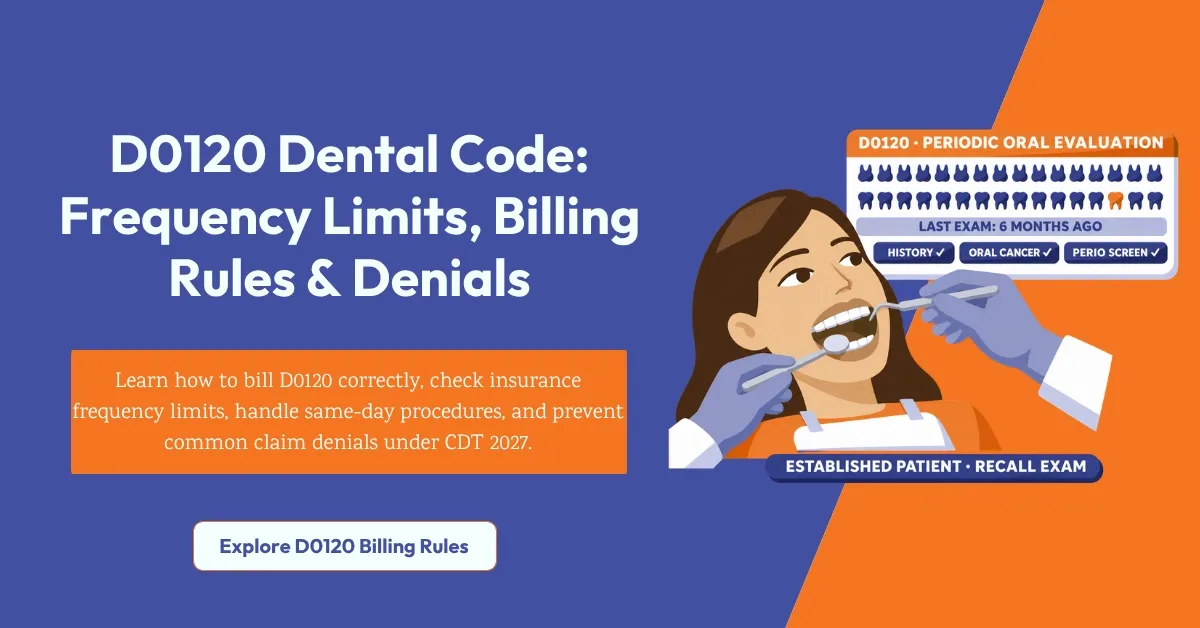
The D0120 dental code is the Current Dental Terminology (CDT) code for a periodic oral evaluation of an established patient. It's the recall exam for a patient of record, with an oral cancer evaluation and a periodontal screening where indicated. Bill x-rays and cleanings on separate lines.
Most D0120 money we see lost starts at the front desk. Many plans count D0120, D0150, and D0180 against one exam limit. Someone books the recall four days early or sets up a new patient as established. Any of those turns a periodic exam into a write-off.
We're the billing team at iDental Billing, and we work recall claims for PPO and Medicaid patients every day. The examples below come from that work and from each payer's own published rules.
Practice managers ask us the same D0120 questions every week. This guide answers them in order: what the code includes, who can bill it, which exam code fits, how often plans pay, what to bill with it, why it denies, and whether CDT 2027 changes anything.
D0120 Dental Code at a Glance
Billers ask about these D0120 facts more than any others, and each row has a sourced explanation further down the page.
| Detail | What it means for billing |
|---|---|
| ADA name | D0120 is the "periodic oral evaluation, established patient" in the American Dental Association (ADA) CDT code set. |
| Code category | D0120 sits in the Diagnostic category of CDT, which runs from D0100 to D0999. |
| Patient type | D0120 is for a patient of record only, never for a new patient. |
| Required parts | D0120 includes an oral cancer evaluation and a periodontal screening where indicated. |
| Billed on separate lines | With D0120, you bill radiographs, cleanings, other diagnostic tests, and any treatment on their own lines. |
| Who performs it | D0120 requires the dentist to evaluate and diagnose; a hygienist can gather findings. |
| Typical frequency | Each plan sets its own D0120 limit; two per year and one per six months are the common versions. |
| Shared limit | Many plans count D0120, D0150, and D0180 against one combined exam limit. |
| Same-day cleaning | Practices bill D0120 with D1110 (adult prophylaxis) or D4910 (periodontal maintenance) on the same claim. |
| Fee | D0120 has no national fee; your fee schedule and each payer contract set what it pays. |
| CDT 2027 | The ADA's published CDT 2027 change list doesn't include D0120. |
What D0120 Covers
The D0120 dental code description has the dentist check a patient of record for changes in dental and medical health since the last evaluation. Indian Health Service (IHS) coding guidance says the exam must include an oral cancer evaluation and a periodontal screening where indicated. The descriptor says, "The findings are discussed with the patient."
What a Periodic Oral Evaluation Includes
Pull any D0120 chart note, and a complete periodic oral evaluation should show six things:
- Updating the medical and dental history
- Checking teeth, restorations, and soft tissue for changes since the last exam
- Performing an oral cancer evaluation
- Doing a periodontal screening where it's indicated
- Interpreting any x-rays or tests taken that day, each billed on its own line
- Discussing the findings with the patient
The oral cancer evaluation is the dentist's check of the lips, cheeks, tongue, floor of the mouth, palate, and throat for lesions or lumps. It's part of D0120 and carries no separate charge. If the office adds a device-based screening, report it as D0431, an adjunctive test for mucosal abnormalities.
A periodontal screening is a quick look at gum health, lighter than six-point charting. The American Academy of Pediatric Dentistry (AAPD) says full-mouth probing isn't required at every D0120, and no standalone code exists for it. Many offices screen with PSR (Periodontal Screening and Recording).
What D0120 Doesn't Include
Anything beyond the evaluation goes on its own claim line with its own code:
- Radiographs, such as bitewings (D0274) or a full-mouth series (D0210)
- Cleanings: adult prophylaxis (D1110) or periodontal maintenance (D4910)
- Full periodontal charting for a diagnosis, which falls under D0180
- Adjunctive screening tests such as D0431
- Treatment the dentist finds during the exam, like retorquing a loose implant screw (D6089), an example from the ADA's own coding guidance
Separate lines also make the explanation of benefits (EOB) easier to reconcile, because your team can match each paid amount to one service.
Who Can Perform and Bill a D0120
Dental code D0120 is a diagnostic evaluation, and in most states the dental practice act keeps diagnosis with the dentist. That rule decides who can bill the exam and which date goes on the claim. Busy hygiene days trip it up more than anything else.
Can a Hygienist Do a D0120?
No. A hygienist can update the history, screen, and record findings, but the dentist must perform the evaluation and diagnosis before anyone bills D0120.
At the same visit, the hygienist can take the history, run the periodontal screening, expose radiographs where state law allows, and do the cleaning. None of that makes a periodic oral exam on its own. Your state's practice act sets the hygienist's scope, and scope varies by state.
The date of service is the day the dentist examined the patient. Say the hygienist cleans on Monday and the dentist sees the patient Wednesday. D0120 goes on Wednesday's date, and the same rule holds for D0180.
What to Bill When the Dentist Doesn't See the Patient
Picture the dentist out sick while the hygiene schedule runs anyway. Bill the cleaning, hold the exam, and don't backfill a D0120 next week to catch up. An auditor who finds an exam code with no dentist note behind it can take the payment back.
You'd report D0190 (screening of a patient) when the visit only decides whether someone needs a dentist's diagnosis. D0191 (assessment of a patient) covers a limited look for signs of disease and referral need. AAPD notes that plans seldom pay either outside some government programs, such as Medicaid.
How D0120 Differs From Other Dental Exam Codes
D0120 is the periodic exam dental code. Picking it over a neighbor comes down to patient status, the reason for the visit, and how deep the exam went.
| Code | ADA name | Use it when | Common mistake |
|---|---|---|---|
| D0120 | periodic oral evaluation, established patient | Routine recall for a patient of record | Billing it for a new patient |
| D0150 | comprehensive oral evaluation, new or established patient | New patient, a patient back after three or more years away, or a significant health change | Billing it at every recall |
| D0140 | limited oral evaluation, problem focused | A specific complaint: pain, trauma, infection, or a broken restoration | Billing it for a routine recall |
| D0145 | oral evaluation for a patient under three years of age and counseling with primary caregiver | Every evaluation before age three, the first visit and each follow-up (AAPD) | Billing D0120 for a toddler |
| D0180 | comprehensive periodontal evaluation, new or established patient | Signs or symptoms of periodontal disease, systemic medical conditions, or social risk factors; requires full-mouth probing and periodontal charting (CDT 2026) | Billing it when the dentist only screened |
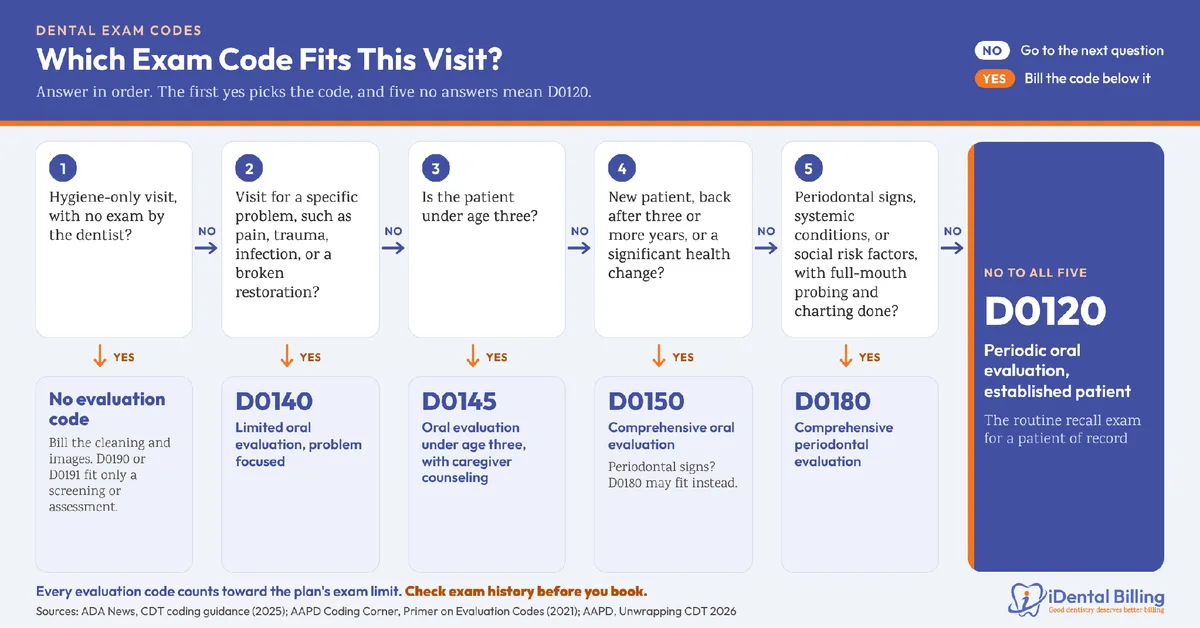
For the rest of the evaluation family, see our CDT exam code guide.
What Is the Difference Between D0150 and D0120?
D0150 is the comprehensive baseline exam for a new patient, a patient away three or more years, or one with a significant health change. D0120 is the routine recall exam for a patient of record who meets none of those conditions.
Plans hold D0150 to a tighter limit than D0120, often once per provider across several years. Colorado's senior dental program, for one, allows one D0150 per 36 months. The ADA's coding guidance in ADA News spells out the official split between the two codes.
Don't write off a qualifying D0150 that denies for frequency. AAPD advises asking the payer for the alternate benefit of D0120, which pays the comprehensive exam at the periodic rate. The denial section below covers how to ask.
What's the Difference Between D0120 and D0180?
D0120 includes a periodontal screening where indicated. D0180 requires full-mouth probing and charting for a patient with signs of periodontal disease or risk factors.
| Factor | D0120 | D0180 |
|---|---|---|
| Patient type | Patient of record only | New or established patient |
| Periodontal assessment | Screening where indicated | Full-mouth probing and charting |
| When it's used | Routine recall | Signs, symptoms, or risk factors for periodontal disease |
| Same-day pairing with the other | Depends on the payer | Depends on the payer |
Billing both on one date depends on the payer. MassHealth has allowed D0120 and D0180 on the same date since August 1, 2018. IHS guidance says not to report D0180 at the same visit as D0120 or D0150. Check the plan before you post both.
Many offices alternate: D0180 once a year when the dentist does full charting, and D0120 at the other recall.
What Is the Difference Between Dental Codes D0140 and D0120?
D0140 is a limited, problem focused exam for a specific complaint or emergency. D0120 is the routine recall exam.
AAPD says a recall that turns into a more complex problem focused evaluation, with extra diagnostic time, may be reported as D0140. Payers that count any evaluation toward one limit will let that emergency exam in spring use up the fall recall slot.
Colorado's senior dental program, for one, doesn't pay D0140 on the same date as D0120.
How Often Insurance Pays for D0120
Each dental plan sets its own frequency for the D0120 dental code, because the CDT descriptor doesn't set one. That's why two patients booked on the same recall date can get opposite EOBs from two different plans.
The Two Ways Plans Count Exams
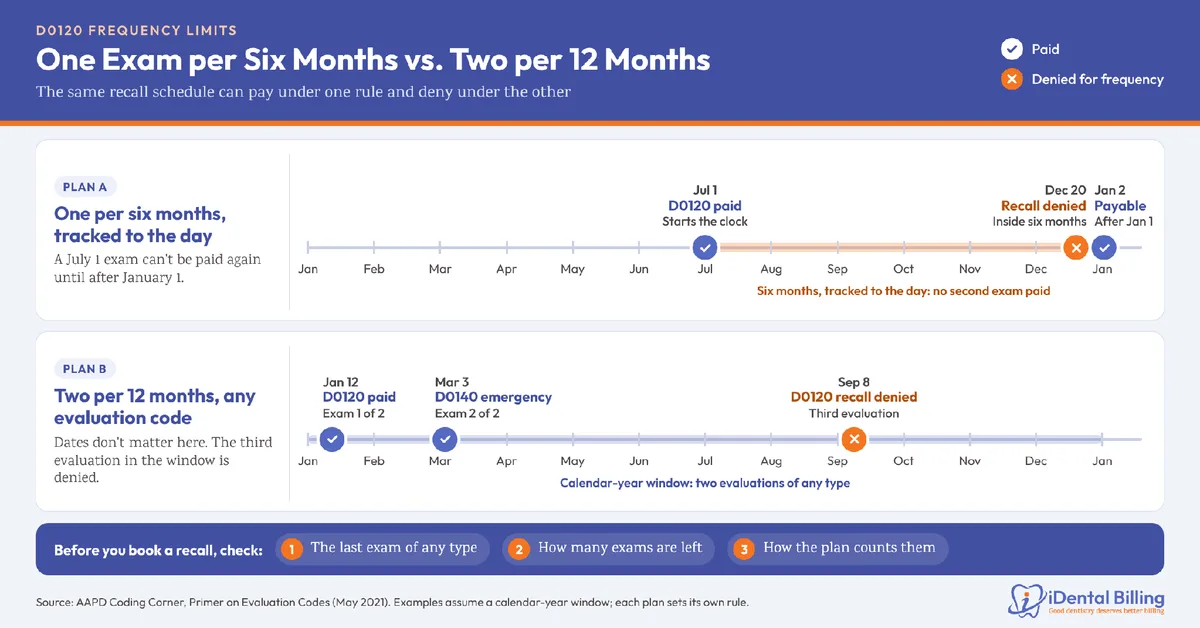
The AAPD's primer on evaluation codes describes two common limits. Some plans pay one evaluation every six months and track it to the day. A periodic exam on July 1 isn't payable again until after January 1. Other plans allow two per 12 months and count visits instead of days.
Each plan also picks its window: a calendar year, a benefit year, or a rolling 12 months. AAPD notes that you can't appeal a frequency denial, and in some cases an in-network office can't bill the patient for the extra exam either.
D0120 Frequency Rules by Payer
Three published examples show how far the rules spread. We pulled each rule from the payer's own document in November 2026.
| Payer | D0120 limit | Detail that trips claims |
|---|---|---|
| Blue Cross Blue Shield of Massachusetts | Two per calendar year; three on certain Dental Blue 65 and Medicare Advantage plans with comprehensive dental coverage | One evaluation code per dentist per date of service |
| Nevada Medicaid (fee-for-service) | One per six rolling months for members under 21 and for pregnancy-related services | Adults 21 and older aren't covered for D0120 |
| NJ FamilyCare | Twice per rolling year per servicing provider or group | Not payable within six months of a D0150 from the same provider or group |
Treat these as examples. The patient's own plan document sets the rule that applies.
Why One Exam Limit Covers Every Exam Code
AAPD's primer says payers treat any evaluation type as one exam toward the limit. Colorado's senior dental program, for example, pays two of D0120, D0150, or D0180 per 12 months combined. At a plan that counts every evaluation, a D0140 emergency visit in March can use up the September recall.
Before booking, check three things: the last exam of any type, how many exams remain, and how the plan counts them. If your front desk confirms eligibility but skips exam history, that's the gap our dental insurance verification covers.
What Can Be Billed With D0120 on the Same Day
A recall claim with D0120 alone is unusual. Most recall visits add a cleaning, and many add images. CDT allows most pairings, and each plan decides how every line pays, including whether two services compete for the same benefit.
| Billed with D0120 | Same date? | What to watch |
|---|---|---|
| D1110 adult prophylaxis | Yes | Same claim, separate lines; check the plan's cleaning frequency too |
| D4910 periodontal maintenance | Yes, in most plans | Confirm the plan pays an exam alongside D4910 |
| D0274 bitewings, four images | Yes | Bitewings carry their own frequency limit, separate from the exam's |
| D0210 full-mouth series | Yes | Many plans allow it once every few years |
| D0220 and D0230 periapicals | Yes | Common when a recall turns problem focused |
| D4355 full mouth debridement | Yes | ADA: allowed with D0120 or D0150, not with D0180 |
| D0180 comprehensive periodontal evaluation | Depends on the payer | MassHealth allows it; IHS guidance says no; BCBS Massachusetts pays one evaluation code per dentist per date |
| D0140 or D0150 | No, at most plans | Expect one paid evaluation per visit; Colorado's senior program won't pay D0140 with D0120 |
| D9110 palliative treatment | Watch it | BCBS Massachusetts counts the exam as inclusive when the same dentist or office does palliative care that day |
Put the exam, cleaning, and images on one claim for one date of service. Splitting them across claims adds reconciliation work and makes a frequency denial harder to trace. You can bill D4355 with D0120 on the same day, but D0180 waits for the next visit.
Bitewing frequency rules get their own walkthrough in our bitewing billing rules guide. FMX limits and bundling are covered in the D0210 full-mouth series post. For single images, see our guide to periapical x-ray codes.
Why D0120 Claims Get Denied and How to Fix Them
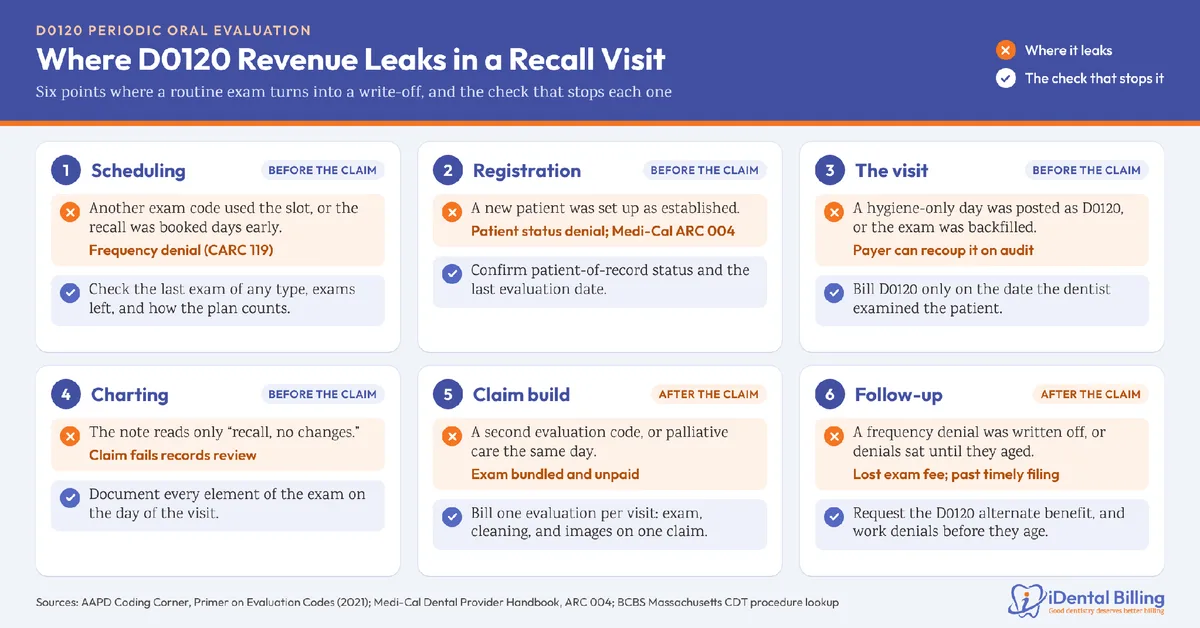
D0120 dental code denials trace back to six common causes, and you can head off most of them at scheduling. Frequency denials often post on the electronic remittance advice (ERA) with claim adjustment reason code (CARC) 119: "Benefit maximum for this time period or occurrence has been reached."
| Denial | Common cause | How to fix or prevent it |
|---|---|---|
| Frequency exceeded | A D0140, D0150, or D0180 used the slot, or the front desk booked the recall days early | Check the last exam of any type and the plan's counting method before booking, and verify exam frequency at scheduling |
| Wrong patient status | A new patient set up as established, or D0150 billed at a routine recall | Fix the registration and recode to the exam the dentist performed |
| No paid D0150 on file | Medi-Cal Dental pays D0120 only when the same provider has a D0150 in history (ARC 004) | Bill D0150 at the first visit; Medi-Cal allows it once per patient per provider, with a repeat after 36 months |
| Bundled with same-day care | Palliative treatment or a second evaluation code on the same date | Bill one evaluation per visit and check the plan's palliative rule |
| Not supported on review | A chart note that says only "recall, no changes" | Document every element at the visit, using the checklist in the documentation section below |
| Billed without a dentist exam | A hygiene-only day posted as D0120 | Don't bill D0120 when the dentist didn't examine the patient |
When to Request an Alternate Benefit
Request the alternate benefit of D0120 when a D0150 or D0180 denies for frequency, as AAPD advises.
Put the request in the claim's remarks or narrative, or on a corrected claim if the payer requires one. Some payers apply the alternate benefit on their own and pay at the D0120 rate. Either way, your office collects part of the exam fee instead of nothing.
Each of these denials looks small on its own. Left unworked for a few months, they stack up in the 60- and 90-day aging buckets and age past timely filing. If nobody on your team has time to chase them, that's what our dental AR follow-up team does.
Documentation That Supports a D0120 Claim
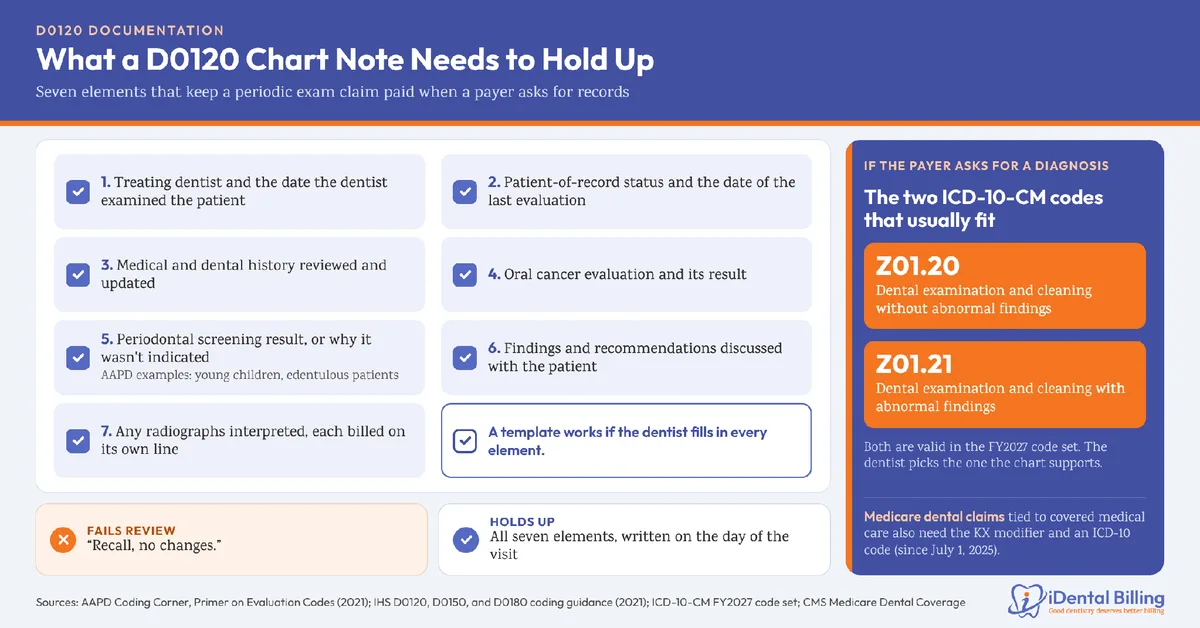
Write every D0120 note so it holds up if a payer asks for records six months later. The chart should show each part of the periodic oral evaluation in the dentist's own words.
- Treating dentist and the date the dentist examined the patient
- Patient-of-record status and the date of the last evaluation
- Medical and dental history reviewed and updated
- Oral cancer evaluation and its result
- Periodontal screening result, or why it wasn't indicated (AAPD gives young children and edentulous patients as examples)
- Findings and recommendations discussed with the patient
- Any radiographs interpreted, each billed on its own line
Two ICD-10 codes cover most payer requests for a diagnosis. Z01.20 is an encounter for dental examination and cleaning without abnormal findings, and Z01.21 is the same encounter with abnormal findings. Both are valid in the FY2027 ICD-10-CM code set, and the dentist picks whichever one the chart supports.
Write the note on the day of the visit. A template works if the dentist fills in every element above. Notes that read only "recall, no changes" are the ones that fail review.
D0120 Dental Code Cost and Reimbursement
CDT lists no fees. Your practice sets its own fee. Each payer's contract or fee schedule sets the allowed amount, so the same exam pays a different amount on each plan. We don't quote a national average, because the D0120 averages we've seen online don't cite a primary source.
Medicaid and Public Program Fees
Colorado's senior dental program publishes one clear example: maximum fees of $46 for D0120, $81 for D0150, and $88 for D0180, effective July 1, 2025. The comprehensive exam pays $35 more than the periodic one, and that gap gives payers a reason to audit exam coding.
State Medicaid fees differ from state to state and change on each state's own schedule. Pull the current fee schedule before you quote a patient or estimate a write-off, because last year's numbers can mislead your front desk.
Does Medicare Cover D0120?
Original Medicare doesn't cover routine dental care, so a routine D0120 isn't a Medicare benefit.
The Centers for Medicare & Medicaid Services (CMS) makes an exception for dental services tied to the success of a covered medical service. Examples include an exam before an organ transplant, cardiac valve replacement, or certain cancer treatments. Since July 1, 2025, those dental claims need the KX modifier and an ICD-10 diagnosis code.
Medicare Advantage plans may add dental benefits. Blue Cross Blue Shield of Massachusetts, for example, allows three D0120 exams a year on certain Dental Blue 65 and Medicare Advantage plans. Those plans carry comprehensive dental coverage.
Is D0120 Changing in CDT 2027?
No change to the D0120 dental code appears in the ADA's published CDT 2027 summary. The ADA announced 67 changes for CDT 2027, with 28 additions, 33 revisions, and six editorial updates, effective January 1, 2027. None of the listed changes touches D0120 or the other oral evaluation codes.
Bill the CDT version in effect on the date of service. A recall on December 30, 2026, uses CDT 2026, and a recall on January 4, 2027, uses CDT 2027. Update your software and fee schedule anyway, since neighboring codes did change.
D0180 is the evaluation code that changed in CDT 2026. The AAPD's CDT 2026 summary shows the revised descriptor calls for full-mouth probing and periodontal charting. It also names systemic medical conditions and social risk factors as indications. Any D0120 versus D0180 comparison written before 2026 may be out of date.
Our CDT 2027 changes breakdown lists every new and revised code, so your team can update the software before January 1.
D0120 FAQs
Is D0120 an exam?
Yes. The D0120 dental code is a periodic oral examination for a patient of record. It covers a history update, an oral cancer evaluation, and a periodontal screening where indicated. Cleanings go on their own lines: D1110 for adult prophylaxis or D4910 for periodontal maintenance. Each plan sets how often it pays.
What is Delta Dental code D0120?
ADA code D0120 means the same periodic oral evaluation at every Delta Dental company. Delta Dental is a group of member companies, and each company and plan sets its own frequency and bundling rules. Check that company's provider handbook before you assume a limit from another state's Delta plan carries over.
Is there a CPT code for D0120?
No. D0120 is a CDT code that the ADA maintains, and the American Medical Association's CPT code set doesn't include it. CMS may fold CDT codes into HCPCS Level II, but it doesn't publish them in its HCPCS files. A dental exam billed to a medical plan follows that plan's rules.
Can you do full mouth debridement and exam in the same day?
Yes, with D0120 or D0150. ADA guidance allows D4355 on the same date as either exam, but not on the same date as D0180. The comprehensive periodontal evaluation comes at a later visit, once debridement lets the dentist probe and chart the full mouth.
Does D0120 need prior authorization?
In most cases, no. Prior authorization comes up when a patient needs an exam beyond the plan limit. Nevada Medicaid, for example, lets providers request extra medically necessary exams for members under 21 through prior authorization. The state treats those as Early and Periodic Screening, Diagnostic, and Treatment (EPSDT) exceptions.
Why does D0120 show up on a patient's statement?
D0120 is the checkup exam code. A balance next to it means the plan's exam limit ran out or a deductible applied. Train your front desk to explain the D0120 dental code in plain words before the patient calls. A line like "your plan already paid for two exams this year" covers most calls.
Keep Recall Exams From Turning Into Write-Offs
You'll recognize the pattern in your aging report. Recall exams deny for frequency, get bundled with same-day care, or never get billed after a hygiene-only day. Each claim under the D0120 dental code is small, yet the same losses come back every recall cycle.
If your team doesn't have time to check exam history and work these denials, our outsourced dental billing team handles both. You can also review our billing pricing before you talk to anyone.
ABOUT THE AUTHOR
Russell Bennett
Russell Bennett is a Dental RCM and Provider Credentialing Specialist at iDental Billing. He reviews billing workflows, resolves claim denials, outstanding insurance balances, and reimbursement discrepancies, and applies CDT coding and payer-specific guidelines. His work includes provider credentialing, payer enrollment, and recredentialing. Russell writes iDental Billing’s educational guides on what claims need, why they matter, and where things go wrong.