












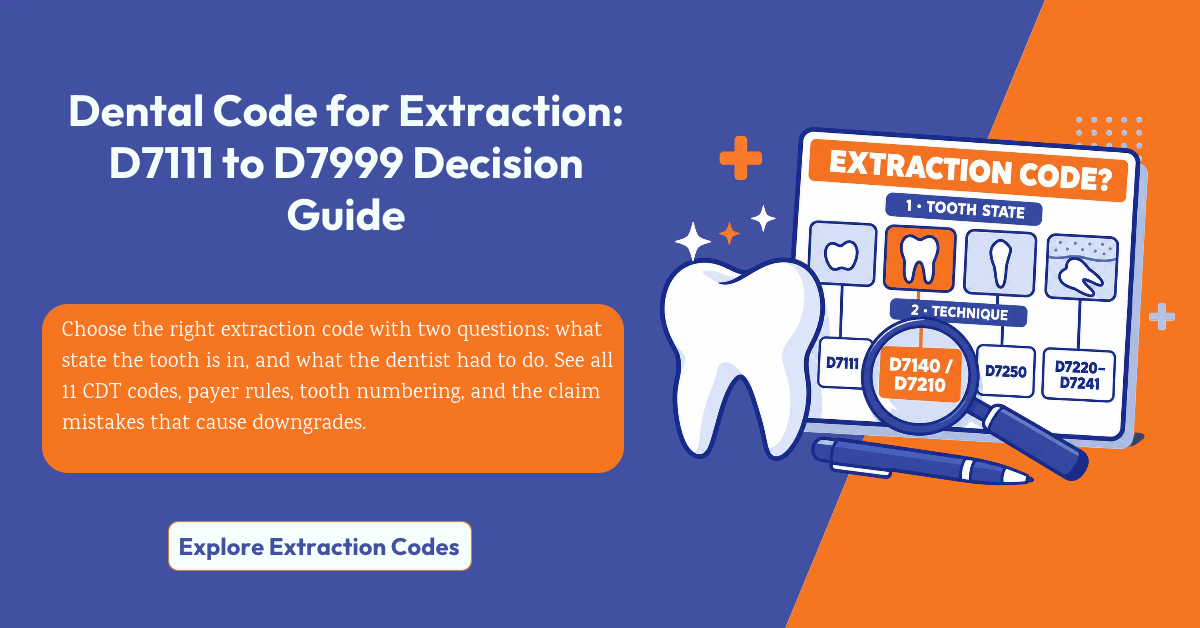
The dental code for extraction is a CDT code from the oral surgery section (D7000 to D7999) of the American Dental Association’s code set. Two facts decide which one goes on the claim: the state the tooth was in, and what the dentist had to do to get it out.
Most problems with the ADA extraction codes start with a guess. A front desk bills D7111 for a baby tooth that still had roots and leaves money on the table. Or a dentist picks D7210 because the extraction felt hard, and the payer downgrades the line.
This guide shows how to choose the dental code for extraction with two questions, then gives you a table of all 11 extraction codes under CDT 2026 and what happens to each one once the claim reaches the payer.
Quick answer
- Erupted tooth or exposed root removed with an elevator and/or forceps: D7140
- Erupted tooth that needed bone removal or sectioning: D7210
- Primary tooth crown held only by soft tissue, roots resorbed: D7111
- Root that needs soft tissue and bone cut to remove it: D7250
- Impacted tooth: D7220 to D7241, chosen by whether soft tissue or bone covers the crown, and how much
The code follows the technique the dentist documented, however long the extraction took. None of the ADA’s extraction nomenclature uses words like “simple” or “difficult,” and chair time never moves a tooth from one code to another.
How to Choose the Right Dental Code for Extraction in Two Questions
Every extraction code answers two questions, in order: what state the tooth is in, then what technique the dentist used. Order matters because the impaction codes and the erupted tooth codes never overlap. Start in the wrong family and no amount of technique detail will rescue the claim.
Question 1: What State Is the Tooth In?
The first question sorts the tooth into one of four states, and each state points to its own small group of codes:
- A primary tooth crown held in only by soft tissue
- An erupted tooth, or a root exposed in the mouth
- A residual root left behind by decay or an earlier extraction
- An impacted tooth, covered by soft tissue, partly by bone, or fully by bone
Impaction isn’t limited to third molars. An impacted canine or an impacted extra tooth goes through the same four impaction codes as a wisdom tooth, so the chart needs to say “impacted” whenever the tooth was.
Question 2: What Did the Dentist Have to Do?
The second question asks how the tooth came out. There are three technique paths, and the note has to show which one happened:
- Elevator and forceps only
- Bone removal, sectioning of the tooth, or both, with a flap if indicated
- A cutting procedure through soft tissue and bone to reach residual roots
The ADA Guide to Extractions settles the most common gray area with two rules. When the crown and root come out in one piece, the extraction is D7140. If the crown and root separate and getting the root tip out requires bone removal, the extraction is D7210.
Picture an upper molar whose crown snaps at the gumline halfway through. If the dentist removes buccal bone to retrieve the roots, the line becomes D7210. Roots that still lift out with an elevator mean the technique never changed, and the code stays D7140.
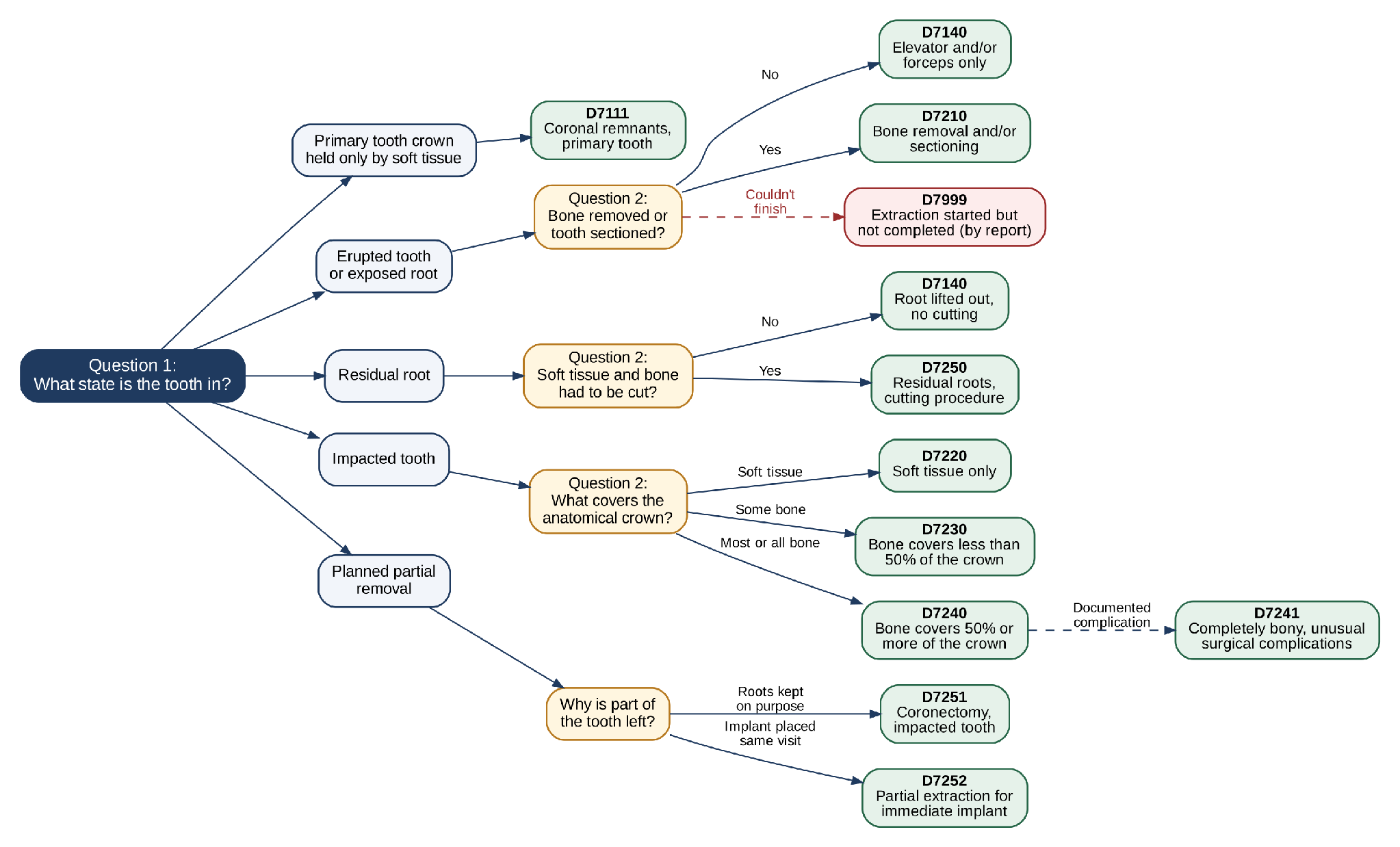
The tooth extraction dental code you land on should match one row in the table that follows. If it seems to fit two rows, go back to the note, because the technique isn’t documented well enough yet.
Dental Extraction Codes at a Glance
In the US, every dental code for extraction on a dental claim comes from CDT. These are the 11 codes you’ll use for teeth, roots, and remnants under CDT 2026, with the trigger for each and the mistake payers catch most often.
CDT 2026 extraction codes and when to use each
| Code | What it covers | Use it when | Watch out for |
|---|---|---|---|
| D7111 | Extraction, coronal remnants, primary tooth | The crown is held only by soft tissue and the roots have resorbed | Roots still present: use D7140 |
| D7140 | Extraction, erupted tooth or exposed root (elevation and/or forceps removal) | The tooth or root comes out with an elevator, forceps, or both | Difficulty never upgrades it |
| D7210 | Extraction, erupted tooth requiring removal of bone and/or sectioning of tooth | Bone was removed or the tooth was sectioned; flap included if indicated | A flap alone doesn’t meet the descriptor |
| D7220 | Removal of impacted tooth, soft tissue | Soft tissue covers the occlusal surface | No bone covers the crown |
| D7230 | Removal of impacted tooth, partially bony | Bone covers less than 50% of the anatomical crown | Measured against the anatomical crown |
| D7240 | Removal of impacted tooth, completely bony | Bone covers 50% or more of the anatomical crown | Full encasement isn’t required |
| D7241 | Removal of impacted tooth, completely bony, with unusual surgical complications | The note names a specific complicating factor | “Difficult” alone won’t support it |
| D7250 | Removal of residual tooth roots (cutting procedure) | Soft tissue and bone had to be cut to reach the root | Not for a hard extraction of an erupted tooth |
| D7251 | Coronectomy, intentional partial tooth removal | Crown of an impacted tooth removed, roots left on purpose | Planned, so it differs from D7999 |
| D7252 | Partial extraction for immediate implant placement | Part of the root is kept and an implant goes in at the same visit | Added in CDT 2025 |
| D7999 | Unspecified oral surgery procedure, by report | An extraction of an erupted tooth couldn’t be completed | Needs a narrative |
CDT codes and nomenclature are © American Dental Association. Nomenclature in this table is shortened and descriptors are paraphrased, so check the current CDT manual before coding from it. Older references still call D7210 a surgical removal and print “deciduous” in D7111; the current wording is what belongs on the claim.
When your team keeps debating which row a tooth belongs in, the clinical notes and the claim usually aren’t telling the same story. Our dental billing services start by matching every extraction code to what the note says, before the claim goes out.
Erupted Teeth and Exposed Roots: Forceps or Bone Removal
D7140 and D7210 both cover erupted teeth, and the only thing separating them is whether the dentist removed bone or sectioned the tooth. Chair time, tooth size, and how stubborn the extraction felt don’t enter into the choice.
D7140, extraction, erupted tooth or exposed root (elevation and/or forceps removal): use it when the tooth or an exposed root comes out with an elevator, forceps, or both. It includes removal of tooth structure, minor smoothing of the socket bone, and closure as needed. A grossly decayed tooth still qualifies when its roots come out without cutting.
D7210, extraction, erupted tooth requiring removal of bone and/or sectioning of tooth: use it when the dentist had to remove bone, section the tooth, or both. Elevating a mucoperiosteal flap is included when it’s indicated. A flap by itself doesn’t meet the descriptor, so the note has to show the bone removal or sectioning.
Offices and payers call D7210 the surgical extraction code, and that nickname causes trouble. The ADA says it’s regularly asked whether D7210 can be reported for every extraction. It can’t. D7210 fits only when bone removal or sectioning happened, and D7140 may be the right code otherwise.
Two patients on the same afternoon show the difference. A periodontally mobile lower incisor lifts out with forceps in under a minute, so it’s D7140. The heavily restored upper first molar that follows needs sectioning into three roots with a bur, so it’s D7210. Both took one appointment slot, yet only the second note supports the higher extraction code.
Primary Tooth Extraction Codes: When D7111 Fits and When It Doesn’t
Most primary tooth extractions aren’t D7111. If you’re looking for the dental code for extraction of a baby tooth, start by asking what’s still holding it in. Resorbed roots, intact roots, and roots that need cutting each lead to a different code.
D7111: Extraction, Coronal Remnants, Primary Tooth
D7111 covers removal of the soft tissue retained coronal remnants of a primary tooth. Coronal remnants are the crown portion left once the roots have resorbed, held in place only by gum tissue. On the radiograph, little or no root shows below the crown.
Older CDT versions and some state Medicaid manuals still print the code as coronal remnants, deciduous tooth. It’s the same code with older wording. What supports the D7111 dental code description on a claim is a note stating that the roots were resorbed and only the crown remained.
Primary Teeth With Roots Still Holding On
A primary tooth still held by its roots is reported with D7140. That code doesn’t separate primary from permanent teeth, so the right primary tooth extraction code for a rooted baby molar is the same one you’d use on an adult.
Reporting D7111 in place of D7140 is a common error, according to the AAPD primary tooth coding advice. The academy also points out that most plans allow more for D7140, so the wrong baby tooth extraction code costs the practice money every time it goes out.
Primary Roots That Need a Cutting Procedure
The ADA’s own example is a primary second molar, tooth K, lost to rampant caries, with residual roots that won’t come out with an elevator or forceps. Removing those roots means cutting soft tissue and bone, so the extraction of primary tooth code in that case is D7250.
Some Medicaid programs restrict surgical extraction codes on primary teeth, which can turn a correctly coded line into a denial. Primary teeth also take letters A through T on the claim, never numbers, and a D7111 line without a letter is incomplete.
Exposed Root or Residual Root: Where Forceps End and Cutting Begins
A root left in the mouth gets one of two codes, and the deciding fact is whether the dentist had to cut. The ADA’s extraction guide draws that line, and many D7250 downcodes come from notes that never say which side of it the procedure landed on.
No cutting, D7140: a residual root that comes out with an elevator and forceps goes on the claim as the same D7140. That holds whether decay left the root behind or another dentist’s attempt did, because “exposed root” is written into the nomenclature.
Cutting, D7250: when getting the root out means cutting soft tissue and bone, the code is D7250, removal of residual tooth roots. Closure is included. The note should describe the cutting, since a root’s presence alone doesn’t support the code.
There’s a trap in the middle. If a tooth fractures during an extraction and the remaining root needs bone removal, you’re still doing the D7210 you started, with no extra D7250 line. The ADA also says D7250 isn’t meant to report a difficult extraction.
Some payers add conditions the CDT code doesn’t have, such as requiring the root to be fully encased in bone before they’ll pay D7250. That’s where the right extraction dental code and the plan’s payment policy can part ways.
Impacted Teeth: Bone Coverage Decides the Code
CDT has four impaction codes: D7220, D7230, D7240, and D7241. The ADA says none of them is based on difficulty. They aren’t wisdom tooth codes either, since an impacted canine or an impacted supernumerary tooth uses the same four.
D7220, removal of impacted tooth, soft tissue: soft tissue covers the occlusal surface, and the dentist elevates a mucoperiosteal flap to reach the tooth. No bone covers the crown, which is what keeps it out of the three bony codes.
The 50% Anatomical Crown Rule
D7230 is the code for an impacted tooth with part of the crown covered by bone, which the ADA reads as less than 50% of the anatomical crown. D7240 covers most or all of the crown, read as 50% or more. Both readings come from the ADA impaction coding guidance.
The anatomical crown is the part of the tooth covered by enamel, above the cementoenamel junction. According to the ADA, it’s incorrect to assume D7240 needs part of the occlusal surface below the bone. A tooth doesn’t have to be fully encased to qualify.
Take a lower third molar with bone over about 60% of its crown on the panoramic image, while its cusp tips sit level with the bone. Some offices would bill D7230 because the occlusal surface isn’t buried. Under the ADA’s reading, the tooth is D7240.
Unusual Surgical Complications Need Their Own Proof
D7241 is a completely bony impaction with unusual surgical complications. The CDT descriptor gives examples such as nerve dissection, separate closure of the maxillary sinus, and aberrant tooth position. Whatever the factor, the note has to name it and show how it changed the surgery.
A note that only says “difficult” gives the payer no reason to pay above D7240. Each plan also sets its own adjudication criteria, as the ADA points out, so even a correct dental code for extraction of an impacted tooth can stall without the pre-op image showing bone coverage.
Impaction claims tend to go sideways before the surgery, when nobody checked whether the plan wanted a pre-op image or a pre-treatment estimate. Our dental insurance verification team checks the plan’s rules five business days before the appointment, which leaves time to send what the payer asks for.
Special Cases: Partial Removal, Incomplete Extractions, and Extra Teeth
Four situations fall outside the usual paths for choosing a dental code for extraction: planned partial removal of an impacted tooth, partial extraction at implant placement, an extraction that can’t be finished, and extra teeth.
D7251, coronectomy, intentional partial tooth removal: the dentist removes the crown of an impacted tooth and leaves the roots in place on purpose, a choice usually made when the roots sit close to the inferior alveolar nerve. Because the partial removal is planned, the procedure is reported as D7251 and never as an incomplete extraction.
D7252: Partial Extraction for Immediate Implant Placement
D7252 is partial extraction for immediate implant placement, added in CDT 2025 after the American Academy of Periodontology asked for a code for the technique. The buccal section of the root is kept to stabilize the buccal plate, and the implant goes in at the same appointment.
Keep D7252 and D7251 apart on the claim. One prepares a site for an implant; the other is a coronectomy of an impacted tooth. The implant itself goes on its own line with its own implant code, so the claim shows both steps.
D7999: When an Extraction Can’t Be Finished
There’s no CDT code for an incomplete extraction of an erupted tooth, so the ADA directs offices to report what was done with D7999, unspecified oral surgery procedure, by report. Like every by report code, the D7999 dental code needs documentation that explains the service.
Sometimes another dentist removes the remaining roots at a later visit. That dentist codes by technique: D7140 if the roots are exposed and come out with forceps or an elevator, or D7250 if soft tissue and bone have to be cut.
A D7999 line without a narrative has little chance of paying. Write it the same day, while the details are fresh: the tooth, what came out, what stayed, why the procedure stopped, and the plan for what remains.
Supernumerary Teeth: Same Codes, Different Tooth Numbers
CDT has no separate extraction of supernumerary tooth code. You use the same extraction code you’d use for any tooth in the same state, and only the tooth number on the claim changes.
Permanent supernumerary teeth are numbered 51 to 82. Numbering starts beside the upper right third molar, runs around the upper arch, and continues on the lower arch to the lower right third molar, so each extra tooth takes the number of its neighbor plus 50.
Primary supernumerary teeth add an S to the letter of the neighboring tooth, from AS through TS. An impacted supernumerary tooth still uses D7220 to D7241, and its ICD-10-CM diagnosis on a medical claim is K00.1, supernumerary teeth.
A mesiodens between the upper central incisors is a common example. It goes on the claim with whichever extraction code matches the technique, and with supernumerary number 58 or 59, depending on whether it sits next to tooth 8 or tooth 9.
What Every Extraction Code Already Includes, and What Bills Separately
Every dental code for extraction already includes local anesthesia, suturing if needed, and routine postoperative care. That inclusion note sits at the start of the CDT oral surgery section, and billing those items on their own lines is a fast way to get them bundled.
Local anesthesia (D9215) billed on the same date as an extraction is generally treated as part of the extraction, and payers commonly deny it as included. Plan rules aren’t identical, so check the plan’s policy before a D9215 line goes on the claim.
Some procedures done at the same visit do bill on their own lines, as long as the note supports them and the plan covers them:
Common add-on codes billed with extractions
| Add-on procedure | Code | Separate line? |
|---|---|---|
| Alveoloplasty in conjunction with extractions | D7310 (four or more teeth or tooth spaces, per quadrant) or D7311 (one to three) | Yes, when it goes beyond the minor socket smoothing every extraction includes |
| Bone replacement graft for ridge preservation | D7953, per site | Yes, when the graft is placed and documented |
| Autologous blood concentrate, such as PRF | D7921 | Yes, when the product is collected and applied |
| Intra-socket biological dressing for hemostasis or clot stabilization | D7922, per site | Yes, when it is placed; plan coverage varies |
| Sedation or general anesthesia | CDT 2026 anesthesia codes | Yes; CDT 2026 restructured these codes |
| Treatment of post-surgical complications | D9930, by report | Yes, for unusual circumstances, with a narrative |
Picture four lower extractions in one quadrant, with the dentist recontouring sharp bone across the whole area. That’s when D7310 enters the conversation. Smoothing a single socket during one extraction doesn’t qualify, because D7140 and D7210 already include minor socket smoothing.
Routine postoperative care means a normal follow-up visit isn’t a separate procedure. Unusual complications are another matter. D9930 exists for them, and the narrative has to explain what went wrong and what the dentist did about it.
Putting Extraction Codes on the Claim Correctly
A correct dental code for extraction still needs a tooth designation and a note that backs it up. The ADA claim form instructions allow two ways to report one procedure on several teeth: separate service lines, or one line listing the teeth in item 27 with the count in item 29b.
Separate lines are the cleaner choice for extractions. Each tooth gets its own code, tooth number, and fee, so a payer can pay D7140 on one tooth and question D7210 on another without holding up the rest. Some state Medicaid programs require separate lines anyway.
Item 27 takes 1 to 32 for permanent teeth, A to T for primary teeth, 51 to 82 for permanent supernumerary teeth, and AS to TS for primary supernumerary teeth. A D7111 line always carries a letter. On electronic claims, the 837D carries the same tooth designation on each service line.
Documentation that holds up when a payer reviews an extraction covers three things, written in the dentist’s own words rather than a template:
- The tooth state and the technique: forceps and elevator, bone removal or sectioning and why, or cutting for a residual root
- A pre-op image when the code depends on bone coverage or bone removal, which payers commonly request for D7210, D7250, and the impaction codes
- A narrative for any by report code, such as D7999
Practice management software often shows a shortened code label instead of the full nomenclature, and two extraction codes can look almost identical in a drop-down. The AAPD warns that relying on abbreviated code names leads to coding errors, so pick each dental extraction code from its full nomenclature.
When the Payer’s Rules Differ From the CDT Code
CDT describes what the dentist did, and the dental plan decides what it pays for. The ADA notes that each benefit plan sets its own adjudication criteria, so a correctly chosen dental code for extraction can still come back reduced or denied.
Medi-Cal’s extraction bulletin limits D7250 to residual roots completely surrounded by bone. It also treats D7250 as not a benefit when the same provider did the original extraction, and it notes that D7250 is often downgraded to D7210 when those criteria aren’t met.
The ADA reads the code differently. Its extraction guide says a fully encased root is a clinical finding that isn’t part of the D7250 code entry, and it attributes denials on that basis to plan limitations. Code to CDT, then document to the payer’s policy.
Missouri’s Medicaid program, MO HealthNet, doesn’t cover D7210 for primary teeth. It also states that place of service doesn’t decide whether an extraction is surgical; the technique does. One state’s rule doesn’t carry over to the next, so each Medicaid program needs its own check.
Many commercial plans carry alternate benefit clauses that pay a lesser code’s allowance. Adoption timing varies too. State Medicaid programs can adopt a new CDT version after January 1, and Medi-Cal implemented CDT 2026 effective May 1, 2026.
Catching these limits before the appointment costs far less than appealing them after the EOB arrives. For impactions and residual roots in particular, it pays to verify extraction benefits first and note any plan rule that differs from CDT.
Why Extraction Claims Get Denied or Downgraded
Most extraction denials trace back to the claim rather than the clinical work: a missing tooth number, a note that doesn’t show the technique, or a code the payer considers bundled. Claim adjustment reason codes (CARCs) on the remittance tell you which problem you’re facing.
CARC codes seen on denied extraction claims
| CARC | What it means (per X12) | Common extraction trigger | First fix |
|---|---|---|---|
| 16 | Claim or service lacks information or has a billing error | Missing tooth number or invalid code on a line | Correct the line and resubmit |
| 18 | Exact duplicate claim or service | Two lines with the same code on one date and no distinct tooth numbers | Add the tooth number to each line |
| 97 | Benefit included in the payment for another service | Inclusive items billed separately, such as local anesthesia | Stop billing inclusive items |
| 150 | Information submitted doesn’t support this level of service | Note doesn’t show bone removal, sectioning, cutting, or bone coverage | Appeal with the note and image if they support the code |
| 169 | Alternate benefit has been provided | Plan paid a lesser code’s allowance | Check the plan clause; appeal if documentation supports it |
| 252 | An attachment or other documentation is required | Pre-op image or narrative not sent | Send the attachment |
CARCs arrive on the 835 electronic remittance advice. Paper dental EOBs often add the payer’s own explanation codes, so read both before deciding whether the dental code for extraction was wrong or the paperwork was.
Four coding habits sit behind a lot of these adjustments, and each one is easy to fix once someone spots it:
- Billing D7111 on a primary tooth that still had roots
- Upgrading to D7210 or D7241 because the extraction felt difficult
- Reporting several teeth with no tooth designation
- Choosing an extraction code from a truncated software label
If CARC 150 and 169 keep showing up on your extraction lines, those adjustments are often worth contesting when the note and image support the billed code. That’s the work our team takes on when we appeal downgraded extraction claims as part of AR follow-up.
Extraction Codes on Medical Claims: CPT and ICD-10
On a dental claim, the dental code for extraction is a CDT code. Medical claims work differently, and they come up when an extraction is tied to a medical condition or billed to the patient’s medical plan.
Is There a CPT Code for Tooth Extraction?
No CPT code describes a routine tooth extraction, which is why medical claims for extractions often fall back on 41899, the unlisted procedure code for dentoalveolar structures. Anyone searching for an extraction CPT code or a CPT code for extraction of teeth ends up at that same unlisted code.
Unlisted codes are typically billed as one line with the operative report and priced by report, so confirm unit rules with the payer. Many medical payers also accept a CDT code on a medical claim, and CMS tells providers to use the appropriate CDT or CPT code for dental services Medicare covers.
Ask the payer which one it wants before you bill. X12 has a reason code, CARC 189, for an unlisted code billed when a specific code exists, which makes the dental extraction CPT code question worth a quick call.
When Medicare Pays for an Extraction
Medicare excludes routine dental care, and CMS lists extraction of an impacted tooth among its non-covered examples. Coverage applies when a dental service is inextricably linked to a covered medical service, according to CMS Medicare dental coverage guidance.
The linked scenarios include organ transplant, cardiac valve replacement, certain cancer treatments, head and neck cancer care, and dialysis for end-stage renal disease. In those cases, an extraction that clears an oral infection before treatment can qualify, provided the medical and dental providers coordinate and document the care.
Since July 1, 2025, these dental claims need the KX modifier and an ICD-10-CM code on the 837D or 2024 ADA claim form. CMS also says not to send attachments such as X-rays with the claim. Some Medicare Advantage plans go further and cover routine dental care as an added benefit.
Tooth Extraction ICD-10 Codes Describe the Reason
There’s no single ICD-10 code for tooth extraction, because the diagnosis explains why the tooth came out rather than the procedure itself. For extraction of teeth, ICD-10 coding means picking the condition that justified it, such as decay, infection, impaction, or trauma.
Billable ICD-10-CM codes often linked to extractions (FY2027 set, effective October 1, 2026)
| ICD-10-CM code | Description |
|---|---|
| K02.9 | Dental caries, unspecified |
| K04.02 | Irreversible pulpitis |
| K04.7 | Periapical abscess without sinus |
| K08.3 | Retained dental root |
| K01.1 | Impacted teeth |
| K00.1 | Supernumerary teeth |
| S02.5XXA | Fracture of tooth (traumatic), initial encounter for closed fracture |
Codes that look right but won’t pass
- K04.0 is the pulpitis category header; a billable child code such as K04.02 goes on the claim
- K05.2, aggressive periodontitis, is also a header code with no billable status
- K08.1 means complete loss of teeth, has nothing to do with loss due to extraction, and isn’t billable either
Several popular lookup sites and AI search answers list these three codes for extractions. Header codes aren’t valid in HIPAA transactions, so a claim carrying one gets rejected before anyone reviews the extraction itself.
Hospital inpatient claims code the procedure itself in ICD-10-PCS. For example, 0CDWXZ1 is extraction of upper tooth, multiple, external approach. Outpatient medical claims use CPT or CDT for the procedure and ICD-10-CM for the reason.
Crossover denials have their own reason codes. CARC 254 means the dental plan wants the claim sent to the medical plan, and CARC 270 means the reverse. Sorting out which plan pays is part of the dental medical billing support our team provides.
CDT 2026 and CDT 2027: What Changed for Extraction Coding
Neither the ADA’s CDT 2026 summaries nor its CDT 2027 announcement lists a change to the dental extraction codes, so D7111 through D7999 carry forward as written. Final confirmation sits in the CDT manual itself, which is worth checking each January.
CDT 2026 took effect January 1, 2026, with 31 additions, 14 revisions, nine editorial actions, and six deletions. The change closest to extractions is anesthesia: D9248, non-intravenous conscious sedation, was deleted, and new, more specific anesthesia codes took its place.
CDT 2027 takes effect January 1, 2027, with 67 changes: 28 additions, 33 revisions, and six editorial updates, according to the ADA’s CDT 2027 summary. Its highlights center on implant procedures, composite crowns on any tooth, neuromodulators, and new orofacial pain management codes.
Update the code list in your practice management software every January, retire deleted codes so nobody can pick them, and confirm when each Medicaid program you bill adopts the new version.
Dental Extraction Coding FAQs
Is There a Single ADA Code for Extraction?
No, there isn’t one dental code for extraction. CDT assigns a separate code to each situation, from D7111 for primary coronal remnants to D7999 for an extraction that couldn’t be completed. “ADA code” and “CDT code” mean the same thing, because the ADA maintains CDT.
CPT is the medical code set, and it has no specific code for a routine extraction. That gap is why medical claims for extractions usually carry the unlisted code 41899 or a CDT code the medical payer accepts.
Can Two Extraction Codes Be Billed for the Same Tooth?
Generally, no, not on the same date by the same dentist. The ADA’s extraction guide treats removal of all parts of an erupted tooth as one procedure, reported with D7140 or D7210 depending on technique. A hard extraction doesn’t become D7140 plus D7250.
The exception is a split episode. When an extraction is left incomplete and reported with D7999, a different dentist who later removes the roots codes that visit by technique, as D7140 or D7250.
Can a General Dentist Bill the Impacted Tooth Codes?
Yes. Nothing in the D7220 to D7241 descriptors limits them to oral surgeons, because they describe bone coverage and technique rather than who performs the procedure. Whether a plan pays a general dentist at the same level depends on the plan and the provider contract.
X12 even has an adjustment code, CARC 170, for services denied because of the type of provider who performed them. Check the plan’s rules before scheduling the surgery.
Does Dental Insurance Cover Extractions?
Many dental plans cover extractions, but the details vary by plan. The benefit category a code falls under, waiting periods, frequency limits, and alternate benefit clauses all change what the patient owes.
Medicare generally excludes routine extractions, though CMS allows coverage when an extraction is inextricably linked to covered medical treatment. Verify benefits before the appointment, not after the EOB arrives, when the only option left is an appeal.
Why Do Extractions Need a CDT Code at All?
HIPAA named CDT as the standard code set for dental services in electronic transactions, so payers expect a current CDT code on every dental claim line. The ADA maintains the code set, and new versions take effect each January 1.
A claim that carries a deleted code after the new version takes effect can be rejected. Medicaid programs can lag behind, though, so a state that hasn’t adopted the new version may expect the prior year’s codes for a few months.
What to Tell Your Team Before the Next Extraction Claim
Three habits head off most of the problems in this guide, and none of them requires new software or a new hire:
- Name the tooth state before anyone opens the code list.
- Get the technique into the note in the dentist’s own words.
- Put a tooth number or letter on every extraction line.
Dental extraction codes leave little room for guesswork. When every dental code for extraction on the claim matches what the chart says happened, fewer lines come back downgraded, and the ones that do are easier to appeal.
If keeping up with this on top of a full schedule isn’t realistic for your front desk, that’s a normal place to be. Our outsourced dental billing team can take extraction coding and payer follow-up off your plate, priced as a percentage of collections starting at 2.95%, with no setup fee.
Sources
- ADA, Guide to Extractions: Tooth and Remnants
- ADA, D7230 and D7240: Guidance on Coding for Impacted Teeth Removal Procedure
- ADA News, Tips to Avoid Claim Denials Due to Common Coding Mistakes
- ADA News, Deleted CDT Codes You Should Know for 2026
- ADA News, 67 Changes Coming to CDT 2027
- ADA, CDT Code
- ADA, 2024 ADA Dental Claim Form Completion Instructions
- AAPD, Coding Corner
- AAP Periospectives, Ask the Coding Coach
- CMS, Medicare Dental Coverage
- CMS, ICD-10 Codes
- CMS, Code Sets Overview
- AAPC, CPT Code 41899
- AGD, Dental to Medical Cross Coding Tips
- X12, Claim Adjustment Reason Codes
- Medi-Cal Dental, Provider Bulletin Volume 41, Number 35
- Medi-Cal Dental, Provider Handbook Section 10, CDT 26 Tables
- MO HealthNet, Coding Dental Extractions D7210 and D7140
CDT codes and nomenclature are © American Dental Association. Codes in this guide reflect CDT 2026, and ICD-10-CM codes reflect the FY2027 code set.
ABOUT THE AUTHOR
Russell Bennett
Russell Bennett is a Dental RCM and Provider Credentialing Specialist at iDental Billing. He reviews billing workflows, resolves claim denials, outstanding insurance balances, and reimbursement discrepancies, and applies CDT coding and payer-specific guidelines. His work includes provider credentialing, payer enrollment, and recredentialing. Russell writes iDental Billing’s educational guides on what claims need, why they matter, and where things go wrong.