












Covers CDT 2027, effective for dates of service January 1 to December 31, 2027. Code numbers and payer notes checked October 20, 2026.
CDT 2027 codes apply to dental claims with dates of service on or after January 1, 2027. Problems tend to surface on remittances for January work. A new code can pay $0 when the payer has no fee loaded for it, and payers can deny a revised code sent in last year's units.
None of the 67 changes deletes a code, so this year's work is adding codes and pricing them. This update covers the new dental codes for 2027, all 33 revisions with their billing effect, the year-end date rule, payer adoption, and medical claims for orofacial pain.
We wrote this update from the billing side at iDental Billing, where our team files dental claims daily for practices, groups, and DSOs.
CDT 2027 at a glance
- Total updates: 67 changes approved by the American Dental Association's Code Maintenance Committee (28 new codes, 33 revisions, six editorial changes, and no deletions), so all CDT 2026 codes stay valid.
- Effective dates: dates of service from January 1 to December 31, 2027.
- Implant codes: D6108 for placing a healing cap, D6109 for removing a screw-retained implant restoration, and D6124 and D6125 for interim fixed dentures on partially edentulous arches.
- Orofacial pain and neuromodulators: five injection and nerve block codes (D9134, D9136, D9138, D9140, D9142), two therapeutic chemodenervation codes (D9127, D9132), two occlusal orthotic device codes (D7882, D9937), and D9913 limited to cosmetic use.
- Restorative and prosthetic: D2390 covers direct composite crowns on any tooth, and fixed splint repair and removal get their own codes, D4324 to D4327.
- Orthodontic revisions: D8210 and D8220 become adjunctive appliance therapy under a renamed subcategory.
- Billing impact: each payer sets coverage and fees for new codes, so load fees and verify benefits before January claims.
What Changed in CDT 2027?
The CDT codes 2027 update makes 67 changes: 28 new codes, 33 revisions, and six editorial changes. At its March 13, 2026, meeting in Chicago, the American Dental Association's Code Maintenance Committee approved them, according to the ADA News announcement. They apply to dates of service from January 1 to December 31, 2027.
After the vote, the ADA's Council on Dental Benefit Programs assigned a number to each new code. The full set appears in the new CDT manual and app, which the ADA set to ship September 16, 2026. Your software vendor licenses the 2027 ADA code changes and pushes them to your code library.
The ADA weighted the 2027 CDT code changes toward revisions; last year, it added more new codes and retired six.
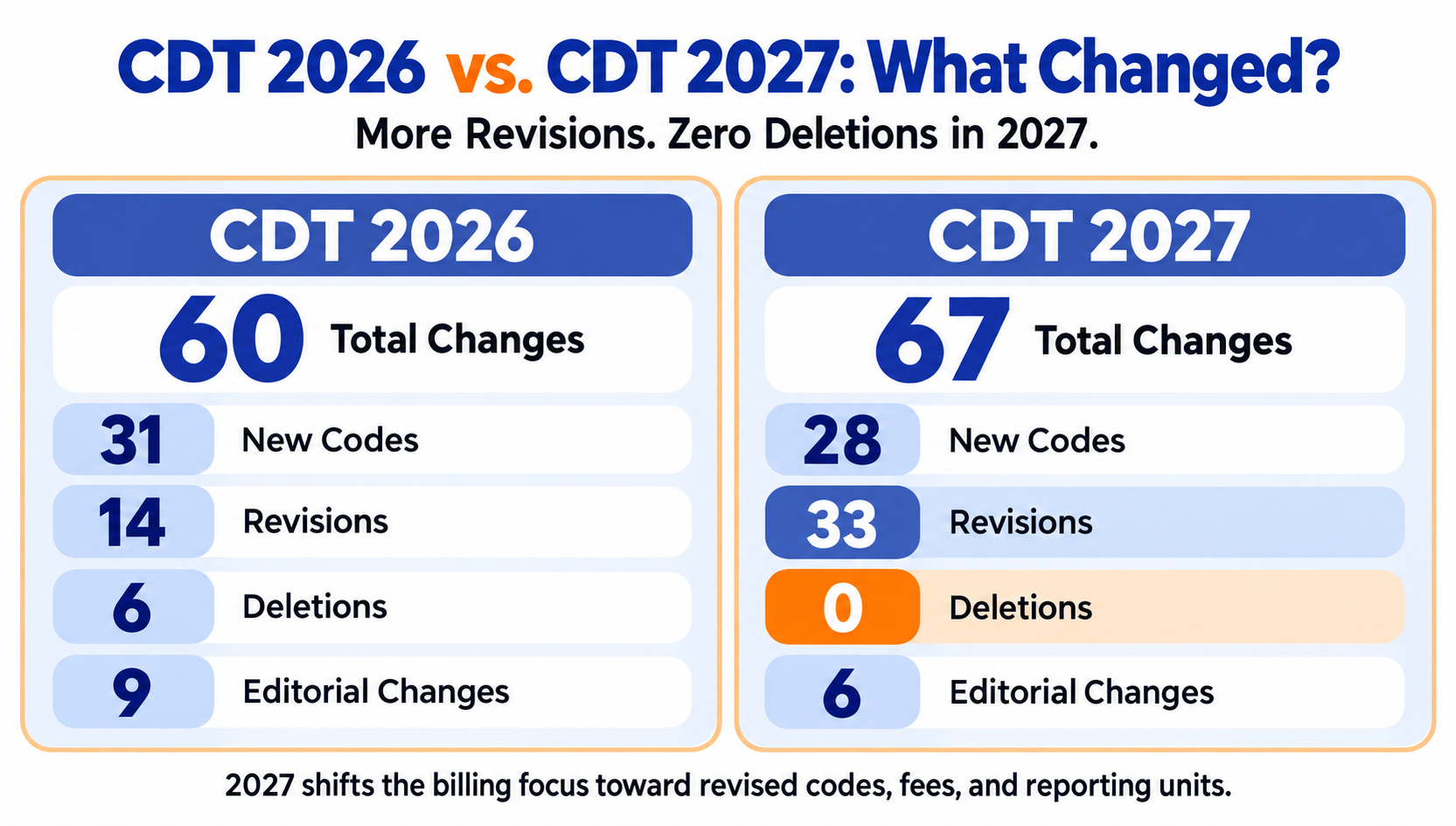
| Change type | CDT 2027 | CDT 2026 |
|---|---|---|
| New codes | 28 | 31 |
| Revisions | 33 | 14 |
| Deletions | 0 | 6 |
| Editorial changes | 6 | 9 |
| Total changes | 67 | 60 |
| Dates of service covered | January 1 to December 31, 2027 | January 1 to December 31, 2026 |
Our CDT 2026 changes section covers last year's update in detail. To see how the ADA builds and groups codes, start with our CDT codes guide.
The 2027 mix changes where billing errors show up. In 2026, teams had to clear deleted codes from fee schedules and treatment plans. For 2027, the ADA added billable services and rewrote 33 entries in the Current Dental Terminology code set, so expect errors in fees, units, and payer adoption.
Were Any CDT Codes Deleted for 2027?
No. CDT 2027 deletes no codes: the ADA committee page lists "0 deletions," so all CDT 2026 codes remain valid on January 1, 2027.
The ADA reworded 30 existing codes and three category headings or descriptors, and some codes change their unit of report, such as D9910 moving to per tooth. Payers can deny a valid code reported the old way.
New CDT 2027 Codes by Clinical Area
The ADA added 28 new CDT 2027 codes, which we group as nine for orofacial pain and TMD, 12 for implant, splint, and prosthetic work, and seven others. Each accepted request appears with its vote in the committee's March 2026 report.
The ADA prints the code numbers only in its licensed CDT 2027 manual and app. California's Medi-Cal Dental program published the first public list in proposed State Plan Amendment 26-0024, released October 7, 2026, and the numbers below match it.
We paraphrased the code titles below. The American Dental Association's CDT 2027 manual holds the official nomenclature and descriptors for the new CDT codes for 2027.
Orofacial Pain, TMD, and Chemodenervation Codes
Nine new codes give dental offices a way to report nerve blocks, muscle injections, therapeutic chemodenervation, and occlusal orthotic device upkeep. Before 2027, most of these services had no CDT code of their own, and therapeutic and cosmetic neuromodulator injections shared D9913.
| New procedure (paraphrased) | Code number | Billing note |
|---|---|---|
| Occipital nerve block | D9134 | A medical claim uses a CPT nerve block code instead |
| Peripheral nerve block, by report | D9136 | By report: name the nerve in a narrative |
| Sphenopalatine ganglion block | D9138 | Cigna's 2026 medical policy excludes it for headache diagnoses |
| Tendon or ligament injection, per site | D9140 | One unit per injection site |
| Trigger point injection, per muscle | D9142 | One unit per muscle injected |
| Therapeutic chemodenervation of head, neck, or supporting muscles, by report | D9132 | Therapeutic injections move to this code |
| Therapeutic chemodenervation of a salivary gland, by report | D9127 | Some medical plans cover chronic sialorrhea (excess saliva) |
| Repair or reline of an occlusal orthotic device | D7882 | Bills upkeep without coding a new device |
| Cleaning and inspection of an occlusal orthotic device, per appliance | D9937 | Check plan frequency limits once payers load it |
The neuromodulator change split the committee, which limited D9913 to cosmetic use by a vote of 14 to 8, with two abstentions. From January 1, therapeutic injections need D9132 or D9127, the two new chemodenervation codes, or a medical claim.
Implant, Splint, and Prosthetic Codes
Twelve of the new ADA codes for 2027 cover implant steps, splints, and prosthesis work, the group with the most new fee schedule entries.
| New procedure (paraphrased) | Code number | Billing note |
|---|---|---|
| Placing a healing cap on an implant body | D6108 | A step that had no code of its own before 2027 |
| Removing a screw-retained indirect restoration on an implant | D6109 | For treating the implant body; not for temporary or provisional restorations |
| Repairing a fixed splint, intra-coronal | D4324 | Separate code from extra-coronal repair |
| Repairing a fixed splint, extra-coronal | D4325 | Price it apart from a new splint |
| Removing a fixed splint, intra-coronal | D4326 | Report removal on its own line |
| Removing a fixed splint, extra-coronal | D4327 | Pairs with the intra-coronal removal code |
| Interim fixed denture on implants or abutments, partially edentulous maxillary arch | D6124 | D6119 still covers the fully edentulous maxillary arch |
| Interim fixed denture on implants or abutments, partially edentulous mandibular arch | D6125 | D6118 still covers the fully edentulous mandibular arch |
| Placing a semi-precision abutment on a natural tooth | D5859 | D6191 now names the implant body, so pick by abutment site |
| Replacing all teeth on a complete denture, maxillary | D5521 | Separate from a reline or a new denture |
| Replacing all teeth on a complete denture, mandibular | D5522 | Same rule for the lower arch |
| Replacing all teeth and acrylic on a hybrid prosthesis, per arch | D6126 | One unit per arch |
CDT 2027 adds D6108 for placing a healing cap on an implant body. The ADA intends it for any healing cap placement, such as after implant placement or second-stage surgery, or when removing an indirect restoration. Set a fee for it, and ask payers whether they bundle it with D6010 or D6011 on the same date.
Maxillofacial, Preventive, Orthodontic, and Special Care Codes
Seven more codes fill smaller gaps across maxillofacial prosthetics, prevention, orthodontics, sleep screening, and special care. Each serves a narrow group of patients, so load fees only for the ones your providers perform.
| New procedure (paraphrased) | Code number | Billing note |
|---|---|---|
| Auricular molding | D5950 | Confirm whether the dental or medical plan covers it |
| Nasal molding | D5961 | Confirm coverage the same way as auricular molding |
| Maxillofacial prosthesis repair, by report | D5998 | The narrative names the prosthesis and the repair |
| Non-fluoride caries preventive medicament, full mouth | D1209 | Full-mouth unit, like the revised fluoride codes |
| Re-cementing or re-bonding a fixed orthodontic appliance | D8689 | For habit, functional, and skeletal appliances, not for brackets or standard fixed appliances |
| Overnight pulse oximetry assessment | D9958 | Supports sleep-related breathing screening |
| Case management for pediatric-to-adult transition, special health care needs | D9998 | Sits beside the existing dental case management codes |
Before its first claim, each new code needs an office fee in your software, a contracted fee from each in-network PPO, and a note template that supports it. Our dental billing services team loads and prices new codes for client practices each December.
Revised CDT 2027 Codes That Change How You Bill
CDT 2027 makes 33 revisions: 30 to existing codes and three to category headings or descriptors. The billing-heavy ones are D2390 (any tooth), D9910 (per tooth), D9130 (15-minute units), D9913 (cosmetic only), D8210 and D8220 (adjunctive orthodontics), and the full-mouth fluoride codes.
Our table groups the 33 revisions to CDT 2027 codes and headings by what changed.
| Code(s) | What changed (paraphrased) | Billing impact | Count |
|---|---|---|---|
| D2390 | Direct composite crown, no longer limited to anterior teeth | Posterior use is valid coding; plans may limit or downgrade it | 1 |
| D9910 | Desensitizing medicament reported per tooth | Fee and units shift to a per-tooth basis | 1 |
| D9130 | TMJ physical therapies reported in 15-minute increments | Bill time-based units | 1 |
| D9913 | Neuromodulator administration limited to cosmetic use | Therapeutic use moves to the new chemodenervation codes | 1 |
| D1206, D1208 | Fluoride varnish and other topical fluoride worded as full-mouth applications | One unit per application | 2 |
| D1354, D1355 | Caries arresting and caries preventive medicament wording clarified | Both stay per tooth | 2 |
| Preventive subcategory | Renamed Topical Preventive and Caries Management Treatments, with a revised descriptor | No claim impact | 1 |
| D8210, D8220 | Renamed adjunctive orthodontic appliance therapy, removable and fixed | Usable alone or with comprehensive treatment | 2 |
| Orthodontic subcategory | Renamed Adjunctive Orthodontic Therapy | Update fee schedule labels | 1 |
| Comprehensive orthodontic treatment descriptor | Descriptor revised | Check ortho contract language | 1 |
| D8696, D8697 | Repair code wording states that repair includes reattachment | Bill reattachment inside the repair code; compare with the new re-cement or re-bond code | 2 |
| D5942 to D5945, D6055, D6110 to D6113, D6280 | Implant and abutment prosthesis wording updated, mainly "supported" to "retained" | Wording only; D5942 to D5945 and D6280 change again a year after the ADA added them | 10 |
| D5511, D5512 | Complete denture base repair descriptors revised | Compare with the new tooth-replacement codes | 2 |
| D5867, D6091 | Replaceable precision attachment part wording | Wording only | 2 |
| D5993 | Maxillofacial prosthesis maintenance and cleaning wording | Wording only | 1 |
| D5995, D5996 | Periodontal medicament carrier descriptors | Wording only | 2 |
| D0802 | Indirect 3D dental surface scan wording | Wording only | 1 |
| Total | 33 |
After your vendor's CDT 2027 update runs, spot-check the revised descriptions in your practice management system. Fix any your team customized, or claims and treatment plans keep printing last year's wording.
Can D2390 Be Used on Posterior Teeth in 2027?
Yes. Starting January 1, 2027, D2390 reports a direct resin-based composite crown on any tooth, anterior or posterior, according to the ADA.
Plans with alternate-benefit or downgrade clauses can limit a posterior D2390 or pay it at a lower-cost alternative's fee. Check the patient's plan before you schedule, and read the EOB line when it pays.
What Does CDT Code D1354 Cover in 2027?
In CDT 2027, D1354 reports a caries arresting medicament per tooth, and the ADA added wording that the application happens without surgical intervention.
Silver diamine fluoride is one product offices report with D1354, and the ADA's D1354 reporting guide says the choice of medicament isn't limited to it. A request to name 38% silver diamine fluoride in the descriptor ended when its submitter withdrew it.
D1355, the caries preventive medicament code, got matching wording. Both codes stay per tooth, unlike the fluoride codes D1206 and D1208, which read as full-mouth applications from January 1. Keep per-tooth fees for D1354 and D1355.
What Does D9910 Represent in 2027?
In CDT 2027, D9910 reports a desensitizing medicament per tooth, a unit change the Code Maintenance Committee approved 16 to 6 in March 2026.
Reprice the code as a per-tooth fee in your fee schedule, update treatment-plan templates, and report one line per tooth. Payers set their own per-visit and frequency limits. Read each payer's December notice before you bill the new unit at scale.
What Happened to Minor Treatment to Control Harmful Habits?
The ADA renamed Minor Treatment to Control Harmful Habits as Adjunctive Orthodontic Therapy, and from January 1, 2027, D8210 and D8220 describe removable and fixed adjunctive appliance therapy.
Practices can use these appliances alone or alongside comprehensive orthodontic treatment, according to the AAO summary. The National Association of Dental Plans noted that many commercial plans already pay orthodontics through comprehensive or global fees, so the new names may not change what you collect.
The Six Editorial Changes
CDT 2027 makes six editorial changes that reword entries without changing what they report, according to the ADA editorial change list.
- D0423: the genetic test entry reads as a laboratory analysis, matching other test codes.
- D4273: the graft descriptor says "overlaying" in place of "overlapping."
- D5982: the surgical stent descriptor drops its list of example materials.
- D5999: the unspecified maxillofacial prosthesis entry adds the word "procedure."
- D6191: the semi-precision abutment entry names the implant body.
- D9959: the unspecified sleep entry matches the renamed sleep-related breathing chapter.
CDT 2026 or CDT 2027: Which Version Goes on the Claim?
Payers expect the CDT version in effect on the date of service, whatever date you file the claim. A procedure done December 30, 2026, keeps its CDT 2026 code on a claim sent in January, and CDT 2027 codes start with services on January 1, 2027.
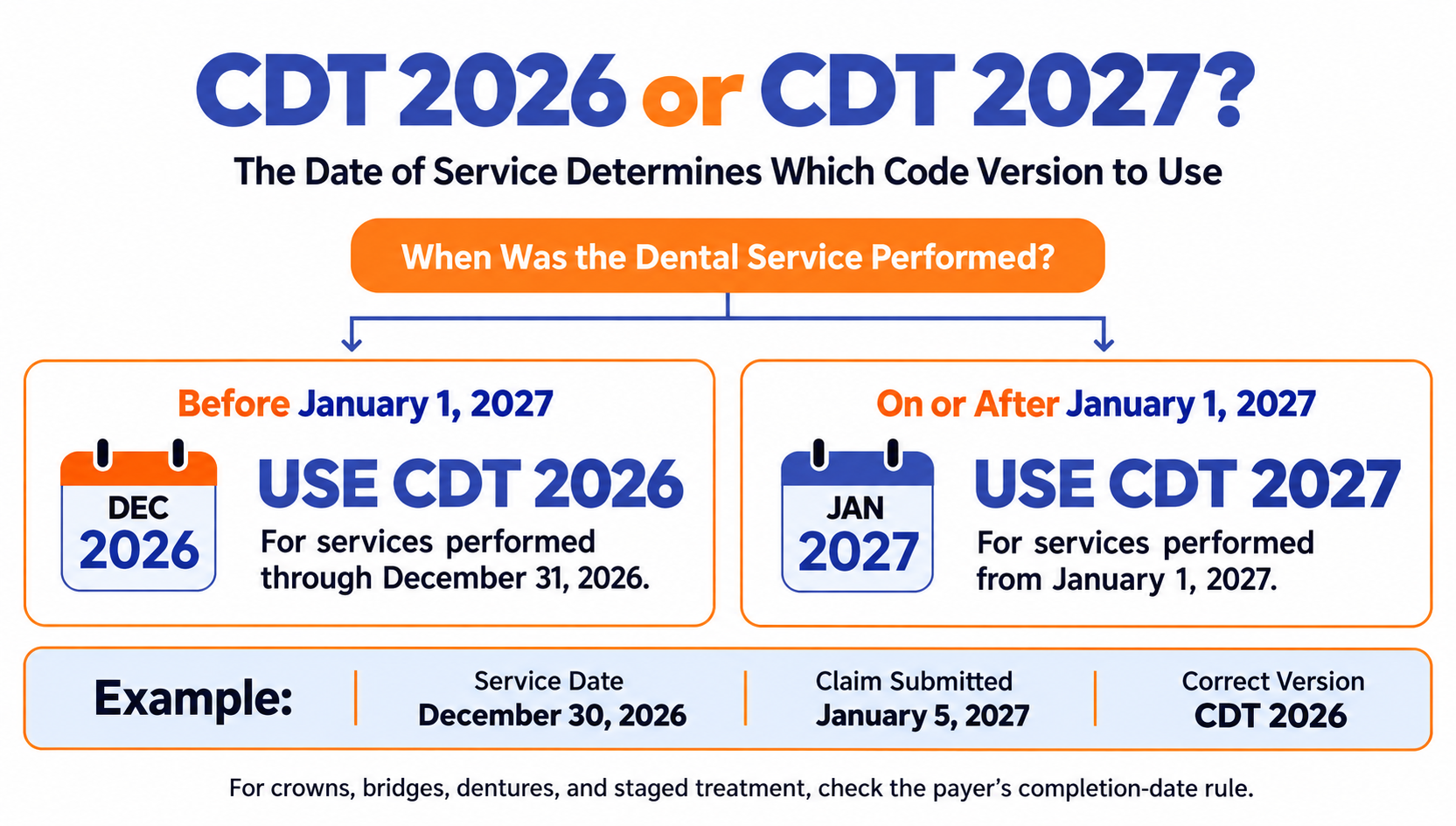
For electronic claims, HIPAA requires code sets that are "valid at the time the health care is furnished," under 45 CFR 162.1000. The ADA dental codes FAQ applies the same rule to dental claims: the code must come from the CDT version "effective on the date of service."
These six year-end cases show where CDT 2026 codes end and ADA codes 2027 begin on real claims.
| Situation | Code version | What to check |
|---|---|---|
| Service December 30, 2026; claim sent January 5, 2027 | CDT 2026 | Keep the 2026 code on the line |
| Service January 4, 2027 | CDT 2027 | Use revised units, such as D9910 per tooth |
| A newly coded 2027 procedure done in December 2026 | CDT 2026 | Report the 2026 option the record supports |
| Crown, bridge, or denture started in December and delivered in January | The payer's completion-date rule | Read each payer's manual before you date the claim |
| Predetermination sent in 2026 for 2027 treatment | CDT 2027 on the claim | Ask whether the estimate carries over if the code changed |
| Corrected claim filed in 2027 for a 2026 service | CDT 2026 | Keep the original date of service and code version |
Payers return or reject lines that carry the wrong year's code. The Northeast Delta Dental notice for CDT 2026 warned that such claims "will be returned to your office for resubmission." On remittances, watch for claim adjustment reason code (CARC) 181: "Procedure code was invalid on the date of service."
Open Dental's code tool warns users who run it before January 1 that payers may reject claims if new codes go out early. In any software, keep new codes off claims with a 2026 date of service, and send December claims before your team starts January work.
Will Insurance Pay for the New CDT 2027 Codes?
Not by default: a new CDT 2027 code gives you a way to report a service, and each dental plan decides coverage, payment, and when its system accepts it.
One of the ADA golden rules from June 2026 says "the existence of a procedure code does not mean the procedure is a covered or reimbursed benefit in a dental benefit plan." The National Association of Dental Plans agrees. Its executive director, Mike Adelberg, wrote on September 4, 2026, that "CDT code changes and benefit coverage decisions are separate considerations."
Five payers and programs handled the new CDT 2026 codes in their own ways last year, and you can expect a similar spread in January 2027.
| Payer or program | What happened with CDT 2026 | What it means for 2027 |
|---|---|---|
| UnitedHealthcare CDT notice, December 12, 2025 | Covered a new code only when its reference code was covered under the member's plan | Find the reference code for each new code you'll bill |
| Humana (2026 CDT notice) | Added a new code to fee schedules when a similar code was already on the schedule | Expect fees only where a related code has one |
| Medi-Cal Dental bulletin, April 2026 | Adopted CDT 2026 on May 1, 2026, and paid deleted codes for dates of service through April 30, 2026 | State Medicaid start dates can trail January 1 |
| Pennsylvania Medical Assistance, fee-for-service (Bulletin 99-26-04) | Added the 2026 dental codes for dates of service from August 1, 2026 | Read your state's bulletin before billing new codes |
| Nevada Medicaid announcement 3841, February 13, 2026 | Suspended claims with 2026 codes under error 853 until rates and policy loaded | Suspended claims sit unpaid until the state releases them |
Medi-Cal Dental published its 2027 plan in October. Its proposed State Plan Amendment 26-0024 adds 24 of the 28 new codes as non-benefit codes and four as global codes from January 1, 2027, pending CMS approval.
Early 2027 remittances can show three problem outcomes: a $0 line or a "no fee on file" flag, a denial as a non-covered benefit, or a Medicaid suspension. Many trace to a payer fee schedule or policy that hasn't caught up with the new edition.
Your team can keep those surprises small with four habits:
- Read each major payer's 2027 code notice when it posts in December.
- Ask in-network PPOs for contracted fees on the new codes you'll use.
- Verify benefits on the new code before treatment, plus the reference code for plans that tie the two.
- Watch the first January remits for each new code before you bill it in volume.
Our team runs insurance verification five business days before each appointment, so you see a new-code limit before the patient sits down. Practices on our billing service get verification, prior authorizations, and predeterminations at no charge.
Orofacial Pain and Therapeutic Botox: Dental Claim or Medical Claim?
Orofacial pain injections and therapeutic botulinum toxin (Botox) can go on either a dental or a medical claim in 2027. The new CDT 2027 codes report them to a dental plan. A medical plan needs CPT and ICD-10-CM codes on a CMS-1500, and many medical policies require prior authorization first.
Each new injection, nerve block, and chemodenervation code has a CPT counterpart, and the trigger point codes count units in different ways on each claim.
| New CDT 2027 procedure | CPT code for a medical claim | Unit note |
|---|---|---|
| Occipital nerve block (D9134) | 64405 (greater occipital nerve); Cigna lists the lesser occipital nerve under 64450 | One nerve per code |
| Peripheral nerve block, by report (D9136) | 64450 (other peripheral nerve or branch) | Name the nerve in the record |
| Sphenopalatine ganglion block (D9138) | 64505 | Check the payer's covered diagnoses |
| Tendon or ligament injection, per site (D9140) | 20550 (tendon sheath or ligament) or 20551 (tendon origin or insertion) | Match the CPT code to the injected structure |
| Trigger point injection, per muscle (D9142) | 20552 (one or two muscles) or 20553 (three or more muscles) | CDT counts each muscle; CPT counts muscles per session |
| Therapeutic chemodenervation, head and neck muscles (D9132) | 64612 (facial nerve muscles, one side) or 64615 (facial, trigeminal, and cervical nerves, both sides) | Confirm the payer's code for one-sided jaw muscle injections, and add the drug supply code it requires |
| Therapeutic chemodenervation, salivary glands (D9127) | 64611 (parotid and submandibular glands, both sides) | Some plans cover chronic sialorrhea |
A Medicare article A59498 from Palmetto GBA confirms the CPT split: 20552 covers one or two muscles, and 20553 covers three or more. The same article treats more than three trigger point sessions in a rolling 12 months as not reasonable and necessary.
Cigna policy 0063 took effect June 15, 2026. It doesn't cover cranial nerve blocks to treat headache, occipital neuralgia, or trigeminal neuralgia, and the exclusion names occipital, trigeminal, and sphenopalatine ganglion blocks. Check a payer's diagnosis list before you choose the medical route.
The Aetna botulinum toxin policy, last reviewed July 14, 2026, covers painful bruxism only after a night guard and drug therapy fall short. Aetna covers myofascial pain only after physical therapy and trigger point injections of local anesthetic and of corticosteroid fail. It lists temporomandibular joint disorders as experimental.
Medical claims need ICD-10-CM diagnosis codes that the exam supports. The FY 2027 code set took effect October 1, 2026, according to CMS, so these codes are valid for January 2027 dates of service:
- M79.11, myalgia of mastication muscle
- M26.623, arthralgia of both temporomandibular joints
- M54.81, occipital neuralgia
- G50.1, atypical facial pain
- G47.63, sleep related bruxism
- K11.7, disturbances of salivary secretion
From January 1, 2027, D9913 reports cosmetic neuromodulator use only. Some dental plans treated D9913 as an exclusion before the change: Delta Dental of North Carolina's CDT 2025 page says "Benefits are DENIED unless covered by group/individual contract."
Before the first injection in 2027, run four checks:
- Verify both the medical and the dental plan.
- Get prior authorization when the medical policy requires it.
- Record the diagnosis, failed conservative care, each muscle or nerve, and the units.
- Follow each plan's coordination of benefits rules, with CDT on the dental claim and CPT on the CMS-1500.
If CMS-1500 claims aren't routine at your front desk, our dental medical billing team codes oral surgery, sleep appliances, and TMD treatment for medical plans. We also handle the prior authorizations those payers require.
How to Prepare Your Office for CDT 2027 Before January 1
Your team can handle the 2027 CDT code changes in seven steps before and after January 1: manual, software, fees, revised entries, note templates, benefits checks, and January remits.
- Get the manual or app. The ADA's CDT 2027 kit pairs the code book and its full descriptors with a new app and the CDT 2027 Coding Companion, which holds more than 300 coding scenarios. Your coders can use the descriptors to settle close calls that code titles can't.
- Update the software code library on your vendor's schedule. Dentrix's most recent CDT update guide ties automatic updates to an active Customer Service Plan on G7.5 or newer. Open Dental requires each US customer to return a CDT Compliance Form before it can supply the codes.
- Load fees for the 28 new codes. As soon as your software has them, set an office fee in your fee schedule for each new code your providers perform, and reprice D9910 per tooth and D9130 per 15-minute unit. Ask in-network PPOs for contracted fees on the same codes.
- Rewrite revised entries and labels. Check descriptions for the 30 revised codes, rename the adjunctive orthodontic and preventive subcategories in your fee schedule, and retire treatment-plan templates that use last year's wording.
- Fix note templates. By-report codes, such as D9136 (peripheral nerve block), D9132 and D9127 (chemodenervation), and D5998 (maxillofacial prosthesis repair), need a narrative. Per-muscle and per-site codes need the count in the note.
- Verify benefits for new codes on January schedules. Run benefits checks on each new code, and record the payer's answer in the patient's file.
- Watch January remits. Track each new code's first payments, returns, and denials, and work them within a week. Fast AR follow-up keeps early rejections from aging into write-offs.
How CDT 2027 Affects Each Specialty
CDT 2027 changes the most for implant and prosthodontic offices, orthodontists, and offices treating orofacial pain or TMD. General offices feel D2390 and D9910 most, while pediatric, periodontal, sleep, and maxillofacial offices get a few new codes each.
The table lists each specialty's share of the dental codes 2027 changes, plus the first billing task to tackle this December.
| Specialty | What changes | First billing task |
|---|---|---|
| General and restorative | D2390 on any tooth; D9910 per tooth; full-mouth fluoride wording; new non-fluoride medicament code (D1209) | Reprice D9910 and verify posterior D2390 benefits |
| Implants and prosthodontics | Healing cap (D6108) and screw-retained restoration removal (D6109); interim fixed dentures for partially edentulous arches (D6124, D6125); semi-precision abutment on a natural tooth (D5859); tooth replacement on complete dentures and hybrids (D5521, D5522, D6126); "supported" to "retained" wording on 10 codes | Load fees for the new dental implant codes |
| Periodontics | Fixed splint repair and removal codes (D4324 to D4327); D4273 editorial change; medicament carrier wording (D5995, D5996) | Price splint repair apart from a new splint |
| Orthodontics | D8210 and D8220 renamed adjunctive appliance therapy; renamed subcategory; repair code wording that includes reattachment (D8696, D8697); new re-cement or re-bond code (D8689); revised comprehensive descriptor | Update fee schedule labels and check ortho contract wording |
| Oral surgery, orofacial pain, and TMD | Five injection and nerve block codes (D9134 to D9142, even numbers); two therapeutic chemodenervation codes (D9127, D9132); occlusal orthotic device repair and cleaning codes (D7882, D9937); D9130 in 15-minute units | Decide between a dental and a medical claim for each patient |
| Pediatrics and special care | Pediatric-to-adult transition case management code (D9998); D1354 and D1355 wording | Add the transition code to special care workflows |
| Sleep | Overnight pulse oximetry assessment code (D9958); D9959 editorial change; sleep appliance and home sleep test revisions declined | Check which plan covers the oximetry code |
| Maxillofacial prosthetics | Auricular and nasal molding codes (D5950, D5961); prosthesis repair code (D5998); D5993 wording | Write by-report narratives for repairs |
Multi-specialty groups and DSOs won't feel the update the same way at each location. Point January monitoring at the offices with new CDT 2027 codes to price, and give orofacial pain providers their own medical claim workflow.
If you want someone to check your CDT 2027 setup before January, request a free billing review. Tell us which codes and payers worry you most, and we'll start there.
What Didn't Make CDT 2027, and When CDT 2028 Opens
The ADA's Code Maintenance Committee declined several CDT 2027 requests, according to its March 2026 report, and for four of them pointed submitters to codes that already exist. You'll keep reporting those four services with today's codes.
- Palatal expanders: no new codes, because the revised D8210 and D8220 cover them.
- Remote orthodontic monitoring: no new code; the committee pointed to D9996.
- Prophylaxis with generalized irritational factors, such as heavy deposits: no new code; the committee pointed to D4346.
- Virtual reality dissociation: no new code; the committee pointed to D9999.
- Revisions to sleep appliance codes D9947, D9948, D9949, and D9953 and to home sleep apnea test code D9956: declined.
- Local anesthesia statements across categories: postponed to the March 2027 meeting.
The ADA set November 1, 2026, as the deadline for CDT 2028 change requests, according to the ADA's CDT 2028 notice. Requests sent after the deadline roll to the following cycle. Anyone can submit one, including a dental office that bills a service with no code in any of the CDT code categories.
The Code Maintenance Committee meets March 4 to 5, 2027, and the ADA plans to notify submitters of its decisions by April 2027. Approved changes take effect January 1, 2028, and the CDT 2027 codes stay in force through December 31, 2027.
CDT 2027 FAQ
CDT 2027 takes effect January 1, 2027, deletes no codes, and reaches your office through the ADA's paid book, e-book, and app or your software's licensed update.
When Do CDT Codes 2027 Take Effect?
CDT 2027 applies to dates of service from January 1 to December 31, 2027. Claims use the version in effect on the date of service, so December 2026 work billed in January keeps its CDT 2026 code.
Is There a Free CDT Codes 2027 PDF?
Not for the numbered code set. The American Dental Association (ADA) holds the copyright and sells CDT 2027: Current Dental Terminology as a book with an e-book and app. As of October 2026, that CDT 2027 book listed at $104.95 for members and $144.95 retail. The ADA's free committee report lists the accepted changes without code numbers.
Will My CDT 2026 Codes Still Work in 2027?
Yes. The 2027 edition deletes no codes, so all CDT 2026 codes stay valid. Revised wording covers 30 codes, though, D9910 and D9130 change their units, and D9913 now covers cosmetic use only, so update descriptions and fees before January 1.
Can I Bill a New CDT 2027 Code Before January 1?
No. A new code doesn't exist for a 2026 date of service. Northeast Delta Dental's CDT 2026 notice told offices that claims using new codes before the effective date would come back for resubmission. Report 2026 services with CDT 2026 codes, and hold the new ones for January 2027 dates of service.
When Will Dental Insurers Publish Their CDT 2027 Updates?
Expect most dental insurers to post their 2027 code updates in December 2026 if they follow last year's pattern. For CDT 2026, Delta Dental's FYI Online newsletter posted its update on December 9, 2025, and UnitedHealthcare dated its notice December 12, 2025. Medi-Cal Dental moved faster this year, publishing its CDT 2027 proposal on October 7, 2026.
Is CDT 2027 a Bigger Update Than CDT 2026?
By total count, yes: 67 changes against 60. The 2027 edition adds fewer codes, 28 against 31, but makes more than twice as many revisions, 33 against 14, and deletes none, while CDT 2026 deleted six. Your 2027 workload falls on fees and units, so plan December time around repricing.
Before Your January Claims Go Out
The CDT codes 2027 update deletes nothing, so January errors will show up on payment lines. Watch for new codes paid at $0, revised codes in last year's units, and orofacial pain claims sent to the wrong plan. Your team can catch most of them in December by loading fees, updating descriptions, and checking benefits.
If you'd rather hand the January rollout to a team that does it every year, look at our outsourced dental billing service. We charge 2.95% to 3.95% of monthly collections depending on volume, with custom DSO pricing and no setup fee. You pay only on what we collect, and the billing pricing page has the tiers.
Sources
- ADA News: 67 changes coming to CDT 2027, April 14, 2026; CDT 2027 available for preorder, June 23, 2026; CDT 2028 change requests due November 1, August 28, 2026; 6 golden rules of coding, June 23, 2026
- American Dental Association: Code Maintenance Committee; final report of March 2026 committee decisions; CDT 2027 editorial action inventory; frequently asked questions on dental codes; D1354 guide to reporting; ADA Store, CDT books and more
- American Association of Orthodontists: ADA accepts AAO-supported orthodontic code language updates, April 29, 2026
- Electronic Code of Federal Regulations: 45 CFR 162.1000, general requirements for code sets
- Payer notices: Northeast Delta Dental, CDT code and policy changes; UnitedHealthcare Dental, annual CDT code changes, December 12, 2025; Humana, 2026 CDT code changes; Delta Dental FYI Online, CDT 2026 updates, December 9, 2025; Delta Dental of North Carolina, CDT 2025 code updates
- State Medicaid: Medi-Cal Dental Provider Bulletin, Volume 42, Number 10, April 2026; Nevada Medicaid Web Announcement 3841, February 13, 2026; Pennsylvania Medical Assistance Bulletin 99-26-04, July 10, 2026; California DHCS, proposed State Plan Amendment 26-0024, October 7, 2026
- Medical policies: Aetna Clinical Policy Bulletin 0113, botulinum toxin; Cigna Medical Coverage Policy 0063, effective June 15, 2026; CMS Medicare article A59498, trigger point injections
- Other references: National Association of Dental Plans, "2027 CDT Code Changes: What I Learned," September 4, 2026; X12 claim adjustment reason codes; CMS ICD-10 code files for FY 2027
CDT is a trademark of the American Dental Association, which holds the copyright to the CDT Code. We paraphrased code titles in this guide; see the CDT 2027 manual for official nomenclature and descriptors. CPT is a registered trademark of the American Medical Association.
ABOUT THE AUTHOR
Russell Bennett
Russell Bennett is a Dental RCM and Provider Credentialing Specialist at iDental Billing. He reviews billing workflows, resolves claim denials, outstanding insurance balances, and reimbursement discrepancies, and applies CDT coding and payer-specific guidelines. His work includes provider credentialing, payer enrollment, and recredentialing. Russell writes iDental Billing’s educational guides on what claims need, why they matter, and where things go wrong.