














Covers CDT 2026. Code numbers and payer notes checked October 2026.
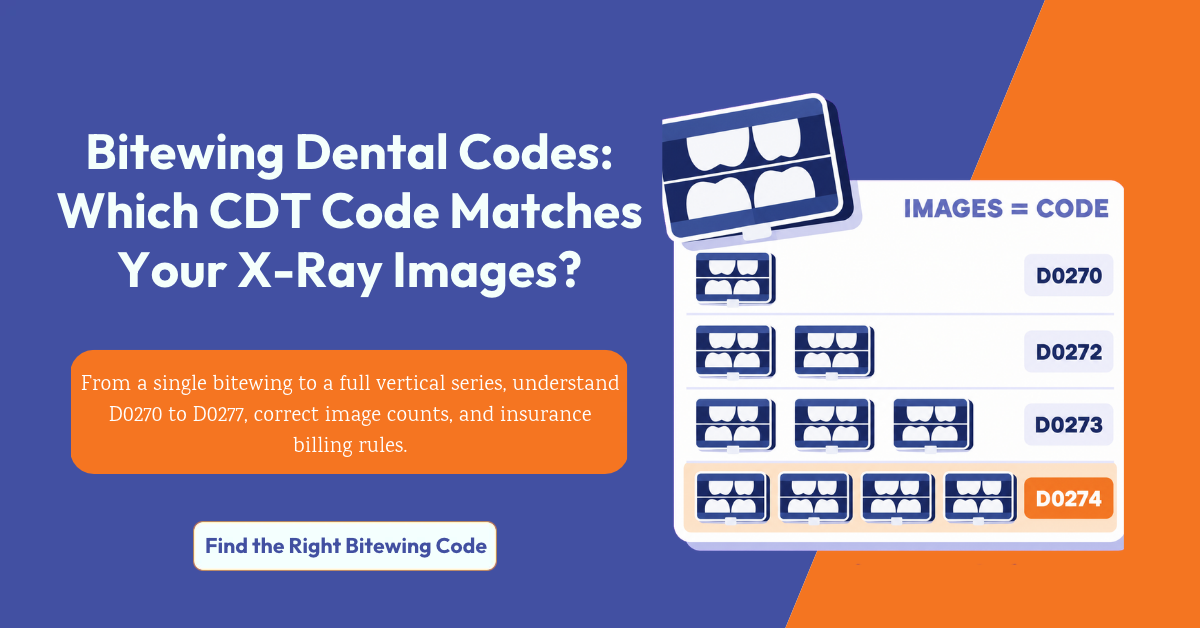
The bitewings dental code depends on how many images you take: D0270 for one, D0272 for two, D0273 for three, and D0274 for four. A vertical set of seven or eight images is D0277. Bitewing images captured outside the mouth on a panoramic or CBCT unit are reported as D0251.
Picking the code takes seconds. Denials come later, from frequency limits that many plans share across every bitewing code, from FMX bundling, and from same-day combinations. One emergency bitewing in February can block the four-image recall set in August, and the denial arrives weeks after the patient has gone home.
We're the dental billing and RCM team at iDental Billing, and bitewing claims cross our desk on every recall day. You'll get a four-question code picker, the billing trap inside each count code, rules for vertical and extraoral sets, FMX bundling, payer frequency examples, and a fix for each common denial.
Bitewings dental code: key takeaways
- Image count sets the code: D0270, D0272, D0273, or D0274, with seven or eight vertical images reported as D0277.
- Vertical orientation doesn't change the code below seven images, so four vertical bitewings are still D0274.
- Bitewings captured on a panoramic or CBCT unit in bitewing mode go to D0251, and capture-only work goes to D0708 or D0705.
- Many plans apply one frequency limit to every count code, so a single emergency bitewing can block the recall set.
- Payers often treat bitewings taken on or near an FMX date as included in D0210.
What Is the Dental Code for Bitewings?
A bitewings dental code is the CDT code, such as D0274, that reports bitewing radiographic images on a dental claim. The ADA assigns one code per image count. Vertical sets, extraoral capture, tomosynthesis, and image capture only each get separate codes, so equipment and workflow matter as much as the count.
Table: CDT bitewing and related imaging codes, CDT 2026
| Code | Paraphrased nomenclature | When offices use it | Billing note |
|---|---|---|---|
| D0270 | One bitewing image | One suspect contact or a localized follow-up | Shares one frequency limit with the other bitewing codes on many plans |
| D0272 | Two bitewing images | Children, smaller arches, or few posterior teeth | One claim line, not two D0270 lines |
| D0273 | Three bitewing images | Missing teeth, or one side needs two views | Falls under the same frequency limit on many plans |
| D0274 | Four bitewing images | Standard adult recall set | One claim line at quantity 01 |
| D0277 | Vertical bitewings, seven or eight images | Periodontal bone level assessment | Some plans count D0277 toward FMX frequency |
| D0251 | Extraoral posterior dental image | Bitewing mode on a panoramic or CBCT unit | Coverage varies by plan |
| D0708 | Intraoral bitewing image, capture only | Captured by someone other than the reading practitioner | Reported per image; the reader bills D0391 |
| D0373 | Intraoral tomosynthesis bitewing image | Offices with tomosynthesis units | Coverage varies by plan |
| D0388 | Intraoral tomosynthesis bitewing image, capture only | Tomosynthesis capture read by another practitioner | Reported per image |
A bitewing shows the crowns of the upper and lower back teeth in one view, along with the contacts between them and the crest of the bone. Chart notes tie bitewings to two jobs: catching interproximal decay that a visual exam misses and tracking bone levels between periodontal visits.
Charts often say "BWX," and staff may call it the ADA code for bitewings or the CDT code for bitewings. Those labels all point to the same entry. Whatever your schedule calls it, the claim line carries the CDT number, and payers match that number against the plan's frequency table.
Bitewing codes sit in the Diagnostic category, D0100 to D0999, one of the 13 CDT code categories. Periodic exams, periapicals, and panoramic images share that range. We've paraphrased every code title on this page because the ADA holds the copyright to CDT nomenclature.
How to Pick the Right Bitewing Code in Four Questions
Choosing the bitewings dental code, from D0270 to D0277 or D0251, comes down to four questions asked in order. Equipment and who reads the image come first. Either one can move you into a different code family before you count a single image, so the count question comes last.
Table: Bitewing code picker
| Question | If yes | Code to report |
|---|---|---|
| 1. Was the image captured outside the mouth on a panoramic or CBCT unit in bitewing mode? | Extraoral image | D0251, or D0705 if capture only |
| 2. Was the image captured with intraoral tomosynthesis? | Tomosynthesis image | D0373, or D0388 if capture only |
| 3. Did one practitioner capture the image and a different practitioner interpret it, or were the patient and dentist in different locations? | Capture only | D0708 per image; the reader bills D0391 |
| 4. How many images were taken? | Count codes | One: D0270. Two: D0272. Three: D0273. Four: D0274. Seven or eight vertical: D0277. Five or six: see the next section |
Horizontal or Vertical Doesn't Decide the Code Below Seven Images
Four vertical bitewings are reported as D0274, the same as four horizontal ones. ADA's guide to image capture only procedures backs this up from another angle. The D0708 descriptor says the image axis may be horizontal or vertical, so CDT has no separate code for a vertical bitewing.
Picture a perio maintenance patient on Tuesday's schedule. The hygienist takes four vertical bitewings to see more bone height, and the chart reads "VBW x4." Someone at the front desk keys D0277 because the note says vertical. Bill D0274 instead. D0277 starts at seven images, so a four-image D0277 line misstates the service.
Who Reads the Image Can Change the Code Family
Capture-only codes such as D0708 apply when one practitioner captures the image and a different practitioner interprets it, or when the patient and the dentist are in different locations. ADA's guide doesn't limit capture-only reporting to teledentistry. A public health hygienist sending images to a dentist at another office fits the same definition.
Each capture-only code covers a single image, so four bitewings captured this way are four units of D0708. The reading practitioner reports D0391, interpretation by a practitioner not associated with capture, also per image. Ask whether the plan wants the count in the quantity field or on separate lines.
Same-office splits follow another rule, and the bitewing dental code stays in the standard family. ADA's guide gives a full-mouth series example: the hygienist captures images Monday, and the dentist reads them Tuesday. The office still reports D0210, dated Tuesday. Many offices apply the same reasoning to a recall bitewing set read the next day.
If your team runs this matrix in its head on a packed recall day, our dental billing services team codes each image set against the chart note before the claim goes out. Mismatches get corrected at our desk, before a payer has a chance to deny them.
D0270, D0272, D0273, D0274, and D0277 Explained
Each bitewings dental code from D0270 to D0277 carries its own billing trap. The D0270 trap can cost a full recall set, because one image can use up a year of bitewing benefit. D0274 is where quantity errors show up. D0277 is where frequency buckets get confusing, since plans disagree about where it belongs.
D0270: Single Bitewing Image
The D0270 dental code reports one bitewing image. Offices use the single bitewing dental code for one suspicious contact, a follow-up on a watched area, or a patient with few posterior teeth left.
The trap sits in the frequency table. Many plans put every count code into one limit. Colorado's 2025 dental program rules for low-income seniors allow one of D0270, D0272, D0273, or D0274 per 12 months. Under that rule, a single bitewing at a February emergency visit can deny the four-image set at the August recall.
Check the last bitewing date before you bill. Some offices choose not to charge for a single image, but network contracts and fee policies govern that choice, so confirm before you do it. Running dental insurance verification before the visit puts the last bitewing date in front of the hygienist.
D0272: Two Bitewing Images
D0272 reports two bitewing images, usually one per side. Offices commonly use D0272 for children, smaller arches, or patients with limited posterior teeth. Report D0272 once, on one line. Don't split it into two D0270 lines, even when the two exposures were taken minutes apart.
A six-year-old with primary molars gets one image on each side at a recall visit. That's one D0272 line. The D0272 dental code, which some staff call the 2 bitewing dental code, prices the pair as a single procedure and counts once against the plan's limit.
D0273: Three Bitewing Images
D0273 reports three bitewing images. The dental code for three bitewings fits patients with missing teeth, or a mouth where one side needs separate molar and premolar views while the other side needs one image. Anatomy decides the count. On many plans, D0273 sits in the same frequency limit as D0274.
Caries risk affects how often a dentist orders bitewings, and it has no bearing on how many images go into the set. If the chart note reads "three BWs, high caries risk," bill D0273. The risk note supports the timing of the set, which matters when a payer questions frequency.
D0274: Four Bitewing Images
The D0274 dental code description covers four bitewing images, usually right and left premolar and molar views, the standard adult recall set. Report the dental code for 4 bitewings on one claim line at quantity 01. Payers read dental code D0274 as one procedure, not four.
Item 29b, the quantity field on the 2024 ADA claim form, defaults to 01. Entering 04 because four images were taken tells the payer you delivered four sets. Older references say "bitewings, four films," but the current nomenclature says radiographic images, and four vertical bitewings still go to D0274.
Tooth information belongs on the line too. ADA's CDT 2026 Appendix 3 recommends reporting tooth anatomy, rather than an area of the oral cavity, for D0270 to D0277. Our walkthrough of 2024 ADA claim form fields shows where Item 27 and Item 29b sit.
D0277: Vertical Bitewings, Seven or Eight Images
D0277 reports a set of seven or eight vertical bitewing images, and dentists order it to assess periodontal bone levels. Staff who search for the ADA code for vertical bitewings or the D0277 dental code reach the same entry. The image count is part of the definition, so six images can't be billed as D0277.
Plans file D0277 in different frequency buckets. Colorado's 2025 senior program counts D0277 as a full mouth series, one of D0210, D0277, or D0330 per 60 months. Sharp Health Plan's 2023 DeltaCare summary for pediatric enrollees groups D0277 with D0274 at one per six months per contract dentist.
Those two rules cost the practice different things. Under Colorado's, a vertical set can block the next FMX for five years. With Sharp's 2023 rule, D0277 uses up the routine bitewing benefit for six months. Check which bucket the plan uses before the hygienist takes the series, and note the answer in the patient's plan record.
How to Code Five or Six Vertical Bitewings
CDT 2026 has no dental code for 6 vertical bitewings, or for five. D0277 starts at seven images, and D0210 requires a full comprehensive series. Report the count codes that match what was taken, and let the payer's rules decide what pays.
Table: One common way offices report five or six images
| Images taken | Common reporting | Status |
|---|---|---|
| Five vertical bitewings | D0274 plus D0270 | Office convention, not ADA language |
| Six vertical bitewings | D0274 plus D0272 | Office convention, not ADA language |
Expect the second line to cause trouble. Some plans pay one bitewing code per date of service. West Virginia Medicaid's code listing for members under 21 marks D0270, D0272, D0273, and D0274 as not reimbursable with each other, so the second line won't pay under that program.
Rounding up to D0277 misstates the service, because the D0277 nomenclature sets the count at seven or eight. D0210 fails for a different reason. ADA's descriptor for the comprehensive series requires the crowns and roots of all teeth plus periapical areas, and five or six vertical bitewings don't capture them.
For edge cases, go to the source. The ADA coding education page lists ADA's coding resources, including the CDT Coding Companion and routes for sending code questions to ADA staff. Whatever you bill, keep the chart note specific about the number and orientation of images.
Extraoral Bitewings: When D0251 Applies Instead of D0272
The bitewings dental code for images captured outside the mouth, on a panoramic or CBCT unit set to bitewing mode, is D0251, an extraoral posterior dental radiographic image. Report D0251 on either type of unit, provided the machine took a dedicated bitewing image rather than a crop of a larger one.
Two miscodes show up on these claims. Billing D0272 codes the result, and billing D0330 codes the machine. ADA walks through the right answer in Part 7 of its Dental Benefit Video Series, Bitewings and Extraoral Image Procedure Codes, and points offices to D0251 as the extraoral bitewings code.
A patient with a severe gag reflex or large lingual tori can't tolerate a sensor. The hygienist switches the panoramic unit to bitewing mode and captures right and left posterior images. Both images report as D0251, the dental code for pano bitewings, and neither goes on the claim as D0272.
The D0251 descriptor limits the image to the complete posterior teeth in both arches and calls it a unique image, one that isn't derived from another image. A bitewing view cropped out of a full panoramic image doesn't qualify. Bill the panoramic image as D0330 and leave the crop off the claim.
Offices commonly report one unit of D0251 per image, so right and left captures go out at quantity 02, or as two lines if the payer prefers. ADA's Appendix 3 recommends tooth anatomy reporting for D0251, the same as the count codes, so fill in Item 27.
Coverage for D0251 varies by plan, so verify it before capture. If a plan may not cover D0251, many offices attach a narrative explaining why intraoral sensors weren't possible and ask the payer to consider the bitewing benefit. The payer decides, and the plan and contract shape that decision.
Capture-only rules apply here too. If a practitioner not associated with the reading dentist captures the extraoral image, report the capture as D0705, the extraoral posterior image capture-only code. The reading practitioner reports D0391, matching the intraoral capture-only logic in the code picker.
Does D0210 Include Bitewings? FMX Bundling Rules Payers Apply
Yes. D0210, the intraoral comprehensive series, covers interproximal areas, so bitewings taken as part of an FMX belong to D0210 and aren't billed as a separate D0274. ADA's own example series include four posterior bitewings inside D0210, the dental code for full mouth series.
ADA's comprehensive series guide spells out what the D0210 dental code has to display. Image count isn't on the list. The descriptor names four things the series must show:
- Crowns and roots of all teeth
- Periapical areas
- Interproximal areas
- Alveolar bone, including edentulous areas
The old "14 to 22 images" wording is gone from the descriptor. ADA's guide says no magic number of images defines a full mouth series, and the dentist decides whether the set meets the descriptor. One ADA scenario counts 15 images as D0210, while 20 images that miss the lower molars would fall short of the descriptor.
A panoramic image isn't part of D0210, the FMX dental code. ADA's guide treats the panoramic as extraoral, with its own code, D0330. A pano plus bitewings goes on the claim as D0330 plus the bitewing count code, and Colorado's 2025 senior program states that this same-day pair shall not be billed as D0210.
Table: How payers bundle bitewings with an FMX (examples; check each plan)
| Pattern | What the payer does | Example |
|---|---|---|
| Bitewings within six months of D0210 | Treats the bitewings as inclusive in the FMX | Blue Cross Blue Shield of Massachusetts |
| More than six periapical images (D0220, D0230) on one date | Processes any combination above six as D0210 | Blue Cross Blue Shield of Massachusetts |
| Same-day images with fees above the FMX fee | Reimburses the combination at the D0210 fee | Colorado senior dental program, 2025 |
| Panoramic image plus bitewings | Combines and pays them as an FMX, using up FMX frequency | Described in ADA's bundling guidance |
A new patient gets an FMX in January. In June, five months later, the hygienist takes four bitewings at recall. A plan that treats bitewings within six months of D0210 as inclusive will deny that D0274 dental code line, so check the last FMX date before the recall images.
Some plans count D0277 toward the same frequency as D0210, as Colorado's 2025 schedule does. One set of vertical bitewings can use up the patient's FMX benefit for years, and that's why the D0277 bucket question belongs on every verification call.
Code what was taken. CDT describes the service, and the plan decides the payment. ADA's bundling guidance tells dentists to code for what they've done and, when they believe the plan got the claim wrong, to appeal the decision in writing.
How Often Does Insurance Cover Bitewings?
Insurance coverage for bitewings, including D0274, follows each plan's design, and no single rule applies. The plan examples in this section range from one set every six months to one set per 12 months. Any bitewings dental code you bill counts against that limit, whatever the image count.
Patients ask whether dental insurance covers bitewings. On every plan in the table, it does, inside a frequency limit, and that limit is what trips up claims. Many plans put every count code into one frequency limitation, and the limit runs on different clocks.
Some plans use a rolling 12 months. Others reset on a calendar year, and a few count per provider. Each clock changes which recall date is safe to bill, so the same August recall can pass on one plan and deny on another.
Table: Bitewing frequency rules vary by plan (examples)
| Plan or program | Bitewing rule | D0277 rule |
|---|---|---|
| Colorado senior dental program, effective July 1, 2025 | One of D0270, D0272, D0273, or D0274 per 12 months | One of D0210, D0277, or D0330 per 60 months; counts as a full mouth series |
| West Virginia Medicaid, dental code listing for members under 21 (2025) | D0270 up to four per calendar year; D0272, D0273, and D0274 once per calendar year; none reimbursable with each other or with D0210 | Not listed |
| Sharp Health Plan DeltaCare, pediatric enrollees, 2023 plan year | One of D0272 or D0273 per six months per contract dentist | One of D0274 or D0277 per six months per contract dentist |
| Blue Cross Blue Shield of Massachusetts, standard limits | Two per calendar year; bitewings within six months of D0210 are inclusive | One set per 12 months for members 16 and older, with no more than two bitewings of any kind per calendar year |
Clinical guidance runs on a separate track. The ADA released new radiography recommendations on January 5, 2026, endorsed by the AAOMR and published in JADA, and their core message is that X-rays should be ordered "only when clinically necessary." ADA's January 2026 imaging recommendations guide the dentist; plan limits decide payment.
Run this seven-step script on each recall patient's plan before the visit:
- Pull the last bitewing date and the code billed.
- Ask whether the limit runs on a rolling 12 months, a calendar year, or per provider.
- Confirm which codes share the limit: all count codes, or D0272 and D0273 in a limit of their own.
- Ask where D0277 sits, with FMX frequency or with bitewings.
- Get the last D0210 date and the plan's inclusion window.
- Check age limits and whether D0251 is covered.
- Record every answer in the plan record before the appointment.
If nobody on your team has time to ask these seven questions for every recall patient, our benefits verification team checks bitewing history and frequency five business days before each visit. Your hygienist walks into the operatory knowing which images the plan will cover.
Why Bitewing Claims Get Denied, and How to Fix Each One
A bitewings dental code can be correct and still deny. Denials on D0274 and the other count codes usually trace to frequency limits, FMX inclusion, same-day combinations, missing tooth information, or plan exclusions. The claim adjustment reason code (CARC) on the ERA or EOB tells you which one you're facing.
Table: Common bitewing denials and the fix (CARC use varies by payer)
| Denial pattern | Typical CARC | Root cause | Fix |
|---|---|---|---|
| Frequency exceeded | 119 or 151 | An earlier bitewing in the same window | Verify the history; appeal only if the payer's record is wrong |
| Bundled with FMX | 97 | Bitewings on or near a D0210 date | Check the inclusion window; appeal if no FMX was taken |
| Second bitewing line on the same date | 97 or 18 | Two count codes on one date of service | Confirm payer policy and document the images taken |
| Missing tooth information | 16 | Item 27 left blank | Add tooth anatomy per Appendix 3 and resubmit |
| Code not covered | 96 or 204 | Plan excludes D0277 or D0251 | Bill the patient only if the contract and signed financial policy allow it |
In plain terms, CARC 16 means missing information and 18 means a duplicate. Codes 96 and 204 flag a service the plan doesn't cover, 97 says the benefit sits inside another service, 119 means the period's benefit maximum is used, and 151 says the information doesn't support that frequency. Our dental denial code table covers the rest.
Appeal if the payer's history is wrong, if no FMX exists on the date the payer cited, or if the payer recoded a vertical series into D0210 without saying so. Attach the images, the chart note, and a short narrative that answers the denial reason in the payer's own policy language.
A genuine frequency overage usually won't overturn on appeal, however clean the bitewing dental code looks. Whether the patient owes the fee depends on the network contract and the financial policy the patient signed, and in-network agreements often limit what you can bill. Check both before a statement goes out.
If bitewing denials sit unworked because nobody owns the queue, our dental AR follow-up team appeals them with the images attached. We also trace each denial back to the front-desk step that caused it, so the same denial doesn't come back next month.
Documentation That Keeps Bitewing Claims Paid
Routine D0274 recall claims seldom need attachments, but a frequency exception, an appeal, or a D0251 claim will need records. Writing the note once, at the visit, takes less time than rebuilding it from memory three weeks later. Whatever bitewings dental code goes on the claim, the chart note should show:
- Reason for imaging, tied to exam findings or risk
- Number and orientation of images
- Teeth or areas captured
- Findings, including contacts and bone levels
- Who captured and who interpreted the images, when they differ
On the claim, report tooth anatomy per Appendix 3 and the count code at quantity 01. Mark Item 39 "Y" for radiograph enclosures. On capture-only claims, each image is its own unit, and the reading practitioner reports D0391.
Radiographs taken during a procedure, such as working images during root canal therapy, belong to that procedure. ADA's bundling guidance notes that root canal therapy by definition includes intra-operative X-rays, so a bitewing X-ray dental code doesn't go on the claim for those images.
Our coders check every bitewing code against this note before submission as part of outsourced dental billing, and lines that don't match the chart go back to the office before they go to the payer.
What Changed for Bitewings in 2026, and What CDT 2027 Means
CDT 2026 took effect January 1, 2026, with 60 code changes, including 31 new codes. None of the 31 additions is a bitewing code, and D0270 to D0277 and D0251 remain the codes to report for 2026 dates of service. Our pillar on CDT 2026 changes lists every addition.
CDT 2027 applies from January 1, 2027, with 67 changes: 28 new codes, 33 revisions, and six editorial updates. ADA's published highlights cover implants, orofacial pain, orthodontics, and neuromodulators, with no bitewing change listed. Bill each claim under the version in effect on its date of service, and see our CDT 2027 guide.
One clinical change reaches the operatory. The ADA's January 2026 release cites its 2024 finding that thyroid collars and lead aprons are no longer necessary for dental imaging. State radiation rules can lag behind professional guidance, so check your state's requirements before you change protocol.
Bitewings Dental Code FAQs
Which bitewings dental code is used for a standard adult set?
D0274 is the code for a standard adult set of four bitewing images, usually right and left premolar and molar views. Report D0274 on one claim line at quantity 01, not as four separate images.
Four vertical bitewings are still D0274, because D0277 starts at seven images. Older references describe the service as "bitewings, four films," while the current nomenclature says radiographic images. Whether someone asks for the dental code for 4 bitewings or the D0274 dental code, the claim line is the same. Check the last bitewing date before recall.
Can D0274 and D0210 be billed on the same date?
Usually not, because bitewings taken as part of a full mouth series belong to D0210, the FMX dental code. The D0210 descriptor covers interproximal areas, so a separate same-day D0274 tends to bundle or deny as included in another service.
Code what was taken. If the dentist ordered an FMX, report D0210 alone. Images that don't meet the D0210 descriptor get the codes that match them. Check the payer's inclusion window too. Blue Cross Blue Shield of Massachusetts, for one, treats bitewings within six months of D0210 as inclusive.
Can bitewings and a panoramic image be billed on the same day?
Yes. Under CDT, a panoramic image and same-day bitewings are reported as D0330, the panoramic dental code, plus the bitewing code, such as D0274. ADA's comprehensive series guide treats the panoramic image as extraoral, so the pair isn't coded as D0210.
Payers can still combine them. ADA's bundling guidance notes that some plans pay a pano plus bitewings as an FMX, which uses up FMX frequency. Colorado's 2025 senior program, by contrast, states that the same-day pair shall not be billed as D0210. Verify the plan's rule before both images are taken.
Is there a CPT code for bitewings?
A dental claim doesn't need a CPT code for bitewings. Dental plans process bitewings under CDT codes such as D0274, and CPT codes belong on medical claims. Offices asking about a CPT code for bitewings often have a medical plan in the picture, such as imaging tied to a medical condition.
A medical plan sets its own rules for dental imaging, if it covers the service at all. Read that plan's policy and confirm the code it accepts before converting any dental imaging service. The dental claim keeps the CDT code.
Do bitewings show bone loss?
Yes. Bitewings show the crest of the alveolar bone between the back teeth, so they can reveal early bone loss along with interproximal decay. Standard horizontal bitewings show a limited band of bone. Vertical bitewings show more bone height, which is why dentists use them for periodontal assessment.
A set of seven or eight vertical images is reported as D0277, the ADA code for vertical bitewings. Document the bone levels the dentist reads from the images. Those findings support the D0277 claim if a payer questions the service or asks for records on appeal.
How much do bitewings cost a practice to bill?
Each practice sets its own fee for every dental code for bitewings, from D0270 to D0277. For in-network patients, the payer contract sets the allowed amount, and the office writes off the difference where the contract requires it.
ADA's claim form instructions say it's always appropriate to report the full fee for each service, so bill your office fee and let the contract adjust it. Out of network, the patient's share depends on the plan's payment and your financial policy. Compare bitewing fees with contracted allowances once a year.
Before Your Next Bitewing Claim Goes Out
Three habits keep bitewing claims paid. Match the bitewings dental code to the image count, the equipment, and who read the images. Check the last bitewing date, the last FMX date, and the plan's frequency clock before the recall visit. Document the count, orientation, and findings while the patient is still in the chair.
Want a second set of eyes on your bitewing claims? Send us a recent month of EOBs, and our free billing review will show which denials trace to frequency, bundling, or coding. You'll see the pattern by payer, with the fix for each one.
Rates are on our billing pricing page. Fees run from 3.95% of monthly collections for practices collecting up to $30K a month down to 2.95% for practices collecting $75K to $150K, with no setup fees or long-term contract. Billing clients pay $95 per commercial payer for credentialing.
If a payer's bitewing rule doesn't match anything on this page, send us the EOB and the plan name. We'll read the policy with you and tell you whether the denial is worth an appeal.
Sources
American Dental Association
- Guide to "Image Capture Only" Procedures and Their Reporting
- CDT 2026 Appendix 3: Reporting Area of the Oral Cavity and Tooth Anatomy by CDT Code (effective January 1, 2026)
- Guide to Intraoral Comprehensive Series of Radiographic Imaging Codes
- Dental Benefit Video Series, Part 7: Bitewings and Extraoral Image Procedure Codes
- Coding Education
- 2024 ADA Dental Claim Form Completion Instructions
- Bundling of Procedure Codes
- Press release, January 5, 2026: New Recommendations Confirm Dental X-Rays Most Effectively Used in Moderation
- ADA News: New CDT codes you should know for 2026
- ADA News: 67 changes coming to CDT 2027
State programs
- Colorado HCPF, Covered Procedures for the Dental Health Care Program for Low-Income Seniors, effective July 1, 2025
- West Virginia Bureau for Medical Services, Medicaid dental code listing for members under 21 (2025)
Payer documents
- Blue Cross Blue Shield of Massachusetts, CDT dental procedure lookup
- Sharp Health Plan, DeltaCare summary of benefits with embedded pediatric dental, 2023 plan year
CDT is a trademark of the American Dental Association, which holds its copyright. Code titles in this guide are paraphrased.
ABOUT THE AUTHOR
Russell Bennett
Russell Bennett is a Dental RCM and Provider Credentialing Specialist at iDental Billing. He reviews billing workflows, resolves claim denials, outstanding insurance balances, and reimbursement discrepancies, and applies CDT coding and payer-specific guidelines. His work includes provider credentialing, payer enrollment, and recredentialing. Russell writes iDental Billing’s educational guides on what claims need, why they matter, and where things go wrong.