




















Covers CDT 2026 and CDT 2027 (effective January 1, 2027). Code wording and payer rules checked October 25, 2026.
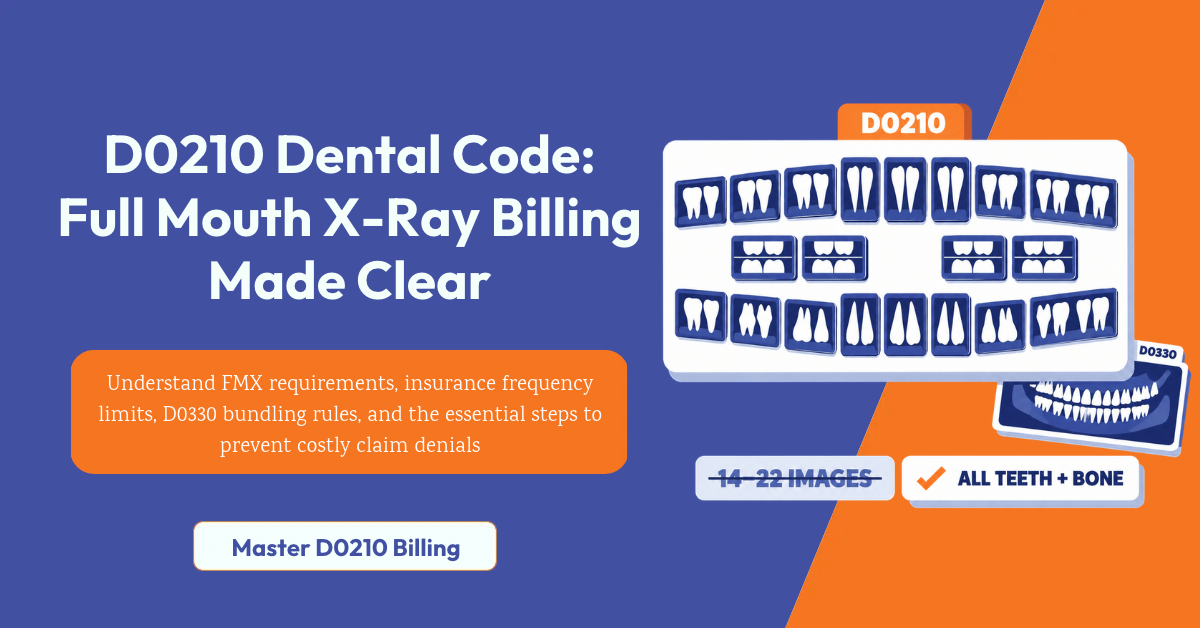
The D0210 dental code is the ADA’s CDT code for an intraoral comprehensive series of radiographic images, the full mouth series most offices call an FMX. A D0210 set must show the crowns and roots of all teeth, periapical and interproximal areas, and alveolar bone, including edentulous areas. No fixed image count defines the code.
Choosing the FMX dental code takes seconds. Getting paid for FMX X-rays takes more work. Payers set frequency limits, count a panoramic image against the same limit, and recode separate periapicals and bitewings into a full series. Your team can head off all three problems before the claim goes out.
We wrote this from the billing side at iDental Billing, where filing and appealing dental claims is the daily work. You’ll get the current ADA rules, real payer limits with their sources, and the claim fixes we use on D0210 denials.
Key Takeaways
- Definition: D0210 is the ADA’s CDT code for an intraoral full mouth series, image capture with interpretation, in the Diagnostic category (D0100 to D0999).
- Image count: CDT has set no fixed number since CDT 2023. The ADA’s own examples qualify sets of 15 and 22 images.
- Frequency: the payer decides. Examples run from once every two years (West Virginia Medicaid adults) to once per 60 months (BCBS Massachusetts).
- Same day: CDT gives a panoramic image its own code, D0330. BCBS Massachusetts still counts both codes against one limit of one per 60 months.
- Claim form: one line, quantity 1, no tooth number or area. D0210 carries into CDT 2027 (effective January 1, 2027) with no committee action.
What Is the D0210 Dental Code?
D0210 is the ADA code for an FMX, also called a full mouth series or full mouth X-rays. In the CDT code set, D0210 sits in the Diagnostic category as an image capture with interpretation code, so the dentist has to read the images and record the findings for the code to fit.
The Official D0210 Dental Code Description
The ADA’s official name for D0210 is intraoral comprehensive series of radiographic images. Payers adjudicate claims against the descriptor under that name, and your appeal letters should quote it too. The ADA’s comprehensive series guide gives the descriptor in one sentence:
“A radiographic survey of the whole mouth intended to display the crowns and roots of all teeth, periapical areas, interproximal areas and alveolar bone including edentulous areas.”
Source: American Dental Association
Intraoral means the sensor or film goes inside the mouth, so a panoramic image can’t satisfy D0210 on its own. Edentulous areas are the ridges where teeth are missing, and the series has to show those too. A patient missing several teeth may need fewer images, but the dentist still captures the empty ridges.
The descriptor defines what the series has to show. It says nothing about how many images that takes, and that gap is where most D0210 confusion starts. Staff trained on the old wording count films first and check the descriptor second.
Where ADA Code D0210 Sits in the CDT Code Set
D0210 belongs to the Diagnostic category, D0100 to D0999, which is the first of the 13 CDT code categories. Inside it, the FMX CDT code falls under Diagnostic Imaging, in the group the ADA labels image capture with interpretation. On a claim, that label tells the payer a dentist read the images.
Dental code D0210 shares its descriptor with three relatives. D0372, the tomosynthesis comprehensive series, also includes interpretation. D0709 is the image capture only version of the standard series, and D0387 is the image capture only version of the tomosynthesis series. Payer coverage differs across all four, and the code comparison table lays out those differences.
Every CDT code starts with the letter D. Plenty of people drop the prefix in searches and office notes and write 0210. That’s the same procedure, but the claim should carry the full D0210 so the payer’s system reads it as a CDT code.
How Many X-Rays Are in a D0210 Full Mouth Series?
CDT sets no required number of X-rays in an FMX. Under the dental code for full mouth series, D0210, the dentist decides the number and type of images, as long as the set shows everything in the descriptor. In the ADA’s own examples, 22 images and 15 images both qualify, while 10 periapicals on a full dentition don’t.
Why the 14 to 22 Image Rule Went Away
Before CDT 2023, the code carried the name intraoral complete series of radiographic images. Its descriptor added that the series was “usually consisting of 14 to 22 periapical and bitewing images.” The ADA’s Code Maintenance Committee accepted the revision in March 2022, as its March 2022 committee summary shows, and the change took effect with CDT 2023.
You’ll still find the 14 to 22 range in payer manuals, older articles, and AI search answers. That’s how a biller ends up recoding a set of 12 images that shows the whole mouth. Under CDT, the test is whether the set covers the descriptor. A payer’s image minimum is a separate benefit rule layered on top.
Three ADA Examples: When a Set Qualifies as D0210
| Patient | Images taken | Code the ADA says to report | Why |
|---|---|---|---|
| Full adult dentition, 32 teeth | 22: 4 bitewings, 6 maxillary posterior PAs, 6 mandibular posterior PAs, 6 anterior PAs | D0210 | The set shows all crowns, roots, periapical areas, interproximal areas, and bone |
| Many missing teeth | 15: 4 PAs of the upper edentulous ridge, 7 PAs of the lower arch, 4 bitewings | D0210 | The set shows each remaining tooth and the edentulous ridge |
| Full adult dentition, 32 teeth | 10 periapicals: 3 maxillary anterior, 3 mandibular anterior, 1 posterior per quadrant | D0220 once, plus D0230 with quantity 09 | The set doesn’t display every area the descriptor lists |
Source: ADA Guide to Intraoral Comprehensive Series of Radiographic Imaging Codes.
Coverage decides the code. The set of 15 images qualifies because it shows each remaining tooth and the edentulous ridge. Ten periapicals on a full dentition fall short of a full mouth X-ray series because they don’t display every area the descriptor lists. D0220 and D0230 counting rules get a separate guide.
Payer Image Minimums Still Exist
The ADA leaves the count open, but some plans don’t. Blue Cross Blue Shield of Massachusetts requires at least seven radiographs, including bitewings, for its full mouth series dental code, according to the BCBS Massachusetts code lookup. Colorado’s Dental Health Care Program for Low-Income Seniors requires 12 to 20 films, per the Colorado senior dental guidelines.
Treat these numbers as benefit rules, separate from coding rules. The D0210 dental code still follows the ADA descriptor, so report what the dentist took. Check each payer’s threshold before the claim goes out, though, or expect a denial or a recode to D0220 and D0230.
BCBS Massachusetts also applies its rules in the other direction. Its D0220 and D0230 entries cap periapicals at six radiographs per date and state that “any combination of radiographs that exceed 6 will be processed as D0210.” That’s how a patient can lose an FMX radiograph benefit without your office ever billing D0210.
Did D0210 Change in CDT 2026 or CDT 2027?
CDT 2027 takes effect January 1, 2027, with 67 changes: 28 new codes, 33 revisions, six editorial changes, and no deletions. The ADA’s March 2026 committee report lists no action on D0210, D0709, D0372, D0387, D0220, D0230, or D0330, so the full series codes carry forward as written.
The wording on today’s claims is the descriptor the ADA adopted for CDT 2023. Your code version follows the date of service, so you’d file a series taken December 30, 2026, under CDT 2026, even if the claim leaves in January. Our breakdown of CDT 2027 changes covers the codes that did move.
If claims keep coming back because a payer counts films by its own rule instead of the ADA’s, our dental billing team codes each claim to that payer’s rules before it goes out.
When Is a D0210 Full Mouth Series Clinically Justified?
A D0210 full mouth series follows the clinical exam and is never a screening tool. FDA and ADA guidance prefers it for patients with generalized oral disease or extensive past dental treatment, and the 2026 ADA and AAOMR update recommends one for periodontal evaluation. Being a new patient doesn’t justify a full series by itself.
The Exam Comes First, Then the Images
The 2026 ADA and AAOMR recommendations on patient selection for dental radiography, published in JADA in January 2026, state that radiographic screening shall not be performed before the clinical examination. Recommendation 1.2 also calls for reviewing images the patient already has before anyone takes new ones.
For billing, the chart should show the exam finding before the imaging order. A reviewer looking at FMX dental X-rays checks that sequence first. Reviewing prior images also heads off the transfer patient denial covered under frequency limits.
New Adult and Adolescent Patients
The FDA selection guidelines, written with the ADA in 2012, recommend an individualized exam for new adolescent and adult patients: posterior bitewings plus a panoramic image, or posterior bitewings plus selected periapicals. A dental FMX becomes the preferred choice when the exam shows generalized oral disease or the patient has a history of extensive dental treatment.
Chart the condition that applies, such as generalized decay, several failing restorations, or bone loss seen on the exam. A claims reviewer looks for that line. At a first visit, you’ll see the series billed next to a comprehensive oral evaluation, D0150.
The 2026 ADA and AAOMR update keeps the same approach for new patients. Its authors state that the recommendations “are not intended as standards of care, requirements, or regulations,” so the dentist’s charted reasoning has to support each claim.
Periodontal Evaluation
Recommendation 2.4 of the 2026 update calls for a 2D full mouth radiographic series, with vertical bitewings as needed, to evaluate periodontal structures after a comprehensive clinical exam. Its recommendation 2.6 adds vertical bitewings for patients with a history of periodontal disease or active disease.
A periodontal workup that pairs a comprehensive periodontal evaluation (D0180) with a full series has solid chart support. Watch the benefit side, though. Colorado’s senior program counts vertical bitewings (D0277) as a full series, so a D0277 from the last 60 months can block a new D0210.
Children and Mixed Dentition
For children, the FDA guidance calls for individualized exams. With primary teeth, that means selected periapical or occlusal views plus posterior bitewings. In the transitional dentition, it means bitewings with a panoramic image or with selected periapicals. The full mouth preference appears in the adolescent and adult columns.
The 2026 update adds that children and young adults are more susceptible to radiation, so dentists should order images with care. Check pediatric age limits on FMX dental benefits before you schedule the series.
The dentist decides whether a series is needed for diagnosis, and the payer decides whether it pays. Our insurance verification confirms the last FMX and pano dates before the patient sits down.
D0210 vs. Other Dental X-Ray Codes
The D0210 dental code covers the 2D intraoral full series with interpretation. D0330 is an extraoral panoramic image, D0220 and D0230 are individual periapicals, and D0270 to D0274 and D0277 are bitewings. D0372, D0709, and D0387 report the tomosynthesis and image capture only versions of the same full series descriptor.
| Code | What it reports | Receptor | Interpretation included | Full series under CDT | Payer examples |
|---|---|---|---|---|---|
| D0210 | Intraoral comprehensive series | Inside the mouth | Yes | Yes | One D0210 or D0330 per 60 months (BCBS MA) |
| D0372 | Intraoral tomosynthesis comprehensive series | Inside the mouth | Yes | Yes | Not covered (BCBS MA); once a year (West Virginia Medicaid adults) |
| D0709 | Comprehensive series, image capture only | Inside the mouth | No | Yes, capture only | Not covered (BCBS MA) |
| D0387 | Tomosynthesis comprehensive series, image capture only | Inside the mouth | No | Yes, capture only | Not covered (BCBS MA) |
| D0220 / D0230 | First periapical / each additional periapical | Inside the mouth | Yes | No | More than 6 radiographs on one date processed as D0210 (BCBS MA) |
| D0270, D0272, D0273, D0274 | 1, 2, 3, or 4 bitewings | Inside the mouth | Yes | No | Inclusive within 6 months of a D0210 (BCBS MA) |
| D0277 | Vertical bitewings, 7 to 8 images | Inside the mouth | Yes | No | Counts as a full series (Colorado senior program) |
| D0330 | Panoramic image | Outside the mouth | Yes | No | Shares the D0210 frequency limit (BCBS MA, Colorado) |
| D0364 to D0368; D0380 to D0384 | CBCT with interpretation; CBCT image capture only | Outside the mouth | Yes for D0364 to D0368; no for D0380 to D0384 | No | Varies by plan |
Payer examples come from the plan documents cited in this guide, checked October 25, 2026. Bitewings dental code rules and every other limit shown can differ on your patient’s plan.
D0210 vs. D0330: Intraoral Series vs. Panoramic Image
The ADA guide treats a panoramic image taken the same day as separate from the series, because the receptor sits outside the mouth. That makes the D0330 dental code, the pano dental code most offices know, its own claim line. Dental code D0210 covers the intraoral set alone.
The two images answer different clinical questions. Under the 2026 recommendations, a panoramic image is the starting point for monitoring eruption before orthodontic treatment (3.1) and for assessing third molars (4.2), and it may be used for initial implant assessment (7.1.1). For presurgical implant planning, the authors point to CBCT.
The trouble starts at the payer. BCBS Massachusetts and Colorado’s senior program both count D0210 and D0330 against one shared frequency limit, so the second image can come back unpaid. The same date billing rules cover the pair in detail.
D0709 and D0387: When Someone Else Reads the Images
D0709 is the image capture only FMX code, and D0387 is its tomosynthesis counterpart. Both share D0210’s descriptor. They fit when the practice that takes the images isn’t the one that reads them, for example in some teledentistry or mobile programs. The practitioner who interprets the images reports that work with D0391.
Coverage is the catch. BCBS Massachusetts lists D0709, D0387, and D0391 as not covered. Before you build a remote or split reading workflow around these codes, confirm coverage with each payer, because an unpaid capture fee and an unpaid reading fee add up fast.
D0372: Tomosynthesis Comprehensive Series
To report D0372, the office needs specialized equipment that captures multiple images at a low dose and reconstructs them into an approximate 3D view the dentist can review layer by layer. The ADA added the tomosynthesis series codes for CDT 2023, at the same March 2022 meeting that accepted the D0210 revision.
Coverage swings from plan to plan. West Virginia Medicaid covers D0372 once a year for adults, while BCBS Massachusetts doesn’t cover it at all. Report a standard 2D series as D0210, since D0372 describes a different capture method.
Can You Bill D0210 and D0330 Together?
Yes. You can report D0210 and D0330 on the same date, because the ADA treats a pano taken the same day as a separate extraoral procedure and tells offices to code what they did. BCBS Massachusetts and Colorado’s senior program put both codes under one frequency limit, though, so the payer can deny one line.
What CDT Says About the Pair
The ADA’s comprehensive series guide places a panoramic image outside the series and points it to D0330, the dental code for a panoramic X-ray. On its bundling page, the ADA adds that “the only proper action is for the dentist to code for what they have done.” Neither source tells you to drop a code because a payer limits it.
Don’t roll a pano and bitewings into a single D0210 line, either. Colorado’s senior program bars that billing in writing, and the claim would describe a service the office didn’t perform.
What Payers Do With the Pair
BCBS Massachusetts allows one full mouth series or one panorex per 60 months. If bitewings come in with a pano, the plan wants them on a separate line and pays the difference between the pano and a full series. Colorado’s senior program counts D0210, D0277, and D0330 against a single limit of one per 60 months.
The ADA’s bundling page notes that some payers combine a pano and bitewings and pay them as an FMX. Once that happens, the patient’s D0210 dental code benefit is spent, and the next full series inside the lookback can deny.
When the Patient Needs Both Images
Give each image its own clinical reason in the chart. A typical pair is a panoramic image to evaluate third molars, plus a full series for generalized disease found on the exam. Adding a narrative helps a reviewer see two diagnostic purposes, but it can’t rewrite the plan’s frequency limit. The denial section includes a narrative template for this case.
How Often Can D0210 Be Billed?
The patient’s plan sets how often D0210 pays; CDT stays silent on frequency. According to the ADA, many plans pay for one full mouth series every five years. Plans we checked range from once every two years to once per 60 months, and three of the four count a pano against the same FMX dental code limit.
| Payer or program | D0210 frequency | Shares the limit with | Other image rules | Source document |
|---|---|---|---|---|
| BCBS Massachusetts (most plans) | One per 60 months | D0330 | At least 7 radiographs, including bitewings; bitewings within 6 months of a D0210 are inclusive | CDT procedure code lookup |
| BCBS Massachusetts (specific ACA-compliant small group plans, members up to age 19) | One per three calendar years | D0330 | Same 7 radiograph minimum | CDT procedure code lookup |
| West Virginia Medicaid, adults 21 and older (effective May 1, 2025) | Once per two years; service limits follow the calendar year | D0330 isn’t on the adult covered list | Not billable with D0220, D0230, D0240, D0250, D0270, D0272, D0273, or D0274 | BMS Chapter 505, Appendix 505C |
| Colorado Dental Health Care Program for Low-Income Seniors (effective July 1, 2025) | One per 60 months | D0277 and D0330 | 12 to 20 films; same date combinations at or above the D0210 fee are billed and paid as D0210 | HCPF covered procedures list |
Plan documents checked October 25, 2026. Your patient’s plan may differ, so verify before treatment.
How the Lookback Is Counted
Payers write limits two ways: rolling months from the last date of service, or calendar years. One payer can use both. BCBS Massachusetts writes “per 60 months” for most plans and “per three calendar years” for specific small group plans, and the West Virginia Medicaid dental limits count service limits by calendar year.
The two methods can give different eligibility dates for the same patient, sometimes months apart. Ask the payer which method applies to the patient’s plan and note the answer in the account, so the next person scheduling a series doesn’t have to guess.
Transfer Patients and Images From the Prior Office
The BCBS Massachusetts wording suggests the FMX limit follows the patient from office to office. Its lookup writes “per dentist or location” for the D0150 exam but adds no such qualifier to D0210. A series another dentist billed four years ago can block your new claim, even if your office has no copy of those images.
Request the previous office’s images first. The 2026 ADA and AAOMR recommendations already call for reviewing images taken before, so the step serves the patient and the claim. If the prior set isn’t diagnostic, chart why, then bill the D0210 dental code with that reason documented.
An electronic eligibility response may not show the last FMX date. Our frequency history checks confirm it with the payer five business days before the visit, along with pano and bitewing history.
When Individual X-Rays Get Paid as a D0210
Payers may treat several intraoral images taken on one date as a full series, or cap their payment at the FMX fee, according to the ADA’s bundling guidance. Once a payer recodes those images as D0210, the recoded series counts against the patient’s FMX frequency, even though your office never billed D0210.
How Payers Write the Rule
BCBS Massachusetts uses a count: the plan processes more than six radiographs on one date as D0210. Colorado’s senior program uses a fee test. If images from one date reach the D0210 fee, the office bills them as D0210 and the program pays that way. The first rule counts images, and the second compares dollars.
A Worked Example
Example fees, for illustration only.
| Code billed | Images | Office fee |
|---|---|---|
| D0274 | 4 bitewings | $70 |
| D0220 | 1 periapical | $35 |
| D0230 | 1 additional periapical | $30 |
| D0230 | 1 additional periapical | $30 |
| Total for the set | 7 images | $70 + $35 + $30 + $30 = $165 |
| D0210, for comparison | Full series | $150 |
Under a fee test like Colorado’s, $165 meets the $150 D0210 fee, so the program pays the set as D0210. BCBS Massachusetts’ count rule can also process seven images on one date as D0210. Either way, the patient’s D0210 dental code benefit is used up, and a real full series next year can deny for frequency.
If you’re in network, read your contract before billing the patient for any bundled difference. The ADA’s bundling page notes that a dentist who is out of network can bill up to the full fee.
Periapicals and Bitewings Taken on the Same Day as D0210
Under CDT, you report what the dentist took. Payment follows the plan. West Virginia Medicaid doesn’t let adult claims combine D0210 with D0220, D0230, or bitewing codes D0270 to D0274. Colorado’s senior program bars periapicals on the same day as D0210 and won’t cover extra periapicals within 60 days unless there’s trauma.
BCBS Massachusetts treats bitewings within six months of a D0210 as inclusive, so the dental code for bitewings, whether D0272 or D0274, won’t pay as its own line inside that window. Plan bitewing recalls with that timing in mind.
How to Report D0210 on the ADA Claim Form
Report the D0210 dental code on one claim line with a quantity of 1, no tooth number, and no area of the oral cavity. The ADA claim data recommendation, effective January 1, 2026, marks D0210 as “not recommended” for both. D0220 and D0230 work the other way and need a tooth number or range.
The Fields That Matter
Five fields on the 2024 ADA Dental Claim Form decide how a payer reads a D0210 line. The right column shows how periapical lines differ.
| Field (2024 ADA Dental Claim Form) | D0210 | D0220 / D0230, for contrast |
|---|---|---|
| Item 24, procedure date | Date the images were taken | Same |
| Item 25, area of oral cavity | Leave blank | Leave blank |
| Item 27, tooth number or letter | Leave blank | Tooth number or range required |
| Item 29, procedure code | D0210 | D0220 once; D0230 for each additional image |
| Item 29b, quantity | 1 | D0230 quantity equals the number of additional images |
Code Version and Attachments
Bill the CDT version in effect on the date of service. If the full series supports another claim, attach the relevant images to that claim, since payers ask for images on procedures that draw extra review, such as surgical extractions. Our guide to D7210 surgical extraction claims covers the documentation those claims need.
Why D0210 Claims Get Denied, and How to Fix Each One
D0210 dental code denials trace back to three common causes: a prior FMX or pano inside the payer’s lookback, a set that misses the ADA descriptor or the payer’s image rule, and images from the same date that the payer bundles. Each cause needs its own fix.
The table pairs each cause with how it shows up on the EOB and the fix that works. Our 2026 dental billing guide covers the wider denial workflow.
| Denial cause | How it shows up on the EOB | Fix |
|---|---|---|
| FMX or pano already paid inside the lookback | Frequency limit reached (for example, CARC 119) | Confirm the history date. Appeal only with a new clinical reason; otherwise follow the plan’s patient responsibility rules |
| Pano counted as an alternate benefit | Frequency limit reached | Same as above; use the pano narrative below if the patient needed both images |
| Fewer images than the payer’s minimum | Denied or recoded | Recode to what was taken: D0220, D0230, and bitewing codes |
| Set doesn’t meet the ADA descriptor | Recoded | Send a corrected claim: D0220 once plus D0230 with the quantity |
| Periapicals or bitewings on the same date | Included in another procedure (for example, CARC 97) | Expected under many plans; don’t bill the patient if your contract forbids it |
| Wrong CDT version for the date of service | Invalid procedure code | Send a corrected claim with the version in effect on that date |
| No documented interpretation | Records request, or recoupment on audit | Chart findings for each image (2026 ADA and AAOMR recommendation 1.3) |
Dental EOBs may show the payer’s own remark text instead of a claim adjustment reason code.
Three Narratives for D0210 Reconsideration
A useful narrative states three things: what the dentist did, why the patient needed it now, and the clinical finding that proves it.
- Early repeat: “[Date]: comprehensive exam found [generalized finding]. Prior full series dated [date] no longer reflects current disease. Full mouth series taken for diagnosis and treatment planning.”
- Transfer patient: “Prior images requested from [office] on [date]; [not received / not diagnostic]. Full series taken after exam showed [finding].”
- Pano and series on the same date: “Panoramic image taken for [third molar evaluation]. Intraoral series taken for [generalized caries / bone loss]. Separate diagnostic purposes.”
Don’t appeal a plain frequency denial without new clinical facts. The appeal uses up a cycle, and the plan’s frequency language stays the same.
If D0210 denials are piling up in your aging report, our dental AR follow-up team sorts out which ones are worth appealing and works them before filing limits close.
Billing a Full Mouth Series to Medical Insurance: CPT 70320
D0210 is a CDT code, built for dental plans, so there’s no CPT D0210. If a medical plan covers the imaging, the comparable CPT code is 70320, which the AAPC entry for CPT 70320 lists as a complete, full mouth exam of the teeth. Medical claims go on the CMS-1500 with an ICD-10-CM diagnosis code.
Related CPT Codes and When Medical Coverage Applies
CPT has three codes for radiologic exams of the teeth. Code 70300 reports a single tooth, 70310 a partial exam that falls short of a full mouth, and 70320 the complete full mouth exam. Match the CPT code to the images taken, the same way you’d match the CDT code.
A medical claim for dental imaging needs a covered medical condition behind it, such as facial trauma or an oral surgery workup. Coverage depends on the medical plan’s own policy, so verify benefits and get any prior authorization the plan requires before the dentist takes the images.
Our dental medical billing team files these CPT claims on the CMS-1500 alongside your dental claims, so one team tracks both sides of the same patient’s imaging.
What Does D0210 Cost? Office Fees, Allowances, and Patient Balances
A D0210 full series has no national price. Each office sets its own fee, and each plan pays its own allowed amount to offices in its network. One published example: Colorado’s Dental Health Care Program for Low-Income Seniors lists a $125 maximum allowable fee for D0210, effective July 1, 2025.
Who Owes What
The patient’s share depends on the plan’s coinsurance and deductible. If the payer denies the series for frequency, your ability to bill the patient depends on the plan terms, your network contract, and state rules. Get a signed financial consent before the dentist takes the images.
Your network status sets which allowance applies. If an associate dentist isn’t credentialed with the patient’s plan yet, the claim can process out of network or deny, depending on the plan. Finish dental credentialing before that dentist starts taking full series on plan patients.
D0210 Pre-Claim Checklist
Run each full mouth X-ray dental code claim through these seven checks, in order, before the claim leaves the office.
- Document the clinical exam before the imaging order.
- Confirm the last FMX, pano, and D0277 dates with the payer, including other offices.
- Check that the images show every area in the ADA descriptor, including edentulous ridges.
- Match the set to the payer’s image minimum and same date limits.
- Check periapicals and bitewings from the same date against the payer’s bundling rules.
- File D0210 on one line, quantity 1, no tooth or area, correct CDT version.
- Chart the interpretation findings and attach images to related claims.
D0210 Dental Code FAQs
What does dental code D0210 mean?
Dental code D0210 means an intraoral comprehensive series of radiographic images, the full mouth series or FMX. The D0210 dental code definition from the ADA describes a survey of the whole mouth showing the crowns and roots of all teeth, periapical and interproximal areas, and alveolar bone, including edentulous areas. D0210 also includes the dentist’s interpretation, and the patient’s plan decides how often it pays.
Is dental code 0210 the same as D0210?
Yes. Dental code 0210 and D0210 name the same procedure, the intraoral comprehensive series. Every CDT code carries a D prefix, and people leave it off in searches, notes, and conversation, which is where the 0210 dental code version comes from. On the claim itself, enter the full D0210, because the payer’s system expects the CDT format and can reject a bare number.
Is D0210 a CPT code?
No. D0210 comes from the CDT code set, which the ADA maintains for dental claims. CPT codes belong to the AMA and go on medical claims. If a medical plan covers a full mouth exam, the matching CPT code is 70320, filed on the CMS-1500 with an ICD-10-CM diagnosis. Anyone searching for a CPT code for D0210 is looking for 70320, and the CPT 70320 section explains when medical billing applies.
Does D0210 need a tooth number?
No. D0210 goes on the claim without a tooth number and without an area of the oral cavity. The ADA’s claim data recommendation, effective January 1, 2026, lists both as “not recommended” for D0210, D0330, D0372, D0387, and D0709. Periapical codes differ: D0220 and D0230 need a tooth number or range. If your practice software fills in a tooth number on imaging lines by default, clear it before you submit.
Can D0210 and D0274 be billed on the same day?
Yes under CDT, since you report what the dentist took, but payment depends on the plan. BCBS Massachusetts treats bitewings reported within six months of a D0210 as inclusive, so D0274 won’t pay on its own. West Virginia Medicaid doesn’t allow D0210 with D0274 or other bitewing codes for adults. Check the plan’s bundling rules before the visit. The same check applies to D0272 and the other bitewing codes.
What if the patient had an FMX at another office?
The prior series can still block your claim. BCBS Massachusetts, for one, limits D0150 “per dentist or location” but writes no such qualifier into its D0210 limit. Ask the previous office for its images first, since the 2026 ADA and AAOMR recommendations call for reviewing earlier images. If they aren’t available or diagnostic, chart the reason and the exam finding, then send a narrative. The frequency rules explain the lookback.
Does the dentist have to read the images to bill D0210?
Yes. D0210 is an image capture with interpretation code, so the dentist reads the images and records the findings. If a different practitioner, not associated with the capture, does the reading, the capturing office reports D0709 for image capture only, and the reader reports D0391 for the interpretation. Confirm coverage first, because BCBS Massachusetts, for example, doesn’t cover D0709 or D0391.
Getting D0210 Paid the First Time
Clean D0210 claims come down to three controls. Confirm the patient’s FMX and pano history before the visit, match the images to both the ADA descriptor and the payer’s rules, and file the D0210 dental code on one clean line with the right CDT version.
If you’d rather hand the history checks, coding, and denial work to one team, look at our outsourced dental billing. You can also send us a month of claims for a free billing review.
Our published pricing puts billing at 2.95% to 3.95% of monthly collections, depending on volume, with no setup fee and nothing charged on denied claims. Provider credentialing costs $150 per commercial payer, or $95 per payer for practices that already bill with us.
Sources
- American Dental Association. Guide to Intraoral Comprehensive Series of Radiographic Imaging Codes. 2024.
- American Dental Association. Code Maintenance Committee, March 2022 Meeting Action Summary. April 13, 2022.
- Blue Cross Blue Shield of Massachusetts. CDT Dental Procedure Code Lookup. Accessed October 25, 2026.
- Colorado Department of Health Care Policy and Financing. Covered Procedures for the Dental Health Care Program for Low-Income Seniors. Effective July 1, 2025.
- American Dental Association. Code Maintenance Committee, March 2026 Final Report. 2026.
- Benavides E, Yepes J, et al. American Dental Association and American Academy of Oral and Maxillofacial Radiology patient selection for dental radiography and cone-beam computed tomography: Clinical recommendations. J Am Dent Assoc. January 2026;157(1):20 to 35.
- US Food and Drug Administration. The Selection of Patients for Dental Radiographic Examinations. Revised 2012.
- West Virginia Bureau for Medical Services. Chapter 505, Appendix 505C, Dental Services. Effective May 1, 2025.
- American Dental Association. Bundling of Procedure Codes. Accessed October 25, 2026.
- American Dental Association. Reporting Area of the Oral Cavity and Tooth Anatomy by CDT Code. Effective January 1, 2026.
- AAPC. CPT Code 70320, Radiologic Examination, Teeth. Accessed October 25, 2026.
CDT is a trademark of the American Dental Association. CPT is a registered trademark of the American Medical Association.
ABOUT THE AUTHOR
Russell Bennett
Russell Bennett is a Dental RCM and Provider Credentialing Specialist at iDental Billing. He reviews billing workflows, resolves claim denials, outstanding insurance balances, and reimbursement discrepancies, and applies CDT coding and payer-specific guidelines. His work includes provider credentialing, payer enrollment, and recredentialing. Russell writes iDental Billing’s educational guides on what claims need, why they matter, and where things go wrong.