


















We checked this guide against the ADA's CDT 2026 code set and the March 2026 Code Maintenance Committee report for CDT 2027. Payer rules checked October 2026.
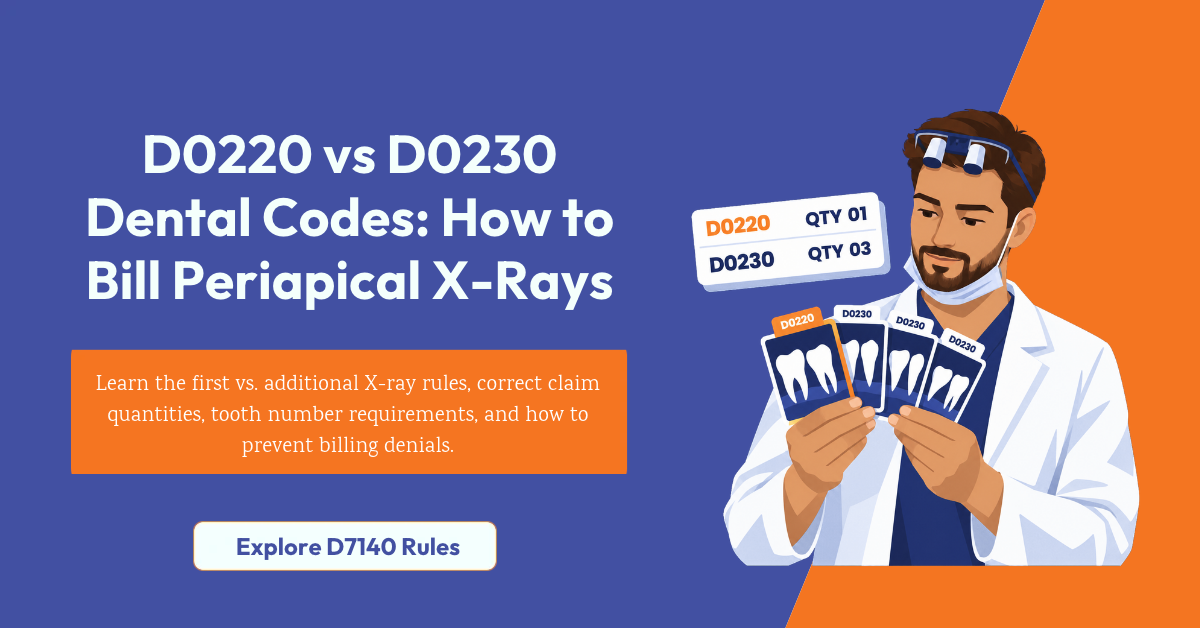
D0220 reports the first intraoral periapical X-ray taken on a date of service, and D0230 reports each additional periapical taken that same day. Both codes come from the American Dental Association's Code on Dental Procedures and Nomenclature, better known as CDT.
That split drives almost every decision on a periapical claim. The D0220 dental code goes on the claim once for that date. Every other periapical becomes D0230 with a quantity and tooth numbers. Some payers also pay a big set of images from one date as a full mouth series (D0210).
We're the billing team at iDental Billing, and periapical claims cross our desk every day. We pulled the claim line rules below from the ADA's own documents and the unit limits from named payers, so you can check each rule against its source.
Key takeaways
- Definitions: D0220 is the first periapical image on a date of service; D0230 is each additional periapical image that day.
- Claim lines: the ADA allows separate lines or one D0230 line with the count in Item 29b.
- Tooth numbers: report them in Item 27; Montana Medicaid denies D0220 and D0230 lines without a valid tooth number.
- Bundling: several payers won't pay periapicals with D0210 on the same date, and some pay a large set of images from one date as D0210.
- CDT 2027: the ADA's March 2026 committee report made no change to D0220 or D0230.
What Are the D0220 and D0230 Dental Codes?
D0220 and D0230 are the two CDT codes for intraoral periapical X-rays, split by order: D0220 for the first image on a date of service, D0230 for each image after it. Both sit in the Diagnostic category, which our CDT code guide walks through code by code.
The ADA publishes a new CDT version each year, effective January 1. Your claim uses the version in effect on the procedure date, per Item 29 of the ADA Dental Claim Form instructions.
D0220: Intraoral Periapical First Radiographic Image
D0220 is the CDT code for the first intraoral periapical radiographic image a dentist takes on a given date of service.
- Official nomenclature: intraoral periapical first radiographic image, as listed in the ADA's radiographic imaging guide.
- What it reports: the first periapical image captured on a date of service.
- Common reasons: a painful tooth, trauma, or a check on earlier treatment.
- Billing rule: one D0220 per patient per date of service.
The D0220 dental code description is short, and the word that carries the weight is "first." Two D0220 lines on one date tell the payer that two images were both first. A claim line built that way won't survive the payer's edits.
D0230: Intraoral Periapical Each Additional Radiographic Image
D0230 represents every periapical image after the first one on the same date of service, reported with a quantity.
- Official nomenclature: intraoral periapical each additional radiographic image.
- What it reports: each periapical image after the first on that date.
- Billing rule: it rides with D0220. Wisconsin's BadgerCare Plus code table says D0230 "must be billed with D0220."
- Short descriptor: fee schedules often print it as "INTRAORAL PERIAPICAL EA ADD," the exact wording on Alabama Medicaid's fee schedule.
Your software may show "EA ADD" where you expected the D0230 dental code description. It's the same code. On any date of service, the D0230 dental code follows a D0220 and never stands alone.
What a Periapical Image Shows, and Why Some Software Still Says "Film"
A periapical image shows the whole tooth, from the crown to the tip of the root, along with the bone around it. Dentists order this periapical dental code for abscesses, fractures, bone loss, and root canal evaluation. A bitewing covers the upper and lower crowns and the bone between teeth, but it stops short of the root tips.
Older CDT editions and many software short descriptors still read "intraoral periapical first film" and "each additional film." Current nomenclature says "radiographic image." Each intraoral periapical image uses the same code whether your office shoots film or uses a digital sensor.
D0220 belongs to CDT, the dental code set. If you're looking for a D0220 CPT code for a medical claim, the closest match is CPT 70300, radiologic examination, teeth; single view.
D0220 vs D0230 vs Other Dental X-Ray Codes
D0220 and D0230 describe the same procedure; the order of the image on the date of service is the only difference. The first periapical that day is D0220, and each one after it is D0230.
How D0220 Compares to D0240, Bitewings, D0210, and D0330
The table lines up the D0220 dental code against the other imaging codes billers see most. Use it as a quick reference when someone asks for the dental code for a periapical X-ray versus a bitewing or a pano.
| Code | What it reports | Images per line | Inside or outside the mouth | Key billing rule |
|---|---|---|---|---|
| D0220 | First periapical image on a date of service | 1 | Inside (intraoral) | One per date of service |
| D0230 | Each additional periapical image on the same date | 1 per unit, count in Item 29b | Inside (intraoral) | Billed with D0220 on the same date |
| D0210 | Comprehensive intraoral series showing the crowns and roots of all teeth | Set by the dentist | Inside (intraoral) | ADA descriptor sets no image count |
| D0240 | Occlusal image of an arch | 1 | Inside (intraoral) | Wisconsin Medicaid allows up to two per day |
| D0270, D0272, D0273, D0274 | Bitewings | 1, 2, 3, or 4 | Inside (intraoral) | Plan bitewing frequency limits apply |
| D0277 | Vertical bitewings | 7 to 8 | Inside (intraoral) | CDT says it isn't a full mouth series |
| D0330 | Panoramic image | 1 | Outside (extraoral) | ADA guide says it's never reported as D0210 |
D0240 differs from D0220 in the view it captures. An occlusal image puts the sensor flat on the biting plane for a view of the arch from above, which helps with impacted teeth, cysts, salivary stones, and jaw fractures. A periapical aims at specific teeth and shows each one from crown to root tip.
You'll still see the claim that a full mouth series means 14 to 22 images. The ADA removed that count from the D0210 dental code descriptor. Its guide leaves the type and number of images to the dentist. Coverage decides the code: the series has to display the crowns and roots of all teeth and the surrounding bone.
Image Capture Only: When D0707 Replaces D0220 and D0230
D0707 reports a periapical image captured without interpretation. It takes the place of D0220 and D0230 when one location takes the image and a different dentist reads it. That second dentist reports the read with D0391, interpretation of a diagnostic image by a practitioner not associated with capture of the image.
- Wisconsin Medicaid allows up to four D0707 per date of service.
- Tomosynthesis periapicals have their own codes: D0374 for the full procedure and D0389 for image capture only.
- Standard D0220 and D0230 don't apply to tomosynthesis images.
How to Bill D0220 and D0230 on a Dental Claim
Bill one D0220 for the first periapical on the date of service. Report every other periapical from that day as D0230, with the quantity and tooth numbers on the claim.
The One Plus Additional Rule, by Image Count
Billing dental code D0220 follows one pattern no matter how many images the dentist takes. You report one first image, then a count of the additional ones.
| PAs taken on one date | What to report | Quantity on the D0230 line |
|---|---|---|
| 1 | D0220 | No D0230 line |
| 2 | D0220 and D0230 | 01 |
| 4 | D0220 and D0230 | 03 |
| 10, not a full series | D0220 and D0230 | 09, the ADA's own example |
The ADA's imaging guide spells out the case with 10 images: for 10 periapicals that don't form a full series, report one D0220 and D0230 with quantity 09.
A quieter error runs the other way. An office takes three PAs, bills D0220 alone, and leaves two D0230 units unbilled. No denial shows up on the EOB, so the office never sees the payment it missed.
One Line With a Quantity, or Separate Lines?
Either format works. The ADA's claim form instructions give two options when the dentist performs the same procedure on more than one tooth on the same date:
- Report each image on its own service line with its tooth number and fee.
- Report one line with the teeth in Item 27, the count in Item 29b, and the total fee in Item 31.
Item 29b accepts 01 to 99 and defaults to 01. Many practice management systems split D0230 into separate lines on their own, and that's fine. Some payers prefer one format, so read the payer manual before you change a template. Our full dental claim workflow guide covers the rest of the 2024 ADA Dental Claim Form.
Tooth Numbers in Item 27
Yes, D0220 needs a tooth number, and so does D0230. The ADA's instructions tell offices to enter the tooth number or range in Item 27 when a procedure involves a tooth or a range of teeth. Write a range with a hyphen (2-5) or list teeth with commas (2, 3, 5).
Montana Medicaid's February 2024 notice shows what a blank field costs: the state denies D0220 and D0230 claim lines without a valid tooth number. Commercial payers vary in how hard they edit for it. The ADA instructions call for the number either way, so put it on every periapical line.
D0220 Counts Once per Date of Service, Even When a Claim Has Two Dates
D0220 counts per date of service. If one claim carries two visit dates with periapicals on each, each date gets its own D0220. Two named programs write the rule this way:
- Alabama Medicaid's fee schedule, updated October 1, 2025, limits D0220 to one per date of service.
- Wisconsin's BadgerCare Plus table limits D0220 to one per day.
Commercial plans can count their own way, so confirm with the payer before you put two dates on one claim. The pairing rule holds on every date: a D0230 needs a D0220 beside it.
If your team still sorts out lines and quantities claim by claim, we can take that work off your desk. Our outsourced dental billing team codes and files periapical claims in the format each payer expects.
Do D0220 and D0230 Have Frequency Limits?
Yes, but the plan sets them, not CDT. Commercial plans write limits into each certificate of coverage, and some Medicaid programs publish hard caps per day, per year, or both.
Commercial Dental Plans
Commercial plans share no universal D0220 dental code frequency. A plan can limit periapicals per date of service, per year, or per tooth, or it can pool every X-ray into one combined limit. Your best check is the patient's benefits and X-ray history, pulled before the appointment.
Medicaid Programs With Published Unit Limits
Four state programs publish their periapical limits in plain numbers. Each row below names the program and the date of the rule.
| Program | D0220 limit | D0230 limit | Other rule | Effective date |
|---|---|---|---|---|
| Alabama Medicaid | 1 per date of service | 4 per day | Periapicals capped at 5 per calendar year | Fee schedule updated October 1, 2025 |
| Wisconsin BadgerCare Plus | 1 per day | Up to 3 per day, billed with D0220 | Neither pays with D0210 on the same date or for six months after; an emergency can override the six-month limit | ForwardHealth table, checked October 2026 |
| Nevada Medicaid IDD waiver | 1 unit per 12 rolling months | 12 units per rolling year | D0220 and D0230 combined capped at 13 units per rolling year | Effective January 1, 2023 |
| Colorado senior dental program | 6 per 12 months | Report images after the first as D0230 | Not allowed on the same day as D0210 | July 1, 2025 |
The Nevada limits come from Nevada Medicaid's waiver guidelines for the waiver serving people with intellectual and developmental disabilities. Colorado's figures come from Colorado's senior dental program rules, a state program separate from Colorado Medicaid. Treat all four as examples, since your patient's plan sets the limit that applies.
What D0220 Costs, and What Payers Allow
The D0220 dental code cost depends on who's paying. Your office sets a full fee, and each payer pays an allowed amount from its own fee schedule. The ADA's claim form instructions say it's always appropriate to report the full fee, whatever the contract allows.
Published state allowances give a sense of the range:
- Alabama Medicaid pays $11.55 for D0220 and $10.50 for D0230 (schedule updated October 1, 2025).
- New Mexico Medicaid's dental fee list shows $13.70 for D0220 and $10.94 for D0230, with prices starting January 1, 2026.
- Colorado's senior dental program allows $25.00 for D0220 and $23.00 for D0230 (July 1, 2025).
Consumer "average cost" figures won't tell you what your office collects. That number comes from your fee schedule and your payer contracts.
You can spot a frequency denial before the patient sits down if someone pulls the X-ray history first. Our insurance verification team confirms coverage, including X-ray frequencies, five business days before each appointment.
When D0220 and D0230 Turn Into a Full Mouth Series (D0210)
Several payers won't pay D0220 and D0230 with D0210 on the same date of service. Some go further and pay a large set of periapicals from one date as a D0210.
Under CDT, image count alone never makes a full mouth series. The ADA's example with 10 periapicals missed some crowns, roots, and periapical areas, so the ADA codes it as D0220 plus D0230, and D0210 doesn't apply.
Payers write their own conversion rules on top of CDT:
| Payer or program | Rule | Date |
|---|---|---|
| Colorado senior dental program | Bill X-rays from one date as D0210 once their combined fees reach the D0210 maximum | July 1, 2025 |
| Blue Cross Blue Shield of Massachusetts | Processes any combination of more than six radiographs as D0210 | Current CDT lookup, checked October 2026 |
| Nevada Medicaid IDD waiver | Offices use D0210 for 14 or more intraoral images on one date | Effective January 1, 2023 |
| Wisconsin BadgerCare Plus | No D0210 within six months of other X-rays, including D0220 and D0230, except in an emergency | ForwardHealth table, checked October 2026 |
The Massachusetts rule appears under both codes in Blue Cross Blue Shield of Massachusetts' code lookup. That lookup also allows one full mouth series or panoramic image per 60 months.
A conversion costs more than the difference in fees. Once a payer processes a set as D0210, the patient's full mouth series benefit is gone for that period. If the dentist orders a true full series a year later, that claim can come back denied for frequency. The patient gets a bill, and your front desk takes the call.
Panoramic images follow their own track. The ADA's guide calls a panoramic image extraoral, so D0330 never counts toward D0210. Delta Dental's national policy once bundled D0330 into its conversion rule, and the Washington State Dental Association's report says D0330 came off that list starting January 2024.
One program runs the other way. Wisconsin's Medicaid table lets offices bill a panorex plus bitewings under D0210. Follow that rule on Wisconsin Medicaid claims, and code what the dentist did everywhere else.
Before the dentist orders a large set of single images, find out whether the plan converts them. Your verification team can ask during the same benefits call.
D0220 and D0230 in Real Billing Scenarios
The code stays the same from one procedure to the next, but the rules around it shift. These five situations show up on our periapical claims every week.
Emergency Visit With a Limited Exam
Typical claim: D0140 limited evaluation, D0220, and D0230 as needed, with tooth numbers in Item 27.
A periapical shows the root tip, which the dentist needs to diagnose an abscess. It can also protect the patient's benefits. On some plans, a single bitewing counts against bitewing frequency and blocks the recall set. Wisconsin's table shows the effect: a D0270 makes D0272, D0273, and D0274 unpayable on that date and for six months after.
Root Canal: Diagnostic Images vs Working Films
Billing rule: bill the diagnostic periapical before treatment as D0220, and leave working and final films off the claim.
CDT's endodontic therapy codes, D3310 to D3330, include intra-operative radiographs but exclude the diagnostic evaluation and its radiographs. The AAE's CDT 2026 guide shows diagnostic images on the first visit's claim, with later films kept in the chart and off the claim.
Colorado's senior dental program states the same split: it doesn't cover working and final endodontic films. Chart which image was diagnostic and which was intra-operative, so the claim matches the record if a reviewer asks.
Recall Visit With Bitewings and a Few PAs
Typical claim: D0274, the bitewings dental code for four images, plus D0220 and D0230 for teeth the dentist wants to see down to the root. Each image needs its own clinical reason in the chart.
The risk sits in the conversion rule. On a plan that processes more than six images as D0210, four bitewings plus three PAs add up to seven, and the payer can pay the whole set as a full mouth series. Count the images before the claim goes out, and ask about conversion during verification.
Trauma Billed to Medical Insurance
Billing rule: a medical claim needs CPT, because the D0220 dental code belongs to CDT. Medical plans use three radiology codes for teeth:
- CPT 70300: radiologic examination, teeth; single view
- CPT 70310: partial examination, less than full mouth
- CPT 70320: complete, full mouth
The diagnosis comes from the chart. A patient who broke a tooth in a fall might carry ICD-10-CM S02.5XXA, fracture of tooth (traumatic), initial encounter for closed fracture, on a CMS-1500 or 837P.
The medical plan's policy decides whether it pays and which CPT code it wants for several views. We handle dental medical billing alongside dental claims, so a trauma case doesn't stall between two payers.
Images Captured in One Place, Read in Another
Billing rule: if one site captures periapicals and a different dentist interprets them, the capture and interpretation codes replace D0220 and D0230.
- D0707 for each periapical captured
- D0391 for the interpretation, reported by the dentist who reads the images
Wisconsin's table tells offices to bill D0391 with the number of images interpreted as units. It also warns providers against billing interpretation only codes together with global codes. DSOs, multisite groups, and mobile hygiene programs run into this setup, since their images often travel to a dentist at another location.
Why D0220 and D0230 Claims Get Denied, and How to Fix Them
Periapical denials trace back to a short list of causes: a missing tooth number, a missing D0220, bundling with D0210, a frequency or benefit limit, or a code that wasn't valid on the date of service.
The reason codes below follow X12's reason code list, with the meanings shortened.
| What the EOB shows | Likely cause | Fix |
|---|---|---|
| CARC 16, claim lacks information | No tooth number in Item 27, or a wrong quantity | Add the tooth numbers or range, correct the quantity, and resubmit |
| D0230 denied, no D0220 on that date | The first image never went out, or it posted to another date | Add D0220 to the correct date and send a corrected claim |
| CARC 97, included in another service | Same date as D0210, or the payer converted the set to D0210 | Check the payer's conversion rule, and appeal if the images didn't form a full series |
| CARC 151, frequency not supported | The patient used up the plan's periapical or combined X-ray limit | Pull the X-ray history, and appeal with the clinical reason if the plan allows exceptions |
| CARC 119, benefit maximum reached | Annual maximum or pooled X-ray benefit used up | Read the contract, then bill the patient if it allows |
| CARC 181, code invalid on the date of service | Wrong CDT version for the date | Recode with the CDT version in effect on the date of service |
Log each denial against the step that caused it. A missing tooth number points to claim entry, and a D0230 dental code denial with no D0220 points to charting or claim entry. Frequency denials point to verification. After a month, the log tells you which step needs retraining, and you stop fixing the same D0220 dental code error every week.
Repeat periapical denials point to follow-up that nobody owns. Our AR follow-up team works the aging report every week, oldest and largest balances first, and appeals denials with the radiographs and notes the payer asked for.
Documentation That Supports Every Periapical Claim
A payer pays a D0220 dental code claim when the chart shows why the dentist ordered the image, which teeth it covered, and what the dentist found.
On January 5, 2026, the ADA released updated recommendations on which patients need dental X-rays, and the American Academy of Oral and Maxillofacial Radiology (AAOMR) endorsed them. The ADA's January 2026 X-ray recommendations tell dentists to order images after reviewing the patient's medical and dental histories, prior images, and current exam findings. A payer reviewer looks for that same record.
Before a periapical claim goes out, the chart should show:
- The reason for the image, such as pain, swelling, trauma, or endodontic evaluation
- The tooth or teeth imaged, matching Item 27
- The number of images, matching the D0230 quantity
- The dentist's interpretation and findings, since D0220 and D0230 include the read
- Prior images the dentist reviewed, when they matter to the decision
One related change came from a separate 2024 ADA paper on radiation safety: it found thyroid collars and lead aprons are no longer necessary. That's a clinical safety point, and it doesn't change how you bill.
Are D0220 and D0230 Changing in CDT 2027?
No. The ADA's March 2026 committee report, which records the decisions for CDT 2027, shows no action on D0220 or D0230.
ADA News counts 67 changes in CDT 2027, which takes effect January 1, 2027. Claims use the CDT version in effect on the date of service, so a periapical taken in December 2026 and billed in January 2027 still goes out under CDT 2026. Our CDT 2027 changes guide covers the codes that did change.
D0220 and D0230 FAQs
Does D0220 need a tooth number?
Yes. The ADA's claim form instructions call for the tooth number or range in Item 27 when a procedure involves a tooth or a range of teeth, and that covers both D0220 and D0230. Montana Medicaid denies D0220 and D0230 claim lines that lack a valid tooth number. Put the tooth number on every periapical line, whether you list one tooth per line or a range on a single line.
What is the difference between D0240 and D0220?
D0240 is an occlusal image, and D0220 is a periapical. For D0240, the sensor rests on the biting plane and captures a wide view of an arch, useful for impacted teeth, cysts, salivary stones, and jaw fractures. D0220 targets specific teeth and shows each one from crown to root tip, plus the surrounding bone. Each code carries its own frequency rules, so check both at verification.
Can D0230 be billed without D0220?
No. D0230 reports each periapical after the first, so a D0220 has to appear on the same date of service. Wisconsin's BadgerCare Plus table states it outright: D0230 "must be billed with D0220." If a payer denies D0230 for a missing first image, check whether the D0220 posted to a different date or never went out, then send a corrected claim.
Can you bill D0220 and D0230 on the same day as D0210?
No, at least with the programs that publish a rule on it. Wisconsin Medicaid, Nevada Medicaid, and Colorado's senior dental program all refuse periapicals with D0210 on the same date. Wisconsin also extends the block to six months after a D0210, except in an emergency. If the dentist needs extra periapicals soon after a full series, document the clinical reason and check the plan's rules before the claim goes out.
Is D0220 a CPT code?
No. D0220 is a CDT code from the ADA's dental code set, and medical claims won't accept it. A medical plan wants a CPT code instead, such as CPT 70300, radiologic examination, teeth; single view, or CPT 70310 for a partial exam. The diagnosis code comes from the chart, and the medical plan's policy decides whether it covers dental X-rays and which CPT code it expects.
How many D0230 units can you bill in one visit?
CDT sets no cap on D0230 units, but payers do. Wisconsin BadgerCare Plus allows up to three D0230 per day, and Alabama Medicaid allows four per day. Blue Cross Blue Shield of Massachusetts processes any combination above six radiographs as D0210. Check the patient's plan before the visit, and count every image on the date, bitewings included, against any conversion rule.
What does "intraoral periapical ea add" mean?
It's the short descriptor many fee schedules and software systems print for D0230. "Ea add" stands for "each additional," so the line reports every periapical image after the first on the same date of service. Alabama Medicaid's fee schedule uses that exact wording. The D0230 dental code pairs with a D0220 for the first image that day.
Can you bill D0330 and D0210 together?
It depends on the payer. The ADA treats a panoramic image as extraoral, so D0330 never counts as part of D0210. Payers still limit the pair. Wisconsin Medicaid won't pay D0330 with D0210, while Delta Dental took D0330 off its full mouth series conversion list starting January 2024. Check the plan's policy before you bill both on one date.
Is there a frequency limit for D0220?
Yes, and the plan sets it, since CDT doesn't assign frequencies. Your D0220 dental code limit lives in the patient's certificate of coverage or the state Medicaid manual. Alabama Medicaid allows five periapicals per calendar year and one D0220 per date of service. Colorado's senior dental program allows six D0220 per 12 months. Check X-ray history at verification so the limit doesn't surprise you after the visit.
Before Your Next Periapical Claim Goes Out
Run three checks on every D0220 dental code claim before it leaves your office:
- One D0220 per date of service, with a tooth number in Item 27.
- D0230 for each additional image, with the right quantity and tooth numbers.
- The plan's X-ray limits and conversion rule, confirmed at verification.
If you want a second set of eyes on how your team bills X-rays, send us a month of claims. In a free billing review, we'll show you where payers deny or underpay your periapical claims.
Our dental billing services cost a percentage of collections: 3.95% up to $30,000 a month, 3.45% from $30,000 to $75,000, and 2.95% from $75,000 to $150,000, with no setup fee. We charge nothing on claims the payer doesn't pay.
Credentialing runs $150 per commercial payer, or $95 for practices we already bill for, and our pricing page has the full breakdown.
Sources
- American Dental Association: Guide to Intraoral Comprehensive Series of Radiographic Imaging Codes; ADA Dental Claim Form Completion Instructions, Version 2024; Final Report of March 2026 Code Maintenance Committee Meeting Decisions; New recommendations confirm dental X-rays most effectively used in moderation, January 5, 2026
- ADA News: Sixty-seven changes coming to CDT 2027, April 14, 2026
- State programs: Montana Medicaid, Tooth Number Required When Billing Codes D0220 and D0230; Wisconsin ForwardHealth, Diagnostic, Preventive, Restorative, Endodontic, Periodontic, and General Codes; Alabama Medicaid Dental Fee Schedule, October 1, 2025; Nevada Medicaid Billing Guidelines PT22, Attachment B; Colorado HCPF, Senior Dental Program Covered Procedures, July 1, 2025; New Mexico Health Care Authority, Dental Codes
- Payers, associations, and standards bodies: Blue Cross Blue Shield of Massachusetts, CDT Dental Procedure Lookup; Washington State Dental Association, A dental benefits win for dentists in Washington and nationwide; American Association of Endodontists, Endodontists' Guide to CDT 2026; X12, Claim Adjustment Reason Codes
CDT is a trademark of the American Dental Association, which holds the copyright to the CDT Code. We paraphrased code titles except where the ADA's public guide is cited; see the current CDT manual for official nomenclature. CPT is a registered trademark of the American Medical Association.
ABOUT THE AUTHOR
Russell Bennett
Russell Bennett is a Dental RCM and Provider Credentialing Specialist at iDental Billing. He reviews billing workflows, resolves claim denials, outstanding insurance balances, and reimbursement discrepancies, and applies CDT coding and payer-specific guidelines. His work includes provider credentialing, payer enrollment, and recredentialing. Russell writes iDental Billing’s educational guides on what claims need, why they matter, and where things go wrong.