












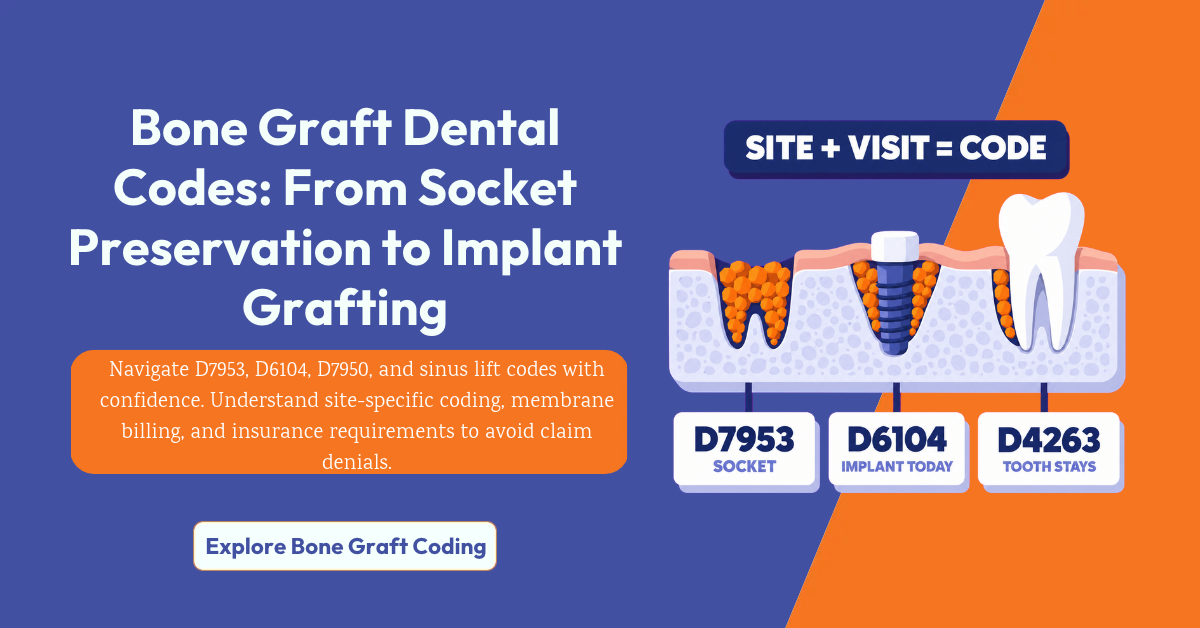
There's no single bone graft dental code. The CDT code depends on where the graft goes and what else happened at that site the same day: D7953 for a socket, D6104 with a new implant, D6103 around an existing implant, D4263 at a tooth that's staying, D7950 on a healed ridge, and D7951 or D7952 in the sinus.
Most graft denials start right there. The code, the visit, and the chart have to tell the same story, and the membrane or biologic usually goes on its own line. Each plan also sets its own payment rules, so picking the right ADA code for bone graft work only gets you halfway.
Our billing team at iDental Billing works graft claims for oral surgery, periodontal, and implant practices. This guide follows the order we check them in: site, timing, add-on lines, plan rules, records, and the appeal if a claim comes back.
Key takeaways
- The site and the visit pick the graft code. The graft material doesn't.
- D7953 can't share a site with an implant placed that day; that graft is D6104.
- Membrane codes follow the site: natural tooth, implant, or edentulous area.
- D7950, D7951, and D7952 already include obtaining the graft, so D7295 doesn't go with them.
- CDT sets the coding rules and each plan sets the payment rules, so verify before surgery.
How to Pick the Right Bone Graft Dental Code in Six Questions
To find the right CDT code for bone graft work, ask six questions in order and stop at the first yes. Order matters because one site can answer yes to more than one question. The AAOMS bone graft coding paper frames code choice the same way: removal, implant placement, healed ridge, existing implant, or reconstruction.
- Is the graft raising the sinus floor? Code D7951 for a lateral window or D7952 for a vertical approach.
- Is a natural tooth staying at the site? Code D4263 or D4264 for a periodontal defect, or D3428 or D3429 during periradicular surgery.
- Is an implant going in at this visit? Code D6104.
- Is an implant already in place with a bony defect around it? Code D6103.
- Did a tooth or implant come out at this visit? Code D7953, per site.
- None of the above? Code D7950 for a healed edentulous ridge, or D7955 for reconstruction after trauma, tumor surgery, or a congenital defect that isn't done for a prosthesis.
An immediate implant in a fresh socket shows why the order matters. It answers yes at question 3, so the graft is D6104, and AAOMS says D7953 isn't used when the implant goes in at the time of extraction. A crestal sinus lift through the osteotomy stops at question 1 and stays D7952.
These six questions pull from four CDT categories: endodontics, periodontics, implant services, and oral and maxillofacial surgery. If your team wants a refresher on how those ranges are organized, our guide to CDT code categories walks through the full code set.
When No Tooth Comes Out: The ADA Code for Bone Graft Without Extraction
The dental code for bone graft work without an extraction depends on what's at the site. A healed ridge is D7950. A graft placed with a new implant is D6104, and one around an implant that's already in is D6103. A tooth that's staying takes D4263, and a sinus lift takes D7951 or D7952.
One caution for mixed cases: if any tooth comes out at that visit, the graft in its socket is D7953, even when the rest of the quadrant is a perio or implant procedure.
Bone Graft CDT Codes at a Glance (CDT 2026)
Each bone graft dental code below ties to one site and one timing. The table also shows which codes already include obtaining the graft material, and which membrane code pairs with each one.
Table 1. Bone graft CDT codes under CDT 2026. Descriptors paraphrased from the ADA's 2026 graft material guide.
| Code | Common name | Where the graft goes | When | Obtaining graft material included? | Membrane code if placed |
|---|---|---|---|---|---|
| D7953 | Ridge preservation (socket graft) | Extraction or implant removal socket, per site | Same visit as the removal | No; D7295 can be added for autogenous harvest | D7956 or D7957 |
| D6104 | Graft at implant placement | Implant site | Same visit as implant placement | Descriptor silent | D6106 or D6107 |
| D6103 | Peri-implant defect repair | Bony defect around an existing implant | After the implant is in place | Descriptor silent | D6106 or D6107 |
| D7950 | Ridge augmentation | Healed edentulous ridge, by report | Its own surgery | Yes | D7956 or D7957 |
| D7951 | Lateral sinus lift | Sinus floor, lateral window | Before or with the implant | Yes | D7956 or D7957 |
| D7952 | Vertical sinus lift | Sinus floor, through the ridge crest | Often with the implant | Yes | Descriptor silent on membranes |
| D4263 | First natural tooth site | Periodontal defect, retained tooth | Periodontal surgery | Descriptor silent | D4266 or D4267 |
| D4264 | Additional natural tooth site | Each additional site, same quadrant | Same surgery as D4263 | Descriptor silent | D4266 or D4267 |
| D3428 / D3429 | Periradicular graft | Root-end defect, retained tooth | Periradicular surgery | Includes non-autogenous material | D3432 (resorbable) |
| D7955 | Maxillofacial defect repair | Facial bones after trauma, tumor, or congenital defect | Non-prosthetic reconstruction | No | Not applicable |
Three columns drive most graft denials: where the graft went, when it went in, and whether obtaining the material is already part of the code. A bone graft ADA code doesn't tell the payer any of that by itself, so the chart and the line items have to carry it.
Before a claim goes out, check each dental bone graft code against the membrane and harvest rules in this guide. A correct graft line paired with the wrong membrane code still comes back.
D7953: Bone Replacement Graft for Ridge Preservation (Socket Graft)
What the D7953 Dental Code Covers
D7953 is the CDT code for a bone replacement graft placed in a tooth or implant socket at the same visit the tooth or implant comes out, to preserve the ridge for a later restoration. You report it per site, and it doesn't include obtaining the graft material.
Put another way, the socket preservation dental code is D7953. Four things stay off that line:
- A membrane over the graft, which goes on D7956 or D7957
- An autogenous bone harvest, which goes on D7295
- A biologic or PRF, which has its own codes
- A graft placed with an implant that same visit, which is D6104
The D7953 dental code description in CDT 2026 gives two examples of when the graft fits: preparing for implant reconstruction, or keeping ridge contour for a planned prosthesis. AAOMS adds that a graft isn't appropriate for every extraction site, so the dentist decides and the chart should say why.
Bone Graft Dental Code With Extraction: One Claim, Separate Lines
The extraction and the graft go on the same claim, each on its own line with its tooth number. The extraction line is D7140 or D7210, picked by technique, and our guide to dental extraction codes covers that choice. Three grafted sockets means three D7953 lines.
You use the same ADA code for bone graft with extraction when a failed implant comes out. AAOMS lists D7953 for a graft placed at the time of implant removal, so that visit carries D6100 for the removal plus D7953 for the site.
Our coders match each graft and extraction line to the operative note before a claim goes out. That check sits at the center of our dental billing and coding work, because a mismatch there turns into the denial you open three weeks later.
How Payers Limit D7953
CDT describes the procedure, and your patient's plan decides whether and how often it pays. Three 2026 payer documents show how far apart those payment rules can sit for the same code.
Delta Dental's 2026 CDT summary for providers says plans that cover D7953 pay it once per tooth or implant site. The same summary says D7953 isn't a benefit when it's performed on third molars.
UnitedHealthcare's bone graft policy, effective May 1, 2026, supports ridge preservation in two situations: a planned prosthesis whose fit or function would suffer from ridge loss, or preparing a site for an implant.
That policy also summarizes a 2020 randomized trial by Avila-Ortiz and colleagues. The investigators found that 48.1% of extraction-only sites needed extra bone augmentation to place the implant, compared with 11.5% of ridge preservation sites. It's a useful line for a narrative because the payer already cites it.
Aetna takes a similar position in its bone graft bulletin: socket grafts aren't routinely indicated, but they help with ridge preservation when an implant is intended and planned. Name the planned implant or bridge, and its expected timing, in the chart and in the narrative.
D6104 vs D6103: Grafts Around a New Implant or an Existing One
D6104: Bone Graft at the Time of Implant Placement
D6104 is the CDT code for a bone graft placed at the same visit as the implant body. The implant goes on its own line, usually D6010, and any membrane or biologic placed with the graft goes on separate lines. AAOMS reports D6104 per site.
On most immediate implant claims, the D6104 dental code is the bone graft dental code you'll reach for. AAOMS describes two common setups for the bone graft at time of implant placement code:
- Filling the gap between an immediate implant and the socket walls
- Adding bone around an implant placed in a healed ridge
AAOMS also says D6104 isn't used when no implant was placed that day. If the claim doesn't carry an implant line for that date of service, D6104 doesn't belong on it.
D6104 vs D7953: The Visit Decides
Table 2. D7953 and D6104 compared.
| Feature | D7953 | D6104 |
|---|---|---|
| What happens at the visit | Tooth or implant comes out; no implant goes in | Implant body goes in |
| Where the graft goes | The socket, per site | Around the new implant, per site (AAOMS) |
| Usual companion line | D7140, D7210, or D6100 | D6010 |
| Membrane codes | D7956 or D7957 | D6106 or D6107 |
| Common denial trigger | Billed on the same date as D6010 at that site | Billed with no implant on the claim that day |
Cigna's 2026 DPPO guidelines follow the same split. Cigna allows D6104 on the implant date when there's an osseous defect to repair. It doesn't allow D6104 at an extraction or implant removal site when no implant goes in that day, so getting the ADA code for bone graft with implant visits right starts with the date on the D6010 line.
D6103: Repairing a Defect Around an Existing Implant
D6103 is the CDT code for a bone graft that repairs a bony defect around an implant that's already in place. The D6103 dental code doesn't include flap entry and closure, so it pairs with D6101 or D6102, and a membrane goes on D6106 or D6107.
The AAP coding coach gives a clean example. Two implants under a hybrid denture get osseous contouring, grafts, and resorbable membranes, coded as D6102 times two, D6103 times two, and D6106 times two.
Cigna's 2026 criteria for D6103 call for pockets of 5 mm or deeper with bone loss and a vertical peri-implant defect. Cigna doesn't allow D6103 during the initial implant placement or at a tooth or implant removal site.
Some plans tie implant-site grafts to the implant benefit, so run pre-treatment benefit checks on both codes at once. A plan that excludes implants may treat D6103 or D6104 the same way, and you want that answer before the surgery date.
D7950: Ridge Augmentation on a Healed Ridge
D7950 is the ridge augmentation dental code for a graft that adds height, width, or volume to a healed edentulous ridge as its own procedure. It's a by report code that includes obtaining the graft material, so each claim needs a narrative and none should carry D7295.
AAOMS guidance reports D7950 per arch. It also says not to use D7950 at a site where a tooth or implant came out that day, or at the time of implant placement. A block graft used to augment the ridge can be reported as D7950.
The D7950 dental code description in CDT 2026 says a barrier membrane, if used, gets reported separately. The AAP coding coach pairs D7950 with D7956 for a resorbable membrane over an augmented ridge.
UnitedHealthcare's policy lists cases where this kind of grafting may not be indicated: unmanaged medical conditions, and medications that impair healing, such as immunosuppressants, corticosteroids, anticoagulants, NSAIDs, and nicotine. Put the relevant medical history in the narrative before the reviewer asks for it.
A typical case: a lower premolar site healed thin years after an extraction. The surgeon places a ramus block graft and a non-resorbable membrane. That claim carries D7950 with a narrative and D7957, and it has no D7295 line, since D7950 already includes obtaining the graft.
Sinus Lift Codes: D7951 vs D7952
The dental code for sinus lift work depends on the surgical approach. D7951 covers a lateral window through the side wall of the maxilla, and D7952 covers a vertical approach through the ridge crest. The amount of bone the surgeon gains doesn't change the code.
Does D7951 or D7952 Include the Bone Graft?
Yes. Both descriptors say the procedure includes obtaining the bone or bone substitutes, so D7295 doesn't go with either code. The ADA's 2026 graft guide lists both among the codes that already include graft material acquisition.
Membrane rules differ between the two. The D7951 descriptor says to report a barrier membrane separately, and AAOMS points membranes at edentulous sites to D7956 or D7957. The D7952 dental code descriptor doesn't mention a membrane, so check the plan before adding one to a crestal lift.
Crestal lifts often go in with the implant. When the surgeon raises the sinus floor through the osteotomy and places the implant that visit, report D7952 and D6010 on separate lines. The sinus graft stays on D7952 and doesn't move to D6104.
A sinus lift is the one case where the surgical approach, more than the visit, picks the bone graft dental code. Whichever sinus lift ADA code you report, the operative note should name the approach in the surgeon's words. AAOMS says D7951 may crosswalk to CPT 21210 in certain extensive cases, while D7952 isn't an appropriate crosswalk.
Grafts Around Teeth That Stay: D4263, D4264, D3428, and D3429
D4263 and D4264: First Site and Each Additional Site
D4263 reports a bone replacement graft around a natural tooth that's staying, for the first site in a quadrant. D4264 reports each additional site in that quadrant. Both descriptors, revised for CDT 2026, say the code isn't reported for an edentulous space or an extraction site.
The D4263 dental code excludes flap entry and closure, wound debridement, osseous contouring, biologics, and membranes. Each of those goes on its own line, often D4260 or D4261, the osseous surgery dental code for the flap and bone recontouring, plus D4265 or D4266 when the surgeon used them.
Count sites by defect. Two separate defects on neighboring teeth are two sites: D4263 for the first and D4264 for the second. One defect that spans both teeth is a single site, so only D4263 applies.
What Payers Check Before Paying D4263
Payers want to see a vertical defect and a tooth worth saving. UnitedHealthcare's policy supports D4263 for infrabony or intrabony vertical defects and Class II furcations. It doesn't support the graft for:
- Non-vertical defects
- Patients with poor oral hygiene or a history of skipping prior periodontal therapy
- Teeth with a hopeless prognosis
- Grafts placed during periradicular surgery
Cigna's 2026 DPPO guidelines ask for pockets of 5 mm or more with a vertical bony defect next to the tooth, plus osseous surgery on the same day. Cigna doesn't allow D4263 at an extraction site, around an implant, or at the same site again within 36 months.
The Third-Molar Exception
AAOMS describes one case where a socket graft is coded as D4263. When an impacted third molar comes out and the surgeon grafts the socket to regenerate bone on the distal of the second molar, the graft treats the tooth that's staying.
Plan rules can still block it. Cigna disallows D4263 at a tooth-removal site, and Delta's 2026 summary excludes D7953 on third molars. Aetna's bulletin sees a benefit only for higher-risk patients, such as those over 26 with significant existing defects. Document the second-molar defect and verify the plan first.
D3428 and D3429: Grafts During Periradicular Surgery
D3428 reports a bone graft placed during periradicular surgery, per tooth, single site. D3429 covers each additional contiguous tooth in the same surgical site. Both include non-autogenous graft material, so a donor or synthetic graft needs no separate material line.
Cigna covers D3428 when it's done with periradicular surgery on the same tooth and the lesion measures 1 cm or more. Cigna pays one regenerative procedure per site, which matters if you also bill a barrier or a biologic at that site.
Picking the wrong bone graft dental code between D7953 and D4263 is a frequent perio graft denial. The tooth decides which one applies.
Table 3. D7953 and D4263 compared.
| Feature | D7953 | D4263 |
|---|---|---|
| Tooth status | Tooth or implant removed at this visit | Natural tooth retained |
| Purpose | Preserve the ridge for a later restoration | Regenerate bone lost to periodontal disease |
| Unit | Per site | First site in quadrant (D4264 for each additional site) |
| CDT category | Oral and maxillofacial surgery | Periodontics |
| Membrane codes | D7956 or D7957 | D4266 or D4267 |
| Common denial trigger | Implant placed the same day at the site | Billed at an extraction site, or X-rays don't show a vertical defect |
Perio graft claims usually come back for missing charting or X-rays that don't show the defect. Send us a few recent denials, and we'll show you what the payer needed in a free billing review.
Free billing reviewMembrane and Biologic Codes That Go With a Bone Graft
Every bone graft dental code in this guide leaves the membrane and the biologic off the graft line. Each one gets its own line, and the dental membrane code you pick follows the site: natural tooth, implant, or edentulous area.
Is D4266 a Bone Graft?
No. D4266 is the guided tissue regeneration dental code for a resorbable barrier around a natural tooth, per site, and D4267 is the non-resorbable version. Both go alongside a graft like D4263, never in place of it, and neither belongs over a socket or an implant.
The D4266 dental code description names natural teeth for a reason. A membrane over a grafted extraction socket goes on D7956, the D7956 dental code for a resorbable barrier in an edentulous area, or on the D7957 dental code when the barrier is non-resorbable.
Match the Membrane to the Site
The ADA code for membrane with bone graft work changes with the site, so pick the row first. The resorbable membrane dental code sits in the second column and the non-resorbable code in the third.
Table 4. Membrane codes by site.
| Site | Resorbable barrier | Non-resorbable barrier | Graft codes it pairs with |
|---|---|---|---|
| Natural tooth | D4266 | D4267 | D4263, D4264 |
| Implant | D6106 | D6107 | D6103, D6104 |
| Edentulous area (socket, healed ridge, lateral sinus window) | D7956 | D7957 | D7953, D7950, D7951 |
| Periradicular surgery | D3432 | No separate code | D3428, D3429 |
Removing a non-resorbable barrier later is D4286. Cigna's 2026 DPPO guidelines treat that removal as part of the original D4267, D6107, or D7957 service, so don't count on a separate payment.
Cigna also disallows D6106 or D6107 with another peri-implant regenerative procedure at the same site on the same date. Report what the surgeon did, and expect the plan to decide which line it pays.
D4265 and D7921: Biologics and PRF
The D4265 dental code reports biologic materials placed to aid soft and osseous tissue regeneration, per site. For PRF or PRP, the D7921 dental code covers collecting the patient's blood and applying the autologous blood concentrate. AAOMS lists both as separately reportable alongside a graft.
Plans don't agree on paying a biologic next to a membrane at the same site, so verify both lines before surgery. D7921 and D7922 also sit next to each other in most practice software, so check the nomenclature before anyone posts the line.
Collagen Plug Dental Code: D7922 vs D7953
A collagen plug placed in a socket to control bleeding or stabilize the clot is D7922, placement of an intra-socket biological dressing, per site. It isn't a bone graft. When graft material goes into the socket, that's D7953, and a collagen membrane laid over the graft is D7956.
Coverage for the D7922 dental code varies by plan, so verify it like any other add-on line before you quote the patient.
Graft Material and Harvest: When D7295 Applies
The material doesn't change the bone graft dental code. Autograft, allograft, xenograft, and synthetic bone all go on the same code for that site. The material only changes whether D7295 can be added, and that depends on whether the graft code already includes obtaining the material.
The ADA's 2026 graft guide defines the material types this way:
- Autogenous: taken from the patient's own body
- Allograft: tissue from another human, such as a donor bank
- Xenograft: tissue from another species
- Alloplastic: synthetic bone
One correction worth making in your templates: allograft is human donor tissue. Some coding pages call allograft man-made, and that description fits an alloplast instead.
Table 5. When D7295 can be added.
| Graft code group | D7295 for autogenous bone harvested from the same patient? |
|---|---|
| D7953, D7955 (descriptors say obtaining isn't included) | Yes, when the harvest is documented |
| D7950, D7951, D7952 (obtaining is included) | No, that would report the harvest twice |
| D4263, D4264, D6103, D6104 (descriptors silent) | Document the harvest and check the payer's policy first |
| D3428, D3429 (include non-autogenous material) | Collecting autogenous bone goes on D3999 or D7999, by report, with a narrative |
No CDT code exists for opening a container of donor or synthetic material. The ADA says a 999 unspecified code applies only if a separate obtaining procedure is performed, with a full narrative. Name the product in the chart narrative, since no CDT code identifies a product.
The ADA also warns that some plans won't pay separately for material acquisition, even when the line is coded right. Ask the plan before you count on that line in a treatment estimate.
Bone Graft Dental Code Examples: Seven Claims, Line by Line
These examples show how each graft code lands on a claim with its companion lines. Tooth numbers use the Universal system, and each row stands on its own.
Table 6. Seven graft claims, line by line.
| # | Scenario | Lines on the claim | What to watch |
|---|---|---|---|
| 1 | #19 lifts out with forceps; socket grafted with allograft; collagen membrane | D7140 #19, D7953 #19, D7956 #19 | No D7295 for donor bone; the membrane takes the edentulous code |
| 2 | #8 extracted; implant placed the same visit; gap grafted; resorbable membrane | D7140 #8, D6010 #8, D6104 #8, D6106 #8 | Not D7953 when the implant goes in that day (AAOMS) |
| 3 | Healed, thin lower left ridge; ramus block graft; non-resorbable membrane | D7950 (by report, narrative), D7957 | No D7295; Cigna treats later barrier removal (D4286) as part of D7957 |
| 4 | Lateral window sinus lift, upper right; implant planned later | D7951, plus D7956 if a membrane covers the window | The graft is included in D7951 |
| 5 | Crestal sinus lift through the osteotomy; implant #3 placed | D6010 #3, D7952 | Keep the graft on D7952, not D6104 |
| 6 | #30 vertical defect; flap with osseous surgery, graft, biologic, resorbable membrane | D4261, D4263 #30 (with quadrant), D4265 #30, D4266 #30 | Six-point charting and an image showing the defect; some plans won't pay a biologic and a membrane at one site on one date |
| 7 | Impacted #17 removed; socket grafted to treat the distal defect on #18 | Extraction code chosen by impaction (for example, D7240 #17), D4263 with the lower left quadrant | AAOMS coding rule; Delta excludes D7953 on third molars and Cigna disallows D4263 at a removal site, so verify first |
The forceps-only extraction in example 1 is a D7140 simple extraction, and the technique note decides that line the same way it decides the graft line. In example 6, D4261 is osseous surgery for one to three contiguous teeth or tooth-bounded spaces; four or more takes D4260.
In example 7, the extraction code follows the documented bone coverage, so D7240 is one possibility among the impaction codes. Each of these claims also needs the records covered in the documentation section.
Coding Rules vs Payment Rules: How Payers Decide Bone Graft Claims
A correct bone graft dental code tells the payer what the surgeon did. It doesn't make the plan pay. CDT and AAOMS set the coding rules, and each plan's policy sets the payment rules, which often run narrower than the code.
Why Isn't a Bone Graft Covered?
Most graft denials trace to the plan, not the code. These are the usual reasons:
- The plan excludes implants and treats the implant-site graft as part of that exclusion.
- The graft code isn't in the benefit package. A Massachusetts fair hearing decision (Appeal 2201575) records a plan denying D7953 for that reason.
- A frequency limit applies, such as Delta's once per tooth or implant site for D7953, or Cigna's 36-month window for D4263 at the same site.
- The site or timing rule fails: D6104 with no implant that day, or D4263 at an extraction site.
- A missing tooth clause applies to the planned implant or bridge.
- The records don't show need.
On that last point, Aetna's bone graft policy says the need for a graft rests on whether normal healing can't be expected to correct the defect. Does dental insurance cover D7953? Some plans do, with limits like these, and some exclude it outright.
How to Get a Bone Graft Covered by Insurance: The Practice-Side Checklist
- Verify coverage by code number (D7953, D6104, D7950), not by the phrase "bone graft."
- Check the implant benefit and any missing tooth clause on the same call.
- Check graft history per site against the plan's frequency limits.
- Ask whether the plan treats grafts as medical first. Aetna classes them as dental-in-nature oral surgery that may be covered under medical or dental plans.
- Send a predetermination with the image, the charting, and a narrative that names the planned restoration.
- Record the answers in the practice software before the surgery date.
Our dental insurance verification team checks implant benefits, frequencies, and missing tooth clauses five business days before the appointment, which leaves time to change the treatment plan or the patient estimate.
What a Bone Graft Claim Needs: Records, Claim Form Fields, and ICD-10 Codes
A bone graft dental code gets paid when the image, the chart, and the claim form tell the same story about the site, the timing, and the reason.
Records That Support the Graft Line
- A pre-op image that shows the defect or the site: periapical, panoramic, or CBCT
- Six-point periodontal charting for D4263, D4264, and D6103
- An operative note with the site, tooth or implant number, graft material type, and product name
- The membrane type, any biologic, and the harvest site if the bone was autogenous
- The planned restoration and its timing, for D7953, D6104, and D7950
- A narrative for each by report code, including D7950, with any relevant medical history
For narrative structure, our D7210 narrative examples show a simple format that carries over to graft lines: the reason for treatment, the clinical finding, and the step the surgeon performed.
ADA Claim Form Fields for Graft Lines
Table 7. Graft-line fields, from the ADA's 2024 claim form instructions.
| Item | What goes in it for a graft line |
|---|---|
| 25 | Area of the oral cavity when the code refers to a quadrant or arch. The ADA's instructions use D4263 as the example. |
| 27 | Tooth number when the procedure involves a tooth |
| 29 | The CDT code in effect on the procedure date |
| 29a and 34a | Diagnosis pointer and up to four ICD-10-CM codes, with qualifier AB in Item 34 |
| 29b | Quantity, when one line reports the same procedure more than once |
| 33 | Missing teeth, when pertinent to periodontal, prosthodontic, or implant procedures |
| 35 | Remarks for by report codes and short narratives |
| 39 | Whether enclosures such as images are included |
Once a claim leaves the office, it moves through clearinghouse edits, adjudication, and a remittance. Our guide to the dental billing process covers each of those steps and where graft claims tend to stall.
ICD-10 Codes That Pair With Graft Codes
Medical plans, Medicare-covered dental services, and some dental plans ask for a diagnosis on the claim. The ADA claim form holds up to four ICD-10-CM codes, and the diagnosis should explain why the graft was needed at that site.
Table 8. Diagnosis codes that support graft lines (billable codes only).
| Graft code | What the diagnosis should describe | Examples |
|---|---|---|
| D7953 | Why the tooth came out | K02.53 or K02.63 (caries into pulp), K04.7 (periapical abscess without sinus), K05.311 to K05.323 (chronic periodontitis by extent and severity), S02.5XXA (traumatic tooth fracture) |
| D4263, D4264 | The periodontal disease at the retained tooth | K05.311 to K05.323, or K05.211 to K05.223 for aggressive periodontitis |
| D7950 | The deficient healed ridge | K08.21 to K08.26 (ridge atrophy by jaw and severity), or K08.20 if unspecified |
| History only (the ICD-10 code for bone graft status) | A prior bone graft | Z94.6, bone transplant status. It records history and doesn't justify a new graft by itself. |
K08.2 and K05.3 are category headers and aren't valid in HIPAA transactions, so use a billable child code. The ADA calls its CDT-to-ICD crosswalk a reference tool, and the dentist assigns the diagnosis from the chart. The codes above come from the FY2027 ICD-10-CM set, in effect since October 1, 2026.
Why Bone Graft Claims Get Denied and How to Appeal Them
Most graft denials happen when the bone graft dental code and the chart disagree, or when the plan's rule runs narrower than CDT. The adjustment reason code on the remittance tells you which problem you're facing, so read it before you resubmit anything.
Table 9. Common reason codes on graft claims.
| Reason code | Meaning | Common graft trigger | First fix |
|---|---|---|---|
| 97 | Included in another service | Harvest billed with D7950, D7951, or D7952; barrier removal after D7957 | Stop billing included items; appeal only if CDT supports a separate line |
| 96 or 204 | Not covered, or not covered under this plan | Implant exclusion; graft code outside the benefit package | Check the plan; bill the patient only if you disclosed the cost in advance |
| 50 | Not medically necessary | Image doesn't show the defect; no planned restoration named | Appeal with the image, charting, and narrative |
| 151 | Frequency not supported | Second D7953 at the same site; D4263 inside a plan's 36-month window | Check history by site |
| 252 | Attachment required | Image or narrative not sent | Send the attachment linked to the claim |
| 16 | Missing information or billing error | No area of the oral cavity on D4263; missing tooth number | Send a corrected claim |
A Massachusetts fair hearing decision shows why the first submission matters. A plan denied D4263 and D4266 for tooth #9 because the X-rays didn't show a bone defect. After new records came in at the hearing, the plan agreed D4266 was supported, but the D4263 request was moot because the dentist had already extracted the tooth.
Send an image that shows the defect with the first submission. An appeal that wins months later can't restore a graft the patient no longer qualifies for.
If graft denials keep coming back on the same reason code, our AR follow-up and appeals team works them with the image and narrative the payer asked for, inside the appeal window.
Bone Graft CPT Codes: When a Graft Goes on a Medical Claim
Will Medicare Pay for a Dental Bone Graft?
In most cases, no. CMS's Medicare dental coverage page excludes services for the teeth and the structures that directly support them, which includes the alveolar bone. CMS lists dental ridge reconstruction done to prepare the mouth for dentures among its non-covered examples.
Two exceptions matter for graft work. CMS covers ridge reconstruction done as a result of, and at the same time as, surgery to remove a tumor, and it covers dental services inextricably linked to certain covered medical treatment. Since July 1, 2025, those dental claims need the KX modifier and an ICD-10 code.
CMS also tells offices not to send attachments, such as X-rays, with these Medicare dental claims. The Medicare Administrative Contractor asks in writing if it needs more.
CPT 21210, 21215, and the Crosswalk Trap
Before you hunt for a bone grafting CPT code, check whether the graft belongs on a medical claim at all. AAOMS says crosswalking D7950 or D7953 to CPT 21210 or 21215 isn't appropriate, and it ties that pattern to Medicare contractor findings on extraction and implant-related grafts.
AAOMS allows one narrow exception: D7951 may crosswalk to CPT code 21210 in certain extensive sinus cases. D7952 isn't an appropriate crosswalk, and D7955 is the better match for trauma or congenital reconstruction.
Both 21210 and 21215 include obtaining the graft. AAOMS advises modifier 52 when the surgeon doesn't harvest, and it says synthetic material cost may be reported with 99070 and an invoice. Harvest codes like CPT code 20900 and 20902 don't go with 21210 or 21215.
There's no allograft CPT code as such. CPT 21210 (bone graft, nasal, maxillary, or malar areas) and 21215 (bone graft, mandible) describe the graft and include obtaining it, which is why AAOMS points to modifier 52 when the surgeon uses donor or synthetic material.
Deciding when a graft belongs on a CMS-1500, and when it doesn't, is part of the dental medical billing we run alongside dental claims.
CDT 2026 and CDT 2027: What Changed for Bone Graft Codes
CDT 2026 took effect January 1, 2026, and CDT 2027 takes effect January 1, 2027. For graft coding, the 2026 changes were descriptor-only. Delta's 2026 summary lists descriptor revisions to D4263 and D4264, and the current text says neither code is reported for an edentulous space or an extraction site.
The ADA announced 67 changes for CDT 2027: 28 additions, 33 revisions, and six editorial updates. None of the actions approved at the March 2026 meeting changes a bone graft code, according to the ADA's Code Maintenance Committee report.
One proposal came close. A D7953 revision would have changed the descriptor to say it includes obtaining bone or bone substitutes, and the submitter withdrew it. D7953 still excludes obtaining the material, so the D7295 rule in this guide stands.
CDT 2027 does add two implant codes you may see on peri-implant cases: one for placing a healing cap, and one for removing a screw-retained restoration to treat the implant body. Check the printed CDT 2027 manual when it ships, and update your fee schedule before January 1, 2027.
Bone Graft Dental Code FAQs
Can D7953 and D6104 Be Billed for the Same Site on the Same Day?
No. When the implant goes in at the visit the tooth comes out, the graft is D6104 and D7953 doesn't apply, according to AAOMS. The two codes can share a claim only when they're at different sites, each with its own tooth number.
How Many D7953 Lines Do I Bill for Several Extractions?
One per grafted site, each with its tooth number. Three grafted sockets means three D7953 lines. Delta's 2026 summary limits D7953 to once per tooth or implant site, so a second graft at the same site later won't pay under those plans.
Does a Bone Graft Need Pre-Authorization?
CDT doesn't require it, and the plan decides. For graft and implant cases, send a predetermination with the image, the charting, and the planned restoration. Keep in mind that a pre-treatment estimate isn't a guarantee of payment, since eligibility and maximums can change before surgery.
Can a General Dentist Bill Bone Graft Codes?
Yes. The ADA says graft procedures can be delivered and reported by any dentist authorized under the state practice act. Payment still depends on the plan and the provider contract, so check both before a general dentist schedules a sinus lift or ridge augmentation.
What's the Difference Between D7950 and D7953?
Timing and unit. D7953 goes in a socket at the visit the tooth or implant comes out, and you report it per site. D7950 augments a healed ridge as its own procedure, reported by report and per arch in AAOMS guidance, and it includes obtaining the graft.
Getting Bone Graft Claims Paid the First Time
- Pick the bone graft dental code by the site and the visit, never by the graft material.
- Put the membrane, the biologic, and any harvest on their own lines, following the site rules.
- Verify the plan, then send an image that shows the defect with the first submission.
If graft claims keep coming back, talk to our billing team and we'll review your last 30 days of graft denials with you. Our dental billing pricing runs from 3.95% down to 2.95% of collections as volume grows, with nothing charged on unpaid or denied claims and no setup fee.
Outsourced dental billing covers the coding, claims, and appeals in this guide for oral surgery, periodontal, and implant practices. When a new associate surgeon joins, billing clients add credentialing at $95 per commercial payer, so the graft claims start going out on the effective date.
Sources
- AAOMS, Coding Bone Grafts (revised January 2026)
- ADA, Guide to Graft Material Collection Procedure Reporting (2026)
- ADA, 2024 Dental Claim Form Completion Instructions
- ADA, CDT 2026 to ICD Diagnosis Code Crosswalk
- ADA, Final Report of March 2026 Code Maintenance Committee Decisions
- ADA News, 67 Changes Coming to CDT 2027 (April 14, 2026)
- AAP Periospectives, Ask the Coding Coach (March 31, 2025)
- CMS, Medicare Dental Coverage
- CMS, ICD-10 (FY2027 files)
- Delta Dental, CDT 2026 Provider Summary
- UnitedHealthcare, Bone Replacement Grafts, DCP048.05 (May 1, 2026)
- Cigna, Dental Clinical Coverage Determination Guidelines, DPPO (2026)
- Aetna, Dental Clinical Policy Bulletin 001, Bone Grafts (reviewed March 24, 2025)
- Massachusetts Board of Hearings, Appeal 2201575
CDT codes and nomenclature are © American Dental Association. Nomenclature in this guide is shortened and descriptors are paraphrased; check the current CDT manual before coding. CPT is a registered trademark of the American Medical Association. Coverage varies by plan, and this guide isn't legal or coverage advice.
Page
ABOUT THE AUTHOR
Russell Bennett
Russell Bennett is a Dental RCM and Provider Credentialing Specialist at iDental Billing. He reviews billing workflows, resolves claim denials, outstanding insurance balances, and reimbursement discrepancies, and applies CDT coding and payer-specific guidelines. His work includes provider credentialing, payer enrollment, and recredentialing. Russell writes iDental Billing’s educational guides on what claims need, why they matter, and where things go wrong.