




















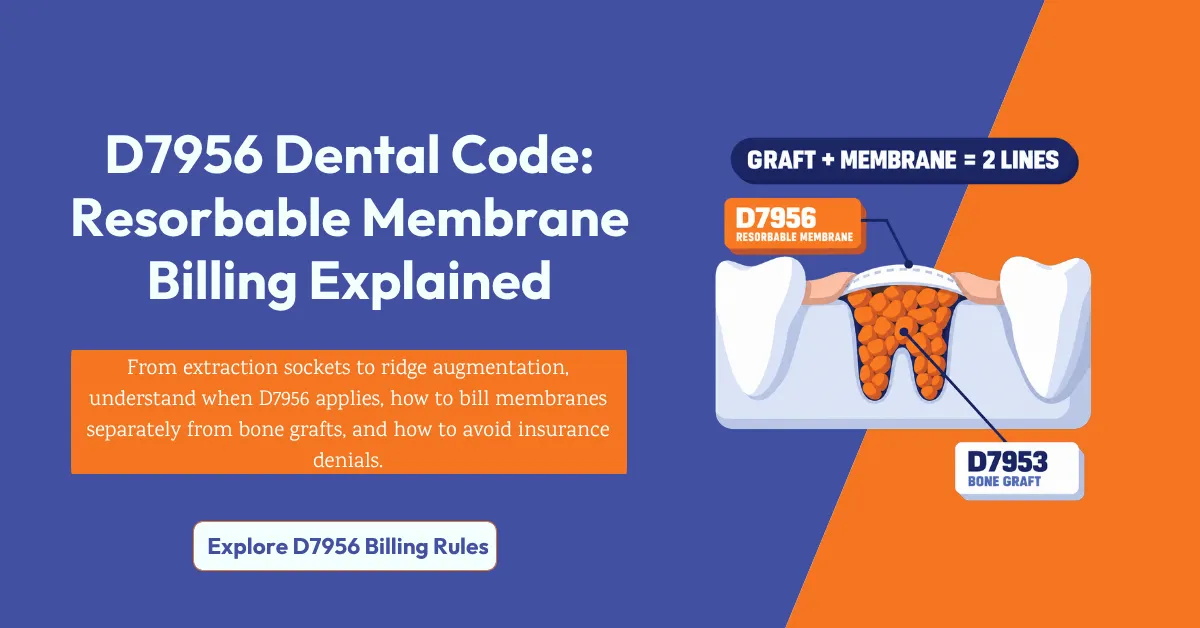
The D7956 dental code reports a resorbable barrier membrane placed at an edentulous site, meaning a spot with no natural tooth and no implant, to guide bone and tissue regeneration, billed per site. Bone graft material under that membrane goes on a separate line with its own code.
Offices lose this line in two ways. Some pick the right barrier type in the wrong site family, so a socket membrane goes out as D4266 or D6106. Others fold the membrane into the graft and never bill it. Payers deny or recode the first mistake, and the second one costs you money without anyone noticing.
Our billing team at iDental Billing works membrane and graft claims every week. We checked each rule below against ADA, AAOMS, and payer policy documents in October 2026, and we date every payer rule so you can see how current it is.
Key Takeaways
- Site first: an edentulous site means D7956 or D7957, a natural tooth means D4266 or D4267, and an implant means D6106 or D6107.
- Barrier second: D7956 guided tissue regeneration uses a resorbable barrier, while D7957 covers a non-resorbable one that comes out later on D4286.
- Separate line: D7953, D7950, D7951, and D7952 report the graft only, so the membrane always needs its own line.
- Coverage varies: some plans exclude D7956, some Medicaid programs require prior approval, and some pay it once per site for life.
- Status: added in CDT 2023, active in CDT 2026, and absent from the CDT 2027 decisions as of October 2026.
Quick Answer: Which Code Goes on the Membrane Line?
- Fresh extraction socket with a resorbable membrane: D7956, plus D7953 for the graft
- Healed ridge augmentation with a resorbable membrane: D7956, plus D7950 for the graft
- Sinus lift with a resorbable membrane: D7956, plus D7951 or D7952 for the augmentation
- Membrane around an implant at placement: D6106, not D7956
- Collagen plug placed only to control bleeding: D7922, not D7956
What Is the D7956 Dental Code?
D7956 is the CDT entry for guided tissue regeneration, edentulous area, resorbable barrier, per site. UnitedHealthcare's barrier membrane policy, effective May 1, 2026, lists D7956 under that same nomenclature. Among the CDT code categories, it sits in the D7000 oral and maxillofacial surgery section.
That placement trips up offices that have billed membranes from the periodontal section for years. The D7956 dental code description in the CDT manual adds what the membrane does, where it's used, and which surrounding work gets coded elsewhere. We paraphrase those parts below, since the ADA holds the copyright to the full descriptor.
What D7956 Covers
The CDT code D7956 definition centers on one job: holding space over the site, so faster-growing soft tissue stays out and bone can fill in underneath. Picture a tarp laid over fresh concrete while it sets, keeping debris off the surface until the pour hardens.
Resorbable means the body absorbs the membrane over time, so no removal visit follows. UnitedHealthcare's policy describes resorbable membranes as natural materials such as collagen or synthetic materials such as aliphatic polyesters. Any resorbable membrane dental code question starts there: if the barrier dissolves, the edentulous line is D7956.
D7956 is reported per site. Each payer defines what a site is, and that definition matters once one membrane covers several missing teeth. Our claim examples and coverage sections below show how to handle a span without splitting lines the plan won't accept.
What D7956 Doesn't Include
Billers searching for dental code 7956 often expect one line to cover the whole surgery. The descriptor and the related codes split the work into separate pieces, and these five sit outside D7956:
- Flap entry and closure, wound debridement, and osseous contouring, which the descriptor lists apart from the membrane
- The bone graft under the membrane, coded as D7953, D7950, D7951, or D7952
- Biologic materials on D4265 and autologous blood concentrate on D7921
- A non-resorbable membrane at the same site, which is D7957
- A membrane at a natural tooth (D4266) or around an implant (D6106)
D7956 Status in CDT 2026 and CDT 2027
ADA code D7956 started with the CDT 2023 rebuild of the guided tissue regeneration codes, which split membranes by site and barrier type. Northeast Delta Dental listed it that year among its new codes that its plans don't cover as a standard benefit.
CDT 2026 brought 31 new codes, 14 revisions, and 6 deletions, according to Delta Dental's CDT 2026 notice. D7956 isn't on the deletion list. Payer policies effective in 2026, including UnitedHealthcare's May 2026 policy, still list it with the same nomenclature.
CDT 2027 takes effect January 1, 2027, with 67 changes, per ADA's CDT 2027 announcement. The only D7000-series request in that cycle, a D7953 revision, was withdrawn by its submitter. Our breakdown of CDT 2027 changes has the full list, and you should still confirm D7956 against the printed CDT 2027 manual.
Last verified: October 2026
D7956 vs D4266, D6106, and D7957: The GTR Code Family
CDT sorts each guided tissue regeneration dental code by two questions in a fixed order. First, where did the membrane go? Second, what is it made of? The D7956 dental code answers both at once: an edentulous site and a resorbable barrier.
Site errors are the ones payers flag. UnitedHealthcare's Q2 2026 coding note lists periodontal codes such as D4266 billed for a membrane at an edentulous or ridge augmentation site as a common coding error. Pick the right barrier in the wrong family and the payer still sends the claim back.
Use this GTR dental code grid before you look at fees. Find the site in the first column, then read across to the barrier type, the reporting unit, and the removal code.
Guided tissue regeneration codes by site and barrier
| Site of the membrane | Resorbable barrier | Non-resorbable barrier | Unit | Removal of non-resorbable barrier |
|---|---|---|---|---|
| Natural tooth (periodontal defect) | D4266 | D4267 | Per site | D4286 |
| Implant (peri-implant defect or at placement) | D6106 | D6107 | Per implant | D4286 |
| Edentulous site (no tooth, no implant) | D7956 | D7957 | Per site | D4286 |
| With periradicular surgery | D3432 | None | Per site | Not applicable |
Code nomenclature shortened. CDT is © American Dental Association. Cigna and Delta Dental fold D4286 into the placement service; Delta applies this when the same office placed the barrier.
D7956 vs D4266: Edentulous Site or Natural Tooth
Both codes report a resorbable membrane, and site type is the only thing separating them. D4266 needs a retained natural tooth with a periodontal defect beside the membrane. Under Cigna's 2026 coverage guidelines, D4266 isn't allowable at the same site as a tooth removal or where no natural tooth is present.
Take a typical case. An office extracts #19, grafts the socket, and bills the membrane as D4266 because the fee schedule still lists that code as the membrane default. Since CDT 2023, a socket counts as an edentulous site, so that line belongs on D7956. Our extraction code guide covers the extraction line itself.
Code the site first and the barrier second: a tooth means D4266, an implant means D6106, and an edentulous site means D7956.
If your team still has D4266 loaded as the membrane default for extraction sites, fix the template before you retrain anyone. Our CDT coding review checks each membrane line against the chart note before the claim goes out.
D7956 vs D6106: Extraction Day or Implant Day
D6106 is reported per implant, for a membrane placed at implant placement or around a peri-implant defect. Billing dental code D7956 requires a site with no implant in it, and it's reported per site. Staged care can carry both codes, each on a different date of service.
On the extraction-day claim, D7956 sits beside D7953. Months later, the implant-day claim carries D6104 for any added graft and D6106 for any new membrane. The AAOMS bone graft coding paper uses D6104 for grafting at implant placement, and Cigna lists D6106 for membranes placed during implant placement.
Immediate implants follow a different rule. AAOMS says D7953 isn't used when an implant goes in at the extraction visit, and D6104 takes its place. Membrane coding at that visit depends on the payer, because Cigna lists D6106 for implant placement but won't allow it at a tooth removal site. Check the plan before you submit.
Staged case: D7956 on extraction day, D6106 on implant day. For an immediate implant, ask the payer which membrane code it accepts.
D7956 vs D7957: Barrier Type and the D4286 Removal Line
Both codes cover the same edentulous site, and barrier material is the only difference. Pick the D7956 code when the membrane dissolves on its own. Choose D7957 when the barrier is non-resorbable material such as e-PTFE, which a clinician has to take out at a later visit.
Removal goes on D4286, but don't count on a separate payment for it. Cigna treats the removal as part of the primary GTR service for D4267, D6107, and D7957. Delta Dental's 2023 summary says its removal fee is included in D7957 when the same office placed the barrier.
Non-resorbable cases carry their own timing, removal, and fee questions, so D7957 gets a separate guide from our team. For this article the rule stays short: a dissolving barrier is D7956, and a barrier that comes out is D7957 plus a removal visit.
When to Bill D7956: Four Edentulous Settings
An edentulous site has no natural tooth and no implant in it at the moment the membrane goes in. The D7956 dental code descriptor names ridge augmentation, sinus lift procedures, and use after tooth extraction. That last setting surprises people: a socket emptied this morning qualifies the same way a ridge that healed years ago does.
Fresh Extraction Sockets (Ridge Preservation)
Fresh socket: D7953 for the graft, D7956 for the membrane. Offices looking for one ridge preservation dental code end up with two lines, because D7953 is the socket preservation ADA code and it reports the graft alone. If you're looking for the ADA code for membrane after extraction, D7956 is it, as long as the barrier is resorbable.
The extraction itself takes a third line. Our D7210 surgical extraction guide covers the surgical version with a flap or bone removal. For an erupted tooth taken out with elevators or forceps, read our post on the simple extraction code, D7140.
AAOMS adds one limit here. D7953 isn't used when an implant goes in at the same visit, so an immediate implant moves the graft to D6104 and changes the membrane question covered in the GTR family section above.
Implant Removal Sites
Implant removal site: D6100 for the removal, D7953 for the socket graft, and D7956 for the membrane. AAOMS states that D7953 applies to implant-removal sites as well as extraction sockets, which puts the membrane on the edentulous code too.
Offices miss this one because the chart still says "implant" after the implant is gone. Once the fixture is out, the site is edentulous, and the membrane belongs on D7956 instead of D6106. Train whoever posts charges to check the procedure note, since the tooth chart lags behind.
Healed Ridge Augmentation
Healed ridge: D7950 for the graft, D7956 for the membrane. AAP's coding coach uses this exact pairing for a flapped anterior ridge graft at #7 to #10 with a resorbable membrane, so you have a published example to point to.
AAOMS says to report D7950 per arch, and it's a by-report code. The claim needs a narrative describing the defect, the graft material, and the planned restoration. Leave that narrative out and you should expect a records request before the payer prices either line.
Sinus Lifts
Sinus lift: D7951 for a lateral window approach or D7952 for a vertical (crestal) approach, then D7956 for a resorbable membrane. AAOMS states that the barrier membrane is reported separately from D7951, so the membrane gets its own line next to the augmentation.
D7952 follows the same site logic. A membrane placed during a crestal lift goes on its own line under the site-based GTR code, with the tooth number of the edentulous site above the sinus. Match that tooth number to the graft line so the claim reads as one procedure.
Coding D7956 With Bone Grafts, Collagen Plugs, and PRF
Graft codes describe the bone material, and membrane codes describe the barrier over it. None of the edentulous graft codes include a membrane. If you're hunting for a single ADA code for membrane with bone graft, you won't find one, because each piece goes on its own line.
Use this matrix as your dental membrane code reference. Find the graft code on the left, then read across to see whether the membrane is included and which code the membrane line takes.
Is the membrane included in the graft code?
| Graft code | Where it's used | Membrane included? | Membrane goes on |
|---|---|---|---|
| D7953 | Fresh extraction or implant-removal socket, implant placed later | No | D7956 or D7957 |
| D7950 | Healed edentulous ridge (by report, per arch) | No | D7956 or D7957 |
| D7951 | Sinus augmentation, lateral open approach | No | D7956 or D7957 |
| D7952 | Sinus augmentation, vertical approach | No | D7956 or D7957 |
| D6104 | Bone graft at the time of implant placement | No | D6106 or D6107 |
| D6103 | Bone graft to repair a peri-implant defect | No | D6106 or D6107 |
| D4263 / D4264 | Bone graft at a retained natural tooth | No | D4266 or D4267 |
Sources: AAOMS bone graft coding paper (January 2026 revision) and Cigna's 2026 descriptors for D6103, D6104, and D4263.
Does D7953 Include a Membrane?
No. D7953 is the ADA code for bone graft with extraction when the implant comes later, and it covers the graft material only. The dental code for membrane over that graft is D7956 for a resorbable barrier or D7957 for a non-resorbable one.
Some plans still bundle the membrane into the graft or deny it as non-covered, and we break those plans down in the coverage section. For the full set of add-on codes billed with extractions, including D7921 and D7922, our extraction code roundup lists each one with its rules.
Collagen Plug: D7922 or D7956?
Code the collagen by what it did in the socket, whatever the box says. ADA's wound dressing guide puts a collagen plug placed for hemostasis or clot stabilization on D7922. Collagen used as a barrier membrane in a guided tissue regeneration procedure is reported with the GTR code.
For bleeding control, then, the collagen plug dental code is D7922. The ADA's guide uses D4266 as its GTR example, but at an edentulous socket the site rule from the GTR table applies. That puts the D7956 dental code on the barrier line whenever the collagen covered a graft.
Some cases use both: a plug to stabilize the clot and a membrane over the graft. The ADA says both are reported separately when both are placed. Anyone checking the ADA code for collagen plug or the D7922 dental code should read the operative note first, since one collagen product can land on either line.
PRF and Biologics (D7921, D4265)
AAOMS says to report D7921 in addition to the graft codes when autologous blood concentrate, such as PRF, is collected and applied. Biologic materials placed to aid regeneration go on D4265. Coverage for both lines varies by plan, so check benefits before you quote the patient a number.
D7956 Claim Examples: Five Common Scenarios
D7956 always sits on its own line, next to the graft code that matches the site's timing. Each scenario below shows the codes, tooth numbers, and line order as they'd appear on the ADA Dental Claim Form, from the extraction or removal line down to the membrane.
Report a tooth number or tooth range on each D7956 dental code line. ADA's claim data recommendation marks D7956 as a code that takes a tooth number or range and no area of the oral cavity, which keeps the membrane tied to the graft site.
D7956 claim scenarios, line by line
| # | Scenario | Claim lines (tooth) | Why |
|---|---|---|---|
| 1 | Surgical extraction #19, socket graft, resorbable membrane, implant planned later | D7210 (#19), D7953 (#19), D7956 (#19) | A fresh socket is edentulous; graft and membrane are separate lines |
| 2 | Simple extraction #30, socket graft, collagen plug for clotting only | D7140 (#30), D7953 (#30), D7922 (#30) | No barrier placed, so no D7956 |
| 3 | Healed ridge #7 to #10, particulate graft, resorbable membrane | D7950 (maxillary arch, by report), D7956 (#7 to #10 as a tooth range) | AAP example; D7950 needs a narrative |
| 4 | Lateral window sinus lift at #3, resorbable membrane | D7951 (#3), D7956 (#3) | AAOMS: membrane reported separately from D7951 |
| 5 | Failed implant removed at #30, socket graft, resorbable membrane | D6100 (#30), D7953 (#30), D7956 (#30) | An implant-removal socket is edentulous |
Scenario 1. At the implant visit months later, the graft goes on D6104 and any new membrane goes on D6106. The site isn't edentulous anymore once the implant is in, so D7956 doesn't return for #19 at that appointment.
Scenario 2. If the chart says the collagen covered the graft as a barrier, the third line becomes D7956 instead of D7922. Read the operative note before you code, and bill from the clinician's description of what the collagen did.
Scenario 3. The ADA's recommendation allows a tooth range on dental code D7956, which fits one membrane spanning several missing teeth. Payers don't all count sites the same way. UnitedHealthcare's New York Medicaid plan limits D7956 per tooth, so confirm the plan's definition before you split or combine lines.
Scenario 5. Offices often bill this membrane as D6106 because the chart still reads "implant." With the implant removed, the site is edentulous, and the D7956 code is the right line for a resorbable barrier over the socket graft.
If grafting and membrane claims keep coming back with one line paid and one denied, send us a recent month of them. A free billing review shows which lines payers are bundling and which ones are worth appealing.
Correct codes get the claim processed the right way. Payment depends on the member's plan, and the next section shows what payers say about D7956 in 2026.
Is D7956 Covered by Insurance?
D7956 insurance coverage runs from flat exclusion to payment with prior approval, depending on the plan. Some programs add a lifetime limit on top. The National Association of Dental Plans points out that adding or revising a CDT code doesn't, by itself, change what a benefit plan covers.
Code status and coverage are two separate questions, and the table below shows how far apart payers sit in 2026. Every row carries a date so you can judge how current the rule is before you rely on it.
D7956 coverage examples by payer (as of October 2026)
| Payer or program | What it says about D7956 | Policy date |
|---|---|---|
| Delta Dental Insurance Co. (Delta Dental's CDT 2023 summary) | Not a benefit of most Delta Dental plans; the fee is the patient's responsibility | CDT 2023 summary (verify current terms) |
| Northeast Delta Dental | Listed among its new codes that plans don't cover as a standard benefit | CDT 2023 changes |
| Medi-Cal Dental, California (Medi-Cal's July 2026 fee schedule) | Not a Benefit; D7953 is also Not a Benefit | July 2026 |
| New York Medicaid, fee-for-service (New York Medicaid fee schedule) | Prior approval, $126.25, 14-day post-op period, reported by tooth | January 1, 2026 |
| UnitedHealthcare Community Plan of New York | 1 per lifetime per tooth, prior authorization, planned prosthesis and placement date required | January 1, 2026 |
| PEHP, Utah public employees (PEHP's GTR policy) | Once per edentulous site per lifetime, permanent teeth only, third molars excluded | January 1, 2026 |
| UnitedHealthcare commercial (DCP045.10) | Indicated with bone grafting for ridge preservation, augmentation, or implant placement | May 1, 2026 |
| Anthem (Policy 04-209) | Routine GTR at extraction sites may not be necessary; major reconstructive GTR goes to the medical plan | Policy 04-209 (check the current version) |
Examples only. The member's plan document controls coverage.
What Payers Check Before Paying D7956
Before a plan pays the D7956 dental code, its reviewer looks for the same handful of facts in the record. These six come straight from the 2026 policies in the table:
- Bone graft present: UnitedHealthcare ties GTR to grafting for ridge preservation, augmentation, or implant placement
- Planned restoration: the implant or prosthesis the site is being built for, with an expected placement date
- Systemic health: no uncontrolled medical conditions that would impair healing
- Tobacco and nicotine: PEHP lists nicotine from smoking or vaping among its non-covered situations
- Hygiene and compliance: UnitedHealthcare lists poor oral hygiene and prior non-compliance as reasons GTR isn't indicated
- Tooth position: PEHP excludes third molar sites
When the Plan Says No: Patient Balances
Read the group code on the EOB before you bill anyone. PR means patient responsibility. CO means contractual obligation, so that amount is a provider write-off. Bill the patient only when the line is PR, your contract allows it, and the patient signed an estimate before treatment.
Medicaid programs set their own rules on billing members for services the program doesn't cover. Check your state's provider manual and get written consent before treatment. Skip that step and a non-covered membrane can turn into a balance you're not allowed to collect.
Many D7956 surprises show up before surgery if someone looks: an exclusion, a lifetime limit, or a prior authorization nobody requested. Our team can verify D7956 benefits ahead of the appointment, so the estimate you give the patient matches the EOB.
D7956 Documentation and Narratives That Hold Up
A reviewer needs four facts from your chart before paying the D7956 dental code: the site was edentulous, the barrier was resorbable, the graft went on its own line, and the membrane was clinically necessary. If any one is missing, expect a records request. Our guide to claim attachments and narratives covers the submission side.
Build each chart note around these seven items:
- Tooth number, or a tooth range for a contiguous span
- Edentulous status: extraction date, implant removal date, or healed ridge
- Membrane type, product name, and size, marked as resorbable
- Graft code and material, documented as a separate procedure
- Planned restoration and expected timing, which UnitedHealthcare's New York Medicaid guide requires for D7956
- Dated preoperative radiograph or CBCT
- Tobacco status and systemic health, with any risk factors addressed
GTR Steps and What to Chart at Each One
The guided tissue regeneration steps for an edentulous site run in a set order, and each one leaves something for the note:
- Diagnosis and plan: why the site needs a graft and a barrier, and which restoration is planned
- Site access: the extraction, the implant removal, or the flap used to reach a healed ridge
- Debridement: recorded in the note, since the descriptor lists it apart from the membrane
- Graft placement: material and amount, coded as D7953, D7950, D7951, or D7952
- Membrane placement: resorbable type, brand, size, and any fixation used
- Closure and post-op instructions, including the follow-up date
Steps 2, 3, and 6 explain the case to a reviewer, but D7956 pays for step 5 only. Make that line of the note the most detailed one in the chart, with the product and size written out.
A D7956 Narrative You Can Adapt
Start from the template below and fill each bracket from the chart. Delete any sentence the chart doesn't support, the tobacco and systemic health line in particular, because a narrative that overstates the record does more harm than a short one.
Template only. Replace every bracket with chart details; this is not a real case.
Tooth #[ ] extracted on [Month Day, Year] for [diagnosis]. Socket grafted with [material] (D7953). Resorbable [collagen] membrane, [product, size], placed over the graft to exclude soft tissue and preserve ridge width for a planned implant at #[ ] in about [ ] months. Preoperative [periapical or CBCT] dated [Month Day, Year] attached. Patient [does not use tobacco and has no uncontrolled systemic conditions].
Why D7956 Claims Get Denied and How to Appeal
Read the CARC on the ERA before you do anything else. On a membrane line, the reason code tends to point to one of three causes: a plan exclusion, a bundle into the graft, or a documentation gap. X12's reason code list gives the official meaning of each code.
D7956 denial reasons by CARC
| CARC | X12 meaning (short) | Typical D7956 cause | Next step |
|---|---|---|---|
| 96 / 204 | Non-covered charge / not covered under the patient's current benefit plan | Plan excludes edentulous GTR | Check the group code; bill the patient only if PR and disclosed in advance |
| 97 | Benefit included in payment for another adjudicated service | Membrane bundled into D7953 or D7950 | Appeal only if the note shows a separate barrier and the plan allows both lines |
| 50 | Not deemed a medical necessity by the payer | No prosthetic plan, or risk factors not addressed | Appeal with the radiograph, prosthesis plan, and risk-factor notes |
| 197 | Precertification or authorization absent | Plan or Medicaid program required prior approval | Ask whether the plan accepts a retro-authorization request |
| 252 | Attachment or other documentation required | Radiograph or narrative missing | Send the attachment tied to the original claim |
| 169 | Alternate benefit has been provided | Plan paid a lesser procedure | Read the alternate benefit clause; appeal if the record supports D7956 |
Reason code meanings paraphrased from the X12 claim adjustment reason code list.
How to Appeal a D7956 Denial
Work each appeal in the same order, and stop at step 2 if the plan excludes the code:
- Match the CARC and any remark code to the table above.
- Confirm the plan covers D7956 at all, since an excluded code won't turn around on appeal.
- Gather the operative note, preoperative image, graft line, and prosthesis plan.
- Write a short letter that answers the payer's stated reason in its own policy language.
- File inside the payer's appeal window and log the date you sent it.
Appeal windows differ by payer, from 30 days to 180 days in the plans we've checked. Our D7210 guide keeps a table of payer appeal deadlines for Aetna and two Delta Dental companies you can work from.
When the Payer Recodes D4266 to D7956
Some payers process a D4266 billed at an extraction site as the D7956 dental code instead of denying it. A Delta Dental dentist handbook says that when a procedure is processed as a different one, participating dentists accept the limitations and approved amount of the procedure the plan benefits.
Post the line the way the EOB processed it, and adjust or refund the patient's share to match. Then change the fee schedule default that sent D4266 out in the first place. UnitedHealthcare already lists that habit as a common coding error, and it will keep showing up until someone fixes the template.
Membrane lines are small, so they're easy to write off. Write them off every month and the total across a year gets hard to ignore. Our team will appeal denied membrane lines with the documentation the payer asked for, while the appeal window is still open.
How Much Does D7956 Pay?
The D7956 dental code has no national payment rate. Each payer's fee schedule or contract sets the allowed amount, and plenty of plans pay $0 because they exclude the code. Delta Dental's 2023 summary and Medi-Cal's July 2026 schedule both put D7956 in that group.
New York Medicaid offers a public benchmark. Its 2026 schedule lists D7956 at $126.25 with prior approval, next to $151.50 for D7957 and $252.50 for D7953. Those figures help you sanity-check a commercial allowance, though they won't predict what a private plan pays.
Your own number matters more than any benchmark. Pull D7956 allowed amounts from recent ERAs, payer by payer, and compare each one with your contracted fee. A gap between the two is an underpayment you can question, and a repeating gap can mean the payer loaded the wrong fee schedule for your contract.
One line might split like this (example figures, not payer rates): a $250 office fee, a $150 allowed amount, and 50% coinsurance. The plan pays $75, the patient owes $75, and the remaining $100 is the contractual write-off on an in-network claim.
Billing D7956 to Medical Insurance
A membrane at an extraction site or healed ridge belongs on the dental claim in most cases. Medical plans come into play when grafting is part of reconstruction after trauma, pathology, or another covered medical condition. Anthem, for example, sends major reconstructive GTR to the patient's medical plan under its GTR policy.
Crosswalks are where offices get into trouble. AAOMS reports that Medicare contractors flagged medical claims that crosswalked D7950 or D7953 to CPT 21210 or 21215. For minor reconstructions, AAOMS says the CDT code itself is the better choice for dental and medical carriers alike. A bad crosswalk can lead to an audit and a recoupment request.
Medicare is narrower still. The CMS Medicare dental coverage page says Medicare pays for dental services only when they're inextricably linked to the clinical success of other covered medical services. CMS excludes ridge reconstruction done to prepare the mouth for dentures, but it lists ridge reconstruction performed at the same time as tumor removal as covered.
Since July 1, 2025, those Medicare dental claims need the KX modifier and an ICD-10 diagnosis code, and CMS asks offices not to send attachments such as X-rays with the claim. If a case does belong on a medical claim, our dental medical billing team codes it with the diagnosis and prior authorization the medical plan expects.
D7956 Dental Code FAQs
Is the D7956 Dental Code Active in CDT 2026?
Yes. The D7956 dental code was added in CDT 2023 as part of the guided tissue regeneration rebuild, and it isn't on the CDT 2026 deletion list. Payer policies effective in 2026, including UnitedHealthcare's May 1, 2026 barrier membrane policy, still list it under the same nomenclature. For CDT 2027, which takes effect January 1, 2027, the only D7000-series request was a D7953 revision that its submitter withdrew. Confirm the code against the printed CDT 2027 manual once it ships.
Can D7956 Be Billed on the Same Day as an Extraction?
Yes. Once the tooth is out, the socket is an edentulous site, so D7956 can go on the same claim as the extraction and the D7953 graft. Each code takes its own line with the same tooth number. Use D7956 only when a resorbable barrier was placed over the graft. Some plans bundle the membrane into the graft or exclude it outright, so verify benefits before surgery and give the patient a written estimate.
Is D7956 Billed per Tooth or per Site?
Per site. The CDT nomenclature ends with "per site," and the ADA recommends reporting a tooth number or a tooth range on the claim line. Payers define a site in different ways when one membrane covers several missing teeth. UnitedHealthcare's New York Medicaid plan, for example, limits D7956 to one per lifetime per tooth. Check the plan's definition before you split one membrane into several lines or combine several sites into one.
What Does the CDT Code D7956 Description Mean in Plain Words?
The CDT code D7956 description covers a dissolving membrane placed at a spot with no tooth and no implant. In practice, that membrane keeps faster-growing gum tissue out while bone fills in underneath, and the body absorbs it, so nobody has to remove it later. Graft material beneath it, the flap work, and any biologic materials are coded separately. CDT's full descriptor also names ridge augmentation, sinus lifts, and extraction sites as settings where the code applies.
Does Insurance Cover ADA Code 7956?
It depends on the plan. ADA code 7956 is a valid CDT code, and a valid code still doesn't guarantee a benefit. Medi-Cal's July 2026 schedule lists it as not a benefit, New York Medicaid lists it at $126.25 with prior approval, and PEHP limits it to once per edentulous site per lifetime. Delta Dental's 2023 summary said most of its plans didn't cover it. Verify the patient's plan before treatment and get a signed estimate.
Can D7956, D7953, and D7922 Go on the Same Claim?
Yes, when the chart supports all three. D7953 reports the graft, D7956 reports the resorbable barrier over it, and D7922 reports a dressing placed for hemostasis or clot stabilization. The ADA's wound dressing guidance says a hemostatic dressing and a barrier membrane are reported separately when both are placed. Your operative note has to describe the purpose of each material, and coverage for each line still depends on the patient's plan.
What's the Difference Between D7956 and D7957?
Barrier type is the only difference. Both codes report guided tissue regeneration at an edentulous site, per site. D7956 covers a resorbable membrane the body absorbs, and D7957 covers a non-resorbable barrier, such as e-PTFE, that has to come out later. Removal goes on D4286, though Cigna and Delta Dental treat it as part of the placement service, with Delta applying that rule when the same office placed the barrier. Our team is preparing a separate D7957 guide.
Before You Submit: A D7956 Claim Checklist
Run each membrane line through these seven checks before the claim leaves the office:
- Confirm the site was edentulous, with no tooth and no implant at placement.
- Confirm the barrier was resorbable, and code D7957 if it wasn't.
- Put the graft on its own line under the code that fits the site's timing.
- Report the tooth number or tooth range on the D7956 line.
- Attach the dated preoperative image and a narrative naming the planned restoration.
- Check the plan for exclusions, lifetime limits, and prior authorization.
- Code a collagen plug placed only for bleeding control as D7922.
Getting the D7956 dental code right is half the job. The other half is chasing coverage, attachments, and appeals across each payer you bill, month after month. If that's more than your front desk can carry, our outsourced dental billing team can take it on.
Billing pricing runs from 3.95% down to 2.95% of monthly collections, depending on volume, with no setup fee and no long-term contract. Larger groups and DSOs above $150,000 a month get a custom rate.
Payment on D7956 also depends on your network status, since the contract sets the allowed amount. If you're joining new plans, our dental credentialing team charges $150 per commercial payer, or $95 per payer for billing clients.
Sources
- UnitedHealthcare Dental Clinical Policy DCP045.10, Dental Barrier Membrane Guided Tissue Regeneration, effective May 1, 2026.
- ADA News, 67 changes coming to CDT 2027, April 2026.
- Delta Dental, CDT 2026 updates, 2026.
- UnitedHealthcare Dental news, reducing denials with correct CDT coding, Q2 2026.
- Cigna Dental Coverage Determination Guidelines, DPPO, June 2026 edition.
- AAOMS, Coding Bone Grafts, revised January 2026.
- AAP Periospectives, Ask the Coding Coach, March 31, 2025.
- ADA, Guide to Reporting Wound Dressings, August 2021.
- ADA, Area of the Oral Cavity and Tooth Anatomy claim data recommendation, 2025 edition.
- National Association of Dental Plans, 2027 CDT Code Changes: What I Learned, 2026.
- Delta Dental Insurance Company, CDT 2023 summary, published 2022 for CDT 2023.
- Medi-Cal Dental, Schedule of Maximum Allowances, July 1, 2026.
- New York Medicaid Dental Fee Schedule, hosted by the ADA, effective January 1, 2026.
- PEHP Dental Policy, Guided Tissue Regeneration, effective January 1, 2026.
- UnitedHealthcare Community Plan of New York, Provider Quick Reference Guide, effective January 1, 2026.
- X12, Claim Adjustment Reason Codes, accessed October 2026.
- CMS, Medicare Dental Coverage, last modified March 10, 2026.
- Northeast Delta Dental, CDT 2023 code and policy changes, 2023.
- Anthem Dental Policy 04-209, Guided Tissue Regeneration, current version on file.
- Delta Dental of Arkansas, Dentist Handbook, 2022.
- U.S. Department of Veterans Affairs, Clinical Determination DNT-0005, updated October 22, 2026.
CDT is a trademark of the American Dental Association, which holds the copyright to the CDT Code. Code titles are paraphrased; see the current CDT manual for official nomenclature and descriptors.
ABOUT THE AUTHOR
Russell Bennett
Russell Bennett is a Dental RCM and Provider Credentialing Specialist at iDental Billing. He reviews billing workflows, resolves claim denials, outstanding insurance balances, and reimbursement discrepancies, and applies CDT coding and payer-specific guidelines. His work includes provider credentialing, payer enrollment, and recredentialing. Russell writes iDental Billing’s educational guides on what claims need, why they matter, and where things go wrong.